•
•

Multi-Currency Account for Isle of Man Company: GBP, EUR and USD Options
[aa disclaimer]
Legal Disclaimer: This article is for informational purposes only and does not constitute legal, financial, compliance, or tax advice. Banking eligibility, regulatory requirements, and provider policies vary by jurisdiction. Consult qualified professionals before making decisions.
[/aa]
An accountant for an Isle of Man company has two weeks to get a supplier payment run out the door in three currencies — and the first account application has just come back rejected. That scenario repeats across finance teams every month, because Isle of Man companies sit outside both the UK and the EU banking perimeter by default. An Isle of Man company multi-currency account GBP EUR USD solution exists, but it depends entirely on submitting the right paperwork to the right provider the first time. This guide covers what to prepare, the step-by-step opening process, why applications get rejected, and how to run the account once it is live.
[aa key-takeaways]
Key Takeaways
A complete document set — Certificate of Incorporation, UBO chain, source of funds — prevents most application delays before they start.
UK electronic money institutions (EMIs) typically onboard Isle of Man companies faster than traditional high-street banks.
GBP unlocks Faster Payments, EUR unlocks SEPA, and USD routes through SWIFT — each rail has its own cost and settlement speed.
Most rejections trace back to an unclear ownership chain or source-of-funds explanation, not the currency requirement itself.
Running the account day to day means actively managing FX conversion timing, not just holding three balances.
[aa btn]See EQWIRE for Business[/aa]
[/aa]
What You Need Before You Apply
An Isle of Man business GBP EUR USD UK EMI application moves fastest when every document is assembled before the first form is submitted. Isle of Man companies are registered under the Isle of Man Companies Registry, which sits outside the UK Companies House system — so UK providers cannot pull company data automatically and will request it directly. Whether the end goal is an Isle of Man company UK bank account or an EMI-based account, the document expectations are almost identical — only the review speed differs.
Document Checklist for Isle of Man Companies
Certificate of Incorporation issued by the Isle of Man Companies Registry
Memorandum and Articles of Association
Register of Directors and Register of Members (or equivalent shareholder register)
Proof of identity and proof of address for all directors and ultimate beneficial owners (UBOs) holding 25% or more
A clear ownership chain diagram if the company sits under a holding structure
Evidence of the source of funds — invoices, contracts, or a prior bank statement showing the origin of initial deposits
A description of intended activity: counterparties, expected transaction volumes, and currencies used
[aa fast-fact]
Fast Fact: There are no licensed EMIs domiciled in the Isle of Man itself — Isle of Man companies access EMI-based multi-currency accounts through UK-authorised providers instead.
[/aa]

Information UK EMIs and Banks Will Request
Beyond the document list, expect a structured risk conversation. Providers ask which countries the company trades with, whether any counterparties sit in higher-risk sectors such as eGaming, and what monthly transaction volume the account should expect in each currency. What this means in practice: vague answers here — "various countries" or "general trading" — slow the review down more than any missing document.
Isle of Man Company Multi-Currency Account GBP EUR USD: Step-by-Step Setup
Opening a multi-currency account for Isle of Man company use follows a fairly consistent sequence, whether the provider is a bank or an EMI. The steps differ mainly in speed.
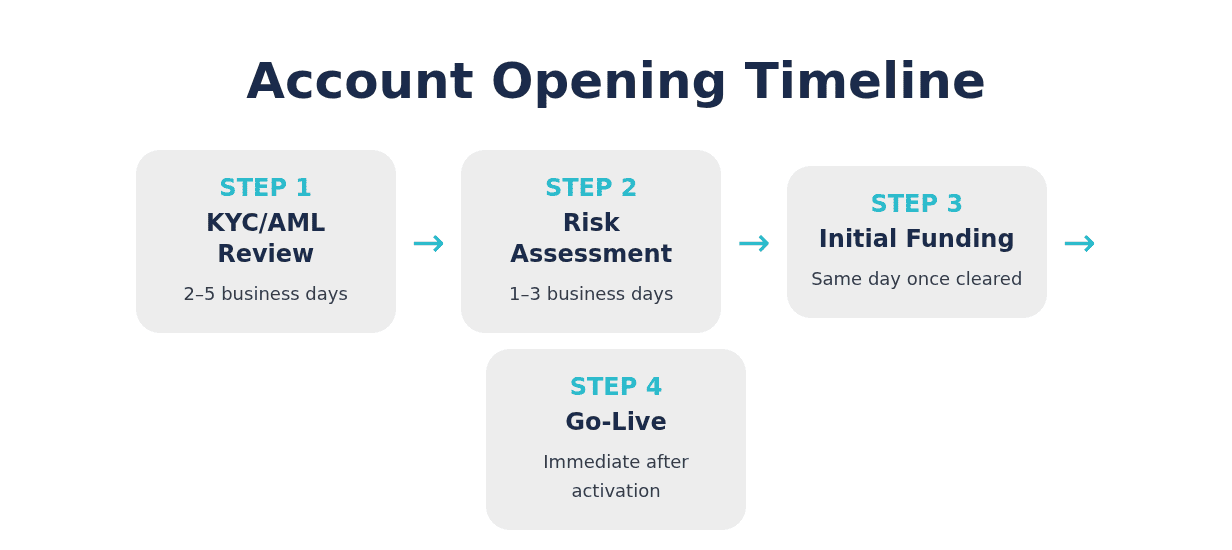
Step 1–2: Provider Selection and Application
Traditional UK banks tend to require an existing UK business connection or physical presence before opening an account for an offshore entity. UK EMIs are built to onboard international and offshore structures directly, which is why most Isle of Man companies end up choosing an EMI for a UK EMI account for offshore company needs. The application itself is usually a digital form plus document upload, taking 20–40 minutes to complete.
Step 3–5: Verification, Funding, Activation
Stage | What happens | Typical duration |
|---|---|---|
KYC/AML review | Provider verifies documents, UBOs, and screens against sanctions lists | 2–5 business days |
Risk assessment | Provider confirms activity, volumes, and counterparties match the application | 1–3 business days |
Initial funding | First deposit received; account activated for GBP, EUR, USD balances | Same day once cleared |
Go-live | GBP, EUR and USD IBANs or account details issued; payments can be sent and received | Immediate after activation |
Summary: a clean application with no missing documents can go from submission to a live GBP EUR USD business account Isle of Man companies can actually use within one to two weeks with an EMI, versus three to six weeks or longer with a traditional bank.
Common Reasons Applications Get Delayed or Rejected
Rejections rarely come down to the Isle of Man registration itself. They come down to gaps in the story the application tells.
Unclear UBO chain: if ownership runs through a second holding company or trust, providers need the full structure — not just the top layer.
Insufficient source-of-funds detail: a bank statement alone often is not enough; providers want to see where that money came from before it reached the account.
Inconsistent company documents: a director listed in the register but missing from the ID documents, or an outdated Memorandum and Articles, both trigger manual review delays.
High-risk activity flags without context: sectors like eGaming or crypto-adjacent trading are not automatically declined, but they need a fuller explanation of controls and licensing than a standard trading company. Comparing how a consumer-facing provider such as Revolut Business handles risk appetite versus a dedicated EMI account explains why some higher-risk Isle of Man companies get declined by one provider and accepted by another.
![Chart showing common reasons Isle of Man company account applications are delayed or rejected]](https://framerusercontent.com/images/nh9YgUhDOU7upYJ6yH8gmIaDLZ4.png)
[aa fast-fact]
Fast Fact: Providers that safeguard client funds under the UK's Electronic Money Regulations 2011 hold customer money in segregated accounts — a different protection model than the Financial Services Compensation Scheme that covers bank deposits. The distinction matters when a compliance team is comparing providers, and it is explained in full in how UK EMI safeguarding actually works.
[/aa]
[aa cta]
Open Your GBP, EUR and USD Account Without the Paperwork Guesswork
A UK-regulated EMI account built for offshore structures, with clear document requirements from the start.
[aa btn]Check Eligibility[/aa]
[/aa]
Managing the Account Day to Day
Getting an Isle of Man company UK bank account or EMI account live is only the first half of the job. The second half is using the right rail for the right payment.
Choosing the Right Payment Rail — Faster Payments, SEPA, SWIFT
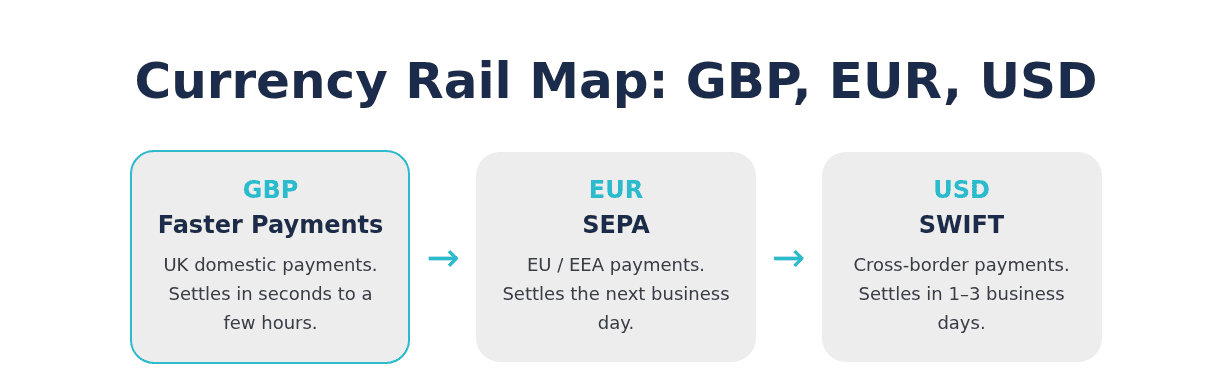
GBP payments to UK counterparties move through the Faster Payments Service, a UK retail payment system overseen by the Bank of England, which typically settles within seconds to a few hours. EUR payments to counterparties in the EU or wider EEA move through SEPA, usually settling the next business day. USD payments, and any payment outside the SEPA and Faster Payments zones, generally route through the SWIFT correspondent banking network — described in detail by the Bank for International Settlements — which can take one to three business days and often involves intermediary bank fees. Can an Isle of Man company open a UK GBP account with Faster Payments access via EMI? Yes — a UK-authorised EMI can issue a GBP account with direct or indirect access to Faster Payments, which is exactly what makes the GBP leg of the account faster and cheaper than routing GBP through SWIFT.
Rail | Currency | Typical settlement | Typical fee range |
|---|---|---|---|
Faster Payments | GBP | Seconds to hours | Low / often free |
SEPA | EUR | Next business day | Low |
SWIFT | USD (and others) | 1–3 business days | £15–£40 per payment plus FX spread |
What this means in practice: routing a EUR payment through SWIFT instead of SEPA, or a GBP payment through SWIFT instead of Faster Payments, adds unnecessary cost and delay on every single transaction.
FX Conversion Timing and Fees
Holding GBP, EUR and USD balances separately avoids forced conversion on every incoming payment — but conversions still happen whenever funds move between currencies to pay a supplier or draw a salary. FX spreads on business accounts commonly run 0.3%–1.5% above the mid-market rate, so a company converting £50,000 a month can lose £150–£750 to spread alone. Batching conversions instead of converting small amounts repeatedly, and timing larger conversions around stable rate periods, reduces that drag without changing providers.
Timeline and Cost Expectations
For a business planning around real dates, the practical range looks like this: an EMI-based Isle of Man business GBP EUR USD UK EMI application, submitted with a complete document set, typically activates within 5–10 business days. A traditional UK bank route for the same company can take four to eight weeks, partly because of manual underwriting and partly because fewer UK banks actively accept Isle of Man-incorporated applicants. Ongoing costs are usually a mix of a monthly account fee, per-payment fees that vary by rail, and the FX spread described above — three separate line items worth tracking, not just the headline account fee.
An Isle of Man company multi-currency account GBP EUR USD setup is not a one-time task — it is infrastructure a finance team maintains. Getting the account open is the easier half; choosing the right rail and tracking FX cost on every transfer is where the ongoing savings actually come from. Other offshore structures face a comparable process: a Panama company opening a UK GBP and EUR account or a Mauritius GBC setting up a multi-currency account both go through the same document-first, EMI-first pattern described above.
For a finance or ops lead comparing options, the decision usually comes down to three questions: how fast does the account need to be live, how many of the three currencies does the business actually transact in today, and how much manual FX conversion is currently being absorbed without being tracked as a cost. A multi-currency business account for offshore company use answers all three at once — it does not remove the need for good documentation, but it removes the currency-conversion tax that a single-currency account quietly adds to every cross-border payment.
FAQ
Can an Isle of Man company open a UK GBP account with Faster Payments access via EMI?
Yes. A UK-authorised EMI can issue a GBP account for an Isle of Man company with access to the Faster Payments network, provided the company passes standard KYC/AML checks and submits a complete document set including its Certificate of Incorporation and UBO information.
What documents does an Isle of Man company need for a multi-currency business account?
At minimum: the Certificate of Incorporation, Memorandum and Articles of Association, registers of directors and members, identity and address verification for all directors and UBOs above 25%, and evidence of the source of funds. Companies with holding structures also need a clear ownership chain diagram.
How long does it take to open a GBP, EUR, USD account for an Isle of Man company?
With a UK EMI and a complete application, activation typically takes 5–10 business days. A traditional UK bank route for the same company usually takes four to eight weeks, largely due to manual underwriting.
Why do Isle of Man company account applications get rejected?
The most common reasons are an unclear beneficial ownership chain, insufficient detail on the source of funds, inconsistencies between company documents, and high-risk activity flags — such as eGaming — submitted without enough supporting context on controls and licensing.
Is a multi-currency business account for offshore company use different from a standard business account?
Functionally, it holds segregated GBP, EUR and USD balances under one relationship instead of three separate single-currency accounts. The underlying KYC, safeguarding, and payment-rail mechanics are the same as any UK-regulated EMI or bank account — the difference is operational convenience, not a different regulatory category.
Reviewed by
Related Articles


Power your payments
with EQWIRE
Create your account in minutes and experience smooth, secure global payments.
" height="9.0156px" id="LIcbdboyB" transform="translate(4.987 4.5)" width="9.01562px"/></svg>)