•
•

How to Receive a GBP Salary as a Non-UK Resident: Sort Code and Account Number Guide
[aa disclaimer]
Legal Disclaimer: This article is for informational purposes only and does not constitute legal, financial, compliance, or tax advice. Banking eligibility, regulatory requirements, and provider policies vary by jurisdiction. Consult qualified professionals before making decisions.
[/aa]
A UK job offer often reaches a candidate who has never lived in the UK. The contract is signed, the start date is set, and then the payroll form arrives asking for a six-digit sort code and an eight-digit account number. Most candidates abroad have neither. To receive a GBP salary as a non-UK resident, the worker needs a valid UK sort code and account number, because UK payroll systems pay through Bacs and Faster Payments rather than international transfers. The fastest route is an account with an FCA-authorised electronic money institution (EMI), which issues full UK account details online with no UK address required. This guide covers the documents, the five setup steps, payroll timelines, and the errors that most often delay a first payday.
[aa key-takeaways]
Key Takeaways
A non-UK resident can get a UK sort code and account number fully online through an FCA-authorised EMI, with no UK address at any stage.
Standard documents: passport or national ID, proof of address in the country of residence, and basic source-of-income information. Verification usually takes days, not weeks.
Payroll asks for three fields only: the account holder name plus the sort code and account number.
Bacs, the rail most UK payrolls use, runs on a three-working-day cycle. Faster Payments settles in seconds, 24/7.
Most delayed salary payments trace back to a name mismatch, an IBAN given instead of UK account details, or an account that has not finished verification.
[aa btn]Book a Call[/aa]
[/aa]
What You Need Before You Can Receive a GBP Salary
To join a UK payroll run, a non-UK resident needs two things: verified identity documents and working UK account details. Employers cannot substitute either one. HMRC-recognised payroll software validates a UK sort code and account number for non-residents the same way it does for domestic employees, so the account must exist before the first payroll cutoff.
The order matters. Account approval depends on document verification, and payroll submission depends on account approval. Starting the account application on the day the contract is signed leaves a comfortable margin before the first pay run.
In practice, the pressure usually sits with the ops team. A UK company hires a remote developer in, say, Georgia or the UAE, and the payroll administrator discovers a week before cutoff that the new hire has no UK account details for payroll. Every option at that point is worse than having started earlier: a manual SWIFT transfer with conversion costs, a delayed first salary, or a rushed application under time pressure.
Documents checklist for non-UK residents
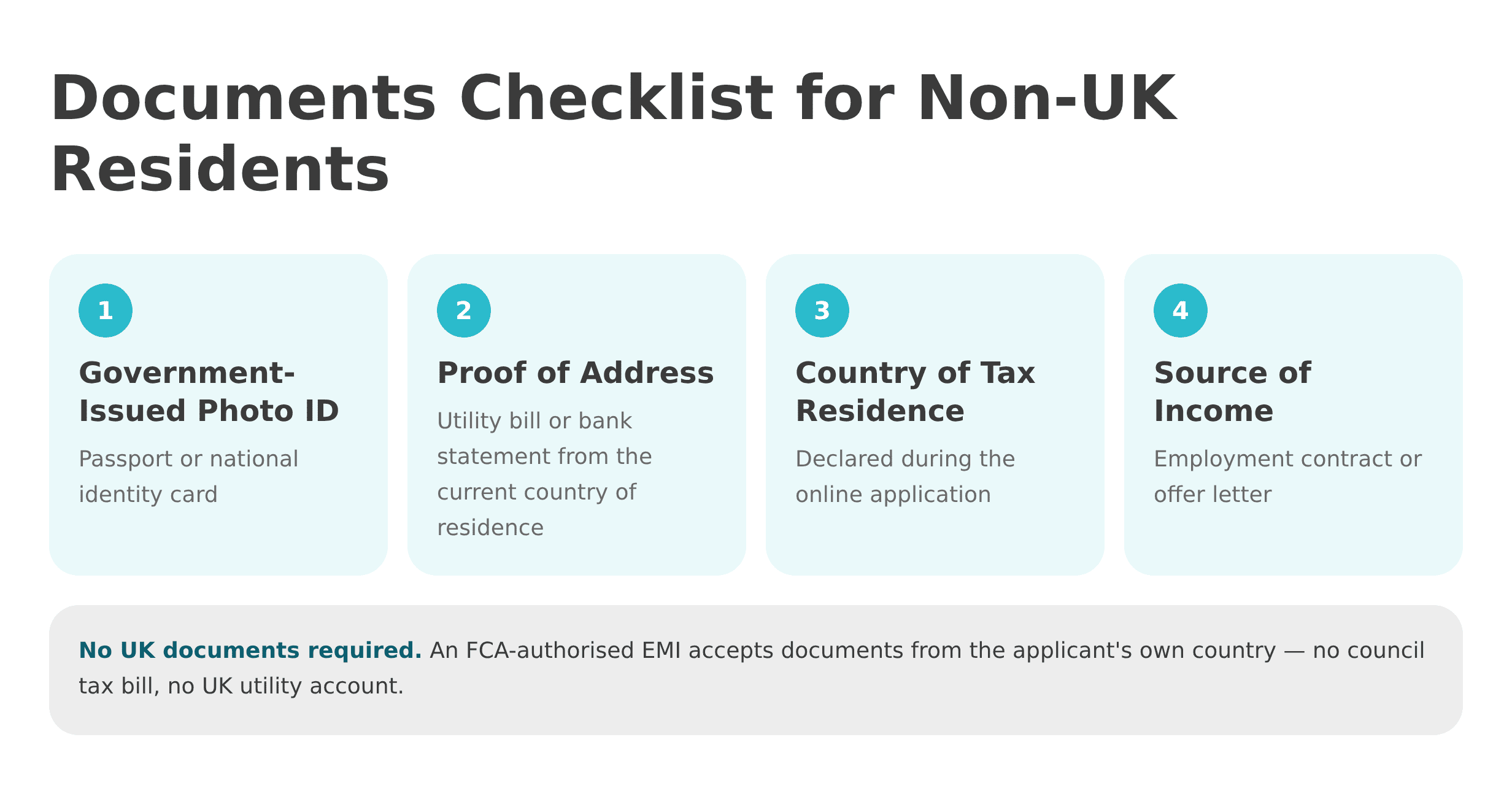
The documents needed to receive a GBP salary abroad are the same documents an FCA-authorised provider requests at onboarding:
Government-issued photo ID: a passport or national identity card
Proof of address in the current country of residence, such as a utility bill or bank statement
Country of tax residence, declared during the application
Source of income, usually the employment contract or an offer letter
No UK documents appear on this list. That is the practical difference between an EMI application and a high-street bank application, which asks for a UK council tax bill or domestic utility account most non-residents cannot produce.
Sort code and account number: the two details payroll asks for
A sort code is a six-digit number that identifies the bank or payment institution holding an account. The eight-digit account number identifies the individual account within that institution. Together they form the pair every UK domestic payment rail reads, and any sort code can be validated through the official Bacs sort code checker.
An IBAN serves a different purpose. It routes international SEPA and SWIFT transfers, and UK payroll software has no field for it. A GBP account that comes with an IBAN alone cannot join a standard UK pay run.
How to Receive a GBP Salary as a Non-UK Resident: Step by Step
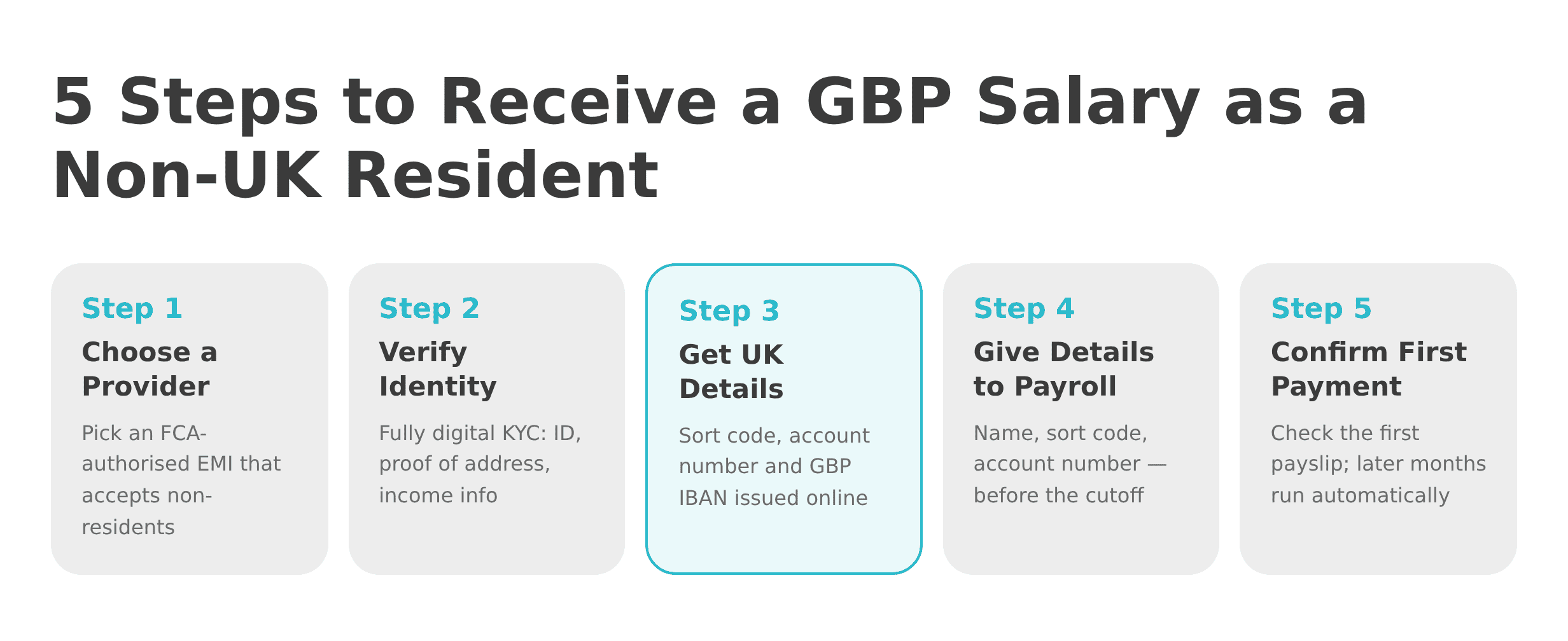
Setting up GBP salary payments takes five steps, all completed online:
Choose an FCA-authorised provider that accepts non-residents
Complete identity verification (KYC)
Receive the UK sort code and account number
Submit the details to the employer's payroll team
Confirm the first payment
Step 1: Choose an FCA-authorised provider that accepts non-residents
High-street banks tie account eligibility to a UK residential address. EMIs regulated under UK e-money rules have no statutory residency requirement, which is why a personal GBP account for non-residents is opened through this route in practice.
Authorisation status is public. Any provider can be checked by name on the FCA Financial Services Register before an application is started. The FCA also publishes plain-language guidance on using payment service providers that are not banks.
Names like Wise and Revolut dominate search results here, and both issue UK details. The comparison that matters is less about brand and more about three practical points: whether the provider accepts the applicant's country of residence, how it safeguards client funds, and what it charges for currency conversion later.
Step 2: Complete online verification (KYC)
The application is fully digital. The applicant uploads ID and proof of address, answers questions about income, and passes a liveness check from a phone camera. The digital KYC verification process at FCA-authorised institutions is risk-based, and a straightforward GBP salary account for non-UK residents usually clears within a few working days.
Delays at this stage almost always come from documents. A blurred ID photo or a proof-of-address document older than three months restarts the review.
Step 3: Receive the UK sort code and account number
Approval produces a full set of UK account details: the sort code, the account number, and a GBP IBAN for payments arriving from outside the UK. For anyone looking for a complete guide for non-UK residents on receiving GBP salary payments with a valid UK sort code, this is the decisive stage. From this point the account behaves exactly like a domestic one on UK payment rails.
The details arrive inside the provider's app or dashboard. Nothing is posted, and no branch visit happens at any point.
Step 4: Submit details to the employer's payroll
Payroll teams ask for three fields: account holder name, sort code, account number. The name must match the verified name on the account exactly, since UK institutions run name-matching checks on incoming payments. This is the moment a non-UK resident starts to receive a GBP salary through a UK sort code, with no further paperwork on the employee side.
One practical note for ops teams: submit the details before the payroll cutoff, not on payday. Bacs runs are committed days in advance, and a detail change after submission waits for the next cycle.
Step 5: Confirm the first payment
A sensible final check is a small test payment, or at minimum a confirmation that the first payslip shows the correct account details. Once the first salary lands, subsequent months run automatically.
[aa fast-fact]
Fast Fact: Faster Payments settles GBP transfers in seconds and operates 24 hours a day, 365 days a year, including weekends and bank holidays.
[/aa]
[aa cta]
Receive Your GBP Salary Without a UK Bank
EQWIRE issues personal UK account details to non-residents entirely online, under FCA EMI authorisation: a real sort code and account number for payroll, plus a GBP IBAN for international senders.
[aa btn]Get UK Account Details[/aa]
[/aa]
Payroll Timelines: Bacs vs Faster Payments
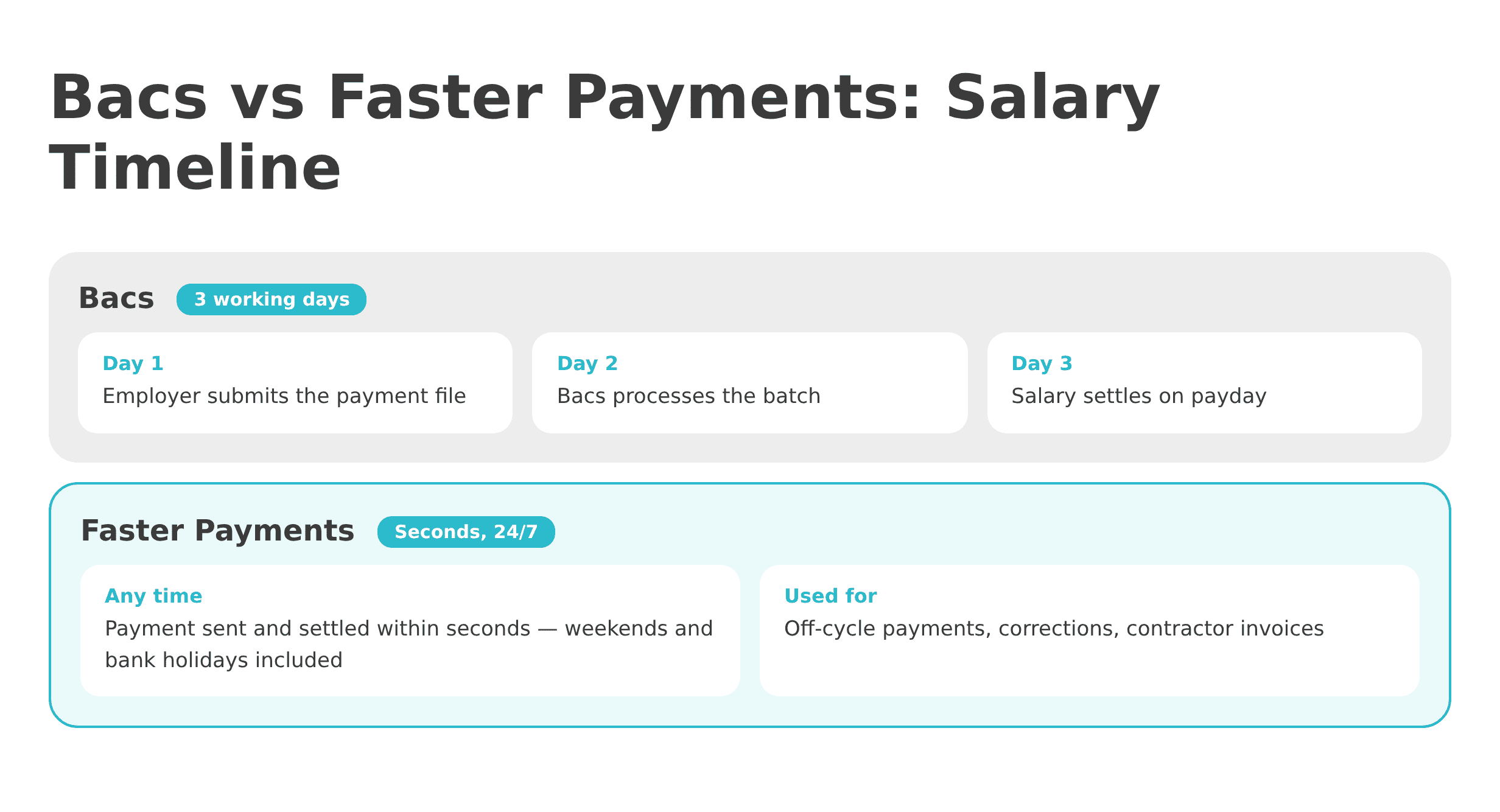
Bacs processes salary payments on a three-working-day cycle. Faster Payments settles in seconds at any hour. Which rail applies depends on the employer: scheduled monthly payrolls run on Bacs in most cases, while off-cycle payments, corrections, and contractor payouts tend to go out by Faster Payments. GOV.UK sets out employer obligations for running payroll, including payment timing.
Rail | Speed | Typical use |
|---|---|---|
Bacs | 3 working days | Scheduled monthly salary runs |
Faster Payments | Seconds, 24/7 | Off-cycle payments, corrections, contractor invoices |
CHAPS | Same working day | High-value transfers, rarely used for salaries |
For the employee, the rail is invisible on a normal month. It becomes visible the first time something changes: a new starter joining mid-cycle, an account detail update, or a correction after an underpayment. Those are the moments when knowing the difference between a three-day batch system and an instant rail saves a support ticket.
CHAPS and the other sterling systems operate under the Bank of England's payment and settlement oversight, which is why settlement on these rails is treated as final.
When the salary actually arrives
On a Bacs cycle, the employer submits the payment file two working days before payday, and funds arrive on day three. Weekends and bank holidays do not count as working days, so a payday falling on a Monday means submission happened the previous Wednesday.
What this means in practice: an account opened after the employer's submission date cannot catch that month's run. The payment either moves to a Faster Payments correction or waits for the next cycle. Anyone planning to get paid in GBP from a UK employer for the first time should treat the employer's submission date, not payday itself, as the real deadline.
Common Errors That Delay Salary Payments (and How to Avoid Them)
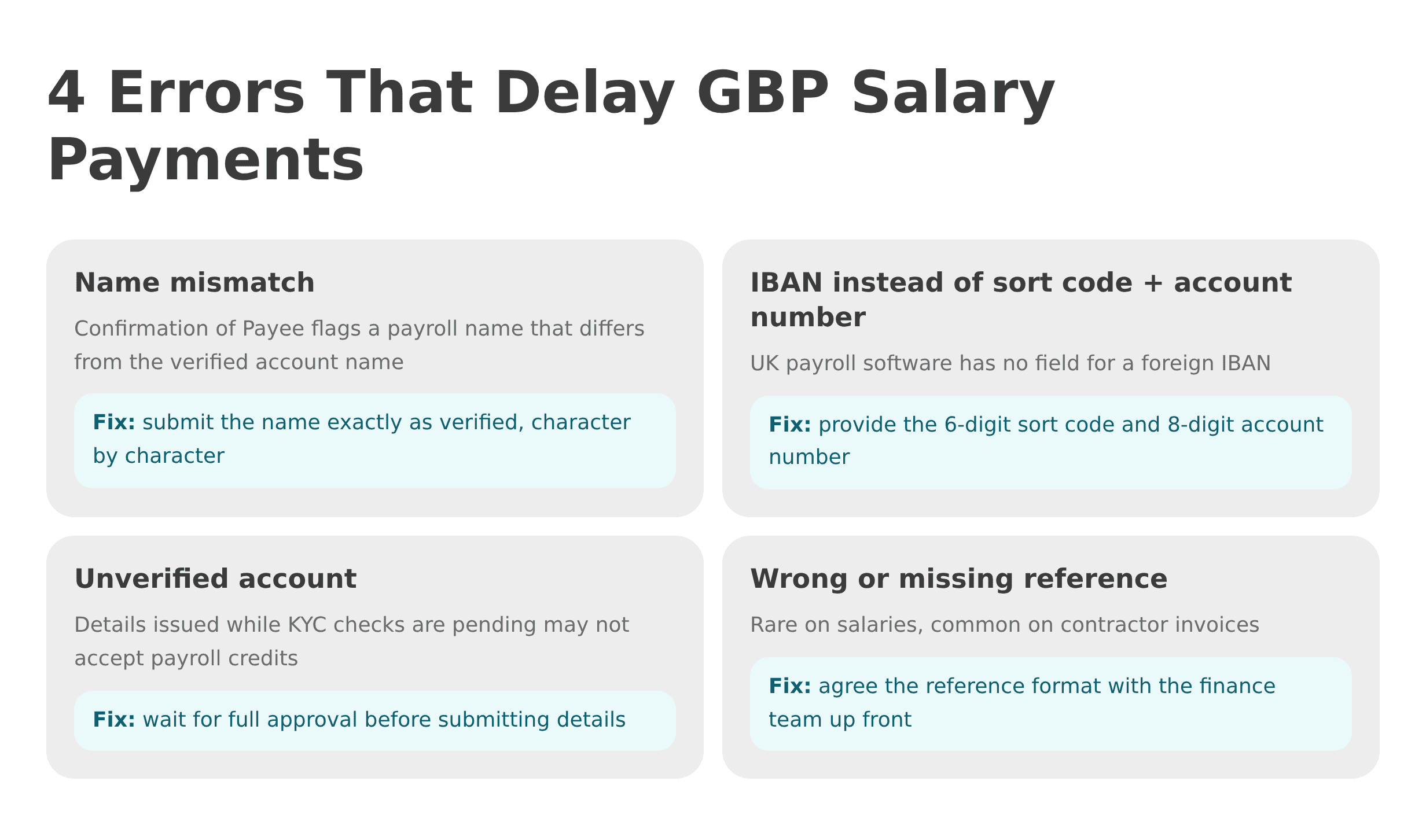
Most delayed GBP salary payments trace back to four preventable errors:
Name mismatch. Confirmation of Payee (CoP) checks the recipient name against the account. "Alex Petrov" on the payroll form and "Aleksandr Petrov" on the account triggers a warning or a rejection. Fix: submit the name exactly as verified.
IBAN instead of sort code and account number. Payroll software rejects the format. Fix: provide the six-digit and eight-digit pair, and keep the IBAN for international senders.
Unverified account. Details issued while checks are still pending may not accept payroll credits yet. Fix: wait for full approval confirmation before submitting details.
Wrong or missing payment reference. Rare on salaries but common on contractor invoices. Fix: agree the reference format with the finance team up front.
CoP deserves particular attention because it fails quietly. The employer's bank shows a "name does not match" warning to the payer, and cautious finance teams pause the payment rather than override the warning. The employee sees nothing except a missing salary. The usual causes are transliterated names and middle names dropped on one side of the form. The safest habit is copying the name from the provider's app character by character.
The IBAN error is the most common one overall. Attempting to receive a GBP salary without a UK bank account by giving a foreign IBAN sends payroll software into a validation failure, and the EMI route removes that failure entirely.
After the First Payday: Managing GBP Income from Abroad
Once the first salary arrives, the account holder controls when and how to convert or move the funds. Salary lands in GBP with no forced conversion, so exchange happens at a moment the account holder chooses rather than on every receipt. For someone who chooses to receive a UK salary abroad while spending in euros or dollars, that control is the difference between converting a full salary at a poor rate and converting monthly living costs at a chosen one.
Fund protection at an EMI works differently from a bank. Client money is safeguarded under the Electronic Money Regulations 2011: held separately from the institution's own funds so it can be returned if the firm fails. The FCA tightened its safeguarding requirements for payment and e-money institutions with new rules taking effect from May 2026. Safeguarding is not FSCS deposit insurance, and understanding how client funds are safeguarded helps in judging a provider honestly.
For anyone paid in sterling but spending in other currencies, a multi-currency account holding GBP, EUR and USD keeps salary income and living costs in their native currencies.
Tax stays with the individual. Non-residents earning UK income may owe UK tax on it, and GOV.UK explains the rules on tax on UK income for people living abroad. A qualified adviser should confirm the position for any specific case.
FAQ
What documents does a non-UK resident need to receive a GBP salary?
Three document types cover almost every application: a government-issued photo ID, proof of address in the current country of residence, and basic source-of-income information such as an employment contract. These are the standard documents needed to receive a GBP salary abroad through an FCA-authorised EMI. No UK address or UK credit history is required, and verification is completed online.
How long does verification take before I can receive a salary payment?
Straightforward salary cases usually clear KYC within a few working days. The account details are issued immediately after approval, and the account can receive Bacs and Faster Payments credits from that moment. Complex cases, such as unclear documents or unusual income sources, take longer because the provider requests additional evidence.
Can my employer pay a GBP salary to a foreign IBAN instead of a UK sort code?
No, not through standard UK payroll. Bacs and Faster Payments route exclusively on the sort code and account number pair, and payroll software has no field for a foreign IBAN. Paying abroad would require a manual international transfer via SWIFT, which adds fees and days of delay on every single payslip. A UK sort code and account number removes the problem at the source.
How do I receive a GBP salary as a non-UK resident without a UK bank account?
Open an account with an FCA-authorised electronic money institution instead of a bank. EMIs issue a real UK sort code, account number, and IBAN to non-residents entirely online, with no UK address requirement. Once verification completes, the details work in any UK payroll system, and the salary arrives in GBP exactly as it would into a high-street bank account.
Can I convert a GBP salary to EUR or USD after receiving it?
Yes. Salary arrives and sits in GBP until the account holder decides to exchange. Multi-currency accounts hold GBP alongside EUR, USD and other currencies, so conversion happens at a chosen rate and moment rather than automatically on receipt. Transfers out can then run on local rails, such as SEPA for euro payments.
Receiving a GBP salary as a non-UK resident stopped being a banking problem the moment FCA-authorised EMIs began issuing full UK account details online. The sequence is short: verify identity, receive a sort code and account number, hand three fields to payroll, and confirm the first payment. The rails do the rest, on a three-day Bacs cycle or in seconds over Faster Payments. EQWIRE provides personal UK account details to non-residents under FCA EMI authorisation, with safeguarded client funds and multi-currency support for income that crosses borders. Opening an account starts at client.eqwire.com/sign-up.
Reviewed by
Related Articles

Personal MUR Account for Expats in Mauritius: Hold Rupees Without a Local Account

Multi-Currency Account for Hong Kong Trade: Hold HKD, USD and CNY Together
How to Receive a GBP Salary as a Non-UK Resident: Sort Code and Account Number Guide

HKD to GBP Conversion: How to Convert Hong Kong Dollars for UK Businesses

Power your payments
with EQWIRE
Create your account in minutes and experience smooth, secure global payments.
" height="9.0156px" id="LIcbdboyB" transform="translate(4.987 4.5)" width="9.01562px"/></svg>)