•
•
Articles
GBP to AED Live Rate Calculator: Convert British Pounds to UAE Dirhams for Business
[aa disclaimer]
Legal Disclaimer: This article is for informational purposes only and does not constitute legal, financial, compliance, or tax advice. Banking eligibility, regulatory requirements, and provider policies vary by jurisdiction. Consult qualified professionals before making decisions.
[/aa]
UK businesses that pay UAE suppliers, maintain Dubai offices, or settle AED invoices regularly face a recurring decision: when to convert GBP to AED and at what rate. The answer has measurable consequences. A property developer converting £80,000 per month at a typical bank spread of 2.5% loses £2,000 per payment — £24,000 over a year that goes directly to the bank's FX margin rather than into operations.
A GBP to AED live rate calculator for business shows the mid-market rate in real time, giving finance teams a benchmark to compare against any provider's quote before committing to a conversion. This article explains how the GBP/AED currency pair works for UK operators, what drives exchange rate movements, which FX instruments are available, and how to structure a payment process that reduces costs on UAE operations.
[aa key-takeaways]
Key Takeaways
The mid-market GBP/AED rate is the interbank baseline — every provider's rate sits above it, and the gap is the real FX cost.
The UAE dirham (AED) is pegged to the US dollar at 3.6725, fixed since 1997, meaning GBP/AED volatility is entirely one-sided — businesses only carry GBP risk.
Bank FX markups on GBP/AED typically run 2.0–3.5%; on £500,000 in annual payments, that difference can reach £17,500.
Forward contracts let UK businesses lock a GBP/AED rate for up to 12 months, protecting margins on future AED invoices and payroll.
A multi-currency business account holding AED eliminates conversion on every payment, reducing FX exposure and transaction costs.
A written rate policy — defining the minimum GBP/AED rate at which conversions execute — removes ad-hoc decision-making from finance operations.
[aa btn]Book a Call[/aa]
[/aa]
GBP/AED as a Business Currency Pair: What UK-UAE Operators Need to Know
The GBP/AED currency pair sits at the centre of UK-UAE trade flows. The UK exported £9.9bn in goods and services to the UAE in 2023, according to the Office for National Statistics, making the UAE one of the UK's top ten export destinations. For the businesses behind those figures (property developers, hospitality operators, professional services firms, and exporters with Gulf clients) the pound to dirham exchange rate for business is an operational constant, not a one-off transaction.
The corridor involves a structurally unusual dynamic. The UAE dirham has been pegged to the US dollar at a fixed rate of 3.6725 by the Central Bank of the UAE (CBUAE) since November 1997. That peg has held through financial crises, commodity cycles, and pandemic disruptions across nearly three decades. The practical implication for UK businesses is significant: managing GBP/AED exposure means managing GBP risk, because the AED side is stable by design.
[aa fast-fact]
Fast Fact: The AED/USD peg has held at 3.6725 without adjustment since November 1997. This makes the UAE dirham one of the most stable major currencies in international business payments.
[/aa]
Industries with recurring GBP/AED payment needs include real estate (project completions, service charges, agent fees paid to Dubai-based entities), oil and gas services (subcontractor payments on GCC infrastructure projects), professional services (monthly retainer payments to UAE-based teams), and hospitality groups managing properties across Gulf cities. For many of these firms, GBP/AED conversions run monthly or more frequently. Even a small reduction in spread percentage is worth thousands of pounds annually.
Cross-border payment costs remain a persistent challenge for businesses in this corridor. The Bank for International Settlements 2024 cross-border payments monitoring survey found no improvement in costs year-on-year, with SMEs continuing to bear a disproportionate burden through bank markups and correspondent bank fees.
Using a Live GBP to AED Rate Calculator to Benchmark Your Costs
A live GBP to AED rate calculator displays the mid-market rate: the interbank exchange rate before any provider applies a markup. Banks trade currency between themselves at this rate; the difference between it and what a commercial client receives is the provider's margin.
The benchmark process runs in three steps. First, enter the GBP amount in a GBP to AED live rate calculator for business and note the AED equivalent at mid-market. Second, request a quote from the current bank or provider for the same conversion. Third, calculate the percentage difference: that figure is the effective markup applied to every transfer.
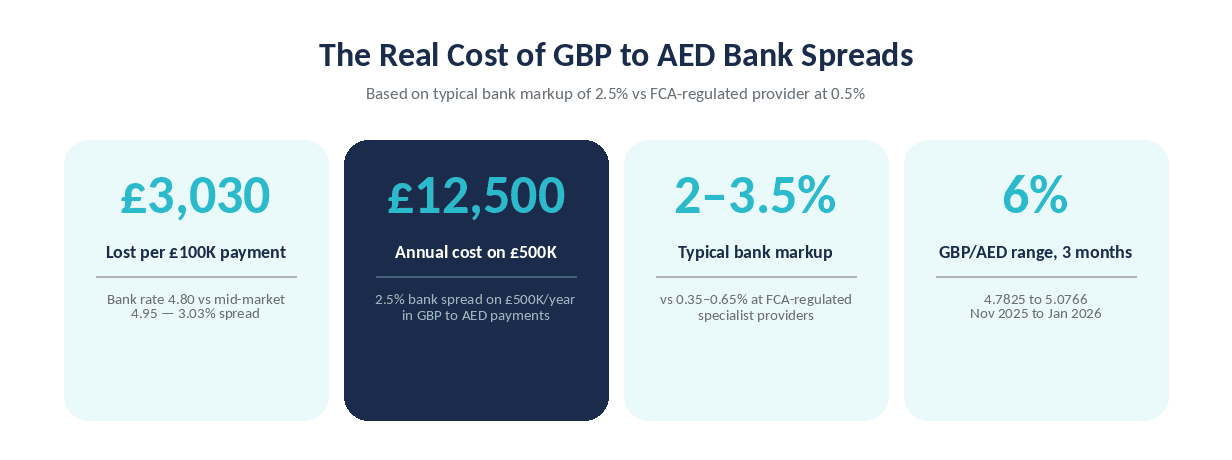
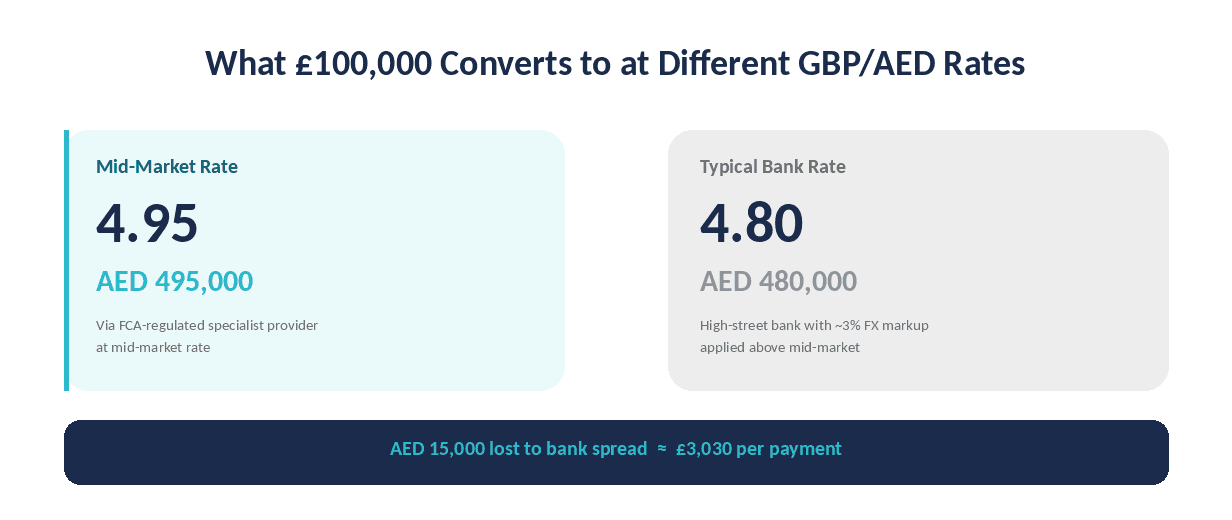
A bank quoting GBP/AED at 4.80 when the mid-market rate is 4.95 applies a 3.03% spread. On a £100,000 payment, that is £3,030 absorbed by the margin rather than arriving as AED. On a £500,000 annual payment programme, a 2.5% spread costs £12,500. The BIS notes that correspondent banking chains add multiple independent fee layers before any rate markup is applied.
[aa fast-fact]
Fast Fact: On £500,000 per year in GBP to AED business payments, a 2.5% bank spread costs £12,500 annually, equivalent to a part-time finance hire.
[/aa]
Specialist FX providers typically charge 0.35–0.65% on GBP/AED conversions, compared to 2.0–3.5% at high-street banks. For finance teams processing regular UAE payments, the GBP AED exchange rate tool offered by multi-currency business account providers delivers both the benchmark rate and execution capability from a single platform.
What Moves the GBP/AED Rate — and How Businesses Can Prepare
GBP/AED volatility originates almost entirely from the pound. The UAE dirham's peg to the US dollar at 3.6725 has held since 1997, leaving UK businesses exposed to GBP swings rather than AED uncertainty.
The Bank of England's Monetary Policy Committee (MPC) is the primary driver of GBP movements. The MPC meets eight times per year, and GBP can move 0.5–1.5% in the 24 hours following a rate decision. Finance teams with scheduled UAE payments should incorporate BoE MPC meeting dates into their conversion calendar.
In recent trading, GBP/AED moved between 4.7825 (November 2025) and 5.0766 (January 2026), a range of nearly 6% over three months. Businesses that converted at the low end rather than the high end on a £500,000 annual payment programme faced a £14,700 cost difference from timing alone.
Seasonal patterns are also observable. GBP has historically performed better in Q1 following UK budget announcements, while AED demand from UK real estate buyers typically peaks in Q4 as Dubai property completions accelerate. Most specialist providers offer rate alert tools: notifications triggered when GBP/AED crosses a target threshold.
GBP to AED FX Tools for Business: Spot, Forward, and Multi-Currency Accounts
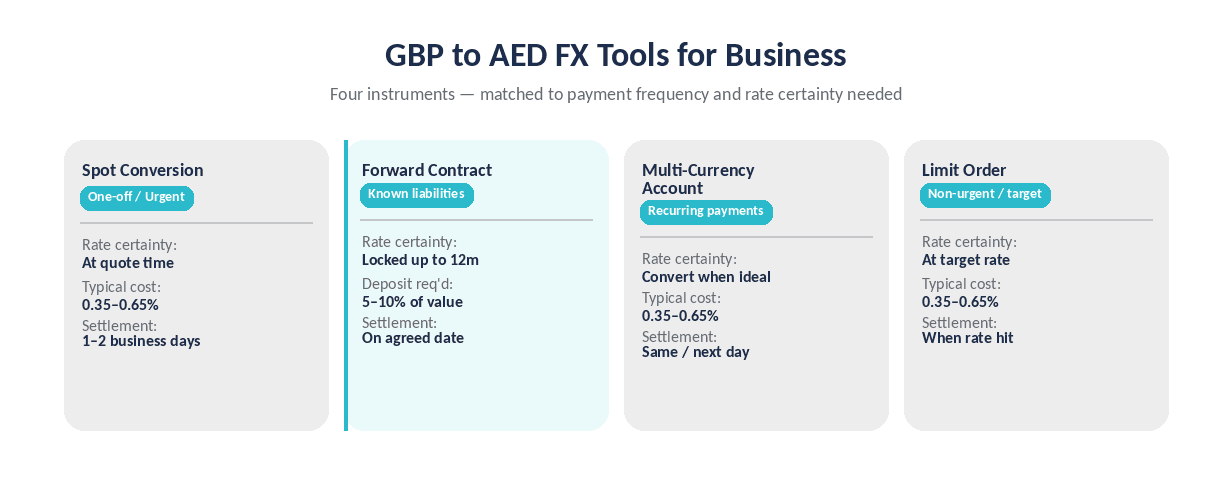
UK businesses converting GBP to AED can choose from four main instruments, depending on payment frequency and the level of rate certainty required.
Spot conversions execute at the current live rate and settle within one to two business days. They suit one-off or urgent payments where the exact AED amount is known and timing is fixed.
GBP to AED forward contracts allow a business to fix a rate today for a payment due anywhere from one week to 12 months ahead. Providers typically require a deposit of 5–10% of the contract value as margin. The arrangement protects against GBP depreciation on known future liabilities, including AED rent, expatriate payroll, and ongoing contractor invoices.
Multi-currency business accounts that hold both GBP and AED change the conversion dynamic. Rather than converting at the point of each payment, businesses accumulate AED balances when the rate is favourable and pay invoices directly from the AED balance. Businesses structuring a multi-currency business account for cross-border operations can access dedicated guidance on account structure and currency options.
Limit orders instruct a provider to convert GBP to AED automatically when the market hits a specified rate. For non-urgent payments where the business has a clear rate target, limit orders remove manual monitoring without committing to a forward contract.
When selecting any of these instruments, UK businesses should verify FCA authorisation. The FCA register lists all Authorised Payment Institutions and Electronic Money Institutions regulated to offer FX and payment services in the UK. The FCA's authorisation requirements for payment institutions set out what regulated providers must meet before offering commercial FX services.
[aa cta]
Open a Multi-Currency Account for GBP and AED Payments
Finance teams managing regular UK-UAE payment flows can hold GBP and AED in a single regulated account, execute conversions at mid-market rates, and pay UAE suppliers directly without routing through a correspondent bank chain.
[aa btn]Create Account[/aa]
[/aa]
Building a GBP to AED Payment Process for Ongoing UAE Operations
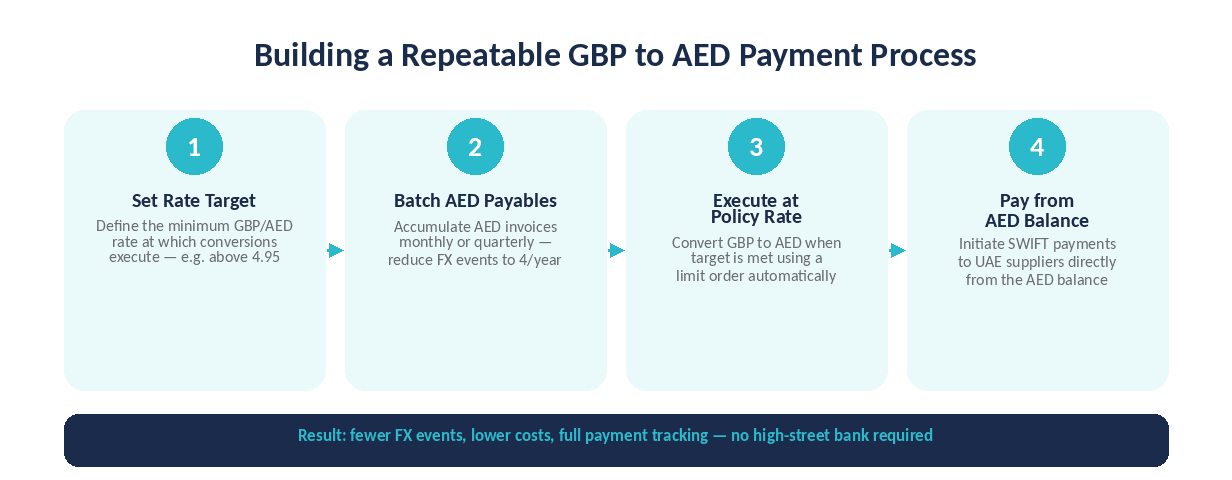
Businesses that process GBP to AED payments on a recurring basis benefit from a defined rate policy — a documented rule specifying the minimum GBP/AED rate at which conversions execute. A working example: convert when the mid-market GBP AED rate exceeds 4.95 using a limit order; otherwise accumulate payables and execute at the next scheduled conversion date.
Batch payments compound the benefit. Instead of triggering a conversion on each AED invoice as it arrives, finance teams accumulate payables and execute a single bulk conversion monthly or quarterly. The EQWIRE guide on batch supplier payments covers how to implement this process without incurring SWIFT wire fees on each individual transaction.
Most multi-currency providers offer direct connections to Xero and QuickBooks, enabling AED payment workflows to feed into the company's financial records automatically. A high-street bank international wire for GBP/AED typically costs £25–45 in transfer fees plus 2.0–3.5% in rate markup, routes through correspondent banks with variable timelines of one to five business days. For businesses with UAE-incorporated counterparties, a GBP account for UAE operations can simplify the structure by giving UAE entities direct access to UK payment rails.
[aa cta]
Reduce GBP to AED FX Costs on Regular UAE Payments
EQWIRE's multi-currency business accounts support GBP and AED holdings, mid-market rate conversions, and direct UAE supplier payments, all accessible from a single regulated platform.
[aa btn]Create Account[/aa]
[/aa]
FAQ
What is the best GBP to AED rate for large business transfers?
For transfers above £50,000, specialist FX providers typically offer GBP/AED rates 1.5–2.5% closer to the mid-market rate than high-street banks. For very large transfers above £250,000, forward contracts add rate certainty — a provider locks the GBP/AED rate in exchange for a 5–10% deposit. Businesses can verify any provider's authorisation status on the FCA register at register.fca.org.uk before entering a contract.
How do forward contracts work for GBP to AED business payments?
A GBP to AED forward contract lets a business agree a fixed exchange rate today for a payment due in up to 12 months. The business deposits a margin — typically 5–10% of the contract value — and the agreed rate is locked. On the settlement date, the conversion executes at the contracted rate regardless of where the market has moved. The tradeoff: if GBP strengthens materially before settlement, the business does not benefit from the improved market rate.
What is the AED peg and why does it matter for UK businesses?
The AED (UAE dirham) is pegged to the US dollar at a fixed rate of 3.6725, a level maintained by the Central Bank of the UAE since November 1997. For UK businesses, GBP/AED volatility is one-sided: AED does not float against GBP independently. This simplifies FX planning — businesses monitor BoE policy and UK macro data rather than tracking two central banks.
How can I reduce FX costs on recurring GBP to AED payments?
The most effective way to reduce FX costs on recurring GBP to AED payments is to move conversions from a bank to an FCA-regulated specialist provider and consolidate payments into batches. Banks charge 2.0–3.5% above mid-market on GBP/AED; FCA-regulated fintechs typically charge 0.35–0.65%. On £200,000 per year in conversions, that difference recovers £3,300–£5,700 annually. A live GBP to AED rate tool for UK businesses sending money to UAE without hidden FX markup, combined with a multi-currency account that holds AED between payments, addresses both the rate cost and the operational friction.
Do I need a UAE bank account to pay suppliers in AED?
A UAE bank account is not required to pay suppliers in AED from the UK. Payments in AED route via SWIFT, using the supplier's IBAN and SWIFT/BIC code. A multi-currency business account held with an FCA-regulated UK provider can hold AED and initiate outbound SWIFT payments directly to UAE bank accounts. The EQWIRE guide on multi-currency EMI accounts covers how this works for businesses with complex multi-currency payment flows.
Managing GBP/AED payment costs is a straightforward operational improvement for UK businesses with regular UAE exposure. The GBP to AED live rate calculator for business functions as the starting point: a benchmark that turns an opaque bank rate into a measurable cost. Finance teams that define a rate policy and hold AED between payment cycles can reduce annual FX costs by thousands of pounds without restructuring their UAE operations. Businesses ready to move GBP/AED payments off a high-street bank can open a regulated multi-currency account at https://client.eqwire.com/sign-up.
Reviewed by

Related Articles

UK Business Account for a Dubai-Focused Trade Consultant Collecting GBP and AED

Multi-Currency Account for Caribbean Businesses: Hold XCD, USD and GBP Together

MUR to USD or EUR: FX Conversion Options for Mauritius-Based International Businesses
ILS to EUR or GBP: Converting Israeli Shekel for International Businesses

Power your payments
with EQWIRE
Create your account in minutes and experience smooth, secure global payments.
" height="9.0156px" id="LIcbdboyB" transform="translate(4.987 4.5)" width="9.01562px"/></svg>)