•
•

UK Payment Account for a Company with Several Licensed Activities and One UK Entity
[aa disclaimer]
Legal Disclaimer: This article is for informational purposes only and does not constitute legal, financial, compliance, or tax advice. Banking eligibility and regulatory requirements vary by jurisdiction and by provider. Consult qualified professionals before making decisions.
[/aa]
A compliance team submits an application, and within days the provider asks how the company's licences relate to each other. The question is routine for a UK payment account for a company with several licensed activities under one entity. Each regulated line brings its own customers and its own supervisor. Providers therefore review the lines one by one and then judge the entity as a whole.
A clear, documented answer usually closes the query. A vague one opens a second round of requests and delays the account. The sections below cover the documents to prepare and a three-step method for explaining each regulated line. A description template and the account setup options follow.
[aa key-takeaways]
Key Takeaways
The KYB file rests on one overview of the whole company plus a separate block for each licence.
Each licence needs a reference number and the exact scope of permitted activity, with the regulator named.
Three steps explain several regulated business lines: an overview, a block per activity and a note on how the lines connect.
A description that states why unrelated lines sit in one company removes the most common follow-up question.
One account can serve several activities when payment references separate the flows; separate accounts suit cases where licence rules demand segregation.
[aa btn]Book a Call[/aa]
[/aa]
UK payment account for a company with several licensed activities: preparation checklist
A provider reviewing a multi-licence company usually asks for one set of entity documents and one set of documents per licence. Collecting both before the application goes in saves at least one round of correspondence.
Documents for the legal entity
The entity file proves who the company is and who stands behind it. Providers typically request:
Certificate of incorporation and articles of association.
Company number and registered office address, matching the Companies House record.
Full names of all directors and the senior managers who run daily operations.
An ownership chart showing every shareholder and each person with significant control (PSC).
Identity and address documents for every beneficial owner.
The latest financial statements or management accounts.
These items follow from regulation 28 of the Money Laundering Regulations 2017 (MLR 2017). The regulation tells a firm to verify the company's name and registered office. It also requires the firm to understand its ownership and control structure and identify the beneficial owner. A PSC register entry alone does not satisfy that duty, because the regulation bars firms from relying solely on information filed with the registrar.
[aa fast-fact]
Fast Fact: Regulation 28(2)(c) of MLR 2017 requires a firm to assess the purpose and intended nature of the business relationship, which is why providers ask what each licence is used for.
[/aa]
Documents for each licence
Every regulated line needs its own small file. The same five items work for each one:
The licence or authorisation reference number and the issuing regulator.
The list of permitted activities, with any conditions or restrictions.
The date of authorisation and the date of the latest review by the regulator.
The name of the person responsible for compliance on that line.
Any regulator correspondence that changes the scope of the permission.
A line authorised by the Financial Conduct Authority (FCA) can be confirmed on the FCA Register in minutes, so providers often check it before reading anything else. Licences from other regulators call for a copy of the licence and a link to the regulator's public register where one exists.

Step-by-step: how to explain several regulated business lines in KYB
How a UK company can present several licensed activities clearly during due diligence comes down to structure. One overview and one block per licence, closed by a paragraph on how the lines connect, give the reviewer everything in the order the review itself follows.
The method also fits the way providers read files. The reviewer first forms a picture of the entity, then tests each licence against that picture, then asks whether the pieces fit together.
Step 1: One-paragraph business overview
The overview runs to 80–100 words. It states what the company does, who pays it, which countries the payments touch and what monthly payment volume it expects, given as a range.
Precision beats polish here. A range such as £200,000 to £400,000 per month tells the reviewer more than the word "substantial".
Step 2: A block per regulated activity
Each licence gets four lines of its own: the activity, the authorisation and regulator, the typical customers and counterparties, and the expected payment flows by currency.
Keeping the blocks parallel lets a reviewer compare them quickly. It also shows that management knows exactly where each permission begins and ends.
Step 3: Show how the lines relate, or why they do not
This paragraph carries the most weight. Where lines share customers, staff or systems, the paragraph says so. Where they are unrelated, it gives the history in one or two sentences: an acquisition in 2021 or a group reorganisation.
The paragraph also states that funds from one line are not mixed with funds from another. A concrete scenario shows the effect. A fictional company holds an FCA permission for insurance distribution and a gambling software licence from the Gambling Commission. Its first application drew three follow-up questions. After the Step 3 paragraph went in, the provider asked none.

KYB business model description for the UK: template and example
A KYB business model description is a short written summary that tells the provider what the company does and under which permissions it operates, and it names the source of the money. The provider reads that text against the purpose-and-nature test in MLR 2017, so the wording must stay consistent between the application and the licence file.
The template below fits one page.
Field | What to write |
|---|---|
Company | Legal name, company number, country of registration |
Overview | Two sentences on what the company does and for whom |
Activity 1 | Name, regulator, reference number, customers, countries, expected flows by currency |
Activity 2 | Same fields as Activity 1 |
Relationship | Shared customers or staff, or fully separate and why |
Source of funds | Revenue per activity, share capital, group loans |
Ownership | Owners with percentages and the ultimate beneficial owner |
An illustrative filled-in version for a fictional company reads as follows. Harbourline Services Ltd supplies licensed gambling software to B2B operators in the UK and EU, and distributes insurance products through an
FCA-authorised subsidiary line. The software line earns about £300,000 a month in GBP and EUR. Insurance commission adds about £40,000 in GBP. The two lines share a finance team but no customers, and commission is never paid into the software revenue flow.
What to include and what to leave out
Include | Leave out |
|---|---|
Licence numbers and the regulator's name | Marketing language and superlatives |
Expected monthly volumes as ranges | Round guesses presented as exact figures |
Countries of customers and suppliers | Plans for markets without a licence |
The reason unrelated lines share one entity | Internal jargon without a definition |
[aa cta]
Prepare the KYB pack before applying
EQWIRE reviews multi-licence companies line by line. A complete pack shortens the exchange with the onboarding team.
[aa btn]Open Business Account[/aa]
[/aa]
What a KYB check looks like in practice
KYB (know your business) is the verification of a company, its owners, its activity and its source of funds before an account opens. KYC checks the individuals behind the company. A company account normally triggers both.
What is KYB in banking
In banking, KYB is the part of customer due diligence that applies to legal entities. The provider confirms that the company exists, identifies the people who own and control it, and learns what the company does with the account. Know your business checks also repeat after opening, because the provider monitors the relationship and refreshes the file when circumstances change.
The depth of the check follows the risk. MLR 2017 requires each firm to assess the money laundering risk of its own business, looking at customers, geographies, products, transactions and delivery channels. A company with several licences scores differently on each line, so the file needs to support each score. Where risk is higher, the firm applies enhanced due diligence and asks for more evidence.
Exact KYB requirements differ between providers. A provider with a low risk appetite may request more documents for the same company than another provider does.
KYB check vs KYC check on the same account
Think of KYC as the identity test for one person and KYB as the test for the legal entity. A business account runs both at once.
KYC check | KYB check | |
|---|---|---|
Subject | A director or beneficial owner | The company |
Core evidence | Identity and address documents | Incorporation documents and ownership chart |
Ownership question | Not applicable | Who owns and controls the company |
Purpose test | Why the person is involved | What the company does with the account |
The practical result: a multi-licence company faces the KYB check once and the KYC check for each director and owner. Missing one document delays the whole file.

Multiple business activities on one company account: setup options
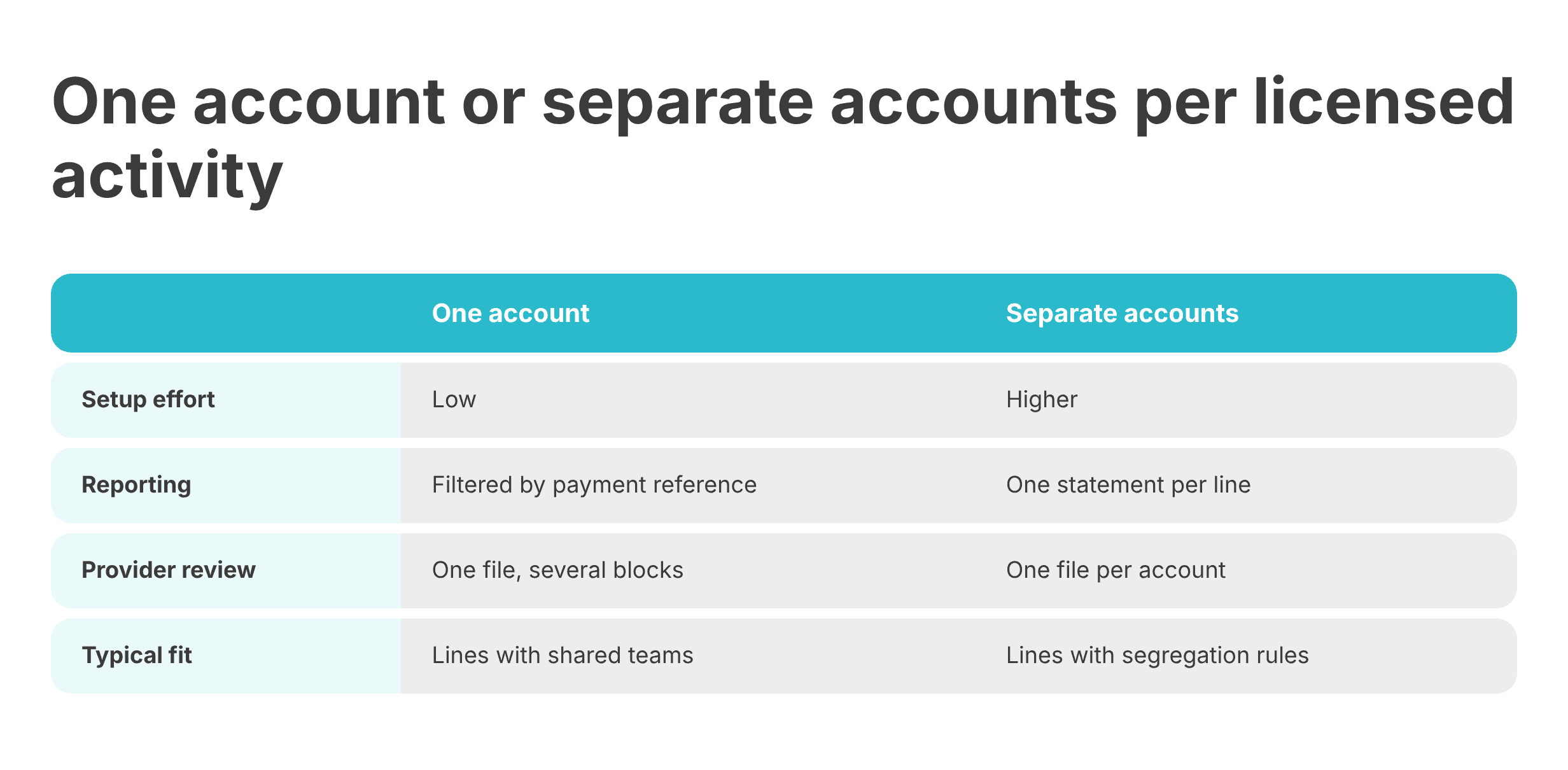
One account can serve several licensed activities when payment references or counterparties keep the flows apart. The right choice depends on the licences and currencies, plus the reporting each line needs.
One account with clear references per activity
A single account suits companies whose lines share a finance team and a bank relationship. Each activity uses its own payment reference prefix, such as SW for software and IN for insurance, and the monthly report is filtered by prefix. The provider then sees one account and two readable flows.
This setup keeps administration light. It also puts the burden on discipline: a missing prefix on a single incoming payment makes the flow ambiguous, and the provider may ask for an explanation.
Separate accounts and when they make sense
Separate accounts fit cases where a licence demands that funds sit apart from the company's own money, or where the lines hold different currencies. Rules on client money differ between licences, so the compliance function confirms the requirement line by line before the structure is chosen.
Separate accounts add reporting work and often add a separate review by the provider. In return, they give each regulated line a clean statement for its regulator.
One account | Separate accounts | |
|---|---|---|
Setup effort | Low | Higher |
Reporting | Filtered by reference | One statement per line |
Provider review | One file, several blocks | One file per account |
Typical fit | Lines with shared teams | Lines with segregation rules |
A business account for a multi-activity company works best when the structure is settled before the application. Changing it later restarts parts of the review. EQWIRE's articles on licensed suppliers and group structures show how the same decisions play out for other company profiles.
Common mistakes that slow the review
Most delays trace back to a short list of preventable errors:
Describing the lines in different words in the application and in the licence file.
Leaving out the reason that unrelated lines share one company.
Listing a licence without its scope, so the reviewer cannot tell what the permission covers.
Giving expected volumes as a single round number with no range.
Relying on the PSC register alone for beneficial ownership.
Sending documents for the entity but none for one of the licences.
Each error invites a follow-up question, and each question adds days. Fixing all six before submission is cheaper than answering them one at a time afterwards.
A UK payment account for a company with several licensed activities under one entity opens fastest when the file explains the structure before the provider asks. The eligibility criteria on EQWIRE's website show which documents and business types providers assess first.
[aa cta]
One account for international business payments
Multi-currency accounts from EQWIRE settle through local rails, so each licensed line can send and receive payments in one place.
[aa btn]Open Business Account[/aa]
[/aa]
FAQ
How can a UK company present several licensed activities clearly during due diligence
Send the reviewer a short overview of the whole company first. Follow it with a summary for every permission and a note on how the permissions connect. Each summary gives the regulator, the licence number, the clients served and the currencies expected, and an electronic money institution (EMI) reads the file in the same sequence.
What happens when one UK entity holds two different regulatory permissions
Two regulatory permissions in one UK company mean the provider assesses each regulated line separately and then reviews the whole. Each permission needs its own evidence: reference number, regulator and scope. The provider may run a longer KYB check than it would for a single-licence company, because the money laundering risk assessment under MLR 2017 weighs the customers and products of every line. A clear note on how the two permissions relate usually shortens the review.
Do payment providers need separate accounts for each licensed activity
Only certain licences force a separate account. If no licence rule requires segregation, one account is enough, provided payment references or counterparties keep the flows apart. The rules differ between regulators, so the company checks its own permissions. Where segregation applies, that line gets a dedicated account and its own statement. Other lines can still use a common account.
Is it a problem if a company has unrelated regulated business lines
Unrelated regulated lines pass review when the company explains the shared entity. Reviewers want the commercial reason, for example a merger or a change of ownership. Funds from each line should stay identifiable, and the KYB check compares the stated purpose of each line with the actual payment flows. A company that gives its reason briefly and shows separate flows normally passes without a second round of questions.
Reviewed by
Related Articles
UK Payment Account for a Company with Several Licensed Activities and One UK Entity

UK Multi-Currency Account for a UK Procurement Group with Separate Entity Billing

UK Business Account for an Industrial Exporter Managing Deposits, Refunds and Final Invoices

UK Payment Account for a Licensed B2B Betting Technology Supplier

Power your payments
with EQWIRE
Create your account in minutes and experience smooth, secure global payments.
" height="9.0156px" id="LIcbdboyB" transform="translate(4.987 4.5)" width="9.01562px"/></svg>)