•
•

UK Business Account for an Industrial Exporter Managing Deposits, Refunds and Final Invoices
[aa disclaimer]
Legal Disclaimer: This article is for informational purposes only and does not constitute legal, financial, compliance, or tax advice. Banking eligibility and regulatory requirements vary by jurisdiction. Provider policies differ too. Consult qualified professionals before making decisions.
[/aa]
A UK machinery maker closes the month and finds EUR 42,000 sitting in its bank feed with no matching invoice. The money is a 30% deposit from a German buyer, sent with the buyer's purchase order number instead of the proforma reference.
Nobody can allocate it until someone emails Stuttgart.
An international business bank account set up around the export contract prevents most of this. Each contract currency gets its own IBAN, and every incoming payment carries one agreed document number, so the customer balance closes at exactly zero.
This guide covers the working procedure for industrial exporters. It starts with setup, then follows a 16-week contract from proforma to balance payment, shows the journal entries for a deposit, and lists the six reconciliation errors that cost finance teams the most time.
[aa key-takeaways]
Key Takeaways
Open one currency account per invoicing currency before the first deposit arrives.
Put the proforma number at the start of every payment reference. SEPA and SWIFT remittance fields hold only 140 characters.
Post deposits to a liability account on receipt and allocate them at shipment.
Send refunds from the account the money landed in, with a credit note number as the reference.
Under HMRC Notice 703, a deposit on zero-rated exported goods follows the VAT treatment of the final supply.
[aa btn]Book a Call[/aa]
[/aa]
Setting Up an International Business Bank Account for Export Contracts
An exporter's account setup should mirror its contracts. A business invoicing German and US buyers needs a EUR IBAN reachable by SEPA plus a USD account reachable by SWIFT, alongside the GBP sort code it already uses for Faster Payments and payroll.
Five steps cover the setup for most industrial exporters:
List every currency on a signed contract from the past 12 months.
Open a currency account for each one.
Agree a payment reference format with the sales team before the next proforma goes out.
Connect statements to the accounting system through a daily feed.
Decide in writing who can release a refund, and set the amount above which a second approver must sign.
Step 3 is where most exporters lose hours later.
A reference such as PF-2291-DEP or INV-2291-BAL tells the ledger what the money is for. "PO 45007812" tells it nothing, since that number exists only inside the customer's ERP.
Currency Accounts to Open Before the First Deposit
A multi currency business account holds several balances side by side under one login, usually with a separate IBAN for each. High-street banks sell a similar foreign currency account UK exporters can use, although those versions often carry a monthly fee per currency and take weeks to open.
For a contract priced in euros, the EUR balance is what matters. When a euro deposit lands in a GBP-only account, the bank converts it on arrival at its own rate. The ledger then shows a sterling amount that will never match the euro invoice.
Holding the deposit in euros keeps the figures aligned with the contract. Conversion becomes a treasury decision taken on a chosen date. The same balances also cover the purchase side of trade, from paying overseas suppliers to settling freight invoices in USD.
Open International Business Bank Account Online: Documents to Prepare
E-money institutions often complete business onboarding online in 2 to 10 working days. The document list is short. It starts with the certificate of incorporation and proof of the registered address, and every person holding 25% or more of the shares will need identity checks.
Two extra documents speed things up: a sample export contract plus a forecast of monthly receipts by country. Compliance teams use both to set expected volumes, and groups with overseas shareholders face further ownership checks at this stage.
A Contract Timeline from Deposit to Final Invoice
Take a packaging line sold for EUR 140,000 on 30/70 terms to a buyer in Stuttgart, who pays EUR 42,000 up front and the remaining EUR 98,000 after shipment. Production takes 11 weeks.
Government export guidance calls payment in advance the most secure option with a new buyer, and a 30% deposit is a common middle ground on capital equipment.
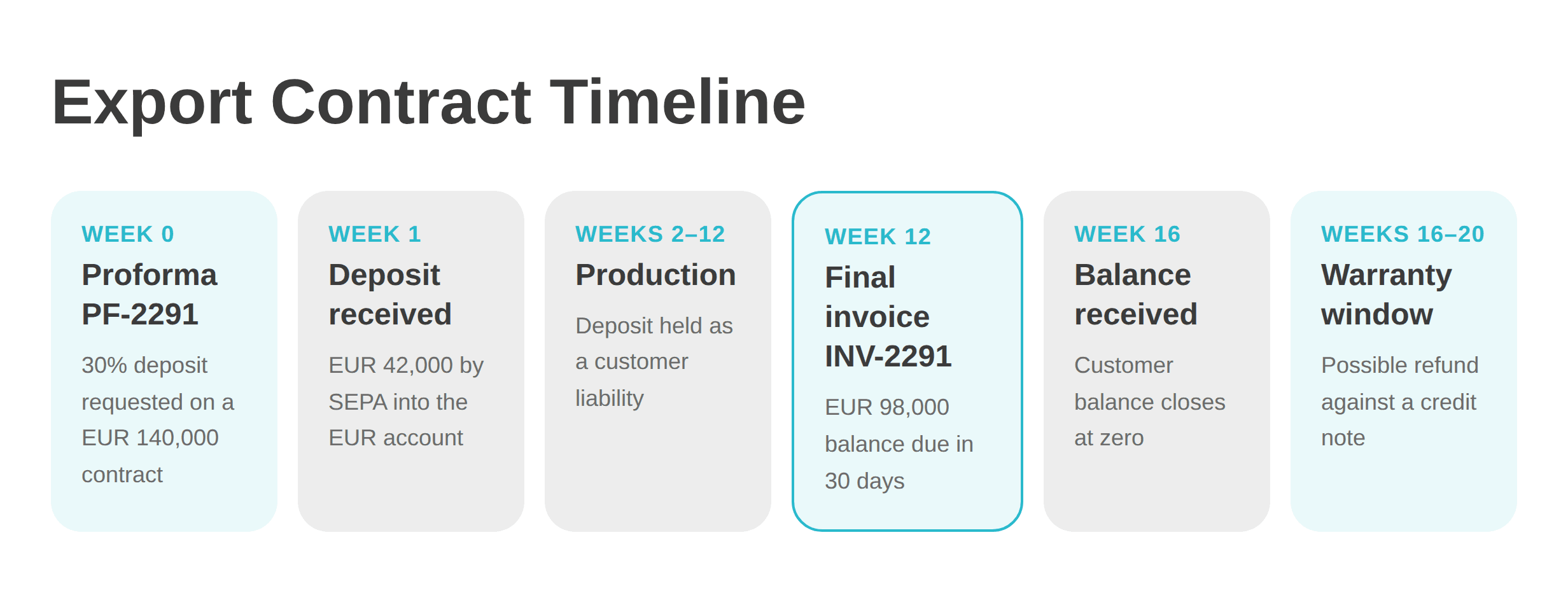
Week | Document | Money movement |
|---|---|---|
0 | Proforma invoice PF-2291 | Deposit requested |
1 | Deposit receipt | EUR 42,000 received by SEPA |
2 to 12 | Production | None |
12 | Final invoice INV-2291 | Balance of EUR 98,000 due in 30 days |
16 | Balance receipt | EUR 98,000 received |
16 to 20 | Warranty window | Possible refund or credit |
Week 0: Proforma and Deposit Request
A proforma invoice is a quotation in invoice format. It carries no VAT entry and creates no tax point on its own.
Many exporters issue a separate invoice for deposit, sometimes called an advance payment invoice. HMRC guidance on deposits and advance payments puts the tax point on whichever comes first: the VAT invoice date or the day the money arrives.
For goods leaving the UK, that tax point rarely produces VAT to pay. HMRC's export notice gives deposits the same liability as the final supply, so a zero-rated sale means a zero-rated prepayment.
[aa fast-fact]
Fast Fact: HMRC normally expects exported goods to leave the UK within 3 months of the time of supply to keep zero-rating, with commercial or official evidence of export on file.
[/aa]
A long build schedule can stretch that window. An exporter taking a deposit in January and shipping in June should confirm the treatment with its accountant.
Shipment: Final Invoice for the Balance
The final invoice goes out when the goods leave, and the Incoterm in the contract fixes that moment. Under EXW the buyer collects from the factory gate. Under DAP the exporter carries the machine to the buyer's site.
A clean final invoice shows the full contract value of EUR 140,000 on line one. Line two deducts the EUR 42,000 already received, and line three states the EUR 98,000 still due. Accounts payable teams at the buyer pay faster when that deduction is visible on the page.
[aa cta]
Keep Every Export Receipt in Its Contract Currency
EQWIRE gives each currency its own IBAN, so euro receipts from a German buyer never pass through sterling on the way to the ledger.
[aa btn]Open a Currency Account[/aa]
[/aa]
How to Record a Deposit Against a Final Invoice
A deposit is recorded as a customer liability on the day it arrives, then allocated against the final invoice when the goods ship. Before dispatch, the buyer still owns that cash in accounting terms.
The sequence below works in Xero or NetSuite with minor label differences:
Receive EUR 42,000 into the EUR account with reference PF-2291-DEP.
Post it to a customer deposits liability code.
Raise INV-2291 for the full EUR 140,000 on the shipment date, following the Incoterm agreed with the buyer.
Allocate the deposit against INV-2291.
Match the EUR 98,000 balance receipt, reference INV-2291-BAL, to the open amount.
Check the customer ledger reads zero before month end.
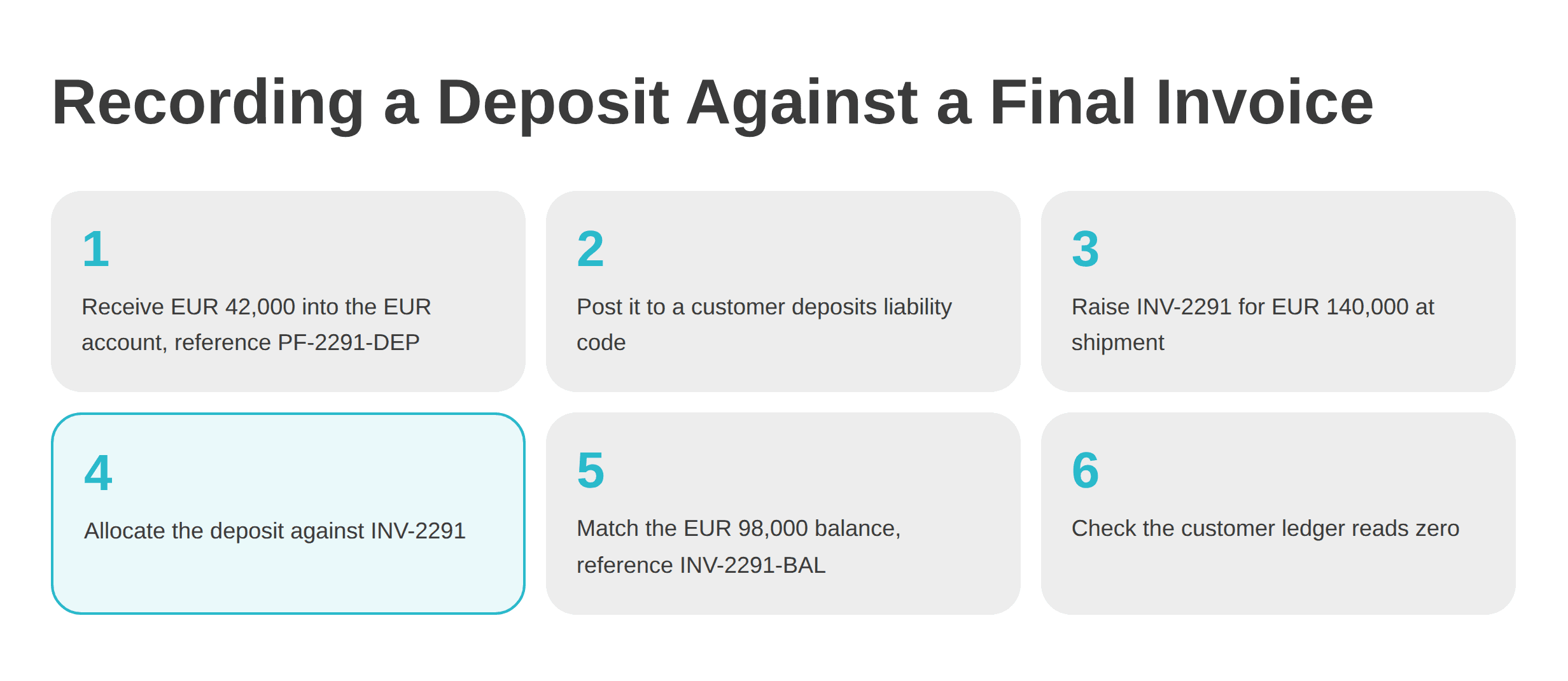
Accountants who ask how do UK exporters record a deposit against a final invoice usually hit trouble at step 2. Posting a prepayment straight to sales overstates revenue for a quarter and breaks the link to PF-2291.
Currency discipline matters here too. With both documents in euros, step 6 closes cleanly. Convert either one into sterling early and a small FX difference appears that someone has to explain at audit.
Export Deposit and Refund Handling: A Working Procedure
Every refund starts with a credit note that cites the original invoice number. Money should not move until that document exists and a named approver has signed it off.
On industrial contracts, refunds come from a handful of events. A buyer might cancel an optional spare-parts kit, or a machine might fail acceptance testing. Duplicate payment runs from the buyer's ERP cause the rest.
Issuing the Credit Note
HMRC treats a credit note as the document that reduces the value of an earlier supply. The VAT guide expects it to carry its own number and date alongside the original invoice number, plus a short reason for the reduction.
That credit note number then doubles as the refund reference. A payment labelled CN-0417 / INV-2291 tells the buyer's team which line has changed, and it tells auditors the same thing two years later.
HMRC record-keeping rules require VAT-registered businesses to keep these documents for at least 6 years.
Returning Funds in the Currency Received
Returning money in the currency it arrived in avoids two conversions and the loss between them.
Suppose the Stuttgart buyer cancels a spare-parts kit worth EUR 8,400. From the EUR account, the exporter sends back EUR 8,400 by SEPA and the buyer's books match to the cent.
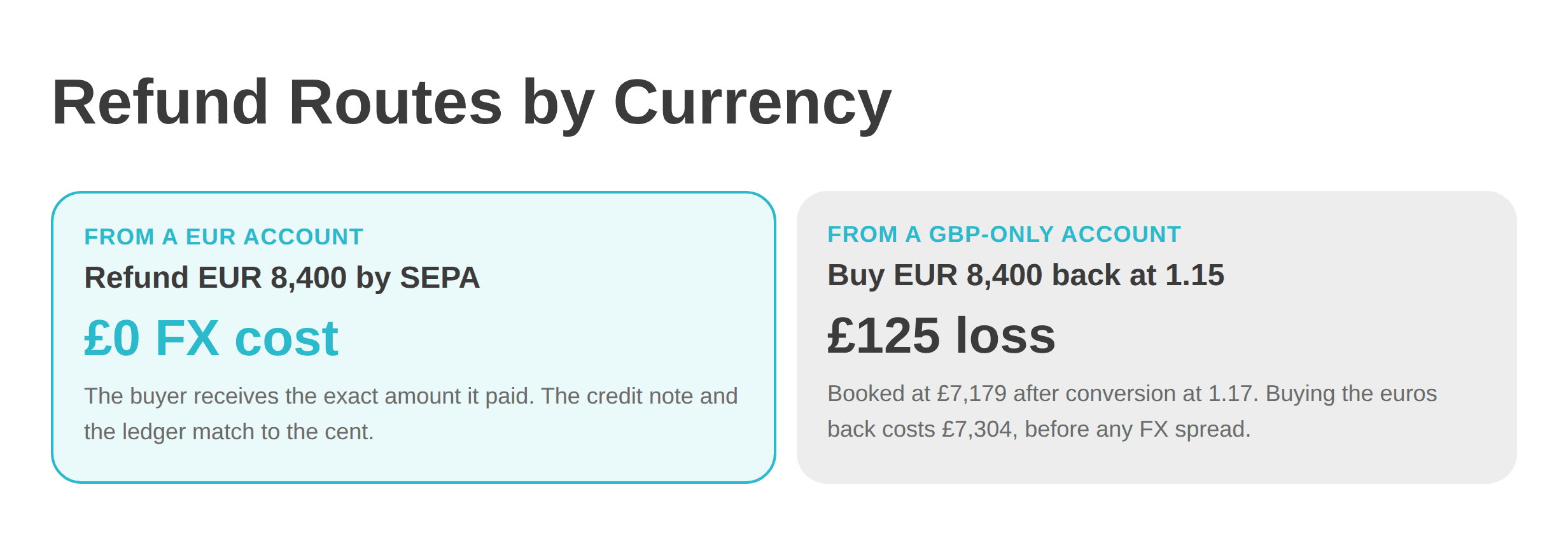
Compare that with a GBP-only setup. The original euros were converted at 1.17, so the kit sat in the books at £7,179. Buying EUR 8,400 back at 1.15 costs £7,304, a £125 loss before any FX spread.
USD refunds follow the same logic, although they travel by SWIFT and intermediary banks can deduct fees in transit. Sending with the OUR charge code puts those intermediary fees on the exporter instead, and the American buyer then receives the full invoiced amount.
Invoice Reconciliation Errors That Cost Exporters Time
Invoice reconciliation on industrial contracts fails for a short list of repeat reasons. Most trace back to a missing reference or a currency mismatch.
Error | Cause | Fix |
|---|---|---|
Unallocated deposit | Buyer quoted its PO number | Print the required reference on the proforma in bold |
Short payment of EUR 15 to EUR 35 | SWIFT sent with SHA or BEN charges | Agree OUR charges in the contract or invoice the shortfall |
FX residue on a closed invoice | Deposit converted to GBP, balance kept in EUR | Hold both receipts in the contract currency |
Two receipts for one invoice | Buyer paid the balance in two parts | Match each to the open amount with a sub-reference |
Duplicate deposit | Buyer's system re-sent a payment run | Hold the duplicate as a liability until the credit note is issued |
Refund with no document | Sales approved a refund by email | Require a credit note number before any outbound payment |
Partial payments cause the most work. A buyer settling EUR 98,000 as EUR 60,000 in March and EUR 38,000 in April creates two bank lines against one invoice, and many bank feeds auto-match only the first.
Payment reconciliation gets easier as richer data travels with each transfer. The Bank of England has published plans for ISO 20022 data in CHAPS, with purpose codes required on all CHAPS payments from November 2027.
For teams automating the match, a dedicated virtual IBAN per large buyer removes the reference problem entirely.
Month-End Checks for Export Receivables
A 20-minute review on the last working day catches most of these errors before they reach the auditors. Four checks do the work:
Every receipt in each currency account has a document number attached.
The customer deposits liability balance equals the sum of open proformas.
No invoice shows a residual balance below EUR 50.
Every outbound refund in the month has a matching credit note.
Check 3 matters more than it looks. Balances of EUR 15 or EUR 35 usually come from SWIFT deductions, and they pile up quietly across dozens of customers until someone writes them off in bulk at year end.
Bank reconciliation software can flag these automatically. The rules still have to be written by someone who understands the contract terms.
What the Best UK Business Bank Account for International Payments Should Offer
From an exporter's point of view, the best UK business bank account for international payments keeps each contract in its own currency from deposit to refund. Fee tables matter less than most buyers expect once the hours spent on reconciliation are counted.
A checklist for finance teams comparing providers:
a separate IBAN for each invoicing currency
direct SEPA access for euro receipts and SWIFT for USD
a daily statement feed into Xero, Sage or NetSuite
payment references passed through in full, up to 140 characters
dual approval on outbound refunds above a set amount
an FCA authorisation number that appears on the FCA register
In practice, the difference shows up on the second contract. A Midlands pump manufacturer selling to a distributor in Ohio receives USD 75,000 by SWIFT, then a USD 6,200 warranty claim four months later. With a USD balance on hand, the refund goes out the same day at no FX cost.
Without one, the finance team buys dollars at the day's rate and absorbs whatever the pound has done since spring.
Protection of funds is the final point. E-money institutions sit outside the FSCS, so the law requires them to safeguard client money instead. The FCA's new safeguarding regime under CASS 15 took effect on 7 May 2026 and added annual safeguarding audits plus a monthly return to the regulator.
EQWIRE provides FCA-regulated business accounts with safeguarded client funds. Each currency on the account comes with a dedicated IBAN.
FAQ
What account workflow helps a UK exporter reconcile deposits, refunds and final payments?
The workflow that works best pairs currency-matched accounts with fixed document references. Receipts in euros stay in a EUR account, receipts in dollars stay in a USD account, and each payment quotes a proforma, invoice or credit note number. Outbound refunds need a second approver above an agreed threshold, which stops sales teams from promising money that finance has not seen.
How do UK exporters record a deposit against a final invoice?
UK exporters treat the deposit as money owed back to the customer until the goods leave. Once the shipment departs, the exporter issues the final invoice for the full contract value and applies the prepayment, so only the balance remains open. Matching currencies on both documents stops FX differences from appearing.
Can a refund be sent back in the currency it was received?
Yes, provided the exporter still holds that currency. A euro deposit kept in a EUR account can go back by SEPA for the exact amount received. If the bank converted it to sterling on arrival, the exporter has to buy euros again, and the rate difference becomes a gain or a loss on the refund.
Why do partial payments cause reconciliation problems for UK exporters?
Each instalment arrives as a separate bank line, and automatic matching in most accounting software expects one receipt per invoice. SWIFT deductions of EUR 15 to EUR 35 per transfer then leave small unexplained balances. Exporters using a multi currency business account avoid a further issue, since instalments no longer convert to GBP at different daily rates.
Industrial exporters rarely lose money on the contract itself. The losses sit in unallocated receipts and in FX residue. Refunds sent without paperwork add more, and each one costs hours at month end. An international business bank account with a separate IBAN per currency turns those problems into routine matching. Finance teams can review how EQWIRE protects client money under FCA rules before moving the next contract onto a currency-matched account.
[aa cta]
Match Every Export Deposit to Its Final Invoice
Separate currency IBANs and document-based payment references give each order a ledger line that closes at zero.
[aa btn]Get Started with EQWIRE[/aa]
[/aa]
Reviewed by
Related Articles
How to Document Expected Transaction Volumes for a UK Multi-Currency Account

UK Payment Account for a Company with Several Licensed Activities and One UK Entity

UK Multi-Currency Account for a UK Procurement Group with Separate Entity Billing
UK Business Account for an Industrial Exporter Managing Deposits, Refunds and Final Invoices

Power your payments
with EQWIRE
Create your account in minutes and experience smooth, secure global payments.
" height="9.0156px" id="LIcbdboyB" transform="translate(4.987 4.5)" width="9.01562px"/></svg>)