•
•

UK Payment Account for a Licensed B2B Betting Technology Supplier
[aa disclaimer]
Legal Disclaimer: This article is for informational purposes only and does not constitute legal, financial, compliance, or tax advice. Banking eligibility and provider policies vary by jurisdiction, as do regulatory requirements. Consult qualified professionals before making decisions. EQWIRE does not provide accounts or payment services to businesses engaged in online gambling activities, in accordance with its Customer Acceptance and Eligibility Policy. This article describes general practice among UK payment providers and does not constitute an offer of EQWIRE services to such businesses.
[/aa]
On 30 July 2026 the UK Gambling Commission moved the gambling software sector from low to medium risk for money laundering. Payment providers feed sector ratings like this into their own reviews. For a firm that sells a sportsbook platform or casino content to regulated operators, the practical result is a longer review and more questions about who pays the invoices.
A UK payment account for licensed B2B betting technology supplier firms is still achievable. Approval hinges on three facts: the permit is current, every paying customer holds its own regulator's approval, and no player money ever sits in the balance. Suppliers who prove all three early usually finish onboarding within a month.
This guide sets out the four document packs providers ask for, in the order they ask. It also covers the most common reasons a gambling bank account application stalls, how a payment account differs from card acquiring, and what changes once the account is live.
[aa key-takeaways]
Key Takeaways
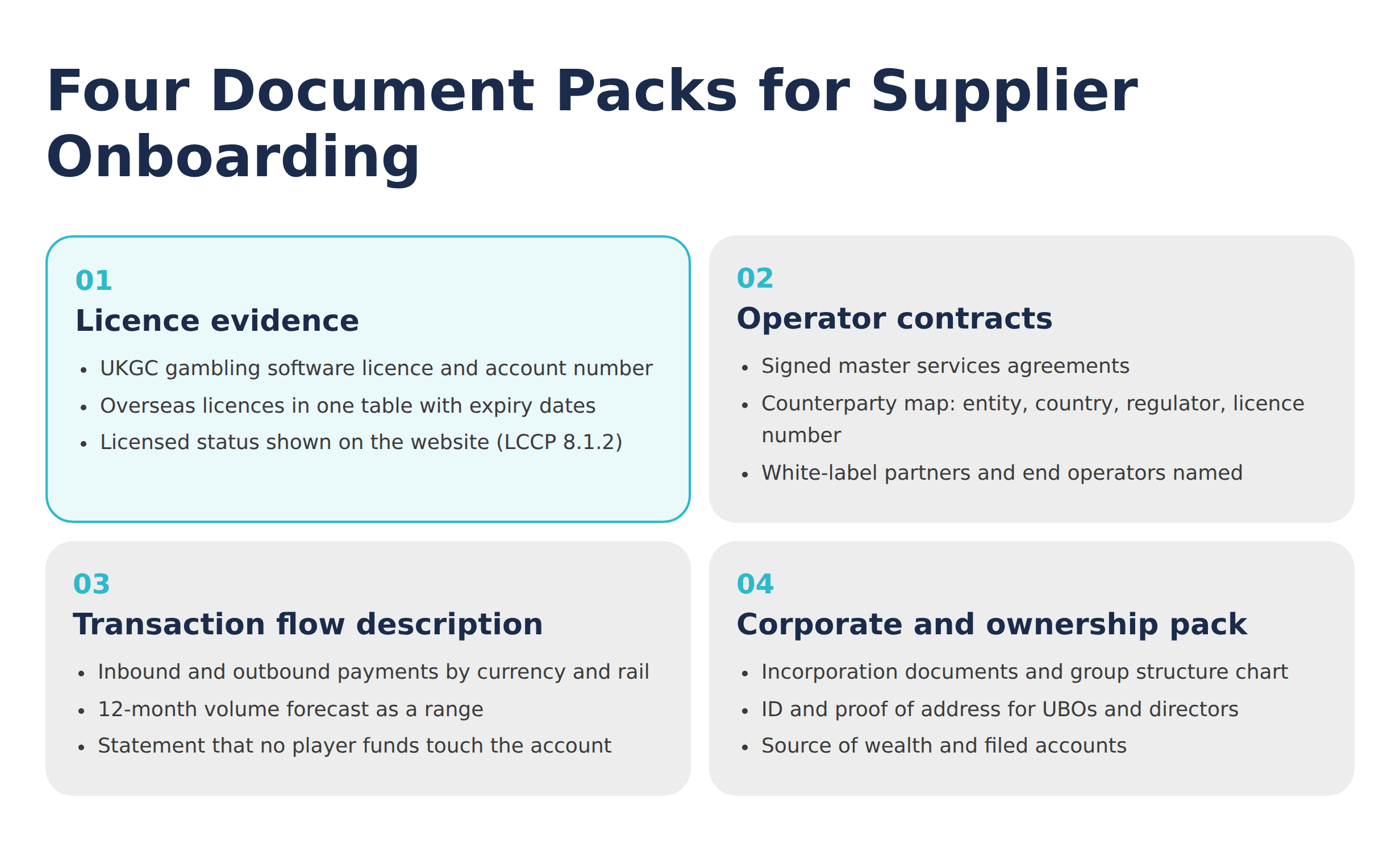
Four document packs decide the outcome: licence evidence, operator contracts, a transaction flow description and the corporate ownership pack.
The UKGC rated gambling software as medium risk in its 2026 assessment, and weak due diligence on third-party B2B partners is its top-rated vulnerability.
A counterparty map listing each operator's regulator and licence number answers most follow-up questions before they are asked.
A supplier that receives only B2B invoices, with no player funds, presents a different risk profile from an operator.
Card acquiring accounts serve player deposits and have no role in B2B fee collection.
[aa btn]Book a Call[/aa]
[/aa]
Can a Licensed Supplier Get a UK Payment Account for Licensed B2B Betting Technology Supplier Revenue?
Yes. A B2B betting technology supplier can open one when its application proves a valid gambling software licence, names regulated operators as the paying counterparties and forecasts monthly flows by currency. Compliance teams reject most files because a single element is missing. Sector alone seldom decides the outcome.
The legal starting point is section 41 of the Gambling Act 2005. It defines gambling software as computer software for use in connection with remote gambling. Commission guidance on what falls within that definition adds a detail many founders miss: the final supplier to a licensed operator needs an operating licence even when another company wrote the code.
What Providers Check First
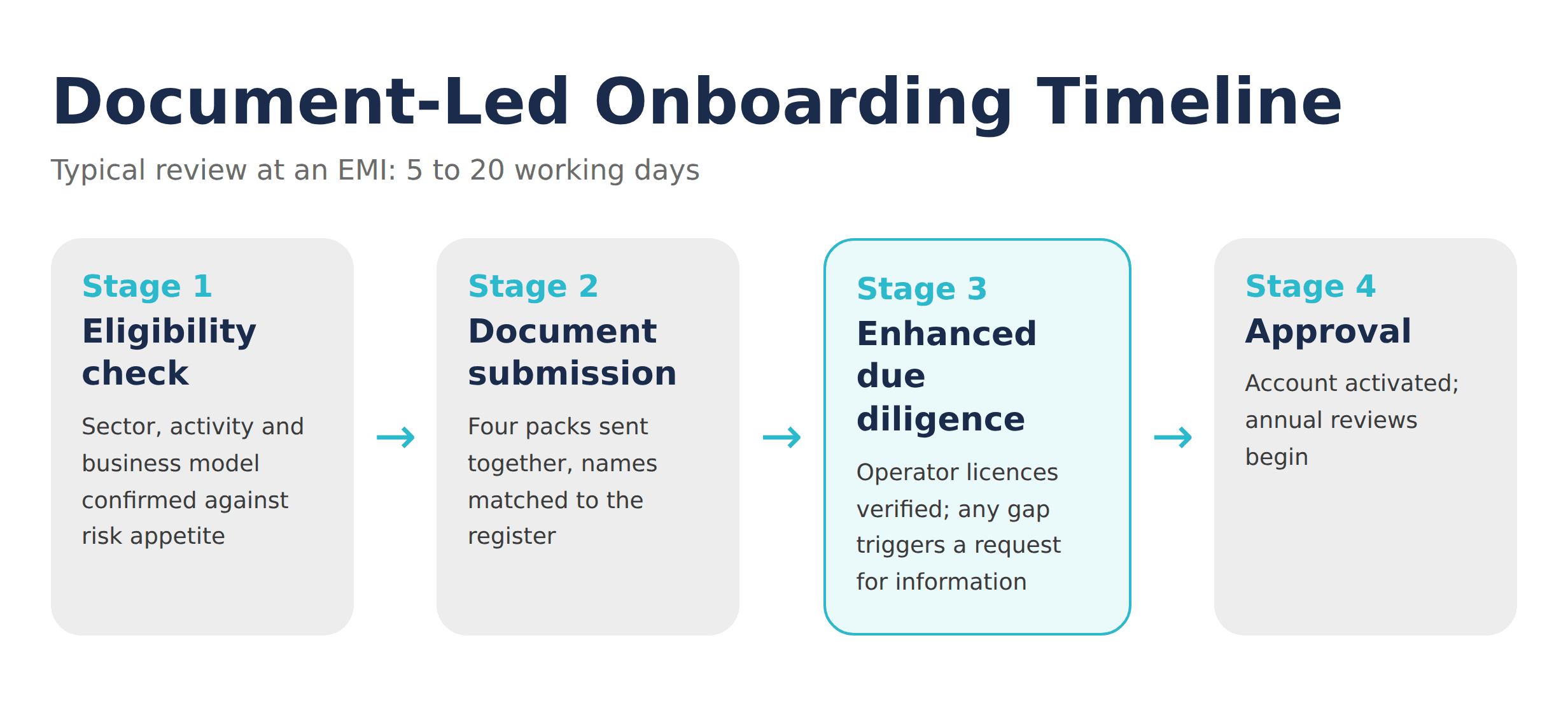
A compliance analyst opening a new supplier file usually runs four checks before reading anything else:
Sector and activity code, compared against the provider's own risk appetite.
Licence status on the regulator's public register, matched to the applicant's legal name.
Paying operators and their licence countries.
Owners above 25% and any foreign director.
Each check maps to enhanced due diligence under the Money Laundering Regulations 2017. A gap in any one of them sends the file back with a request for information, and each round restarts part of the review clock.
Why a High Risk Business Bank Account Is Not a Dead End
The label "high risk business bank account" describes how a provider reviews the file. It says nothing final about approval. High street banks often stop at the first check, because gambling sits on an internal exclusion list tied to the SIC code.
Electronic money institutions (EMIs) regulated by the FCA usually go further. Their teams assess the specific supplier and the operators it serves. That gap explains why many firms searching for a high risk business account UK option end up with an EMI instead of a clearing bank.
One caveat applies. Some EMIs exclude remote gambling entirely, including suppliers, so eligibility must be checked before any documents are sent. A high risk business bank account UK provider that accepts sportsbook operators may still refuse a white-label platform supplier, and the reverse also happens.
Step 1: Licence Evidence
The first document a provider asks for is the operating licence itself. For a British-facing supplier that means the UK Gambling Commission gambling software licence, with the account number printed on the certificate.
Analysts then verify it independently on the public register of licensed businesses. The legal entity name on the register must match the applicant's Companies House name character for character. A trading name on the licence and a holding company on the application is the single most common mismatch.
UKGC Gambling Software Licence and Other Regulators
Suppliers that also serve operators in Malta, Gibraltar, the Isle of Man or Ontario should include each of those licences in the same pack. Providers want one table showing regulator, licence number, expiry date and the entity that holds it.
LCCP condition 8.1.2 requires B2B licensees to display their licensed status and account number on any website offering their software. A reviewer will open the supplier's site and look for it. A missing footer statement costs nothing to fix and removes an easy objection.
[aa fast-fact]
Fast Fact: In its 2026 risk assessment the UK Gambling Commission rated inadequate due diligence on third-party business relationships as a High overall risk for the gambling software sector.
[/aa]
Step 2: Operator Contracts and Counterparty Map
The second pack proves who pays. Operators buying gambling platforms B2B pay through platform fees or GGR revenue share, and each of those contracts belongs in the file.
The 2026 UKGC assessment of the gambling software sector explains why. Its main concern is licensed suppliers ending up on illegal websites through resellers and white-label partners. A provider that banks the supplier inherits part of that exposure.
Evidencing Contracts With Operators Licensed Overseas
A counterparty map turns a stack of PDFs into something an analyst can check in ten minutes. It works best as a single spreadsheet with one row per operator:
Operator entity | Country | Regulator and licence number | Payment type | Currency | Expected monthly amount |
|---|---|---|---|---|---|
Operator A Ltd | Malta | MGA/B2C/xxx/2021 | GGR revenue share | EUR | €40,000–€60,000 |
Operator B plc | UK | UKGC 0000-0-000000 | Fixed platform fee | GBP | £25,000 |
Operator C Inc | Ontario | iGO registration | Integration fee | CAD | CA$15,000 one-off |
Signed master services agreements back each row, with fee schedules attached. Where a contract sits with a group entity and the invoice goes to a subsidiary, the map should show both names.
In practice, uk gaming supplier corporate payments that arrive from an entity absent from the map trigger an alert on day one. Adding a new operator to the map before its first payment prevents that.
Step 3: Transaction Flow Description
The third pack describes the money in motion. It is a two-page document, and most rejected files either skip it or keep it to one vague line.
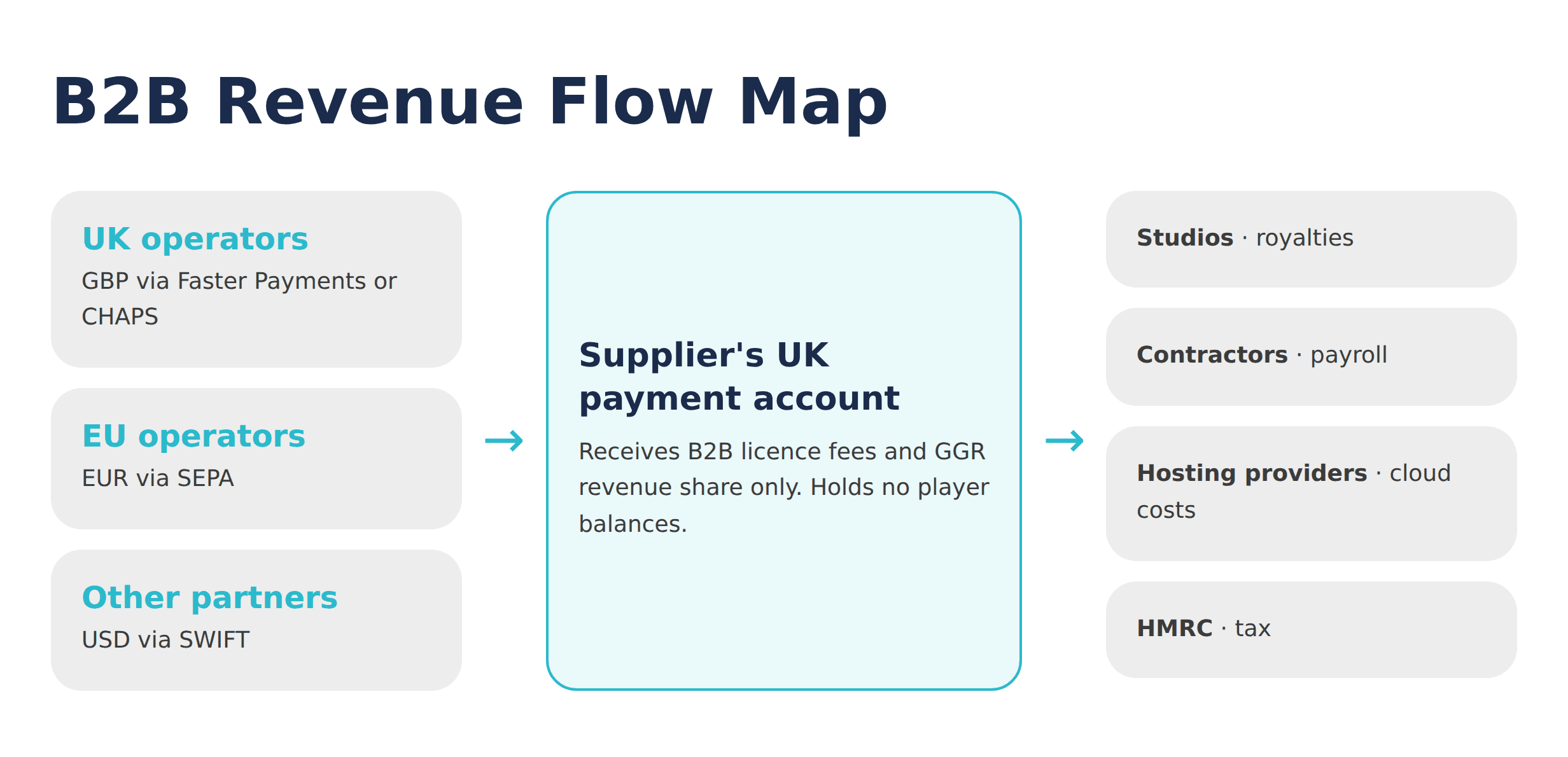
A useful flow description answers who sends funds, in which currency, how often and roughly how much. It also covers the outbound side: studio royalties, cloud hosting, contractor payroll and HMRC.
Currencies, Volumes and Rails
Each currency usually travels on its own rail. UK operators pay GBP over Faster Payments or CHAPS. EU operators settle EUR over SEPA, and USD income from Latin American or North American partners arrives by SWIFT.
Stating those routes up front matters more than it seems. An analyst who expects a EUR revenue-share payment on the 10th of each month will not flag it when it arrives.
Volume forecasts should cover 12 months and show a range. A platform supplier expecting £150,000 to £220,000 a month across 14 operators gives the provider a baseline for transaction monitoring. Unexplained spikes above that range are what trigger reviews later.
Founders who search for how to open bank account for a gambling project often assume the licence carries the application. The flow description carries at least as much weight, because it is the document the monitoring team keeps after approval.
The strongest single sentence in the pack is also the simplest: the account receives B2B invoices only and holds no player balances. Unlike igaming payment solutions built for operators, a supplier account never touches deposits or withdrawals.
[aa cta]
Bring a Complete Flow Map to the First Review
Eligibility comes first. EQWIRE business accounts support GBP and EUR, with SWIFT for other currencies, for companies within its acceptance policy.
[aa btn]Create Account[/aa]
[/aa]
Step 4: Corporate and Ownership Pack
The fourth pack is standard KYB, applied more strictly. It starts with the certificate of incorporation and articles of association. A group structure chart then traces ownership down to every ultimate beneficial owner (UBO).
For each UBO and director, providers ask for photo ID and proof of address issued within three months. Owners above 25% add a wealth statement. Where a founder funded the business from a previous exit, the sale agreement or a completion statement usually satisfies it.
Groups with shareholders abroad face extra questions, and the guide on UK accounts for groups with owners outside the UK lists the documents that apply. Companies incorporated in Gibraltar have a separate set of considerations, covered in the article on Gibraltar-registered companies.
The last item is financial. Two years of filed accounts, or management accounts for a younger company, let the provider test whether forecast volumes match actual turnover.
Common Reasons a Gambling Business Bank Account Application Stalls
Most stalled files fail on the same small set of issues. A gambling business bank account review at an EMI typically runs 5 to 20 working days, and these five problems account for most of the extra time:
The licence holder and the applying entity differ, with no explanation of the group link.
The operator list names brands but omits the legal entities and their licence numbers.
Forecast volumes jump from £20,000 to £400,000 a month without a signed contract to justify it.
Outbound payments go to jurisdictions that neither the flow description nor the contracts mention.
A white-label partner exists, and the end operator is unnamed.
Each one is fixable in a day. Left unaddressed, each one adds a full request-for-information cycle.
A supplier looking for a gambling industry business account UK firms can rely on should treat these five points as a pre-submission checklist. Running through it before applying costs an afternoon.
Gambling Bank Account Versus High Risk Merchant Account
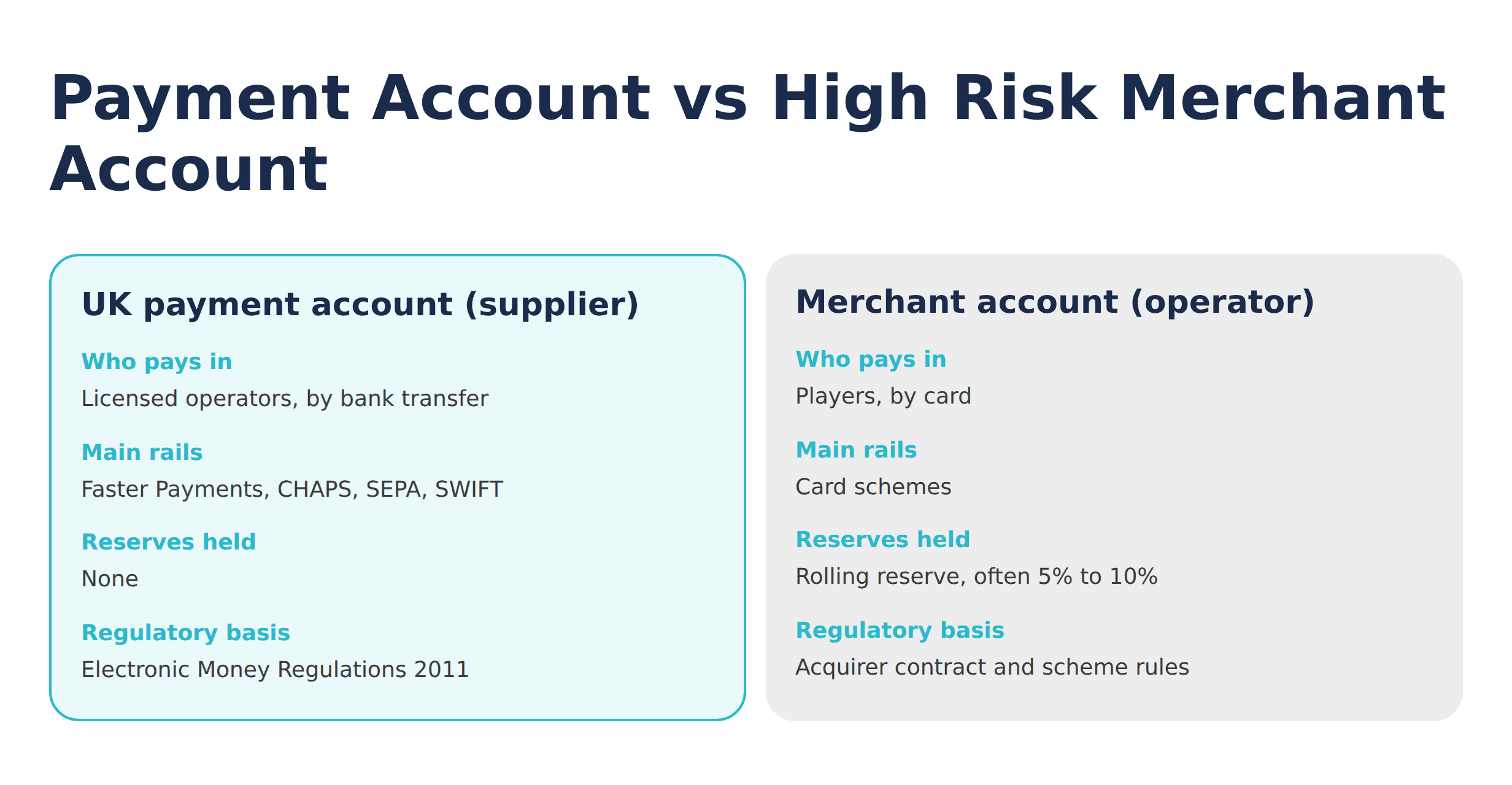
A gambling bank account for a supplier and a high risk merchant account for an operator solve different problems. Confusing them is a frequent reason suppliers apply for the wrong product.
This acquiring product lets an operator accept card deposits from players. An acquirer issues it under card scheme rules, usually with a chargeback reserve attached. A B2B supplier takes no card payments from the public.
Feature | UK payment account (supplier) | Merchant account (operator) |
|---|---|---|
Who pays in | Licensed operators, by bank transfer | Players, by card |
Main rails | Faster Payments, CHAPS, SEPA, SWIFT | Card schemes |
Reserves held | None | Rolling reserve, often 5% to 10% |
Regulatory basis | Electronic Money Regulations 2011 | Acquirer contract and scheme rules |
Many gambling payment solutions marketed online bundle both, and suppliers pay for acquiring they will never use. A product sheet mentioning "MID" or "chargeback" describes acquiring.
Running an International Business Account After Approval
Approval opens a monitoring relationship. Providers review high-risk files at least once a year, and a material change at the supplier can trigger an earlier review.
Three events should prompt a proactive update to the provider: a new operator in a new country, a licence renewal or variation, and a change in ownership above 10%. Sending the updated counterparty map with each one keeps the file current and payments moving.
An international business account also changes the cost picture. Holding EUR revenue in euros avoids converting every Malta or Dublin payment into sterling and back again when paying a Lisbon studio. Firms that also pay many overseas vendors can compare structures in the guide on paying global suppliers from one UK account. Platform vendors in adjacent verticals follow a similar process, described in the article for lottery technology vendors.
A UK payment account for licensed B2B betting technology supplier activity depends on four packs prepared before the first call, and on keeping them current afterwards. Acceptance rests with each provider's risk appetite, so eligibility is worth confirming first. EQWIRE operates as an FCA-authorised electronic money institution, and its regulated status and payment services are published in full.
FAQ
What licence and transaction flow documents should a B2B betting technology supplier prepare?
The core set is a gambling software licence plus a counterparty spreadsheet. A written description of expected money movements sits alongside them. Suppliers holding several permits put the UKGC certificate and every overseas approval into one table with expiry dates. The written description covers inbound and outbound payments by currency and rail, with a monthly range for the next 12 months. Signed master services agreements and a corporate ownership file complete the submission.
Can a licensed betting technology supplier open a UK payment account?
Yes, a licensed betting technology supplier can open a UK payment account, usually with an FCA-regulated electronic money institution. High street banks often refuse the sector. Approval depends on the provider's risk appetite, and some providers exclude all remote gambling activity. A complete document pack shortens review to between 5 and 20 working days in most cases reported by providers.
How do gaming suppliers evidence contracts with licensed operators overseas?
Gaming suppliers prove foreign deals by pairing each signed agreement with a one-page spreadsheet of paying customers. Every line of that spreadsheet records the customer's legal name, country, regulator, licence number, fee type and typical monthly amount in the invoice currency. Reviewers then look up those numbers on official registers, for example the Malta Gaming Authority's or the UK Gambling Commission's. Intermediaries such as white-label platforms belong on the sheet too, next to the end customer they serve.
Why are gambling technology firms treated as higher risk by UK payment providers?
Payment firms apply enhanced due diligence to this sector because money can move through several companies and countries before it reaches a supplier. Resellers and white-label arrangements make it harder to confirm who the end customer is. Under the Money Laundering Regulations 2017, a firm that cannot trace that chain must either collect more evidence or decline. The regulator's latest sector rating, published in summer 2026, raised the baseline further.
How to get a gambling licence UK?
A gambling licence in the UK comes from the UK Gambling Commission through an online operating licence application. B2B suppliers need a gambling software licence. The application asks for ownership details, financial information, policies and technical standards evidence. The Commission publishes the documents required for an operating licence application. Fees depend on the licence type and the applicant's gross gambling yield or turnover band.
Prepared suppliers finish onboarding in days instead of weeks. The licence, the operator map, the flow description and the ownership file do the persuading, and they also form the basis for every annual review that follows.
The July 2026 rating change will not be the last. Providers are likely to ask for refreshed operator lists more often, and a supplier that keeps its spreadsheet current can answer a periodic review in one email. Firms adding operators in Ontario, Brazil or other newly regulated markets should update the map before the first invoice leaves the building. The same four packs are the starting point for a conversation with any UK provider whose acceptance policy covers the supplier's activity.
Reviewed by
Related Articles
How to Document Expected Transaction Volumes for a UK Multi-Currency Account

UK Payment Account for a Company with Several Licensed Activities and One UK Entity
UK Payment Account for a Licensed B2B Betting Technology Supplier

UK Payment Account for an Online Lottery Technology Company with Cross-Border Vendors

Power your payments
with EQWIRE
Create your account in minutes and experience smooth, secure global payments.
" height="9.0156px" id="LIcbdboyB" transform="translate(4.987 4.5)" width="9.01562px"/></svg>)