•
•

Articles
UK Business Payment Account for a Multi-Jurisdiction Corporate Group with Non-UK UBOs
[aa disclaimer]
Legal Disclaimer: This article is for informational purposes only and does not constitute legal, financial, compliance, or tax advice. Banking eligibility and regulatory requirements vary by jurisdiction. Provider policies vary too. Consult qualified professionals before making decisions.
[/aa]
Corporate groups with a holding company in one jurisdiction and operating entities in two or three others routinely lose two to four weeks at the account-opening stage. The application itself is rarely the problem. A group waiting on funds that a stalled application blocks feels that delay directly, usually as a missed supplier deadline, not an abstract compliance inconvenience. Nobody prepared the ownership documentation before the request went in. A UK business payment account for a multi-jurisdiction group with non-UK UBOs requires the standard KYB pack any company submits, plus proof of who actually controls the business behind every entity in the structure. Residency does not exempt anyone from that check. This guide sets out what to prepare for each entity. It also covers a realistic timeline and the errors that cause applications to stall.
[aa key-takeaways]
Key Takeaways
Every entity in the group needs its own corporate document set — a UK EMI cannot rely on the holding company's paperwork to verify an operating subsidiary
UBOs are identified using the 25% control threshold, and each one needs identity and address verification regardless of residency
Missing ownership-chain documentation and untranslated or non-apostilled paperwork account for most delays past the first week
A realistic KYB timeline for a group with layered ownership runs two to three weeks once every document is submitted correctly the first time
Currency and IBAN setup for a multi-currency business account typically takes a few days once KYB clears
[aa btn]Book a Call[/aa]
[/aa]
Before You Apply: What to Prepare for Each Entity in the Group
Every entity in the structure needs its own paperwork. A single company-wide file will not satisfy a reviewer. A UK Electronic Money Institution (EMI) verifies every legal entity separately under the Money Laundering, Terrorist Financing and Transfer of Funds Regulations 2017. Enhanced due diligence applies automatically once ownership spans more than one country. The FCA expects providers to trace the chain of control all the way to a natural person, not stop at the first holding entity listed.
Layers of ownership are not always resolved to a named individual on day one. A holding company can sit under a trust, a fund, or another corporate vehicle registered in a third country, and a reviewer looks through each layer until a real person appears. Groups that map this chain internally before applying tend to submit a complete file on the first attempt.
Board resolutions and signatory authority round out the document set. A UK EMI will not activate an account without an authorised signatory tied to a verified director or UBO, named through that resolution. Centralising payment approval under one manager does not remove this step: verification still applies against every subsidiary that person represents.
Take a group structured as one holding company plus two operating subsidiaries in different countries. It needs three separate incorporation packs and three sets of shareholder registers, plus identity verification for every UBO across all three entities. Submitting only the holding company's paperwork is the single most common reason applications get sent back for more information. Non-resident directors face the same bottleneck.
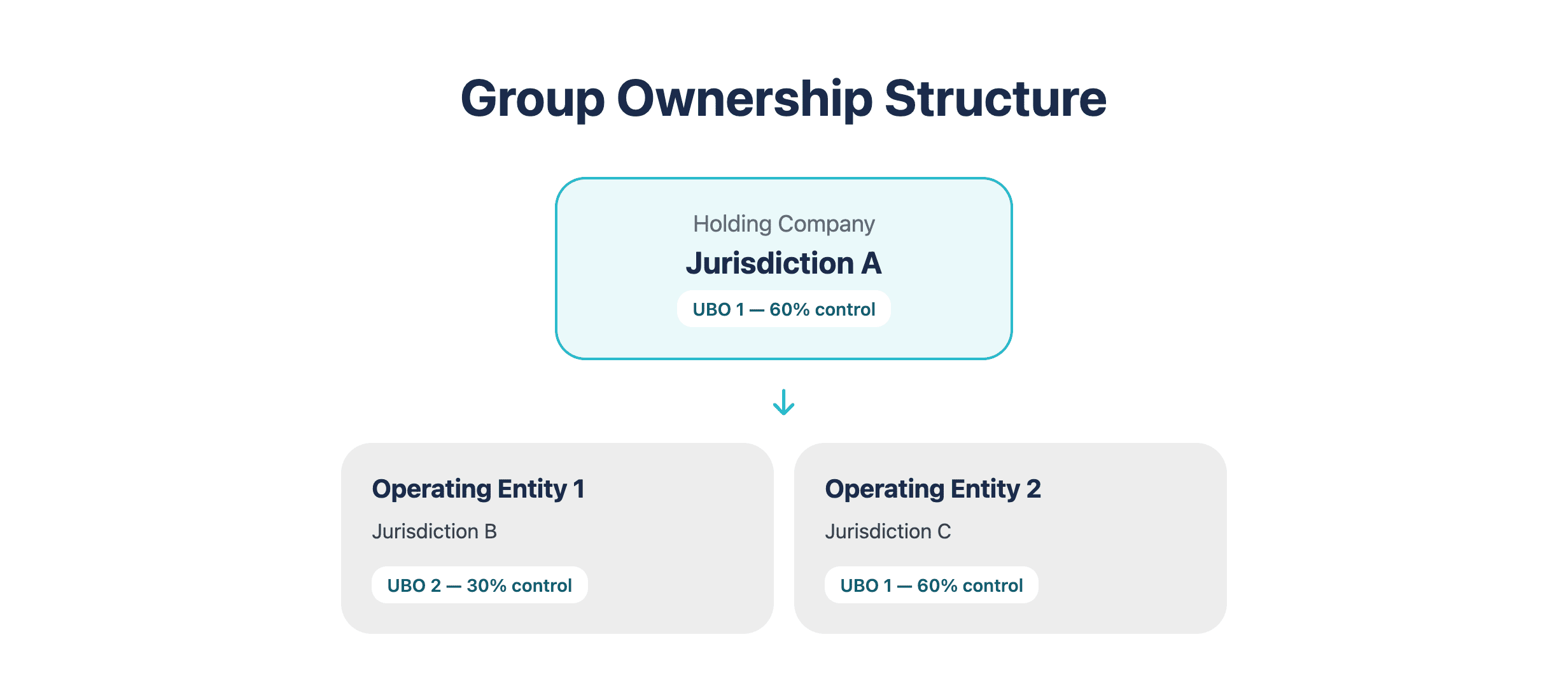
Corporate Documents per Jurisdiction
Each entity should have a certificate of incorporation and its current shareholder register. Articles of association need translation where the original is not in English. Some jurisdictions have no direct equivalent to the UK's Companies House register of people with significant control (PSC). In that case, the group submits a notarised ownership declaration signed by a director instead.
Kyb requirements uk applies equally to foreign entities. An EU company typically sits on a public register a UK reviewer can cross-check directly, cutting a step out of the process. Somewhere without that kind of register, common across parts of the Gulf and the Caribbean, a director's declaration confirming ownership stands in instead, adding three to five days to the timeline.
[aa fast-fact]
Fast Fact: Mandatory identity verification for every UK PSC took effect on 18 November 2025, run through this same register. Foreign UBOs have no equivalent to check against, which is exactly why a UK EMI collects the documentation itself.
[/aa]
UBO Identity and Address Documents
An ultimate beneficial owner holds 25% or more of a company's shares or voting rights, or otherwise exercises significant control over it. That definition holds regardless of nationality. Each UBO submits a certified passport copy and a proof of address dated within three months. Where a nominee shareholder sits between the company and the real owner, the group also submits a signed declaration naming the person actually in control.
Proof of address rules do not relax for a UBO living outside the UK. A recent utility bill, bank statement, or government-issued residency document, all dated within three months, satisfies the requirement regardless of country. A UBO whose only proof is older than that window needs a fresh document before the reviewer will accept the file.
Small discrepancies matter more than they might seem. A UBO holding shown as 24% on one document and 26% on another gets flagged as a mismatch requiring clarification, not treated as rounding. Keeping every entity's shareholder register updated to the same date before submission avoids that exact problem.

Step-by-Step: The KYB Timeline for a Multi-Jurisdiction Group
A group with a holding entity and two operating companies across different countries can expect kyb verification to run two to three weeks. That estimate assumes every document arrives complete on the first submission. The clock resets each time a reviewer has to request something missing, so front-loading the ownership-chain paperwork matters more than the application form itself. Opening a UK business payment account for a multi-jurisdiction group with non-UK UBOs is fundamentally a documentation exercise, and progress only happens once every record is correct.
Timeline length scales with structure size. Three companies spanning two jurisdictions typically clear in two to three weeks under normal conditions. A larger structure, six entities spread across four or five countries, should budget closer to a month, since each additional layer adds its own review pass.
Week 1 — Document Collection
The first week goes to gathering corporate documents per entity and identity documents per UBO. Filling in the application form takes a few minutes by comparison. Groups that assign one internal owner per jurisdiction to chase local paperwork tend to finish this stage in five to seven days. Groups that leave it to a single person usually take twice as long.

Week 2–3 — Verification and Follow-Up Requests
Once submitted, a reviewer cross-checks each entity's ownership chain against the documents provided and flags any gap directly with the applicant. A holding company in one jurisdiction plus operating entities in two others typically triggers one or two follow-up requests during this stage. Most of those requests ask for a missing apostille or an unclear ownership percentage. Responding within 48 hours keeps the file moving. A week of silence adds a week to the timeline. A request left unanswered for two weeks or more typically triggers a full file review instead of a simple reminder. Some providers close the application at that point, pending a fresh submission.
[aa cta]
Avoid a Second Round of KYB Requests
A document pack checked against every entity and UBO in the structure before submission is the fastest way through verification.
[aa btn]Create Account[/aa]
[/aa]
Common Reasons Applications Stall
Most delays in kyb requirements corporate group reviews trace back to one of two gaps: an incomplete ownership chain, or documents submitted in the wrong format entirely.
None of this is unique to one jurisdiction. A non uk ubo business account kyb review can hit the same wall in the UAE, Cyprus, Ireland or the UK, since the underlying requirement, a fully traceable ownership chain, does not change by geography.
Missing Ownership Chain Documentation
Reviewers need to see every layer between the holding company and each named UBO. Picture a group whose paperwork stops at the top: it submits that entity's shareholder register but omits the intermediate company connecting it to an operating subsidiary. That file gets returned. The JMLSG guidance used across UK financial institutions treats an incomplete chain as unverifiable, not simply incomplete.
A third gap shows up less often but costs just as much time: ownership percentages that do not match across documents. A shareholder register showing one UBO at 30% and a separate declaration showing 28% for the same person reads as an unresolved discrepancy. The file stops until the group clarifies which figure is current.
Untranslated or Non-Apostilled Documents
A certificate of incorporation issued outside the UK usually needs an apostille or a certified translation before a reviewer can accept it. Submitting the original alone is the single most common document-level rejection reason. Building translation and apostille steps into the timeline from day one avoids a two-week round trip later.

Setting Up the Multi Currency Business Account Once KYB Clears
Once KYB clears, a multi currency business account lets a group hold multiple currencies under one structure instead of opening a separate account per currency. Settlement then runs through dedicated IBANs, one per currency. A multi currency business account uk provider typically issues that IBAN per currency, so an operating entity paying suppliers in euros and collecting revenue in sterling avoids unnecessary conversion on either side.
Providers differ meaningfully past this point. Groups comparing options for the best multi currency business account uk should check settlement speed per currency corridor. They should also confirm whether iban accounts for business are issued per entity or shared across the group; the two setups carry different reconciliation overhead. A foreign currency account for business only pays off when trading volume in that currency justifies holding it. A documented source of funds record pays off again here, since providers reuse the same file to support ongoing transaction monitoring once the account is live.
Choosing Currencies and IBANs for Each Operating Entity
An international business account uk setup usually assigns one IBAN per active currency, using the ISO 20022 messaging standard that most UK and EU payment rails now run on. A group trading in three currencies needs at least three IBANs, mapped so each operating company's payments settle against the correct one. A Gibraltar holding structure faces the same currency-mapping decision. Cross-border tech groups covered in the Israel-UK multi-currency setup follow an identical pattern once verification clears.
Currency choice affects cost as well as convenience. Settling in the operating entity's local currency avoids the FX spread that applies whenever a payment converts through the group's base currency first. Supplier payments settled in euros against a GBP-denominated account absorb that cost on every transaction, which adds up across a full month of payment runs.
Access controls matter just as much as currency choice once several entities share the same infrastructure. A group with three operating companies typically assigns separate viewing and approval rights per entity, so a controller for one subsidiary cannot authorise payments from another without an explicit permission change.
Keeping the Account Compliant After Onboarding
KYB is not a one-time check. Ultimate beneficial owner kyb obligations continue for the life of the account. A UK EMI expects timely reporting of ownership changes and new directors, typically within a 30-day window.
Ongoing UBO Update Obligations
A group that adds a new UBO, or shifts its ownership split above the 25% threshold, needs to notify the provider proactively. Waiting for a periodic review to catch the change is the wrong sequence. A new director appointment counts too: the provider expects the same identity and address documents used at onboarding, submitted for that individual before they gain any authority over the account. The Payment Systems Regulator's framework requires providers to keep AML records current, and an unreported ownership change can freeze payment activity until the file is updated. Groups with layered ownership and non-UK UBOs face a stricter version of these kyb requirements with a greater focus on ubos simply because there are more moving parts to track.
Transaction monitoring runs on the same file collected at onboarding. A provider periodically checks account activity against the source of funds record gathered during KYB, and a pattern that no longer matches triggers a fresh request instead of an automatic block. Keeping it current costs far less than rebuilding it from scratch at a later review.
Requirements do vary by jurisdiction. Groups should confirm specifics with their own legal counsel alongside their account provider. The UK business payment account for a multi-jurisdiction group with non-UK UBOs that clears this process runs on the same rails as any standard UK account once it is live. The extra effort sits entirely upfront, in verification, before the first transaction ever moves.
FAQ
What ownership and transaction documents should an international group prepare for UK KYB?
Paperwork needs to match the group's actual structure, not just the top entity. Every operating company contributes its own incorporation record and shareholder listing, carried through a certified translator wherever the original sits in another language. Each named UBO adds passport-grade identification and a recent address check to that file. Where a jurisdiction has no equivalent to the UK's PSC register, a signed ownership declaration from a director fills that gap. Groups should also keep recent transaction records on hand, since reviewers often request a source of funds statement alongside everything else.
How does an EMI verify UBOs who live outside the UK?
How to verify ubo status for someone outside the UK comes down to the same core check an EMI runs on any UK-based owner: certified identity document, proof of address, and confirmation of the percentage of control held. The difference is documentary. A foreign UBO has no UK PSC register to reference, so the group supplies notarised or apostilled equivalents from the UBO's home jurisdiction instead. FCA-regulated providers apply the same 25% control rule no matter where a person lives.
What is a UBO?
A UBO, or ultimate beneficial owner, is the individual who ultimately owns or controls a company. What is ubo in kyc terms comes down to the same answer: 25% or more of shares or voting rights, or otherwise exercising significant influence over the entity. That person is not always the one named as director or listed shareholder, particularly where nominee arrangements sit between the company and its real controller. UK and EU AML rules require every regulated financial provider to identify and verify each UBO before opening a business account.
Can a group with layered ownership open a UK business account?
Yes, provided every layer of control between the parent entity and each UBO is documented. Verification simply takes longer than for a single company, often two to three weeks against a few days, because a reviewer confirms each layer individually. One missing link in that chain, not the number of entities itself, is what stops the file.
Why do complex ownership structures slow down business account onboarding?
Complex ownership structures slow onboarding because a UK EMI verifies every layer of control individually, and one incomplete step halts the whole file. Kyb requirements with a greater focus on ubos apply once ownership crosses borders, since foreign entities rarely have anything equivalent to the UK's PSC register to point to. The apostille or certified translation a paper needs before a reviewer will accept it is where most groups lose the extra week.
Groups that treat document preparation as the first milestone finish in weeks instead of months. A UK EMI holds every applicant to the same bar regardless of structure, so nothing here is special pleading; the account simply needs proof before it needs activity. Once that's on file, a multi-currency business account behaves like any standard UK account, with no further checks on routine payments. Extra paperwork now buys a stable account later, and that exchange is what every multi-jurisdiction group signs up for. Groups that budget the time for it upfront rarely think about KYB again once the account is live.
Reviewed by


Power your payments
with EQWIRE
Create your account in minutes and experience smooth, secure global payments.
" height="9.0156px" id="LIcbdboyB" transform="translate(4.987 4.5)" width="9.01562px"/></svg>)