•
•

Crypto and Web3 Companies: Multi-Currency Fiat Account for GBP, EUR and USD Settlement
[aa disclaimer]
Legal Disclaimer: This article is for informational purposes only and does not constitute legal, financial, compliance, or tax advice. Banking eligibility, regulatory requirements, and provider policies vary by jurisdiction. Consult qualified professionals before making decisions.
[/aa]
Crypto and Web3 companies solve custody first. Wallets get audited, keys get split across signers, and treasury policy covers every token the business touches. The fiat side usually gets solved last, often after a high-street bank closes the account following the first inbound payment from a trading venue. A crypto business account covers the part most teams postpone: where the company holds GBP for payroll, EUR for contractors, and USD for exchange settlement, and which payment rail moves each of those balances. This article explains what that infrastructure includes, how an electronic money institution differs from a bank and from an exchange balance, why most applications from Web3 firms get declined, and how a working settlement loop connects crypto revenue to outbound fiat payments.
[aa key-takeaways]
Key Takeaways
Crypto custody and fiat settlement run on separate infrastructure, and a corporate fiat account needs its own IBAN, sort code, and access to Faster Payments or SEPA.
An exchange balance functions as a trading position rather than a payment instrument, so payroll and vendor runs cannot originate from it.
Electronic money institutions hold client money under FCA safeguarding rules, and the strengthened CASS 15 regime has applied since 7 May 2026.
FSCS deposit protection rose to £120,000 per customer per firm on 1 December 2025, and safeguarded e-money sits under a narrower look-through arrangement rather than standard deposit cover.
Applications from crypto firms fail on evidence quality far more often than on eligibility, and source of funds documentation carries most of the weight.
[aa btn]Book a Call[/aa]
[/aa]
What a Crypto Business Account Actually Covers
A crypto business account is a corporate account that lets a company hold and move both cryptoassets and traditional currency under one operational structure. On the fiat side it provides named account details, an IBAN, and access to domestic and cross-border payment rails. In the United Kingdom the fiat leg sits with a bank or with a firm authorised by the Financial Conduct Authority (FCA).
That combination is what separates a working corporate setup from a wallet. The account has to accept an inbound settlement from a market maker on Monday and release a payroll batch on Tuesday, from the same balance, with a statement an auditor can read.
Three capabilities matter most in practice:
Named receiving details in each operating currency, so counterparties pay the company rather than a pooled address
Outbound access to local rails, so a GBP supplier payment does not route through an international network
A single transaction ledger covering every fiat movement, which is what year-end reporting depends on
Fiat Rails vs Crypto Custody: Two Separate Systems
Crypto custody and fiat settlement run on separate infrastructure. Custody answers who controls the private keys and how signing is authorised. Fiat settlement answers which scheme carries the payment, what account details the sender needs, and when the funds arrive.
Unlike a wallet address, a fiat account identifier is issued by a regulated institution and tied to a specific payment scheme. A UK sort code and account number reach the Faster Payments Service. An IBAN in euro reaches the SEPA area. Neither can be generated by the treasury team.
The practical consequence shows up in reconciliation. Blockchain movements carry a transaction hash, and fiat movements carry a reference plus a scheme identifier. Finance teams that never map one to the other spend every month closing the gap by hand.
Why an Exchange Balance Is Not an Operating Account
An exchange balance functions as a trading position, and a corporate operating account functions as a payment instrument. The distinction decides what the finance team can actually do with the money.
Most trading venues hold corporate fiat in a pooled account at a partner institution and release it only back to the account that funded it. Outbound payments to third parties are usually restricted or unavailable, which rules out salaries, invoices, and tax payments. Some venues offer safeguarding accounts for client fiat, though the terms vary by venue and by jurisdiction.
There is also concentration risk. Operating cash sitting on a venue is exposed to that venue's solvency and to its withdrawal policy during periods of market stress.
The Three Currencies a Web3 Company Cannot Avoid
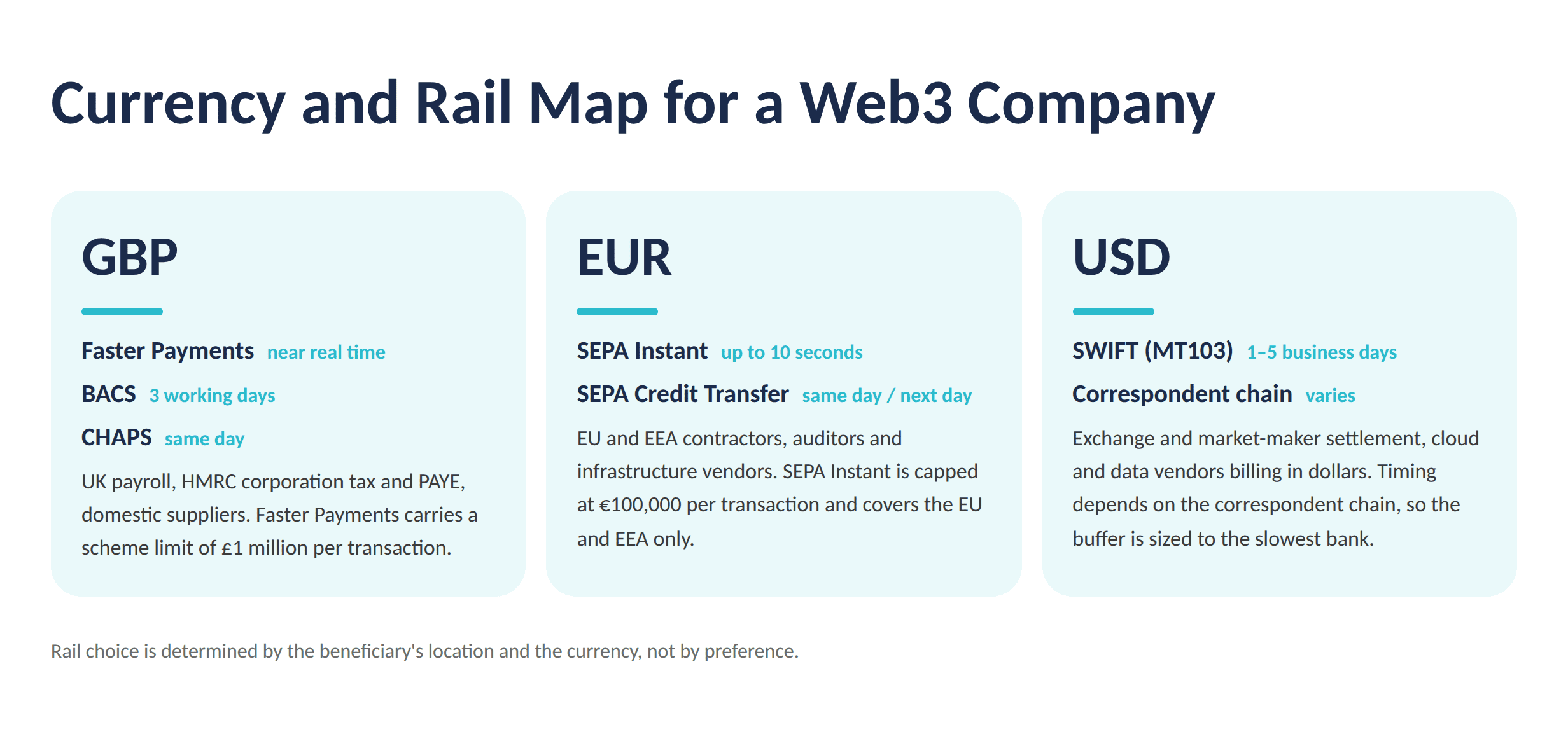
Three currencies account for most fiat movement in a UK or EU crypto business: GBP, EUR and USD. Each one travels on a different scheme, settles on a different timeline, and carries a different cost structure. A multi currency account holds all three in their original denomination, so conversion happens when the business chooses rather than on every receipt.
GBP for UK Payroll, HMRC and Domestic Suppliers
GBP obligations are the least flexible in the calendar. Salaries land on a fixed date, and Faster Payments settles domestic GBP transfers in near real time, with a scheme limit of £1 million per transaction. Corporation tax and PAYE payments to HM Revenue and Customs (HMRC) follow statutory deadlines that do not move for a delayed off-ramp.
Companies holding cryptoassets on the balance sheet also carry a GBP reporting obligation. The HMRC Cryptoassets Manual sets out how corporation tax applies to cryptoasset holdings and disposals, and every figure in that return is denominated in sterling.
Crypto payroll adds a second layer. Firms paying part of a salary in tokens still owe the sterling employment taxes on that value, so a funded GBP balance remains necessary even when compensation is partly on-chain.
EUR for SEPA Vendors and EU Contractors
Euro payments cover contractors, auditors, and infrastructure vendors across the European Economic Area. SEPA Instant Credit Transfer settles in up to 10 seconds, with a cap of €100,000 per transaction, and the European Central Bank publishes the framework for instant euro payments across the area.
Coverage is the limitation. SEPA reaches the EU and EEA only, so a euro payment to a supplier in Singapore still travels as an international transfer. SEPA and SWIFT differ on cost and settlement time, and the choice between them is determined by the beneficiary's location rather than by preference.
USD for Exchange Settlement and Market-Maker Flows
USD is where trading and liquidity relationships settle. Payments in dollars typically travel through SWIFT as an MT103 message, and settlement usually takes one to five business days depending on the correspondent chain. The Bank for International Settlements documents how correspondent banking arrangements shape cross-border settlement times.
That timing creates a working capital question. A market maker settling on T+2 while a payroll run leaves on T+0 means the company needs a funded buffer rather than a perfectly timed flow. In practice, finance teams size that buffer against the slowest correspondent in their payment chain.
Electronic Money Institution vs Bank vs Exchange Account
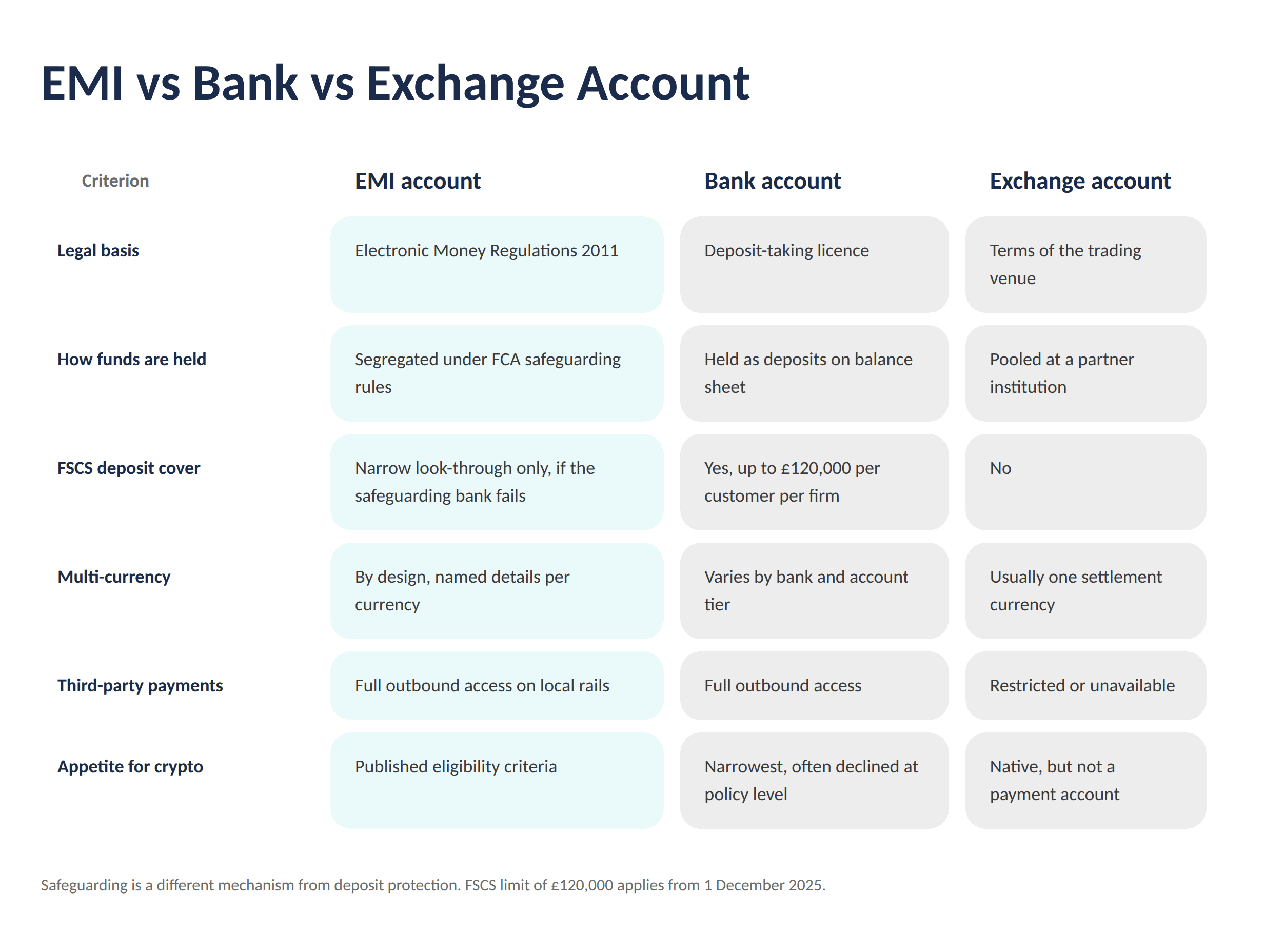
An electronic money institution (EMI) holds client funds under safeguarding rules, and a bank holds them as deposits. That single difference determines what happens to a crypto company's fiat balance if the provider fails, and it is the part most comparison articles skip.
EMIs in the United Kingdom operate under the Electronic Money Regulations 2011, with payment services governed by the Payment Services Regulations 2017. An EMI licence in the UK permits account issuance, IBANs, and access to payment schemes, and it does not permit lending against client balances.
The three account types compare like this:
EMI account: client money segregated under safeguarding rules, multi-currency by design, generally faster onboarding, no deposit lending
Bank account: funds held as deposits, eligible for FSCS protection, broader product range, strictest appetite on crypto exposure
Exchange account: balance tied to a trading relationship, limited or no third-party payments, no independent account identity
What Safeguarding Means for a Crypto Company's Fiat
Safeguarding requires the institution to keep client money separate from its own funds, usually in designated safeguarding accounts at a credit institution. The FCA strengthened this regime, and the CASS 15 safeguarding rules have applied to payment and e-money firms since 7 May 2026, adding reconciliation, record-keeping, and reporting obligations.
For a Web3 treasury account, the operational effect is transparency. The institution must be able to demonstrate, daily, that segregated balances match client entitlements.
[aa fast-fact]
Fast Fact: The FCA's strengthened safeguarding regime under CASS 15 has applied to UK payment and e-money institutions since 7 May 2026, introducing daily reconciliation and enhanced reporting requirements for client funds.
[/aa]
FSCS Deposit Protection and Why EMIs Sit Outside It
FSCS deposit protection covers money held with authorised banks, building societies, and credit unions. The protection limit rose to £120,000 per eligible customer per firm on 1 December 2025, with the temporary high balance limit at £1.4 million.
Safeguarded e-money sits under a narrower arrangement. Since the Prudential Regulation Authority amended its depositor protection rules in March 2023, the Financial Services Compensation Scheme (FSCS) can look through an EMI and compensate its end customers if the bank holding the safeguarded funds fails. That look-through does not extend to the failure of the EMI itself while its bank remains solvent, and it does not cover funds safeguarded through the investment method, the insurance method, or an account at a bank outside PRA authorisation.
Finance teams evaluating providers should therefore ask two specific questions: which method the institution uses to safeguard funds, and which credit institution holds the safeguarding account.
[aa cta]
Hold GBP, EUR and USD Under One Regulated Account
EQWIRE issues multi-currency accounts with named details in each currency, so crypto and Web3 companies can receive settlement and pay teams without forced conversion.
[aa btn]Create Account[/aa]
[/aa]
Crypto Friendly Banks UK: Why Most Applications Fail
Most applications from crypto and Web3 companies fail on evidence, not on eligibility. Compliance teams rarely decline a business because it touches digital assets. They decline because the file does not let them trace where the money came from.
The market splits into three tiers. High-street banks maintain the narrowest appetite and often decline crypto exposure at the policy level. Challenger banks assess case by case. Regulated payment institutions and EMIs sit in the middle, with published eligibility criteria and specialist onboarding. Providers such as Coinpass and Banxe target this segment directly, and comparison of any crypto friendly bank account should start with the licence type rather than the feature list.
Firms searching for crypto friendly banks uk also need to check one prerequisite. A UK business carrying out cryptoasset activity must be registered with the FCA under the money laundering regulations, and the cryptoasset AML and CTF regime sets out that requirement. Applying for a bank account for crypto business without that registration in place ends most conversations early.
What Compliance Teams Check Before Approving a Web3 Firm
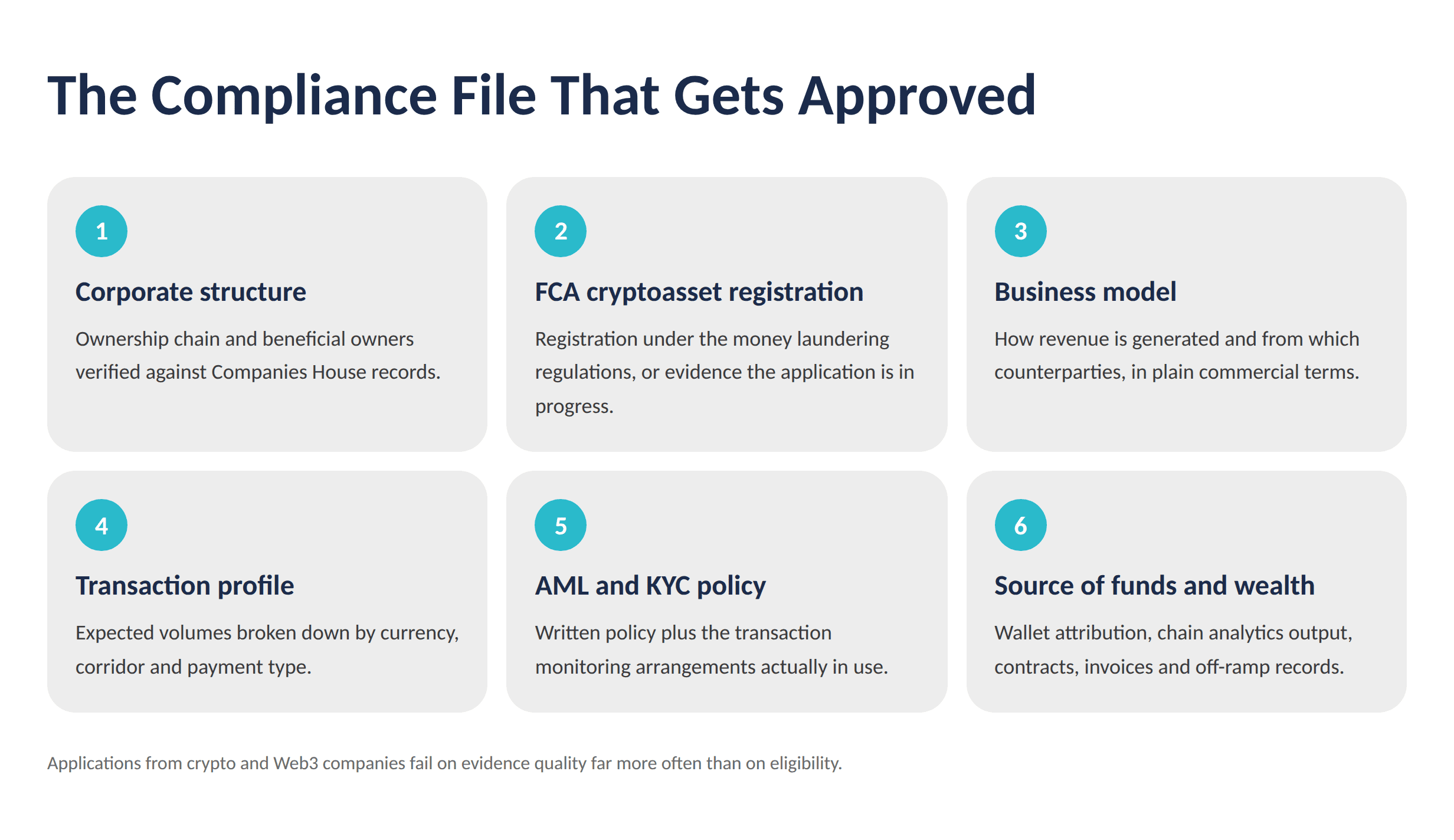
Compliance review follows a consistent shape across UK providers. Six document groups carry the decision:
Corporate structure, including ownership chain and beneficial owners verified against Companies House records
FCA cryptoasset registration, or evidence of the application in progress
Business model description covering how revenue is generated and from which counterparties
Expected transaction profile by currency, volume, and corridor
AML and KYC policy, including transaction monitoring arrangements
Source of funds and source of wealth evidence for the opening balance and expected inflows
Firms operating in the European Union face an additional dimension, since the Markets in Cryptoassets Regulation (MiCA) framework shapes how an EU counterparty is assessed. The FCA maintains its own published expectations for firms handling cryptoassets.
Source of Funds Evidence for Crypto Revenue
Source of funds is where crypto-native businesses lose the most time. A company invoicing in USDC cannot produce a conventional bank statement showing the revenue, so the file has to reconstruct the chain differently.
Providers typically expect wallet addresses attributed to the company, blockchain analytics output from a tool such as Chainalysis, and the commercial documents behind each flow. In practice, a firm with £400,000 of annual USDC revenue from four clients will be asked for the contracts, the invoices, the receiving addresses, and the off-ramp records that connect them. Preparing source of funds documentation before applying shortens the review considerably.
Building the Settlement Loop: From Crypto Revenue to Fiat Payout
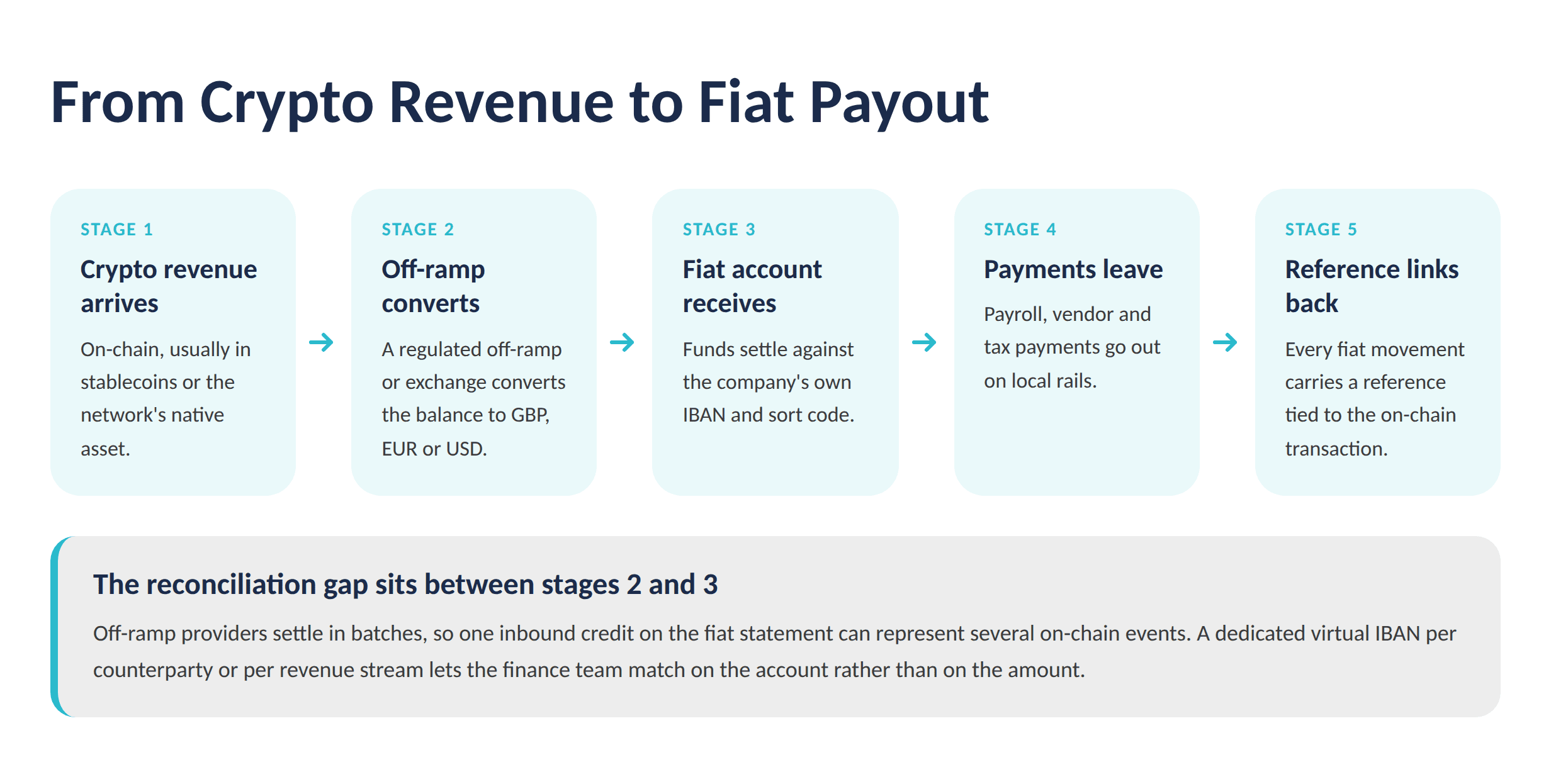
The settlement loop has four stages: crypto revenue arrives, an off-ramp converts it, a fiat account receives it, and outbound payments leave from that balance. Designing it as one process rather than four disconnected steps is what removes the manual work at month end.
A functioning loop follows this order:
Revenue arrives on-chain, usually in stablecoins or in the network's native asset
An off ramp crypto provider or exchange converts the balance to GBP, EUR, or USD
Converted funds settle into the company's fiat account against its own account details
Payroll, vendor, and tax payments leave from that account on local rails
Every movement carries a reference that links the fiat leg back to the on-chain transaction
Off-Ramp, IBAN and the Reconciliation Gap
The reconciliation gap opens between stage two and stage three. Off-ramp providers settle in batches, and a single payout often bundles several conversions, so one inbound credit on the fiat statement corresponds to multiple on-chain events.
A virtual IBAN reduces the problem structurally. Issuing a dedicated virtual IBAN per counterparty or per revenue stream means the inbound credit identifies its own source, and the finance team matches on the account rather than on the amount. A company processing 200 inbound settlements a month from three off-ramp partners can allocate them automatically once each partner pays into its own identifier.
Stablecoin payments introduce one further check. Conversion rate and timing are recorded at the off-ramp, and that record is what supports the sterling figures in the statutory accounts.
Multi-Currency Business Account UK Setup for a Web3 Treasury
Setting up a multi currency business account uk for a Web3 operation follows the same sequence as any corporate onboarding, with the compliance file doing more work. Application, verification, and account issuance typically run in that order, and timelines vary by provider and by the completeness of the documentation.
Structure matters as much as speed. A corporate fiat account should separate operating cash from treasury reserves, keep each currency in its own balance, and give the accounting team read access without payment rights. Companies paying a distributed team across currencies usually add a dedicated payroll balance so a delayed off-ramp never touches salary funds. Groups holding assets through an offshore entity may also need a multi-currency account for a non-UK holding structure alongside the UK operating account.
One honest caveat applies. A company with modest fiat turnover in a single currency may find a challenger bank account cheaper and simpler than a specialist corporate crypto account, and the case for a regulated payment institution strengthens as currencies, corridors, and counterparties multiply.
FAQ
How to withdraw crypto to a bank account
Withdrawing crypto to a bank account requires an off-ramp that converts the asset to fiat and then sends the proceeds to named account details. The sequence is consistent across providers: the company sells or converts the cryptoasset on a regulated exchange or off-ramp service, the platform credits the fiat balance, and the company instructs a withdrawal to its own account. Settlement then depends on the currency. A GBP withdrawal to a UK account usually arrives through the Faster Payments Service within minutes. A euro withdrawal within the SEPA area settles same day or next day, and SEPA Instant Credit Transfer completes in up to 10 seconds where both institutions support it. A USD withdrawal typically travels through SWIFT and takes one to five business days. Companies asking how to withdraw crypto to bank account uk should also confirm that the receiving account is held in the same legal name as the exchange account, because name mismatches are the most common cause of rejected payouts. Withdrawal limits, verification tiers, and fees vary by platform, and the off-ramp record should be retained for tax reporting.
How to move crypto to a bank account for a company
Moving crypto to a bank account as a company involves the same conversion mechanics as a personal withdrawal, with corporate verification added at both ends. The company needs a corporate account on the off-ramp platform, verified against its ownership structure, and a corporate fiat account able to receive the payout. Payouts to a director's personal account create an audit problem and are usually blocked by the platform. Larger conversions may trigger additional review, and providers often ask for the commercial background of the transaction before releasing funds. Finance teams handling regular flows typically schedule conversions rather than converting on demand, which makes the fiat arrival predictable against payroll and vendor dates.
How to open a crypto business account in the UK
Opening a corporate crypto account in the UK starts with registration rather than with the account application. A business carrying out cryptoasset activity must be registered with the Financial Conduct Authority under the money laundering regulations, and providers check that status early. The application then requires corporate documents, verified beneficial ownership against Companies House, a description of the business model, an expected transaction profile by currency and corridor, AML and KYC policies, and source of funds evidence. Providers assess the completeness of that file more than the industry itself. Firms comparing options should confirm the licence type, the safeguarding method, and which currencies come with named receiving details rather than relying on a feature comparison.
How to open a business crypto account without a UK entity
Opening a business crypto account without a UK entity is possible with several regulated providers, though eligibility depends on the jurisdiction of incorporation. Non-UK companies are assessed against the provider's accepted country list, the risk rating of their sector, and whether any UK or EU operating presence exists. Providers generally require the same document set as for a UK company, with certified translations and apostilled corporate records where applicable. Some jurisdictions are excluded outright by policy. Groups incorporated offshore often open the payment account in the name of a UK or EU subsidiary while the parent holds the assets, which keeps the operating account on local rails.
Is an EMI account safe for a crypto company's fiat balance
An EMI account holds client money under FCA safeguarding rules, which requires segregation from the institution's own funds and, since 7 May 2026, daily reconciliation under the CASS 15 regime. Safeguarding is a different mechanism from deposit protection. FSCS cover applies to deposits with authorised banks up to £120,000 per eligible customer per firm as of 1 December 2025, and safeguarded e-money benefits from a narrower look-through arrangement that pays out if the bank holding the safeguarded funds fails. It does not cover the failure of the EMI itself while that bank remains solvent. Companies asking how do i cash out crypto to my uk bank account and where the resulting balance should sit are really asking about that distinction. The practical answer is to confirm the safeguarding method, identify the credit institution holding the safeguarding account, and keep balances above the operating requirement with a deposit-taking institution where deposit cover matters.
Crypto and Web3 companies that treat fiat as a separate system stop losing time to closed accounts and manual reconciliation. The fiat leg needs its own account identity in each currency, a rail chosen per payment type, a compliance file built before the application, and a settlement loop that links on-chain revenue to outbound payments without a spreadsheet in the middle. Regulatory expectations continue to tighten, with the CASS 15 safeguarding regime in force and EU cryptoasset rules maturing under MiCA, so the providers a company selects now will be assessed against a higher standard than a year ago. For finance teams weighing an electronic money institution against a bank, the deciding detail is usually the protection mechanism, and EQWIRE documents how safeguarding works under FCA rules for exactly that comparison. A well-structured crypto business account turns fiat from a recurring obstacle into ordinary operations.

Power your payments
with EQWIRE
Create your account in minutes and experience smooth, secure global payments.
" height="9.0156px" id="LIcbdboyB" transform="translate(4.987 4.5)" width="9.01562px"/></svg>)