•
•

Articles
Source of Funds for Business Account Opening: What Documents You Need
[aa disclaimer]
Legal Disclaimer: This article is for informational purposes only and does not constitute legal, financial, compliance, or tax advice. Banking eligibility, regulatory requirements, and provider policies vary by jurisdiction. Consult qualified professionals before making decisions.
[/aa]
Every FCA-authorised electronic money institution asks one question before it activates a business account: where does this money come from? Files with a documented answer clear review in days. Files without one stall in compliance, and onboarding stays frozen until the gap closes.
This guide covers the source of funds documents business account opening at a UK EMI requires, from bank statements and client contracts to the UBO-level evidence offshore companies provide under enhanced due diligence. The requirement comes from the Money Laundering Regulations 2017 rather than provider policy, so no applicant can negotiate around it.
For CFOs and finance managers, preparation decides the timeline. A complete pack moves KYB review through in 1–3 business days. An improvised one can add weeks of lost banking access.
[aa key-takeaways]
Key Takeaways
Source of funds verification is a legal duty under the Money Laundering Regulations 2017, and every FCA-authorised EMI applies it before activating an account.
Source of funds covers the specific money entering the account; source of wealth explains how the owners built their overall assets. The two checks need different documents.
The core evidence set depends on funding origin: recent bank statements plus the contracts or agreements behind each major inflow.
Offshore companies go through enhanced due diligence, which adds UBO-level evidence, from ownership declarations to structure charts.
A complete document pack cuts KYB review from 5–10 business days to 1–3.
[aa btn]Book a Call[/aa]
[/aa]
What Source of Funds Means in UK Account Opening
Source of funds refers to the origin of the specific money a company deposits and moves through a business account. In UK account opening, the term covers the immediate sending account and the underlying activity that generated the balance, such as sales or an investment round.
A compliance reviewer needs the full trail. Knowing that £250,000 arrived from a shareholder is half the answer; the file must also show where the shareholder obtained it.
For applicants, this shifts the task from proving a balance to documenting a history. Account screenshots show what a company holds. Source of funds evidence shows how the money got there.
Source of funds vs source of wealth
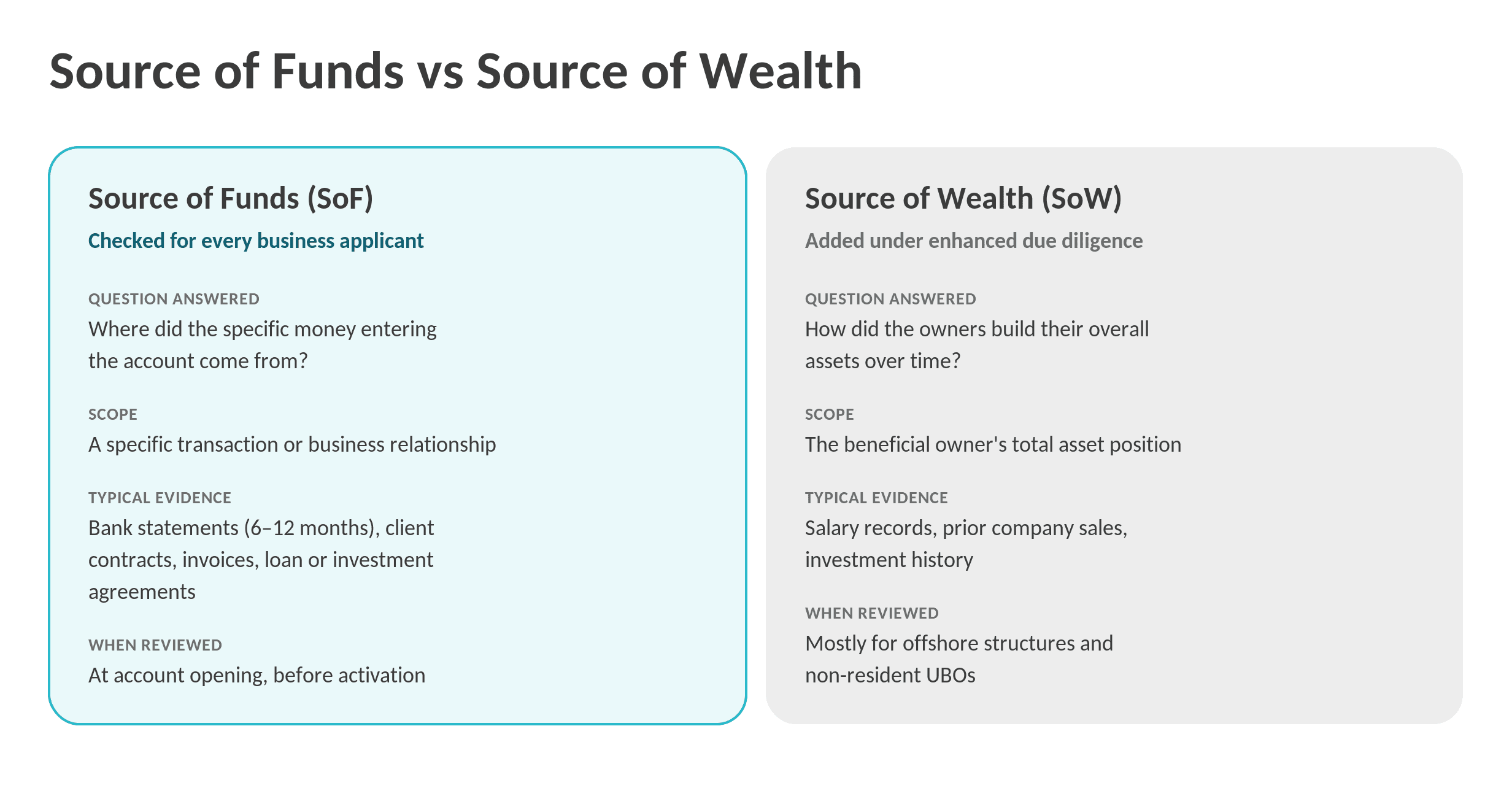
The key difference between source of funds and source of wealth is scope. Source of funds (SoF) explains the origin of the money in a specific transaction or business relationship. Source of wealth (SoW) explains how a person or company accumulated its overall assets over time. HMRC's anti-money-laundering guidance draws this exact distinction for supervised firms.
In practice, a UK EMI reviewing a company application starts with SoF. SoW enters the file when enhanced due diligence applies, most often for offshore structures with non-resident beneficial owners.
Confusing the two wastes review cycles. Sending a director's ten-year wealth summary when the reviewer asked for last quarter's inflow evidence answers the wrong question.
The legal basis: MLR 2017 and FCA expectations
Under the Money Laundering Regulations 2017, UK banks and EMIs count as relevant persons and must complete customer due diligence before establishing a business relationship. Regulation 28 sets the core duties:
identify the customer and verify its identity
identify the beneficial owners who ultimately control the company
assess the purpose and intended nature of the business relationship, obtaining supporting information where needed
The FCA supervises how authorised firms apply these rules. An EMI that activates accounts without credible source of funds verification risks its authorisation. No compliance team treats the step as optional, whatever the commercial pressure to onboard faster.
What this means in practice: the checks are identical in legal basis across providers, whether the application goes to a high-street bank or an FCA-authorised EMI. What varies is risk appetite, and that decides how much evidence a given applicant profile must supply.
Source of Funds Documents Business Account Opening at a UK EMI Requires
The document set depends on where the money originates. Most UK EMIs ask for:
Business bank statements covering the last 6–12 months
Client contracts and invoices behind major inflows
Investment agreements with proof of investor funds
Loan agreements for director or shareholder financing
Sale contracts or completion statements for asset disposals
A UBO declaration where ownership sits offshore
One list rarely fits every applicant. Reviewers match evidence to the company's actual funding story, so the sections below break the pack down by origin.

Documents for trading revenue
Companies funded by their own sales prove it with the operational paper trail. Statements from the previous banking provider carry the most weight, ideally showing 6–12 months of inflows that match declared activity.
Supporting evidence strengthens the picture:
signed client contracts for recurring revenue
recent invoices matching statement credits
settlement reports for businesses paid through a PSP such as Stripe
A UK e-commerce company applying with six months of settlement reports and matching statements gives a reviewer a closed loop. Nothing needs explaining, so nothing gets queried.
Documents for investment and shareholder capital
Investment-funded companies document the round itself. A share purchase agreement or convertible note shows the legal basis of the inflow. The cap table confirms who invested and at what stake.
EMIs often look one layer deeper and request proof of the investor's own funds, especially for large single inflows. A statement from the investor's account showing the outbound transfer usually settles the question.
Newly incorporated companies fall into this category by default. With no trading history, the shareholders' evidence is the source of funds, and proof of funds for the business account rests on personal or corporate investor documents.
Documents for director loans and asset sales
Director loans need a signed loan agreement plus the director's personal bank statement showing the funds leaving their account. Reviewers also check that the personal balance has a plausible origin, such as salary history or a property sale.
Asset disposals follow the same logic. A completion statement from a solicitor documents a property sale. A sale-and-purchase agreement covers equipment or a business unit changing hands.
[aa fast-fact]
Fast Fact: UK AML rules set no fixed statutory lookback period for source of funds. HMRC guidance expects firms to trace evidence as far back as needed to explain the specific money involved, which in practice means 6–12 months of statements for most applicants.
[/aa]
How a UK EMI Reviews Source of Funds During KYB
Source of funds review is one stage of KYB, the business-side counterpart of KYC. The KYB documents UK providers collect cover the company first and the money second, and the two strands run in parallel.
Where SoF sits in the onboarding flow
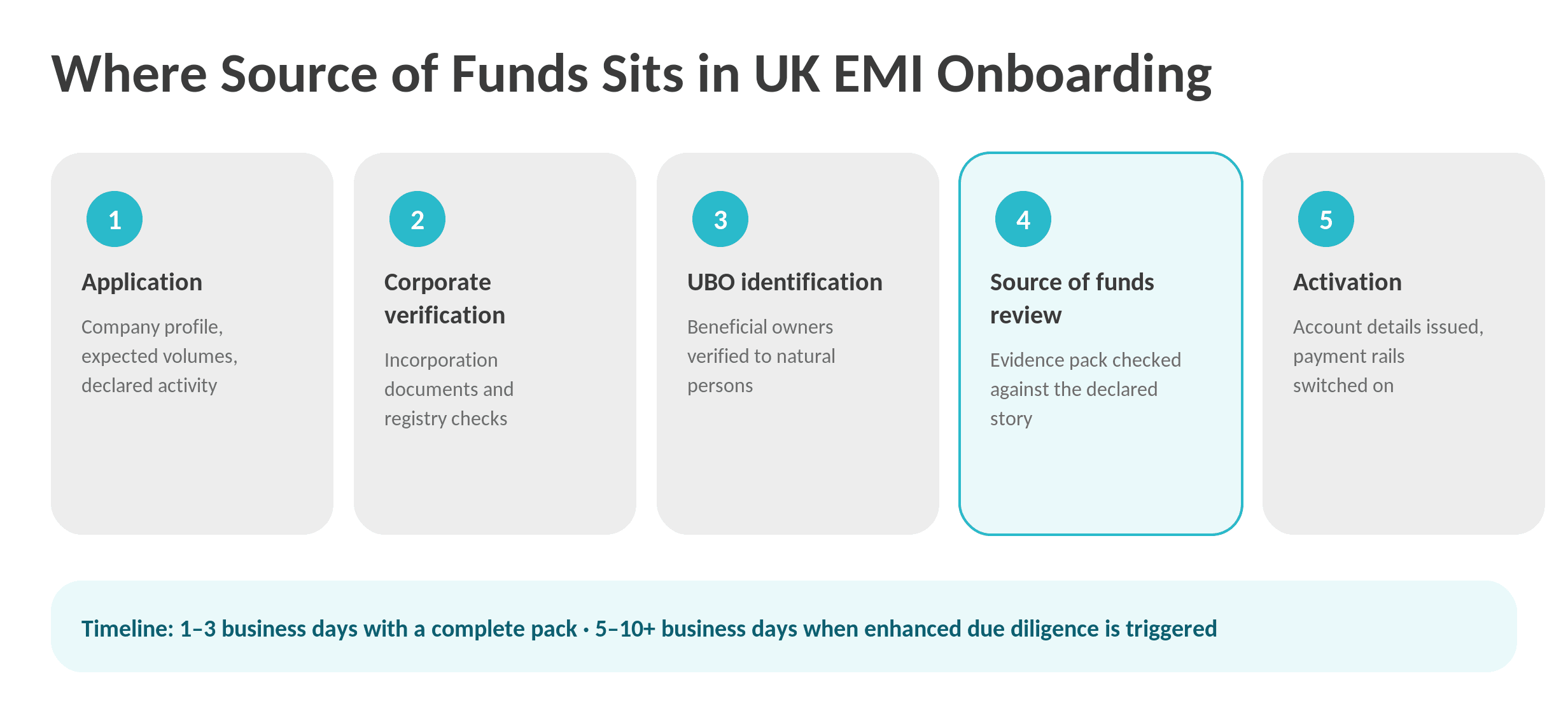
A typical FCA EMI onboarding sequence runs:
Application: company profile, expected volumes, declared activity
Corporate verification: incorporation documents and registry checks
UBO identification: beneficial owners verified to natural persons
Source of funds review: the evidence pack against the declared story
Activation: account details issued and payment rails switched on
EQWIRE runs these stages as a single digital KYC and KYB onboarding flow, so applicants see the full document checklist before the review starts.
For straightforward UK companies with complete packs, the cycle takes 1–3 business days. Enhanced due diligence extends it to 5–10 business days or longer, and every follow-up document request restarts part of the clock.
What compliance teams look for in the narrative
A source-of-funds narrative is a short written explanation connecting the documents to the expected account activity. Reviewers read it for:
coherence: every major inflow has a matching document
consistency: the money's origin fits the declared business activity
plausibility: volumes match the company's size and market
Weak narratives sink more applications than missing paperwork does. A reviewer who understands why GBP flows are commercially expected approves faster than one left to reconstruct the logic alone. AML checks for business accounts reward applicants who explain, rather than merely attach.
[aa cta]
Open a UK Business Account With Documents Ready
EQWIRE onboards UK and offshore companies with a clear source-of-funds checklist upfront, so KYB review starts from a complete file instead of a document chase.
[aa btn]Start Onboarding[/aa]
[/aa]
Source of Funds for Offshore Companies: Enhanced Due Diligence
Offshore companies opening a UK EMI account go through enhanced due diligence (EDD), the deeper review Regulation 33 of MLR 2017 requires when higher-risk factors appear. For source of funds KYB at a UK EMI, an offshore company should expect every layer of its ownership to be evidenced down to natural persons.
Why offshore structures trigger EDD
Corporate registries in jurisdictions such as the BVI publish limited ownership data. FATF standards on beneficial ownership push regulated firms to verify UBOs independently when public records cannot. The trigger is opacity, and EDD compensates for it with documents.
Non-resident directors, layered holding structures and nominee arrangements each raise the risk score further. None of them blocks an application on its own. Each one adds evidence the pack must contain.
Mainstream fintechs often decline offshore applicants at this point. Specialist FCA EMIs accept offshore companies and run the deeper review instead, a one-time cost that opens access to UK banking infrastructure. EQWIRE, as an FCA-authorised EMI, onboards entities registered in BVI, Cayman, Seychelles, Bermuda and the UAE through exactly this route.
Additional documents for BVI, Cayman, Seychelles and similar jurisdictions
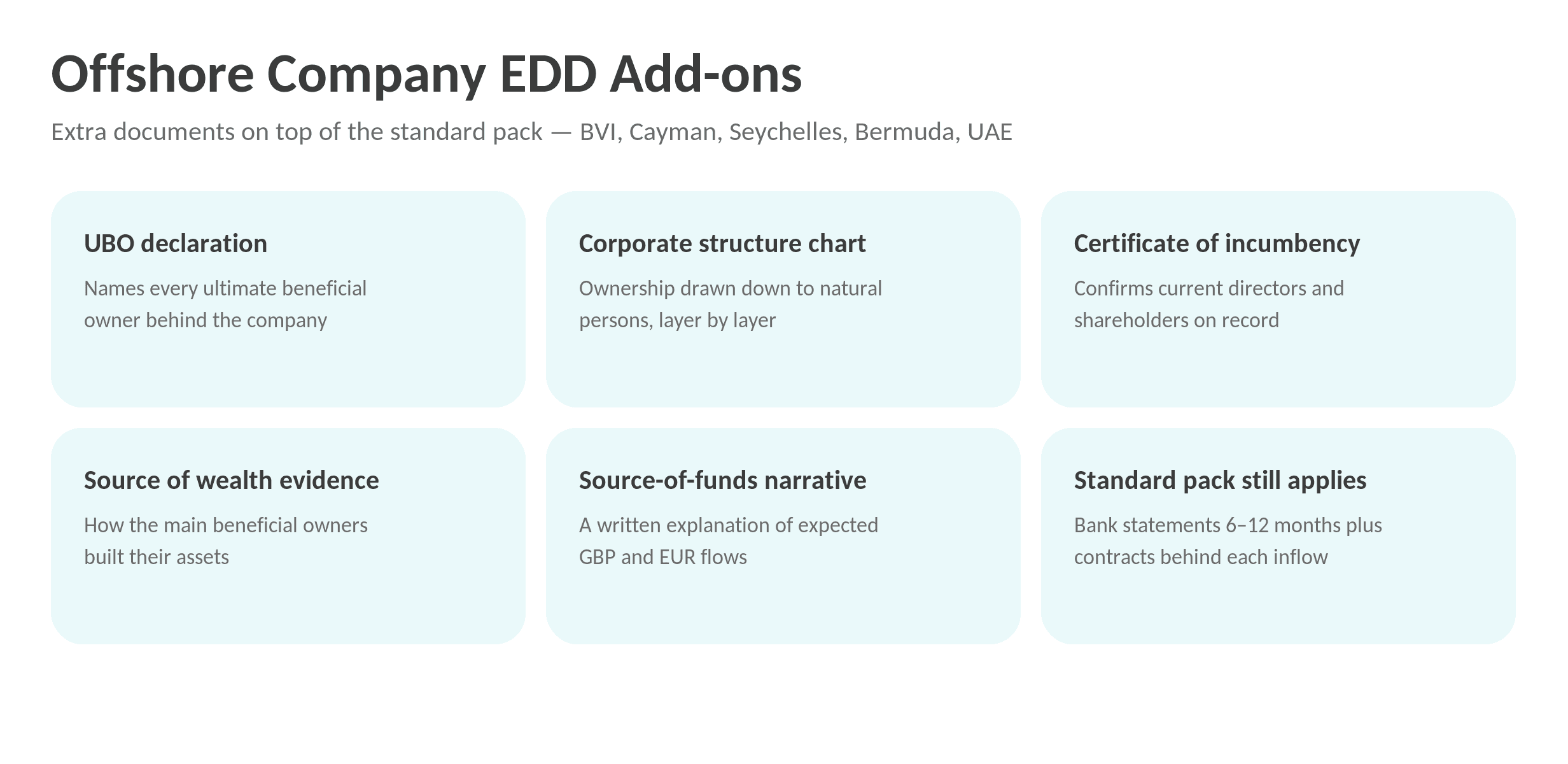
On top of the standard pack, source of funds documents for offshore companies usually include:
a UBO declaration naming every ultimate beneficial owner
a corporate structure chart drawn down to natural persons
a certificate of incumbency confirming current directors and shareholders
source of wealth evidence for the main beneficial owners
a written source-of-funds narrative for expected GBP and EUR flows
In practice, a BVI holding company receiving PSP settlements can clear EDD in a single cycle when the pack arrives complete. Once approved, the company operates a GBP account with a UK sort code without any UK presence, and its balances are held safeguarded under FCA rules.
Common Reasons Source of Funds Evidence Gets Rejected
Most source of funds rejections come down to gaps in the money trail. The recurring failure modes:
Stale documents. Statements older than three months at the date of submission.
Name mismatches. Funds arriving from an entity that appears nowhere in the ownership or contract file.
Unexplained third-party inflows. Credits from unrelated companies with no agreement behind them.
Screenshots instead of documents. App captures with no account holder name or IBAN visible.
A missing narrative. Documents attached in bulk with no explanation of how they connect.
Anyone working out how to prove source of funds in the UK should read that list backwards: date the evidence and match every name before submission. Fixing a rejected file costs more calendar time than preparing a complete one, because each resubmission joins a new review queue.
There is one honest caveat. Document lists vary by provider and risk profile, and no article replaces the checklist a compliance team issues for a specific application. The constant is the principle: every pound entering the account needs a documented origin.
Once your documents are ready, see how fast a UK business account can actually be opened online.
[aa cta]
Get UK Payment Rails After One KYB Review
A GBP sort code with Faster Payments access, plus SEPA in EUR, follows a single verified onboarding at EQWIRE.
[aa btn]Open an Account[/aa]
[/aa]
FAQ
What source-of-funds documents do offshore companies need when opening a UK FCA EMI business account?
Offshore companies need the standard evidence pack plus enhanced due diligence additions. The standard part covers 6–12 months of bank statements and the contracts or agreements behind each major inflow. The EDD part adds a UBO declaration and a corporate structure chart, together with a certificate of incumbency and source of wealth evidence for the main beneficial owners. A short written narrative explaining expected GBP and EUR flows completes the file. Companies registered in BVI, Cayman, Seychelles, Bermuda or the UAE should prepare all of it before applying, since incomplete offshore files are the most common cause of extended review.
What is the difference between source of funds and source of wealth?
Source of funds explains where the specific money entering an account came from; source of wealth explains how the owner built their overall assets. A £100,000 deposit from a client payment is a source of funds question, answered with the invoice and contract. The director's ability to lend the company £100,000 is a source of wealth question, answered with salary records or evidence of previous business sales. UK EMIs check SoF for every business applicant and add SoW checks when enhanced due diligence applies.
How far back do bank statements for source of funds need to go?
Most UK EMIs ask for 6–12 months of business bank statements, and there is no fixed statutory lookback period. HMRC's AML guidance expects evidence to reach as far back as needed to explain the specific funds involved. A company depositing routine trading revenue rarely needs more than six months. A company depositing the proceeds of a one-off asset sale may need to document the full chain, from the sale contract to the account the money rests in at application.
Can a newly incorporated company prove source of funds without trading history?
Yes. A new company proves source of funds through the people and entities funding it. Shareholder capital is evidenced with an investment agreement and the investor's own bank statement. A director loan is evidenced with a signed loan agreement and personal statements showing the transfer. Reviewers expect the personal or investor funds to have their own documented origin, such as employment income or a prior company sale. New entities face more questions than trading ones, but a clean two-layer trail passes review without trading history.
How long does source of funds verification take at a UK EMI?
Source of funds verification at a UK EMI takes 1–3 business days for straightforward companies with complete documents. Enhanced due diligence, which applies to most offshore structures, extends the review to 5–10 business days or longer. The single biggest variable is completeness: each follow-up document request adds days, because the file re-enters the review queue. Applicants who submit statements, contracts and a source-of-funds narrative together consistently see the shortest timelines.
Opening a business account in the UK rewards preparation more than any other step of company banking. The source of funds documents business account opening at a UK EMI requires are knowable in advance: recent statements, the agreements behind each inflow and, for offshore structures, UBO-level evidence. Applicants who assemble that pack before applying compress weeks of back-and-forth into days. As regulators sharpen beneficial-ownership standards, the gap between prepared and unprepared applicants will keep widening. EQWIRE publishes its document expectations upfront and onboards UK and offshore companies onto GBP and EUR rails after one review; businesses ready to start can open an account with the pack in hand.
Reviewed by

Related Articles
How to Document Expected Transaction Volumes for a UK Multi-Currency Account

UK Payment Account for a Company with Several Licensed Activities and One UK Entity

UK Payment Account for a Licensed B2B Betting Technology Supplier

Personal MUR Account for Expats in Mauritius: Hold Rupees Without a Local Account

Power your payments
with EQWIRE
Create your account in minutes and experience smooth, secure global payments.
" height="9.0156px" id="LIcbdboyB" transform="translate(4.987 4.5)" width="9.01562px"/></svg>)