
•
•
Articles
Cross-Currency Payroll: Paying International Teams in Local Currencies from One Account
[aa disclaimer]
Legal Disclaimer: This article is for informational purposes only and does not constitute legal, financial, compliance, or tax advice. Banking eligibility, regulatory requirements, and provider policies vary by jurisdiction. Consult qualified professionals before making decisions.
[/aa]
A company with fifteen employees spread across London, Berlin, Dubai, Hong Kong and Tel Aviv runs payroll in six currencies. At five international hires, a spreadsheet and a bank portal cope. At fifteen, FX losses and per-seat platform fees start consuming money the business never sees itemised. Cross-currency payroll addresses the problem at the account level: a company can pay staff in GBP, EUR, USD, AED, HKD and ILS from a single multi-currency account by holding core currencies natively and converting to the rest at the point of payment.
Three structures compete for this job. This guide compares them on cost per pay run and FX control, then sets out when consolidating the payment side of paying international teams in local currencies into one account is the right decision.
[aa key-takeaways]
Key Takeaways
Companies paying global teams choose between local bank accounts in each country, employer of record (EOR) platforms and a single multi-currency account.
Local accounts require a registered entity per country, carry maintenance fees and trap working capital in idle balances.
EOR platforms charge a per-employee monthly fee and set the FX rate applied to each salary; spreads typically run 0.5–3% above the mid-market rate.
One multi-currency account holds GBP, EUR and USD natively and sends AED, HKD and ILS by SWIFT, with the exchange rate visible before each run.
Headcount, payment corridors and existing legal entities determine the right model; a switch takes one parallel pay cycle.
[aa btn]Book a Call[/aa]
[/aa]
Three Ways to Run Cross-Currency Payroll
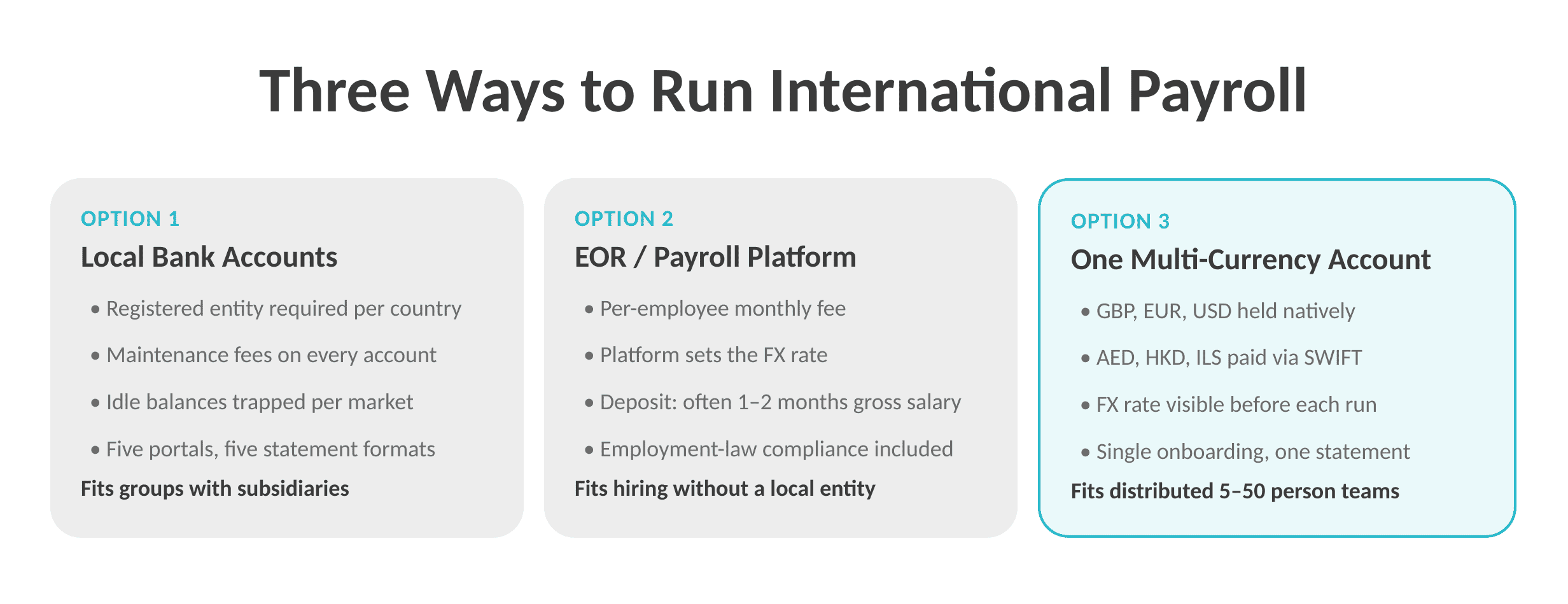
Companies that pay a distributed team pick one of three structures:
Local bank accounts in each country of employment
An employer of record (EOR) that pays staff on the company's behalf
One multi-currency account that funds every salary corridor
Each option carries a different mix of setup effort, per-payment cost and FX control. The sections below take them in turn.
Option 1: Local Bank Accounts in Every Country
Opening a business account in most jurisdictions requires a registered local entity. For a team spread across five countries, that can mean five incorporations and five compliance calendars before the first salary leaves.
Each account also traps working capital. Balances sit idle in AED or HKD waiting for payday, and monthly maintenance fees apply whether the account moves money or not.
Reconciliation multiplies with every account added. Five banking portals produce five statement formats, and month-end close stretches accordingly.
The model suits groups that already operate subsidiaries. For everyone else, the admin cost usually outweighs the benefit, a pattern examined in more depth in this guide to cross-border business payments.
Option 2: EOR and Global Payroll Platforms
An employer of record (EOR) is a third-party firm that legally employs staff on a company's behalf and carries the local employment-law compliance. Platforms such as Deel, Papaya Global and Multiplier built the category.
The compliance coverage is real. So is the price. EOR pricing typically runs to several hundred dollars per employee per month, and many providers ask for a deposit of one to two months of gross salary per employee.
The quieter cost sits in FX. The platform converts the funding currency into each local currency at a rate it sets, with spreads typically 0.5–3% above the mid-market rate. On a $1 million annual payroll, that FX layer alone can cost $5,000–$20,000 a year even at the best-case spread.
What this means in practice: the employer approves payroll in one currency and only discovers the rate applied to each salary after the run has settled.
Option 3: One Multi-Currency Account with SWIFT and SEPA Reach
A multi-currency account for payroll holds several currencies under one login and sends payments over both local and international rails. A UK example: an account with an FCA-authorised electronic money institution holds GBP, EUR and USD natively, then pays AED, HKD or ILS by SWIFT with conversion executed at the moment of sending.
UK regulation requires an authorised EMI to safeguard client funds under the Electronic Money Regulations 2011, keeping customer money separate from the provider's own funds in line with FCA safeguarding requirements.
The structural difference from an EOR is control. The company sees the FX quote before confirming each conversion, decides when to convert, and runs international payroll from one account instead of pre-funding a platform. Holding a multi-currency account in GBP, EUR and USD removes forced conversion on the corridors where most salaries land.
One caveat applies. An account replaces the payment layer only; payroll calculation and tax withholding still need a compliant setup in each jurisdiction.
Cost Comparison: What Each Model Really Costs per Pay Run
Three components decide what a pay run costs:
Fixed fees: account maintenance, per-payment charges, per-seat subscriptions
FX margin: the spread between the applied rate and the mid-market rate
Conversion timing: who decides when funds convert, and at what quote
Fees, FX Margin and Hidden Charges Side by Side
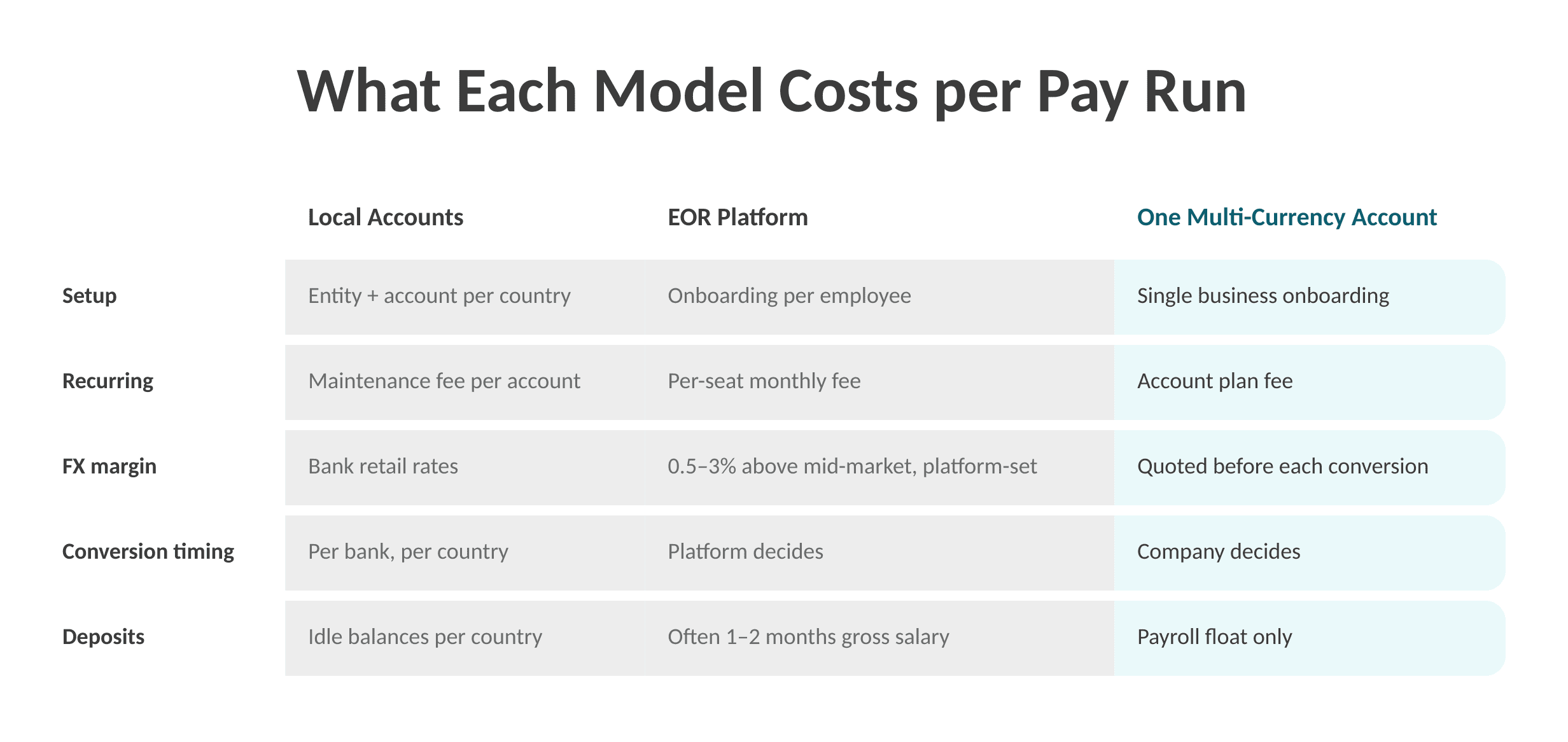
Cost line | Local accounts | EOR platform | One multi-currency account |
|---|---|---|---|
Setup | Entity + account per country | Onboarding per employee | Single business onboarding |
Recurring | Maintenance fee per account | Per-seat monthly fee | Account plan fee |
FX margin | Bank retail rates | 0.5–3% above mid-market, platform-set | Quoted before each conversion |
Conversion timing | Per bank, per country | Platform decides | Company decides |
Deposits | Idle balances per country | Often 1–2 months gross salary per employee | Payroll float only |
Correspondent chains add a second layer on SWIFT corridors. A payment routed through intermediaries can lose a deduction at each hop, and BIS data shows active correspondent banking relationships fell by roughly 30% between 2011 and 2022, concentrating traffic in fewer, pricier chains. The G20 made cheaper and faster cross-border payments a formal target because these frictions persist.
Budgeting feels the FX layer too. A salary bill fixed in EUR or ILS moves against a GBP budget month by month, so finance teams that control conversion timing can smooth what platform-set rates pass straight through.
Reporting differs just as sharply between the models. A single account produces one statement covering every corridor, with each salary, rate and fee on one line. Spread the same run across five country accounts or a platform's internal ledger, and month-end close means stitching together exports that never quite match.
Why this matters: the FX line is the only payroll cost that scales with salaries themselves rather than with headcount. Fixed fees stay flat as a team grows. A percentage spread grows with every raise and every hire.
[aa fast-fact]
Fast Fact: Payroll providers typically apply an FX spread of 0.5–3% above the mid-market rate. On £100,000 of monthly international salaries, that is £500–£3,000 lost every month before any fixed fees.
[/aa]
Decision trigger: a company converting £100,000 a month at a 1.5% spread pays £18,000 a year for rate decisions it never sees. Rate visibility before sending is worth auditing for that reason alone.
[aa cta]
Keep the FX Margin In-House
Open a multi-currency account and see the exchange rate before every salary run, with GBP, EUR and USD held under one login.
[aa btn]Open an Account[/aa]
[/aa]
When One Multi-Currency Account Is the Right Choice
Unlike an EOR, a multi-currency account keeps the FX decision with the company. That single difference drives most of the economics for teams of roughly 5 to 50 international staff.
The fit is strongest when three conditions line up: the company already employs staff lawfully in each country, salaries land on corridors the account serves directly, and the finance team wants rate visibility rather than outsourced convenience. Miss the first condition and the comparison changes entirely.
Use Case: UK Company Paying Staff in GBP, EUR, USD, AED, HKD and ILS
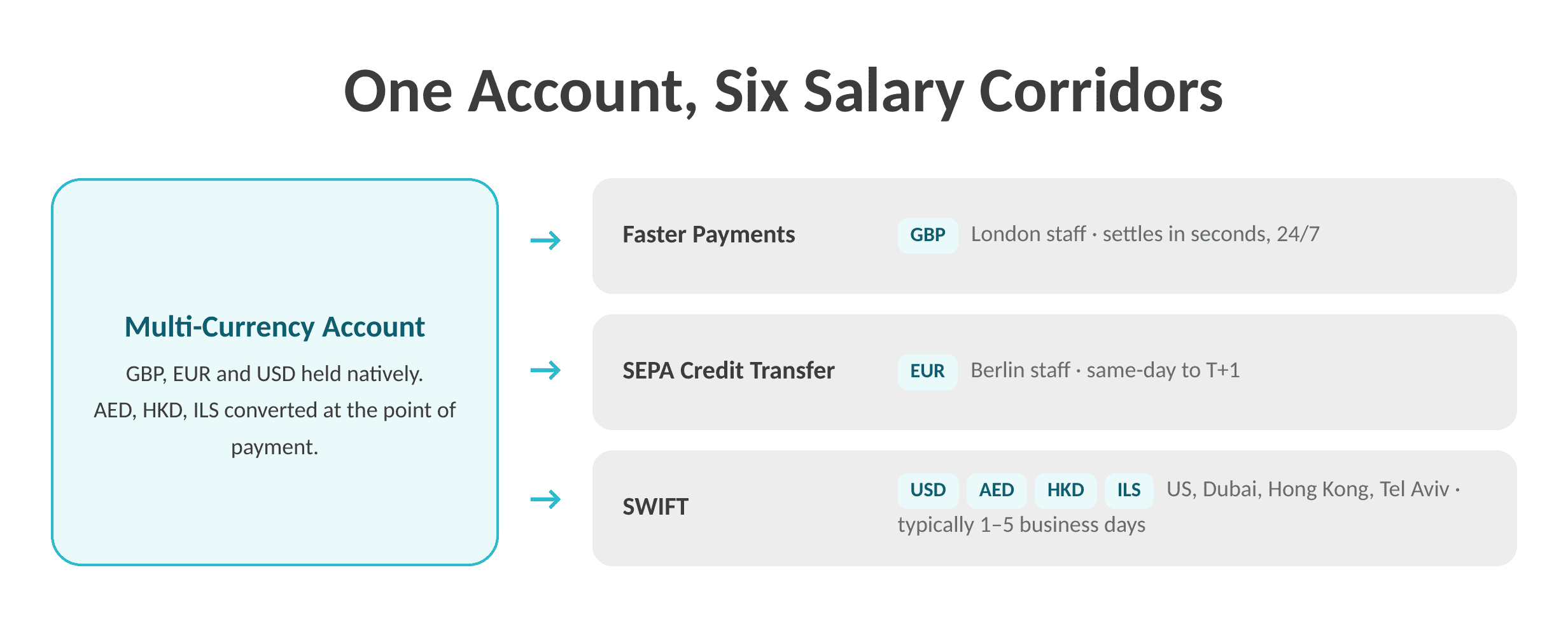
Consider a UK software firm with employees in London, Berlin, Dubai, Hong Kong and Tel Aviv, plus a contractor in the US. Its pay run maps to rails corridor by corridor:
GBP (London): Faster Payments settles in seconds, 24/7 by design
EUR (Berlin): SEPA credit transfer, same-day to T+1; SEPA carries the bulk of euro-area credit transfers
USD (US contractor): SWIFT, typically 1–2 business days
AED (Dubai), HKD (Hong Kong), ILS (Tel Aviv): SWIFT, typically 1–5 business days depending on the correspondent chain
To pay staff in local currencies from one account, the finance team funds one balance and converts what payday requires. Payments then go out corridor by corridor. Employees in Dubai receive dirhams and employees in Tel Aviv receive shekels, and neither the company nor the employee pays a receiving-side conversion.
The same balance covers salaries and supplier invoices. Firms already paying global contractors from one balance run payroll as one more scheduled batch on the account.
When Local Accounts or an EOR Still Make Sense
Some jurisdictions require salaries to run through a registered local payroll, and a few require payment from an in-country account. Where the law says local, local wins, and qualified employment counsel should confirm the position per country.
An EOR remains the right tool when the company has no legal entity in the employee's country, since without one there is no lawful way to employ that person directly. UK employers, for instance, still operate PAYE for UK staff under HMRC payroll guidance whichever account pays the salary.
Large single-country concentrations also change the maths. Fifty employees in one market may justify a local entity and account; five employees in five markets rarely do. Cross-currency payroll for global teams fits best where headcount is wide and shallow.
Switching: Moving Payroll to a Single Account Without Missing Payday
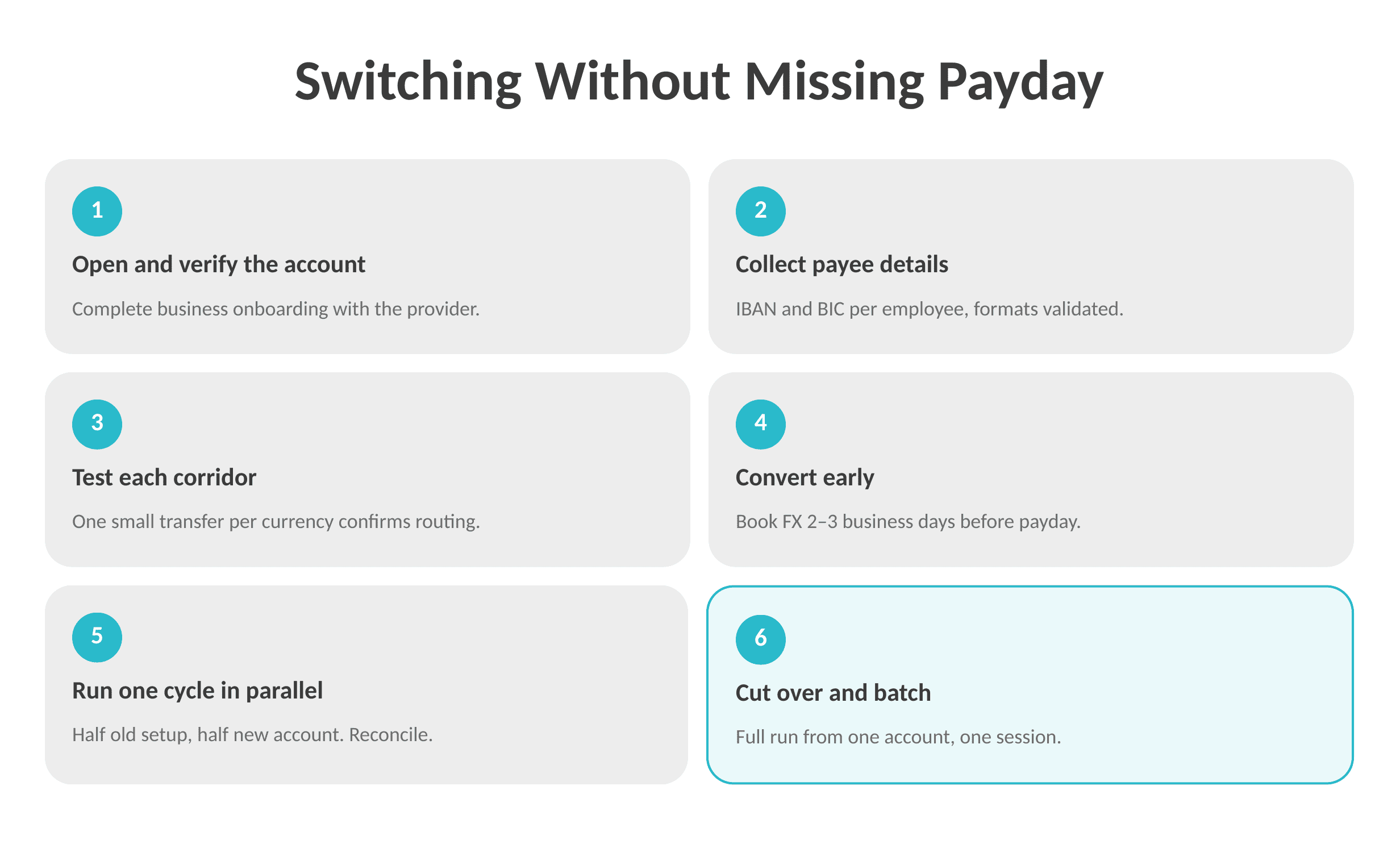
Moving payroll to a single account takes one parallel pay cycle when sequenced correctly. Staff notice nothing except, occasionally, a salary that arrives earlier than usual. The sequence below assumes a monthly cycle with payday on the last working day.
Open and verify the account. Complete business onboarding with the provider; UK EMIs operate under the Payment Services Regulations 2017.
Collect payee details. Gather IBAN and BIC for every employee and validate the formats before the first run. Format errors sit behind most returned salary payments.
Send a test payment per corridor. One small transfer each to GBP, EUR, USD, AED, HKD and ILS recipients confirms routing and receiving-bank behaviour.
Convert early. Book FX 2–3 business days before payday rather than on the morning itself, since SWIFT corridors need 1–5 business days of lead time.
Run one cycle in parallel. Pay half the team from the old setup and half from the new account, then reconcile both sides.
Cut over and batch. Move the full run onto the new account; batch payment workflows compress a six-currency payroll into a single session.
Multi-currency payroll migrations fail on operational detail. The usual culprits are an unverified IBAN and a missed SWIFT cut-off, with a conversion left to payday morning close behind. The parallel cycle exists to surface those issues while the old setup still works.
FAQ
How does a company with a global team pay staff in GBP, EUR, USD, AED, HKD and ILS from a single multi-currency account?
The company holds GBP, EUR and USD as native balances and converts to AED, HKD and ILS at the moment each SWIFT payment goes out. That is how a company with a global team pays staff in GBP, EUR, USD, AED, HKD and ILS from a single multi-currency account: Faster Payments delivers sterling in seconds, SEPA delivers euros same-day to T+1, and SWIFT delivers the remaining currencies within 1–5 business days. The finance team books FX a few days before payday, checks the quoted rate, and releases the run from one dashboard.
Is a multi-currency account cheaper than an EOR for payroll?
For the payment leg, usually yes. An EOR applies its own FX spread, typically 0.5–3% above the mid-market rate, and charges a per-employee monthly fee, while an account shows the exchange rate before each conversion and charges per payment. An EOR bundles employment-law compliance that an account does not provide, so the honest comparison is payment cost against legal coverage. Companies that already have entities in their employees' countries usually save by running payments directly.
Do companies need a local bank account to pay employees in the UAE, Hong Kong or Israel?
In most cases, no. A SWIFT payment delivers AED, HKD or ILS to an employee's local account without the employer holding an in-country account. The obligations that usually matter are the salary currency and the local payroll registration; the sending account is rarely specified. Businesses that pay staff in local currencies from one account still need compliant local payroll and tax treatment, which varies by jurisdiction and deserves professional advice.
What headcount justifies moving payroll to one account?
Around 10–15 international staff is where consolidation typically starts to pay. At that size, FX spreads of 0.5–3% per salary and per-seat platform fees exceed the cost of running payments in-house for most teams. Below five hires, simplicity often wins. Above 50 employees in a single country, a local entity and account start to justify themselves.
How long do salary payments take on each rail?
Faster Payments credits GBP in seconds to minutes, around the clock. SEPA credit transfers settle same-day or next business day across the euro area. SWIFT payments in USD, AED, HKD or ILS typically arrive within 1–5 business days depending on the correspondent chain, so finance teams schedule those legs first and the domestic legs last.
Cross-currency payroll is an infrastructure decision before it is a software decision. Local accounts suit groups with subsidiaries, and EOR platforms suit companies employing where they have no entity. For the wide middle, paying international teams in local currencies from one regulated account keeps the FX margin and the conversion timing on the company's side of the ledger. EQWIRE's FCA-regulated multi-currency accounts hold GBP, EUR and USD under one login and pay out worldwide over Faster Payments, SEPA and SWIFT. Opening an account takes minutes at client.eqwire.com/sign-up.
Reviewed by

Related Articles

Sandbox Testing for UK Payment APIs: Faster Payments, SEPA and SWIFT
Cross-Currency Payroll: Paying International Teams in Local Currencies from One Account

Multi-Currency Account for Property Management Companies: Collect Rents in GBP and EUR
ILS to EUR or GBP: Converting Israeli Shekel for International Businesses

Power your payments
with EQWIRE
Create your account in minutes and experience smooth, secure global payments.
" height="9.0156px" id="LIcbdboyB" transform="translate(4.987 4.5)" width="9.01562px"/></svg>)