•
•

Articles
SWIFT vs SEPA: When to Use Each for EUR Payments from a UK Account
[aa disclaimer]
Legal Disclaimer: This article is for informational purposes only and does not constitute legal, financial, compliance, or tax advice. Banking eligibility, regulatory requirements, and provider policies vary by jurisdiction. Consult qualified professionals before making decisions.
[/aa]
A UK company pays two EUR invoices of €10,000 each from the same business account. The first reaches a German supplier the next morning with the full amount intact. The second takes three days and arrives €28 short after two intermediary banks take their cut. The difference is the payment rail. This SWIFT vs SEPA EUR payments UK account comparison explains how each rail routes and prices euro transfers, and when each one makes sense. The short answer: SEPA is the default for euro payments to accounts in the 41 SEPA-zone countries, and SWIFT covers everything else. For finance teams managing EUR transfers from a UK account, the choice comes down to three questions answered below.
[aa key-takeaways]
Key Takeaways
SEPA covers euro transfers to 41 countries and territories (EPC list, 2025), including the UK, which kept its SEPA membership after Brexit.
A SEPA Credit Transfer from a UK provider costs roughly 50p–£5 and settles within one business day; SEPA Instant arrives in under 10 seconds.
SWIFT sending fees run £15–£50, and each correspondent bank in the chain may deduct a further £10–£25 from the amount in transit.
SWIFT is the only option when the recipient's account sits outside the SEPA zone, or when the payment is not denominated in euros.
The decision framework has three steps: check the currency first, then the recipient's IBAN country code, then how fast the funds must arrive.
[aa btn]Book a Call[/aa]
[/aa]
SWIFT vs SEPA EUR Payments from a UK Account: Comparison at a Glance
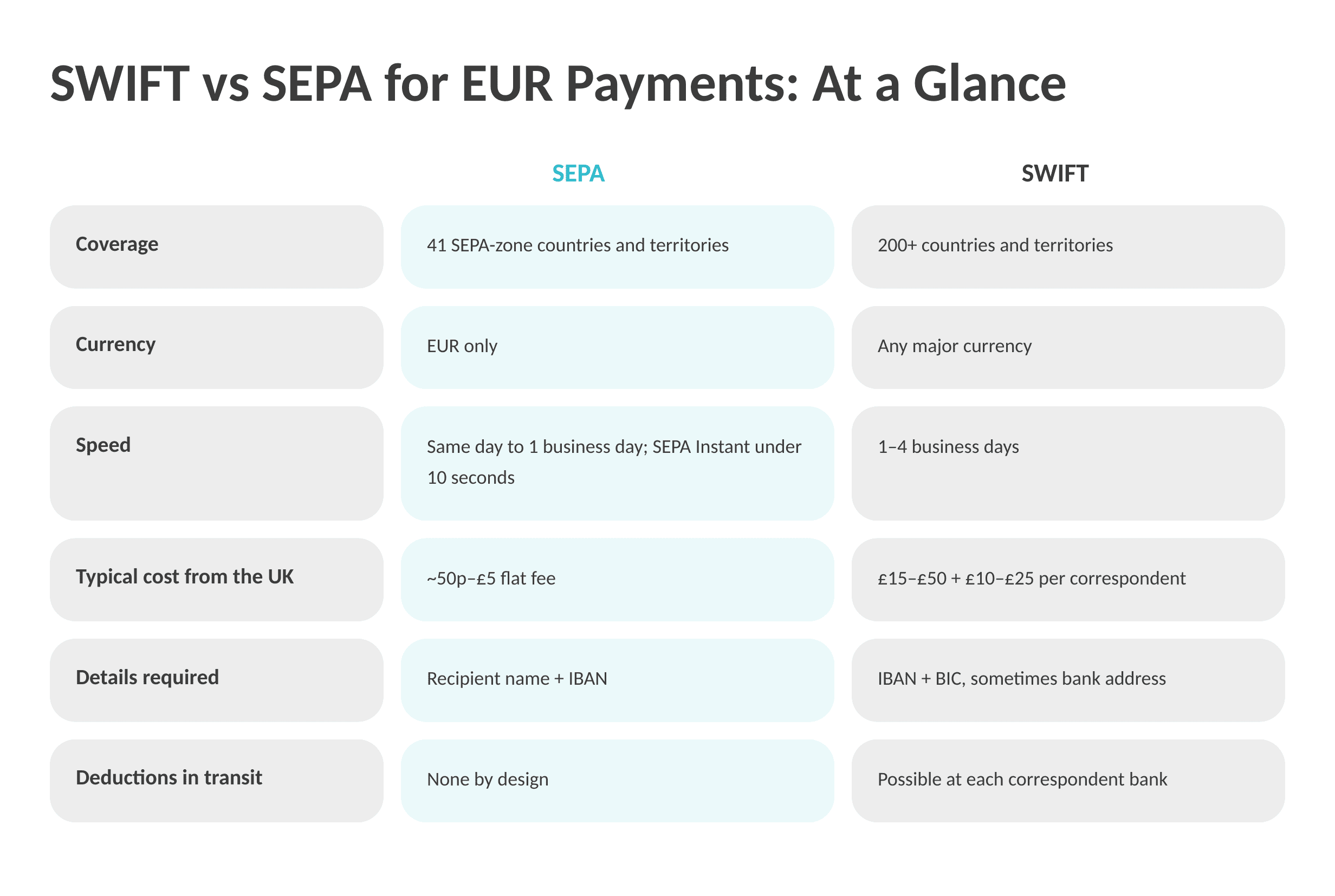
The key difference between SWIFT and SEPA for EUR payments from a UK account is scope and cost. SEPA moves euro transfers to 41 European countries at low fixed fees with no intermediaries. SWIFT reaches more than 200 countries in any major currency, routing each payment through correspondent banks that add both time and deductions.
SEPA | SWIFT | |
|---|---|---|
Coverage | 41 SEPA-zone countries and territories | 200+ countries and territories |
Currency | EUR only | Any major currency |
Speed | Same day to 1 business day (SCT); under 10 seconds (SEPA Instant) | 1–4 business days |
Typical cost from the UK | ~50p–£5 flat fee | £15–£50 sending fee, plus £10–£25 per correspondent |
Details required | Recipient name and IBAN (plus payer address for UK-originated payments) | IBAN and BIC, sometimes the beneficiary bank's address |
Deductions in transit | None by design | Possible at each correspondent bank |
The table understates one structural point. SEPA operates as a closed scheme with uniform rules set by the European Payments Council, so a payment from London behaves exactly like a payment from Lyon. SWIFT behaves differently on every route, because the cost and speed depend on which correspondent banks sit between sender and recipient. Businesses that send SEPA transfers from a UK business account see predictable costs on every payment; SWIFT users find out the final deductions only after the funds land.
How SEPA Handles EUR Payments from the UK
SEPA (Single Euro Payments Area) is a set of payment schemes run by the European Payments Council (EPC) that makes euro transfers between member countries work like domestic payments. One scheme, one format, one rulebook. The European Central Bank describes SEPA as the foundation of harmonised euro retail payments across Europe.
Brexit did not remove UK access. The EPC approved the UK's continued participation in March 2019, so UK-based accounts kept sending and receiving SEPA payments without interruption. One operational change applies: payments originated from the UK must include the payer's full address, and a missing address is among the most common reasons a UK-originated SEPA payment gets rejected.
In practice, a UK e-commerce firm paying a Polish warehouse in EUR uses the same SEPA rails as a French company would. The payment carries no premium for crossing the Channel.
Coverage, Speed and Cost
The SEPA zone spans 41 countries and territories according to the EPC's official list, covering all 27 EU member states plus non-EU participants such as the UK and Switzerland. Recent additions include several Western Balkan countries, so the zone keeps widening.
Cost is where SEPA separates itself. UK providers price a SEPA Credit Transfer between 50p and £5, and the beneficiary receives the full amount because no intermediary sits in the chain. Businesses that send EUR from UK via SEPA pay the same flat fee whether the destination is Dublin or Warsaw.
Speed follows the same pattern. A SEPA Credit Transfer submitted before the provider's cut-off settles the same day or the next business day. The only common failure point is a mistyped account number, which is why validating the recipient's EUR IBAN before submitting a payment saves both the fee and the delay of a rejected transfer.
SEPA Credit Transfer vs SEPA Instant
A SEPA Credit Transfer settles within one business day; SEPA Instant settles in under ten seconds, around the clock, every day of the year. The two schemes share the same reach, so the choice is purely about urgency and provider support.
Regulation has pushed SEPA Instant from premium feature to standard. Under the EU Instant Payments Regulation, euro-area payment providers must offer instant euro transfers priced no higher than standard credit transfers, with the receiving obligation in force since January 2025 and sending since 9 October 2025. Settlement runs through infrastructure such as TIPS, operated by the Eurosystem.
One caveat matters for UK senders. A small number of EU banks still reject GB IBANs in violation of SEPA rules, a practice known as IBAN discrimination. When that happens, the fix is usually a EUR IBAN issued in an EU country rather than a switch to SWIFT.
[aa fast-fact]
Fast Fact: Since 9 October 2025, euro-area banks must offer SEPA Instant transfers at no premium over standard SEPA Credit Transfers under the EU Instant Payments Regulation (European Commission, 2024).
[/aa]
How SWIFT Handles EUR Payments — and What It Costs
SWIFT is a messaging network, not a settlement system. It carries standardised payment instructions between banks, historically as MT103 messages and now migrating to the ISO 20022 format. The euros themselves move separately, hopping between banks that hold accounts with one another until they reach the beneficiary.
That hop-by-hop design is called correspondent banking, and the Bank for International Settlements has documented both how it works and how the number of active correspondent relationships keeps shrinking. Fewer correspondents means longer chains on some routes, and every extra link adds cost and delay.
For a UK business, the practical consequence is uncertainty. The same EUR payment to the same beneficiary can settle over different chains on different days, arriving with different deductions each time. SWIFT gpi, the network's tracking service, shows where a payment sits in the chain but does not remove the intermediaries.
Correspondent Chains, Deductions and FX Margin
SWIFT transfer fees for EUR payments stack in three layers. The sending bank charges £15–£50. Each correspondent in the chain may deduct £10–£25 while the payment is in transit. If the account holds GBP rather than EUR, conversion adds an FX margin that often reaches 2–4% at high-street banks, and the FX conversion rates applied to business accounts frequently cost more than every transfer fee combined.
Who pays which layer depends on the charge option selected at submission:
SHA (shared): the sender covers their own bank's fee, and the beneficiary absorbs correspondent deductions. This is the default for most EUR payments.
OUR: the sender pays all charges along the chain, so the beneficiary receives the full invoice amount. Sending banks price this option higher upfront.
BEN: the beneficiary bears every charge, including the sending fee. Suppliers rarely accept it.
The SWIFT vs SEPA cost difference therefore has little to do with the sending fee alone. It comes from the chain: SEPA has no intermediaries to pay, and SWIFT may have several.
When to Use SEPA and When to Use SWIFT: Decision Framework
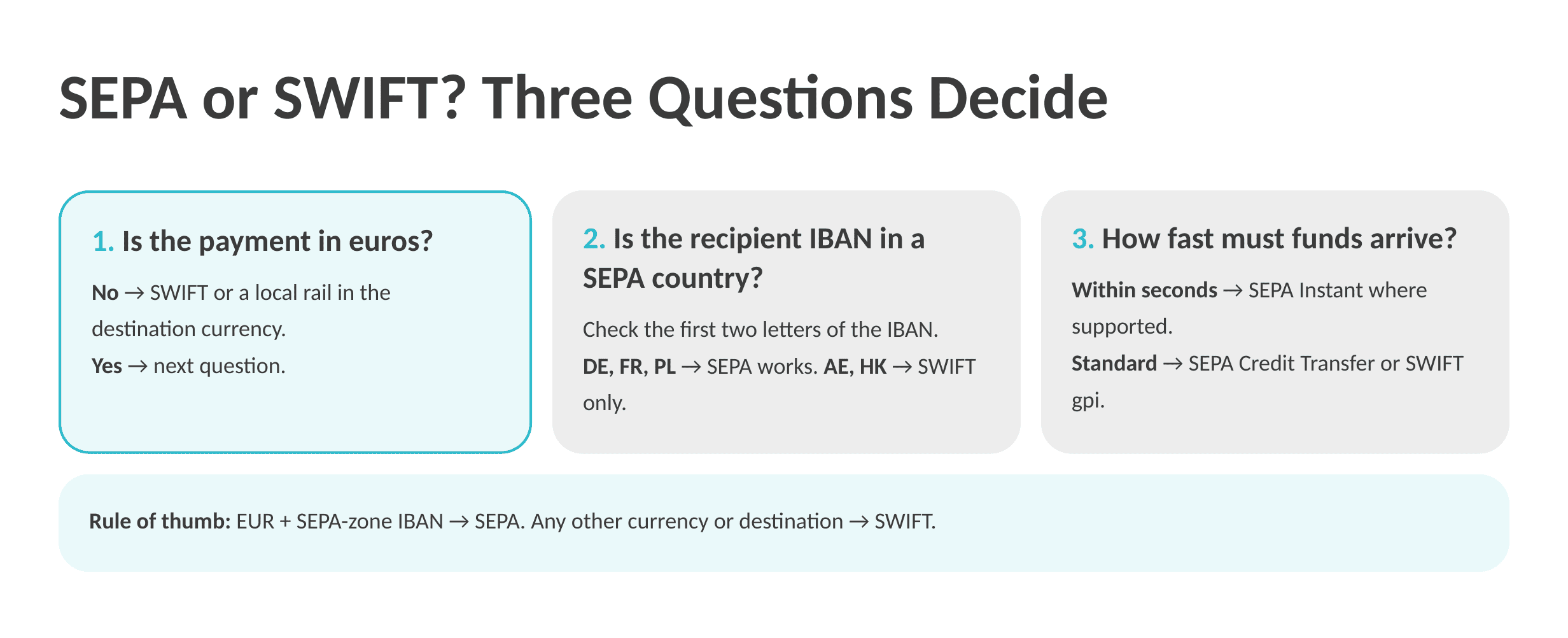
Three questions settle the choice between SEPA vs SWIFT for UK businesses:
Is the payment in euros? If not, SEPA is unavailable and the payment routes via SWIFT or a local rail in the destination currency.
Is the recipient's IBAN in a SEPA country? The two-letter country code at the start of the IBAN answers this instantly. DE, FR or PL means SEPA works; AE or HK means it does not.
How fast must the funds arrive? Same-day needs are met by SEPA Instant where the receiving bank supports it, and by premium SWIFT products elsewhere.
Answering these three questions before every payment run removes rail selection as a source of error. Most modern providers automate the check and route each payment accordingly.
Scenario 1: Paying an EU Supplier in EUR
For a EUR invoice to an EU supplier, SEPA is the default choice. The payment settles within a day, costs a few pounds at most, and the supplier receives the exact invoice amount, which keeps reconciliation clean on both sides.
For teams weighing a SEPA or SWIFT EUR payment, a UK business account with direct SEPA access removes the question entirely for intra-European invoices. Finance teams running weekly payment cycles can also batch these transfers; recurring supplier payments without SWIFT keep per-payment costs flat as volume grows.
Scenario 2: Sending EUR Outside the SEPA Zone
A EUR payment to a recipient bank in Dubai or Singapore cannot travel over SEPA rails, even though the currency is euro. SEPA reaches accounts held in SEPA-zone countries only, so the destination decides the rail regardless of currency.
Here SWIFT earns its fees. It is the established network for reaching banks outside Europe, and the sensible cost control is choosing the OUR charge option when the beneficiary must receive an exact amount, or agreeing with the counterparty in advance who absorbs deductions.
Scenario 3: Urgent Same-Day EUR Transfer
When a EUR payment must arrive within hours, SEPA Instant is the first option to check. It settles in seconds at any hour, including weekends, provided the receiving bank supports the scheme, and euro-area banks have been required to receive instant payments since January 2025.
Where the receiving bank sits outside SEPA, SWIFT gpi provides tracking and faster routing than legacy correspondent flows, though same-day arrival still depends on cut-off times at every bank in the chain. Submitting before late-morning UK time gives a cross-border SWIFT payment its best chance of same-day settlement.
Cost Comparison: The Same €10,000 Payment via SEPA and SWIFT
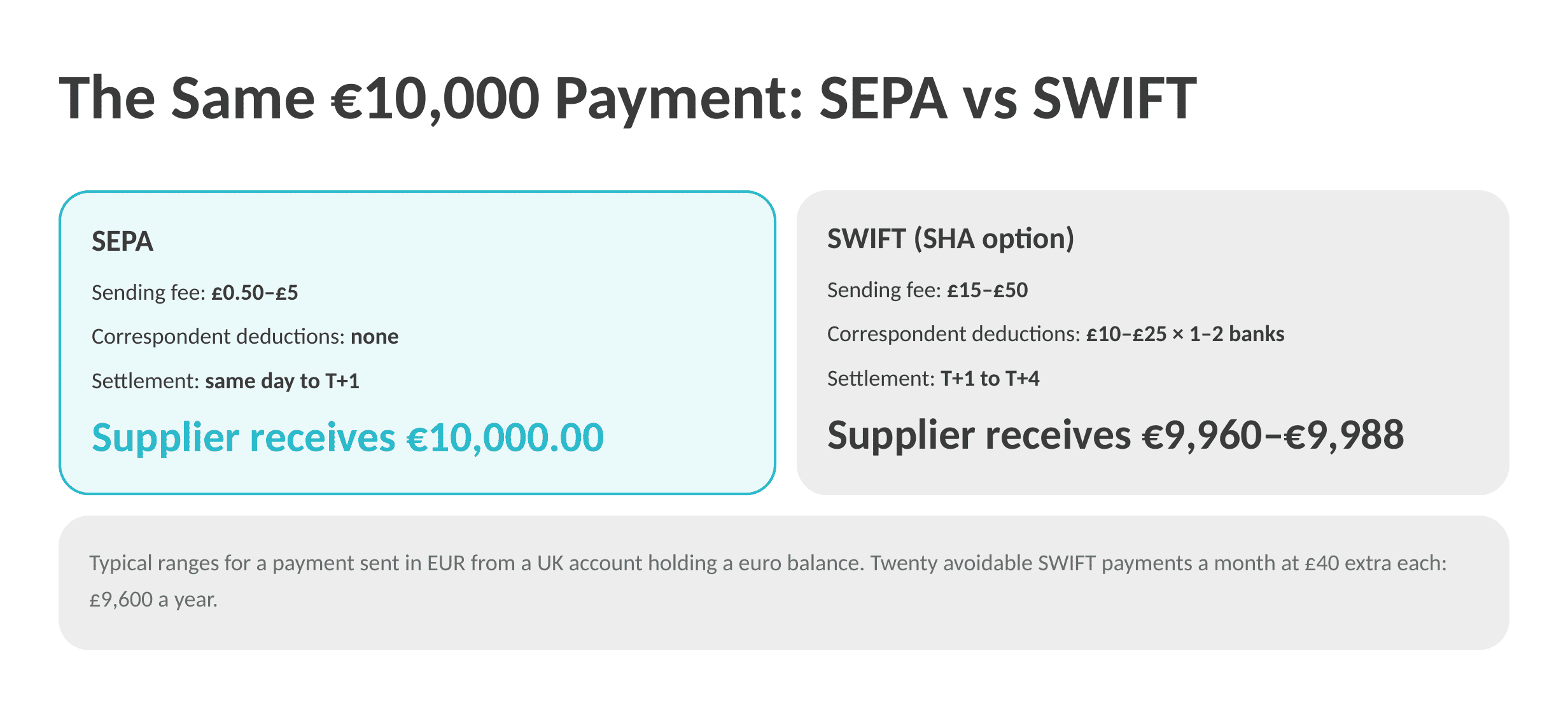
The same €10,000 supplier payment can cost under £5 via SEPA and £40–£90 via SWIFT once every fee layer is counted. The table shows a typical breakdown for a payment sent in EUR from a UK account that already holds a euro balance.
Cost line | SEPA | SWIFT (SHA option) |
|---|---|---|
Sending fee | £0.50–£5 | £15–£50 |
Correspondent deductions | None | £10–£25 per intermediary (1–2 typical) |
Amount the supplier receives | €10,000.00 | €9,960–€9,988 |
Typical settlement time | Same day to T+1 | T+1 to T+4 |
If the account holds only GBP, conversion cost applies on either rail, so the FX margin belongs to the provider comparison rather than the rail comparison. A 2% high-street margin on a £8,700 conversion adds roughly £174, which dwarfs every fee in the table.
Scale turns the gap into a budget line. In any SWIFT vs SEPA EUR payments UK account comparison, the difference compounds with volume: twenty supplier payments a month routed over SWIFT at an avoidable £40 extra each is £9,600 a year that SEPA routing would have kept in the business.
[aa cta]
One UK Business Account for EUR via SEPA and SWIFT
Hold, send and receive EUR without forced conversion, with transparent fees on both rails from an FCA-authorised provider.
[aa btn]Open Business Account[/aa]
[/aa]
The decision rule stays stable across every scenario above. For euro payments to SEPA-zone accounts, SEPA wins on cost, speed and predictability; SWIFT earns its place where SEPA cannot go. UK firms with regular EUR flows benefit most from a provider that offers both rails under one roof and routes each payment automatically. EQWIRE, an Electronic Money Institution authorised by the Financial Conduct Authority (FRN 901100) and safeguarding client funds under the Electronic Money Regulations 2011, provides SEPA and SWIFT access from a single multi-currency account, with the full fee schedule published openly. The conclusion of this SWIFT vs SEPA EUR payments UK account comparison points one way: match the rail to the destination, and route EUR transfers from a UK account through SEPA whenever the recipient's IBAN allows it.
FAQ
SWIFT vs SEPA for EUR transfers: cost comparison and when to use each from a UK business account?
SEPA is cheaper and faster for EUR transfers whenever the recipient's account is in one of the 41 SEPA-zone countries: UK providers charge roughly 50p–£5 per SEPA Credit Transfer and the beneficiary receives the full amount. SWIFT costs £15–£50 in sending fees, and correspondent banks may deduct a further £10–£25 each in transit, so the same payment can arrive €12–€40 short. Use SEPA for euro payments to European accounts. Use SWIFT when the destination is outside the SEPA zone or the payment is in another currency, and select the OUR charge option when the beneficiary must receive an exact amount.
Can UK businesses still use SEPA after Brexit?
Yes. The UK remains a member of the SEPA schemes, a status the European Payments Council confirmed in March 2019, so SEPA payments after Brexit continue under the same rulebooks. Two practical differences apply: UK-originated payments must include the payer's full address, and a small number of EU banks unlawfully reject GB IBANs, a practice known as IBAN discrimination. Most UK banks and EMIs continue to offer SEPA transfers as standard.
Is it cheaper to send EUR from UK via SEPA than SWIFT?
Almost always. To send EUR from UK via SEPA costs a flat 50p–£5 with no deductions in transit, while the all-in cost of a SWIFT EUR payment commonly lands between £25 and £75 once sending fees and correspondent deductions are added. The exception is a destination outside the SEPA zone, where SEPA is unavailable at any price and SWIFT is the working option.
When is SWIFT the only option for a EUR payment?
SWIFT is the only option when the recipient's bank account sits outside the 41 SEPA countries and territories. A euro payment to an account in the UAE, Singapore or the United States cannot use SEPA rails regardless of currency. SWIFT also applies when a provider lacks direct SEPA access, which is common at banks outside Europe.
How long does a SWIFT EUR transfer take from a UK business account?
Typically one to four business days. The exact time depends on how many correspondent banks sit in the chain, each bank's cut-off times, and any compliance checks along the route. By comparison, a SEPA Credit Transfer from the same account settles within one business day, and SEPA Instant arrives in under ten seconds where the receiving bank supports it.
Reviewed by
Related Articles

Named IBAN for UK B2B Invoice Collections: Practical Operating Guide

UK Multi-Currency Account for a Global Payroll Software Company Paying Service Providers

Citizenship by Investment Jurisdictions: Financial Accounts for Antigua, St Kitts and Dominica Companies

SWIFT Code Lookup: Find BIC Code for International USD and CNY Payments

Power your payments
with EQWIRE
Create your account in minutes and experience smooth, secure global payments.
" height="9.0156px" id="LIcbdboyB" transform="translate(4.987 4.5)" width="9.01562px"/></svg>)