•
•
How to Document Expected Transaction Volumes for a UK Multi-Currency Account
[aa disclaimer]
Legal Disclaimer: This article is for informational purposes only and does not constitute legal, financial, compliance, or tax advice. Banking eligibility, regulatory requirements, and provider policies vary by jurisdiction. Consult qualified professionals before making decisions.
[/aa]
A UK company applying for a multi-currency account often meets one question that stalls the whole application: what volume will pass through the account each month? Compliance teams at electronic money institutions (EMIs) use the answer to build a risk profile, and a figure with no explanation behind it usually brings a request for more documents.
KYB onboarding moves faster when the forecast matches the business plan and splits by currency. This guide shows how to document expected transaction volumes with six metrics, how to build the forecast in four steps, which papers support the numbers and when the declared figures can change.
[aa key-takeaways]
Key Takeaways
Six figures answer most onboarding questions: monthly turnover, payment count, average payment, largest payment, currency split and countries.
A breakdown per rail and per denomination gives reviewers more to work with than a single total.
Contracts and past statements back the declared numbers and shorten follow-up requests.
Round figures with no basis and forgotten peak months generate most of the questions.
Declared volumes can be updated after onboarding. An update before limits bite is easier than an explanation afterwards.
[aa btn]Book a Call[/aa]
[/aa]
Before You Start KYB Onboarding: What to Collect
A finance team needs a short list of numbers before the application form opens. Gathering them first avoids the half-finished applications that come back with questions a week later.
Monthly turnover: total money in and out of the account, per month
Payment count: how many incoming and outgoing payments occur monthly
Average payment: turnover divided by payment count
Largest payment: the single biggest transfer expected in a year
Currency split: the share of volume in each currency
Countries and rails: where counterparties sit and which payment route they use

Together these form the baseline that every later payment gets compared with. Reviewers rarely see the spreadsheet behind them. They see the six lines, so each line has to stand on its own.
What KYB Means and How It Differs From KYC
KYB (know your business) verifies the company itself: its registration, ownership structure, activity and planned use of the account. KYC verifies the directors and shareholders behind it. The KYC and KYB checks run side by side, and the volume forecast belongs to the business half.
Regulation 28 of the Money Laundering Regulations 2017 requires regulated firms to understand the purpose and intended nature of each business relationship. A volume forecast puts a figure on that requirement.
[aa fast-fact]
Fast Fact: An EMI holds its authorisation from the Financial Conduct Authority under the Electronic Money Regulations 2011.
[/aa]
Providers differ on what a business needs to open an account. Typical requests include a certificate of incorporation and proof of address. Reviewers also ask for the list of directors and owners, with a description of the activity. The forecast is the part that rests most on the finance team's own judgement. Payment services follow the Payment Services Regulations 2017.
Business Model and Revenue Streams
The forecast starts with how the company earns and spends. A software company with 120 monthly subscribers paying £50 each has a predictable inflow of £6,000, while an importer with four large supplier invoices a quarter has lumpy outflows.
Each revenue stream gets one line in the application: what is sold, who pays, how often and in which currency. Compliance reviewers compare that description with the numbers, so the two must agree. A company that describes a subscription product but forecasts ten payments of £90,000 invites an obvious question. The case of a Delaware company with UK SaaS revenue shows how a subscription model reads inside a full application, from the business description down to the forecast lines.
Counterparties and Payment Routes
Counterparties are the customers and suppliers that send or receive money. Contractors on the payroll count too. For each group, the forecast names the country and the route: Faster Payments inside the UK, SEPA for euro transfers inside the EU and EEA, SWIFT for the rest of the world.
A company that pays 15 suppliers in Germany and Poland should say so. Groups that bill through a separate entity face a related question, and the multi-currency account guide for a procurement group walks through it step by step for finance teams. A declared pattern of euro payments is an expected pattern. An undeclared one is what draws attention later.
Step-by-Step: Documenting Expected Transaction Volumes
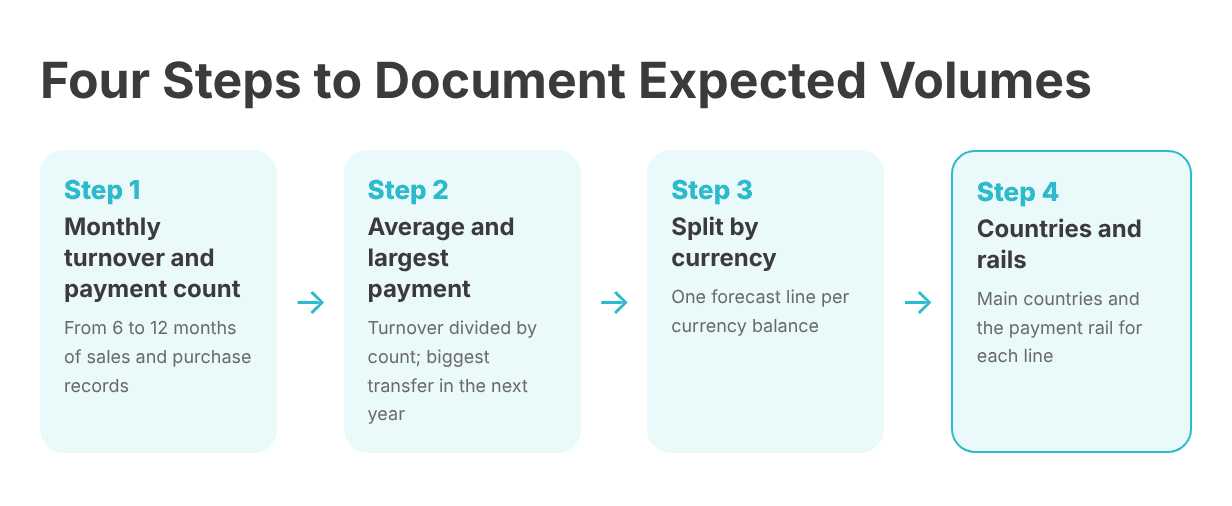
A volume forecast takes four steps:
Calculate monthly turnover and payment count from 6 to 12 months of sales and purchase records.
Work out the average payment, then identify the largest single transfer expected in the next year.
Split the forecast by currency.
Assign the main countries and the payment rail to each currency line before submitting the application.
The steps follow the order of the typical KYB onboarding process, so the answers transfer straight into the application form.
Step 1: Monthly Turnover and Payment Count
Monthly turnover is the sum of expected incoming and outgoing payments over a month. The best base is 6 to 12 months of sales records and purchase ledgers, and a company with no trading history relies on signed contracts and its business plan instead.
Payment count comes from the same records. Forty invoices a month at £1,500 each makes £60,000 of turnover over 40 payments, and both numbers go into the expected turnover business account application. One tip saves time: pull the count straight from the ledger, because a round "about 50" rarely survives a cross-check.
Step 2: Average and Largest Single Payment
The average payment is turnover divided by the payment count. The largest payment is the biggest single transfer expected within the next 12 months, such as an annual licence fee or a stock purchase.
Applicants tend to underrate the second figure. An average of £4,000 with one annual invoice of £45,000 is a normal profile for a small importer. The identical transfer inside an account declared as tiny raises questions. Naming it in advance removes the surprise. A single line with the reason and the likely month is enough.
Step 3: Split the Forecast by Currency
The currency split turns one turnover total into a separate forecast per currency. A company that bills £60,000 a month in sterling and €35,000 in euros declares two lines, plus a third for its $20,000 of dollar revenue.
This is the shape a KYB transaction forecast takes for GBP and EUR flows, and for USD where it applies. Each currency has its own counterparties, so a combined total hides the detail that reviewers look for. Converting everything into pounds before declaring it has the same effect.
Step 4: Countries and Payment Rails
The last step adds geography. Each currency line lists the main countries and the rail: Faster Payments for GBP, SEPA for EUR and SWIFT for USD and most other currencies.
Rail matters because settlement and monitoring differ by route. SWIFT payments pass through correspondent banks, so a transfer to Singapore and one to Texas can look very different on the account. If a line names a country with a higher risk rating, expect a follow-up question about the counterparty.
Sample Forecast Table for a Multi-Currency Account
The table below shows an illustrative forecast for a fictional UK software company. The figures show structure only and carry no recommendation on size.
Currency | Monthly volume | Payments per month | Average payment | Largest payment | Main rail |
|---|---|---|---|---|---|
GBP | £60,000 | 45 | £1,333 | £8,000 | Faster Payments |
EUR | €35,000 | 20 | €1,750 | €6,000 | SEPA |
USD | $20,000 | 8 | $2,500 | $7,500 | SWIFT |

Read the table row by row. The sterling line carries the bulk of the volume, driven by 45 small subscription receipts. The euro line is thinner but steadier, since it covers a handful of agency contracts in Germany. Dollar payments are few, and each one is large.
What is a multi-currency account? One account that holds several currency balances, each with its own local payment details. A forecast for such a business account mirrors that layout, with one line per balance. The same company with the same turnover looks clearer on three lines than on one.
[aa cta]
Open a Multi-Currency Business Account
EQWIRE business accounts hold balances in several currencies and send payments over local rails and SWIFT. Applications start on the sign-up page, where the company submits its details and documents for review.
[aa btn]Open an Account[/aa]
[/aa]
Documents That Support the Forecast
Documents turn declared numbers into evidence. A short file of the right papers heads off most follow-ups.
Customer contracts and purchase orders: show expected inflows
Supplier invoices and agreements: show expected outflows
Bank statements from 3 to 6 months: show real trading volume at another bank
Management accounts or a business plan: support the forecast for a new company
Tax filings or annual accounts: confirm annual revenue
Compliance teams typically cross-check the forecast against these papers. A declared yearly turnover of £10 million next to £400,000 in filed accounts is the sort of gap that produces a request for an explanation.
Matching Documents to Each Forecast Line
Every forecast line should point to at least one document. The sterling line might cite twelve months of invoicing exports. The euro line cites the two framework agreements with German clients, and the dollar line cites a single licence contract. A reviewer who can trace every number to a paper has little left to ask.

Special Cases: Owners Abroad and Group Structures
Companies with owners abroad may need further ownership papers, as the guide to business account setup for groups with non-UK UBOs explains. Non-resident founders face a similar path. The guide to a UK business account for a non-resident covers what providers typically ask.
In practice, a finance manager at a UK agency with five clients can assemble the whole file in about two hours: five contracts, six months of statements and last year's filed accounts. Supporting documents rarely need to be complicated. They need to match the declared numbers line by line.
Common Mistakes in KYB Transaction Forecasts
Most forecast problems come from three habits: guessing, averaging and omitting. Each produces a profile that fails the consistency check.
Round Numbers Without a Basis
A forecast of £1,000,000 a month across 100 payments looks like a placeholder. Reviewers read many applications, and a number with no calculation behind it invites questions.
A figure built from 12 months of invoices reads as real, even at £847,320.
Ignoring Peak Months and One-Off Payments
Seasonal businesses, such as retail before Christmas or agriculture at harvest, often declare the yearly average and ignore the peak, and a month that runs at three times the declared level may trigger a review.
The fix is simple. Declare the typical month, then add the peak: "£50,000 normally, up to £150,000 in November". One-off events deserve the same treatment. A planned equipment purchase, a tax payment or a refund wave can each be mentioned in a sentence with a date range. An industrial exporter handling deposits and refunds is a good example of lumpy flows that need this note.

Leaving Out One Currency
A company that sells in sterling and pays a euro supplier but never declares euros will see its first euro payment compared against a profile that excludes it. Software licences paid in dollars create the same gap.
Before applying, a business also checks that the account covers every currency it needs.
How to Update Declared Volumes After Onboarding
Declared volumes can change after onboarding. The usual route is a message to the provider's support or compliance team with the new figures and the reason for them. The reason carries more weight than the number: a new contract, a new market or a growth plan all qualify.
A business that expects to exceed its declared volume contacts the provider before it happens. Waiting until the account is flagged turns planning into explaining.
Providers typically review volumes on a schedule and whenever activity departs from the forecast. They may ask for fresh papers. A growing company can run a quarterly check of actual figures against the declared ones, and the team that owns payments can set that reminder.
Approval workflows help here too. Where two people sign off every transfer, as in a maker-checker payment workflow for a UK finance team, an unusually large payment gets a second look before it leaves the account. That review is the natural moment to ask whether the declared volume still fits.
FAQ
What transaction volume information should a UK company prepare for account due diligence?
A UK company preparing for account due diligence should hold six figures: monthly turnover, payment count, average and largest payment, currency split and main countries. Supporting papers such as contracts and recent bank statements usually follow. A short description of the business model completes the set. Providers differ on format, so the application form sets the final list.
How do EMIs use expected transaction volumes during onboarding?
EMIs use expected transaction volumes to set a risk rating and a monitoring baseline for each new business. A £150,000 transfer in an account declared at £20,000 a month stands out against that baseline. Reviewers may ask about it before they release the payment.
Does a business need to forecast EUR and USD payment volumes for KYB?
A business that expects to send or receive euros or US dollars should include both in the forecast. A currency left out of the declaration meets an unprepared profile when the first payment arrives. One short line per currency with volume and countries is enough.
Can a UK company update its declared transaction volumes later?
Yes, a UK company can revise the numbers it declared by writing to the provider with the new figures and the reason. Typical reasons include a growth plan and a new customer contract. The provider may request supporting papers before it adjusts the profile or any limits.
Companies that document their volumes well complete KYB onboarding with fewer questions and open the account with a profile that matches its use. A forecast built from invoices and backed by contracts takes an afternoon and saves repeated requests. Businesses that want to check the rules before applying can read EQWIRE's eligibility and acceptance policy, and the EQWIRE sign-up page starts the application.
Reviewed by
Related Articles
How to Document Expected Transaction Volumes for a UK Multi-Currency Account

UK Payment Account for a Company with Several Licensed Activities and One UK Entity

UK Multi-Currency Account for a UK Procurement Group with Separate Entity Billing

UK Business Account for an Industrial Exporter Managing Deposits, Refunds and Final Invoices

Power your payments
with EQWIRE
Create your account in minutes and experience smooth, secure global payments.
" height="9.0156px" id="LIcbdboyB" transform="translate(4.987 4.5)" width="9.01562px"/></svg>)