•
•

UK Payment Account for a Delaware Company with UK SaaS Revenue
[aa disclaimer]
Legal Disclaimer: This article is for informational purposes only and does not constitute legal, financial, compliance, or tax advice. Banking eligibility, regulatory requirements, and provider policies vary by jurisdiction. Consult qualified professionals before making decisions.
[/aa]
A UK customer paying a Delaware SaaS company in sterling creates more than a currency question. Finance teams must decide which account receives the money, whether GBP can remain available for UK invoices, and how each PSP settlement will reach the ledger. A UK payment account for a Delaware company with UK SaaS revenue can provide local GBP collection and payment functionality without automatically creating a UK company.
The practical answer for this UK payment account for Delaware company with UK SaaS revenue is qualified: an eligible Delaware company may collect GBP and pay UK vendors from a GBP balance when the provider supports the entity, the payment rails and the expected activity. This guide covers the application evidence, account setup, vendor-payment controls and reconciliation workflow.
[aa key-takeaways]
Key Takeaways
Prepare Delaware formation, ownership, director, business-model and source-of-funds evidence before the KYB review.
Match the legal entity name across GBP details, invoices, checkout settings and PSP settlement instructions.
Use a GBP balance for eligible UK vendor payments to reduce avoidable GBP-to-USD-to-GBP conversions.
Select Faster Payments, Bacs or CHAPS according to value, timing and provider support.
Treat a payment account as different from a UK bank deposit account, and review UK nexus questions separately.
[aa btn]Book a Call[/aa]
[/aa]
UK payment account for Delaware company with UK SaaS revenue — the pre-application check
A pre-application review should establish whether the company, ownership chain and payment pattern fit the provider’s acceptance criteria.
Confirm the legal entity and ownership chain
The application should name the exact Delaware corporation or LLC receiving customer funds. Legal name, formation state, registration number, tax identifier and operating address should match incorporation records.
The ownership chain should be clear. Directors, authorised signatories and ultimate beneficial owners (UBOs) may be reviewed even when they live outside the United States or the UK. Any parent or intermediate holding company should be explained.
Confirm UK customer and vendor flows
The provider needs a coherent explanation of why GBP enters and leaves. A SaaS business may receive subscriptions, settle PSP proceeds and pay UK contractors or vendors.
The expected flow should include monthly count, average ticket, largest payment, refund pattern and main counterparties.
Define currencies, monthly volumes and payment rails
The operating plan should separate GBP customer collections, USD operating costs, other currency flows and cross-border SaaS payments. It should identify whether the company needs a local account number and sort code, wires, batch payments or accounting exports.
The result is a short eligibility brief covering entity, owners, flows, currencies, volumes and rails. It helps assess a GBP business account for a US company without assuming that every foreign company qualifies.
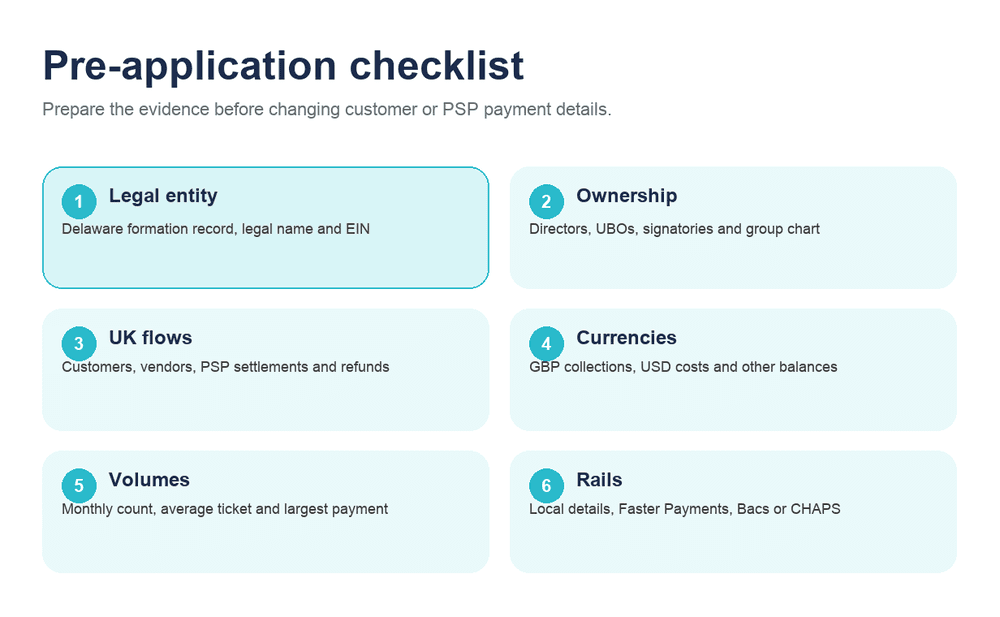
Documents needed for a US company to open a UK payment account
A provider reviews the legal entity, controllers, activity and expected transactions together. The related question of what documents are needed for a UK payment account is answered by a complete KYB file rather than a single certificate.
Corporate documents checklist
The core file usually includes:
Certificate of Incorporation or equivalent Delaware formation record.
Certificate of Good Standing when available and current.
EIN confirmation and company registration details.
Articles, operating agreement or constitutional documents.
Registered address and operating address, if different.
Board or member authority for the account signatory where required.
Business.gov.uk guidance notes that overseas-company onboarding can require company, director, address and business information, with additional checks for a company formed outside the UK. The exact list remains provider-specific.
UBO, director and authorised signatory evidence
The file should include identity and residential-address evidence for directors, UBOs and authorised users requested by the provider. Ownership percentages should reconcile across the application, formation documents and any group chart.
Approval rights should also be clear: a finance manager may prepare payments while a director releases them. This supports maker-checker controls.
SaaS website, contracts, invoices and source of funds
The website, product description, subscription terms and sample invoices should make the activity legible. Useful evidence includes PSP statements, customer contracts, payout reports, bank statements and a short source-of-funds narrative.
The FCA-authorised EMI / safeguarding distinction should be clear before production. The FCA explains how authorised payment and e-money institutions protect relevant customer funds. The Payment Services Regulations 2017 and Electronic Money Regulations 2011 are the UK legislative references.
UK nexus without overstating tax or permanent-establishment facts
UK customers and UK vendors do not, by themselves, prove that a Delaware company has a UK permanent establishment or must form a UK subsidiary. A UK payment setup is an operational arrangement, not a tax opinion.
If the company establishes a UK place of business or usually carries out business from the UK, GOV.UK guidance on overseas-company registration explains when Companies House registration may be required. Tax, VAT and permanent-establishment analysis should be handled separately by qualified advisers.
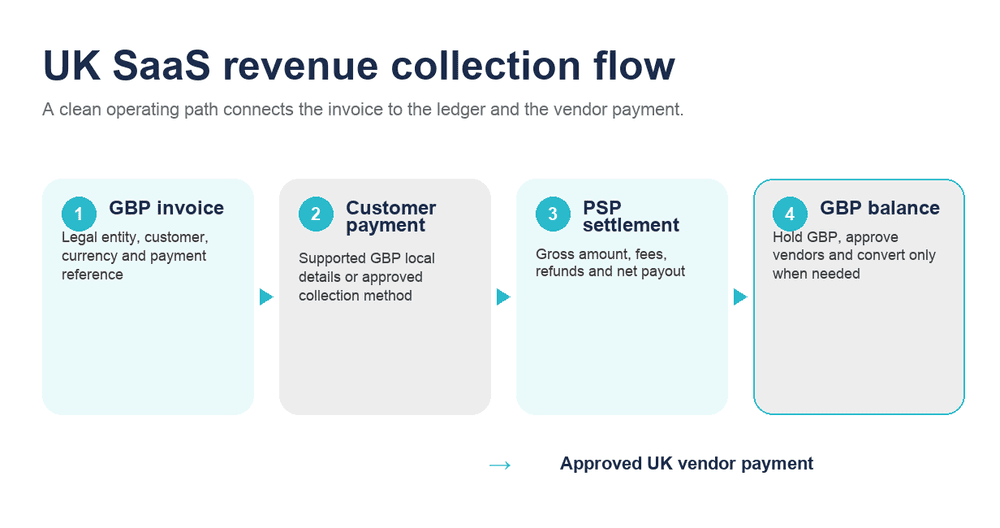
Setup checklist to receive UK SaaS revenue in GBP
To receive UK SaaS revenue in GBP, the company must align its legal name, GBP details, invoices and settlement settings.
Choose the GBP receiving details
UK local GBP payment details usually mean a sort code and account number for domestic payments. Some providers also supply IBAN or BIC details, while others issue virtual account details through a regulated payment account.
The distinction matters. A GBP payment account for a non-UK company may provide local collection details without being a UK bank deposit account. The EQWIRE guide to opening a GBP account for a non-UK company explains the account-model question in more detail.
Before publishing the details, confirm whether the setup can receive GBP from UK clients, inbound payment types, payer-name checks and limits. A sort code is not, by itself, proof of bank status.
Update invoices and PSP payout settings
The invoice and payment processor must point to the same legal entity and receiving account. Templates should show the Delaware legal name, GBP currency, payment details and reference.
The practical question of how do US SaaS companies bill UK customers in GBP is answered through GBP pricing, clear invoices, supported collection and a compatible PSP destination.
Set naming conventions and payment references
Every invoice should have a stable identifier that appears in the PSP report and, where supported, the account payment reference. A recurring customer can then be matched by invoice number, payer name, gross amount, fees and net settlement.
Keep USD collections and GBP collections clearly separated
A USD business account UK may be useful for US payroll, US vendors or USD processor settlements. It should not replace GBP details when UK customers or vendors expect domestic sterling payments.
The account map should state which balance receives each corridor and when conversion occurs. This lets the setup hold GBP without forced conversion when permitted, then convert only the amount needed for USD obligations.
Pay UK vendors from the same GBP balance
Yes, potentially. A Delaware company can receive GBP from UK customers and use that balance to pay UK vendors if an eligible provider supports GBP receiving details and outbound UK payments for the entity. The company must still pass KYB, confirm rail access and limits, and reconcile invoices, fees and payment references.
For the question can a Delaware company collect UK SaaS revenue in GBP while paying UK vendors, the operating sequence is:
Issue the UK customer invoice in GBP.
Settle the payment into supported GBP details.
Approve and send the UK vendor payment through the available rail.
Match the payment confirmation to the invoice and ledger.
Faster Payments for routine UK supplier invoices
Faster Payments is the usual rail to discuss for routine sterling transfers between UK accounts, but access, cut-offs and limits depend on the provider. It can suit approved supplier invoices, contractor payments and recurring operating costs when the beneficiary details have been verified.
The Bank of England’s payment-system access guidance explains that non-bank payment service providers may access Bacs, Faster Payments and CHAPS through direct or indirect arrangements. An end customer’s available service can still be narrower.
[aa fast-fact]
Fast Fact: Bacs, Faster Payments and CHAPS are the UK rails most relevant to this workflow.
[/aa]
Bacs and CHAPS for scheduled or high-value payments
Bacs can fit scheduled or batch-style payment processes. CHAPS is designed for high-value, time-critical sterling payments and operates differently from routine supplier transfers. The Bank of England CHAPS overview describes CHAPS as a same-day, high-value system.
The provider’s current terms should confirm whether each rail is available inbound, outbound or both directions.
Approval, batch upload and reconciliation controls
A controlled payment run follows a repeatable sequence:
approve the supplier invoice;
verify beneficiary name and account details;
prepare the payment or batch file;
apply maker-checker approval;
submit through the supported rail;
retain confirmation and payment reference;
match the debit to the invoice and ledger.
The EQWIRE SaaS payment infrastructure article covers GBP receipts, other currency balances and contractor payouts. The benefit is a documented flow from revenue to approved expenditure.
[aa cta]
Assess GBP collections and vendor payments
An account assessment can map the Delaware entity, UK flows, supported rails and controls before billing details change.
[aa btn]Create Account[/aa]
[/aa]
USD business account UK or multi currency business bank account?
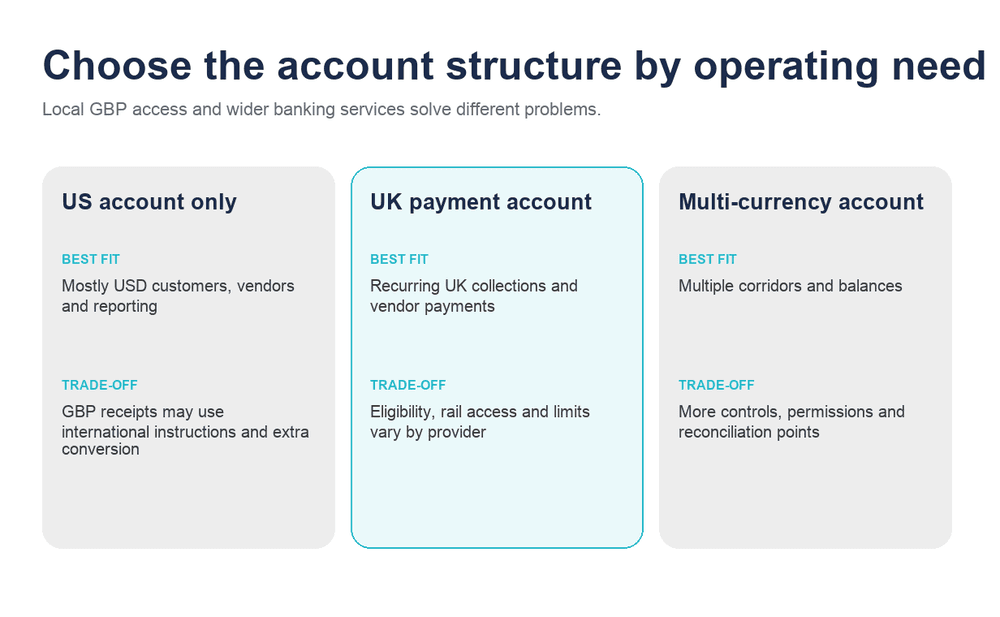
The right structure depends on revenue, vendor currencies and required bank services. A US-only account, UK payment account and multi-currency payment account solve different problems.
Decision checklist by currency mix
A US-only model can work when customers, vendors and reporting are mainly in USD. Local GBP details matter more when UK receipts recur or vendors expect domestic sterling payments.
A multi currency business bank account can centralise GBP, USD and other balances. A multi-currency payment account may provide similar functionality, but the legal model, safeguarding terms, cards, credit and deposit protection can differ.
Account access, conversion and provider model
The decision should compare:
Model | Best fit | Main trade-off |
|---|---|---|
US account only | Predominantly USD operations | GBP receipts may require international payment instructions and extra conversion |
UK payment account with GBP details | Recurring UK collections and vendor payments | Eligibility, rail access and limits are provider-specific |
Multi-currency account | Multiple corridors and balances | More controls, permissions and reconciliation points |
For a GBP business account for a US company, the key questions are local details, inbound payment types, outbound UK rails and permitted activity. For a multi-currency payment account, the same questions apply across every currency.
Bank, EMI and fintech account limitations
A bank deposit account, an FCA-authorised EMI and a fintech interface are not interchangeable terms. EMI funds are safeguarded under the applicable rules; they are not automatically deposits covered by the Financial Services Compensation Scheme.
The FCA explains the difference through its safeguarding requirements for payment and e-money institutions. EQWIRE operates as an FCA-authorised EMI environment for eligible businesses, subject to its onboarding and product terms. Account capabilities should be confirmed before a company relies on them for critical collections.
Reconciliation workflow for UK SaaS revenue
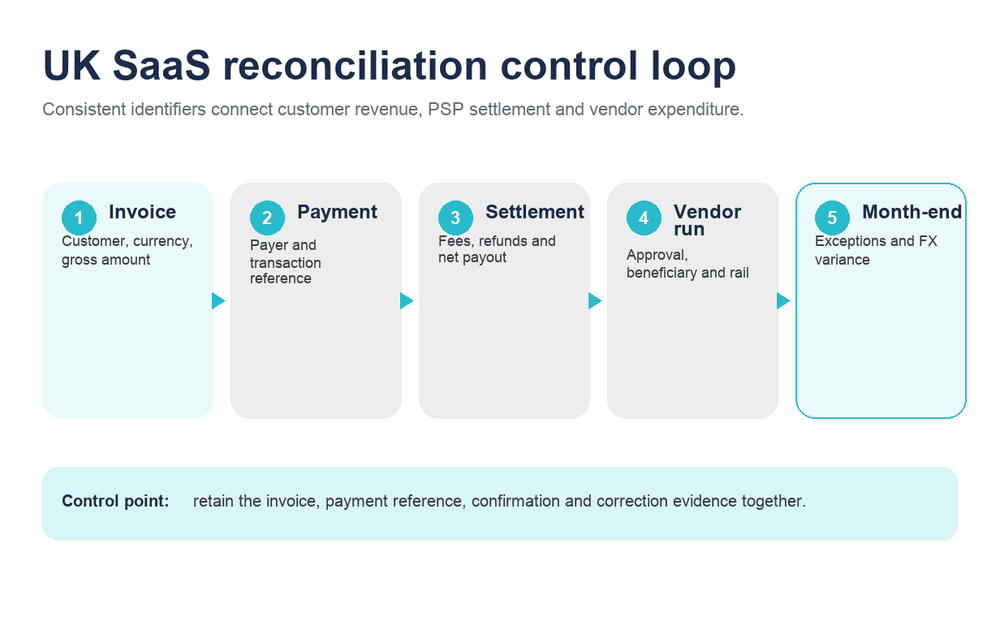
Reconciliation improves when invoices, PSP settlements and vendor payments carry consistent references. GBP invoicing can reduce currency mismatches, but it does not remove fees, refunds, chargebacks, tax analysis or FX variance.
Invoice → customer payment → PSP settlement
The first reconciliation link is between the invoice issued and the net settlement received:
Record the invoice number, customer, currency and gross amount.
Match the customer payment or PSP transaction ID.
Record processing fees, refunds and chargebacks.
Match the net payout to the GBP account statement.
Post the settlement date and any currency conversion separately.
GBP balance → UK vendor payment
A GBP vendor invoice can be matched directly to a GBP balance when the provider supports the required UK rail. The finance team should retain the beneficiary record, approval evidence, payment reference, confirmation and invoice status.
The question does invoicing UK customers in GBP improve SaaS reconciliation and conversion has a qualified answer. GBP pricing can reduce customer-side surprises and simplify matching, while conversion and reporting decisions remain with the company.
Month-end exceptions and FX variance
Month-end exceptions usually arise from timing, reference or currency mismatches. A payout may arrive after the invoice period, a refund may reduce a later settlement, or a conversion may create a realised FX variance.
An exception log should record the original transaction, correction, approval and supporting evidence. The EQWIRE article on a UK account for non-residents provides related context on account access and documentation. Related guidance on paying international contractors covers entity naming and vendor-payment planning.
Common setup errors for a Delaware SaaS company
Most avoidable failures come from a mismatch between the application story and later activity. A company may describe software sales during KYB, then route unrelated funds or unexpected high-value payments through the account.
Using a personal or unrelated entity account
Customer receipts should reach an account held for the same legal entity named on the invoice. Personal accounts and accounts belonging to another group company create ownership, tax and reconciliation problems.
Presenting a UK address without a clear operating rationale
A virtual address or UK customer address should not be presented as proof of a UK establishment. The application should distinguish registered address, operating address, directors’ residences and customer locations.
Treating local payment details as proof of a UK bank deposit
Local GBP details can improve payment routing without changing the provider’s legal status. Safeguarding, deposit protection, card availability, lending and account closure processes should be reviewed separately.
Omitting expected UK vendor payments from the application
The intended US company UK business account use case should include both inflows and outflows. UK contractors, hosting suppliers, software vendors and tax advisers can form part of the expected activity even when customer revenue remains the main source of funds.
The correction is practical: prepare a consistent entity profile, publish verified payment details and check the first cycle before scaling.
FAQ
What does a US company need to prepare for a UK payment account?
The answer to what is needed for a us company to open a uk payment account is formation and good-standing records, EIN evidence, constitutional documents, director and UBO identification, addresses, a website, SaaS contracts, sample invoices, expected volumes and source-of-funds evidence. Provider eligibility, account terms and rail support still determine approval. A professional adviser should review any UK tax or establishment question separately.
Can a Delaware company collect UK SaaS revenue in GBP while paying UK vendors?
Yes, potentially, when an eligible provider supports GBP receiving details and outbound UK payments for the Delaware entity. The company can invoice in GBP, receive the settlement, approve a vendor payment through Faster Payments, Bacs or another supported rail, and reconcile the reference. Provider limits, beneficiary checks and compliance review still apply.
How do US SaaS companies bill UK customers in GBP?
US SaaS companies can set GBP prices, issue GBP invoices and route PSP settlements to supported UK local payment details or another approved GBP account. The invoice should identify the Delaware legal entity, payment reference and currency. PSP availability, contract terms, VAT treatment and provider eligibility require separate review.
Does invoicing UK customers in GBP improve SaaS reconciliation and conversion?
Often, GBP invoicing can reduce customer-side currency uncertainty and simplify matching between invoices, settlements and UK vendor payments. It does not remove FX variance, processor fees, refunds, chargebacks or tax-accounting work. The outcome depends on customer mix, PSP configuration and the company’s reporting policy.
A UK payment account for Delaware company with UK SaaS revenue is an operational choice, not an automatic outcome. A suitable provider may give an eligible Delaware SaaS company local GBP details, a GBP balance and supported UK payment rails without requiring a UK subsidiary solely for collection. The company still needs a complete KYB file, clear entity naming, documented source of funds and a controlled approval process.
The strongest setup connects customer invoices, PSP settlements, GBP balances and vendor payments in one reconciliation trail. A separate USD account can remain useful for US obligations, while GBP remains available for UK costs. Companies assessing this structure can review the flow and account requirements with EQWIRE.
Reviewed by
Related Articles


Power your payments
with EQWIRE
Create your account in minutes and experience smooth, secure global payments.
" height="9.0156px" id="LIcbdboyB" transform="translate(4.987 4.5)" width="9.01562px"/></svg>)