•
•

Articles
Named IBAN for UK B2B Invoice Collections: Practical Operating Guide
[aa disclaimer]
Legal Disclaimer: This article is for informational purposes only and does not constitute legal, financial, compliance, or tax advice. Banking eligibility and regulatory requirements vary by jurisdiction, as do provider policies. Consult qualified professionals before making decisions.
[/aa]
Large UK businesses took an average of 32 days to pay suppliers in 2025, and 15% of their invoices were paid late. Slow payers are only half of the cash problem. The other half starts when the money finally lands with a reference like "INV" or "PAYMENT 03", and nobody in accounts receivable can tell which of 300 open invoices it settles.
This guide gives the named IBAN for UK B2B invoice collections explained from the operating side. Such an IBAN carries the firm's registered legal name, so the payer's bank displays that name during its pre-payment check and funds land in an account the business visibly owns. Add a dedicated sub-number for each large client, and the finance team knows the sender before opening the reference field.
The account-opening side is covered in a separate guide to getting a named IBAN business account in the UK. The sections below cover what happens after approval: setup, invoice wording, daily matching and the errors that leave cash unallocated.
[aa key-takeaways]
Key Takeaways
A named IBAN shows the company's own legal name to the paying bank, which lets UK Confirmation of Payee and EU Verification of Payee checks return a full match.
Six setup steps lead to the first reconciled payment within 2–4 weeks.
GBP invoices need a sort code and account number, while EUR invoices need the IBAN and BIC printed in the exact account name.
One virtual IBAN per corporate customer turns the receiving number into the matching key.
Five recurring errors, from trading names on invoices to stale bank details in templates, account for most unallocated receipts.
[aa btn]Book a Call[/aa]
[/aa]
Named IBAN for UK B2B Invoice Collections Explained
A named IBAN is an International Bank Account Number issued in the account holder's own legal name. Payers see that name when their bank runs a payee check, and the receiving provider books the credit straight to the company's balance.
The alternative is a pooled account. In that model, the provider holds one IBAN in its own name and tells each client to add a reference so incoming money can be attributed. When that code is missing or mistyped, the payment waits in a suspense queue until someone traces it.
A dedicated IBAN is the term some providers use for the same arrangement. The label matters less than two checks: whose name is registered against the number, and whether the IBAN serves one client only.
Named, Pooled and Virtual IBANs in One Table
Unlike a pooled IBAN, a named IBAN needs no reference to reach the right company. A virtual IBAN goes one level further and identifies the individual payer.
Feature | Pooled IBAN | Named IBAN | Virtual IBAN (per customer) |
|---|---|---|---|
Account name shown to payer | Provider's name | Company's legal name | Company's legal name (provider-dependent) |
How the credit is attributed | Payment reference | IBAN itself | IBAN identifies company and payer |
Name-check result (CoP / VoP) | Often "no match" | Match | Match when configured correctly |
Manual matching effort | High | Medium | Low |
Typical fit | Low volume, one-off payers | Steady B2B receipts | Many repeat corporate payers |
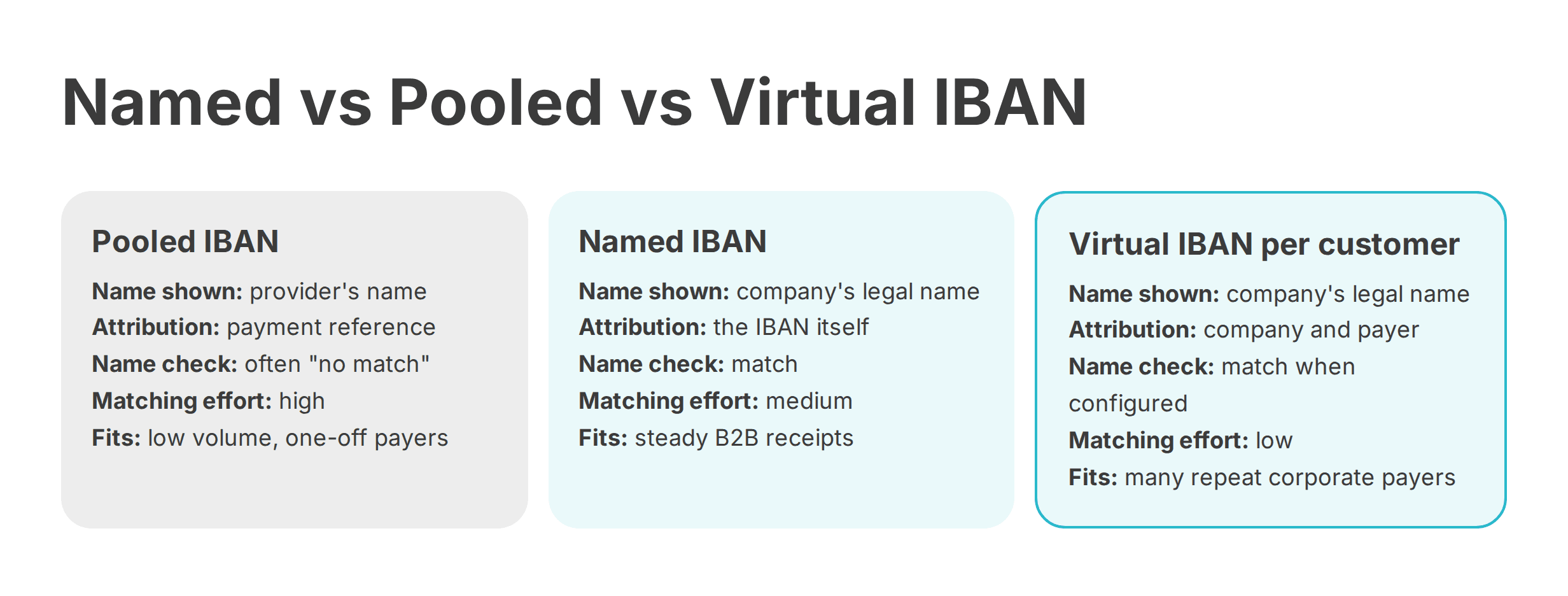
In practice, a named IBAN answers the payer's question of whose account this is. The virtual layer tells the finance team who sent the money.
When a Named IBAN Is Worth It for a UK Company
A named setup pays off once a business collects more than about 30 B2B payments a month or bills customers based in the euro area. Smaller volumes usually work with a spreadsheet plus a strict reference policy.
Every UK bank account already carries a GB IBAN of 22 characters, built from the sort code and account number. Domestic sterling payers still key in those two UK details, while EU payers need the full IBAN. An iban business account with a EUR IBAN in the company's name removes the need for EU customers to pay into a sterling account through SWIFT.
Open Business Account IBAN: Setup in 6 Steps
These six steps take a finance team from an approved account to a first reconciled payment. Most companies finish them in two to four weeks, with customer notice periods setting the pace.

Step 1. Map Payers by Currency and Rail
Start with the last 12 months of receipts. Group them by currency and payment method. UK customers normally pay GBP by Faster Payments or Bacs, with CHAPS for high-value same-day sterling transfers.
EUR customers pay by SEPA Credit Transfer, and SEPA Instant makes funds available within ten seconds. USD and other currencies arrive through SWIFT. The currency split decides which IBANs the account needs.
Step 2. Choose the Account Structure
A distributor with 40 trade clients can run one GBP account and one EUR IBAN in its own name. At 400 buyers, per-payer virtual IBANs routed to the same pot save far more hours.
Groups with several legal entities need a multiple IBAN business setup, with a separate named IBAN for each entity. One shared IBAN breaks the name check for one entity.
Step 3. Pass Onboarding and KYB
Know-your-business checks cover the certificate of incorporation, the register of beneficial owners and expected monthly volumes. Providers also ask for source of funds documents and a description of the customer base.
Stating the expected number of payers and the currency split at this stage avoids a second review later, when virtual IBAN volumes grow.
Step 4. Update Invoice Templates and Remittance Details
Replace the payment block on every invoice template, including the templates inside the billing system and the PDF footer. Print the legal name exactly as it appears on the account, followed by the currency-specific details covered in the next section.
Add one line asking payers to quote the invoice number. With per-customer IBANs, the IBAN itself does the matching and that line serves as a backup.
Step 5. Notify Customers and Run a Test Payment
Send a change-of-bank-details letter on company letterhead at least 30 days before the old account stops receiving funds. Include a phone number for verbal confirmation, because many corporate payers now refuse email-only changes to prevent fraud.
Ask one customer for a £1 or €1 test. The test confirms the name check result and the booking of the credit.
Step 6. Connect the Account to the Accounting System
Link the account to Xero, QuickBooks, Sage or NetSuite through a bank feed, or schedule a daily statement export. Map each virtual IBAN to the customer record so the accounting system can suggest matches automatically.
Teams with their own tooling can pull statements through a payments API and post receipts to the ledger several times a day.
[aa cta]
Collect GBP and EUR Invoices into One Named Account
Receive sterling and euro credits under the company's own legal name, with IBANs ready to print.
[aa btn]Open a Business Account[/aa]
[/aa]
IBAN for Receiving Customer Payments UK: What to Put on the Invoice
The payment block on a B2B invoice needs five fields: account name, currency, account identifiers, bank or BIC code, and the payment reference. Each currency uses a different identifier, so one invoice template per currency avoids confusion.
GBP Details vs EUR IBAN and BIC
Field | GBP invoice (UK payers) | EUR invoice (EU payers) |
|---|---|---|
Account name | Exact legal name, e.g. "Northgate Supplies Ltd" | Exact legal name, same spelling |
Identifier | Sort code + 8-digit account number | IBAN (GB or EU format) |
Bank code | Not needed | BIC / SWIFT code |
Rail | Faster Payments, Bacs or CHAPS | SEPA Credit Transfer or SEPA Instant |
Reference | Invoice number | Invoice number (max 140 characters) |
[aa fast-fact]
Fast Fact: An IBAN can run to 34 characters, but a UK IBAN always has exactly 22: "GB", two check digits, a four-letter bank code, a six-digit sort code and an eight-digit account number.
[/aa]
Finance teams can run the printed EUR IBAN through an IBAN validator before the template goes live. A single transposed digit fails the checksum and bounces the first payment.

Name Consistency for Confirmation of Payee and Verification of Payee
Confirmation of Payee (CoP) checks the account name before a UK payment is sent. Pay.UK reported 2 billion CoP checks and 1.9 million a day across more than 100 organisations by March 2024.
The EU introduced Verification of Payee (VoP) for euro transfers. The European Payments Council scheme rulebook entered into force in October 2025, and euro-area payment providers have checked payee names since 9 October 2025.
Both systems return a match, a close match or no match. A trading name such as "Northgate" on the invoice, against "Northgate Supplies Ltd" on the account, can trigger a close-match warning. The payer's AP clerk then pauses the payment and emails for confirmation, which adds days to collection.
Virtual IBAN Account per Customer: Matching Rules for Finance Teams
A virtual IBAN account per customer assigns every client a unique number that feeds the company's main pot. Anything credited to that number belongs to one buyer, whatever the reference field says.
Take a SaaS company with 300 corporate subscribers. Before virtual IBANs, its two-person AR team spent roughly three days each month-end tracing unreferenced receipts. After it assigned one virtual IBAN account for business use to each subscriber, about 90% of incoming money matched to the right customer automatically, and the chasing shrank to half a day. The payment setup for SaaS companies follows the same logic for GBP subscriptions.
A virtual bank account with IBAN routing of this kind still relies on the invoice reference when one buyer has several unpaid bills.
The reference problem will not disappear on its own. The Bank of England dropped its plan to mandate structured remittance data in CHAPS in its July 2026 update, so free-text references will remain common on high-value sterling payments.

Daily Reconciliation Routine
A 20-minute daily routine keeps unallocated cash close to zero:
Download or sync the previous day's statement before 10:00.
Auto-match credits by virtual IBAN first, then check the invoice number against the amount.
Review every credit that matched on the IBAN but not on the amount.
Contact payers about unmatched credits within 48 hours, while their AP team still remembers the payment.
Post confirmed receipts and send remittance acknowledgements the same day.
Handling Part-Payments, Overpayments and Missing References
Part-payments are the most frequent exception in B2B collections. Record the partial receipt against the oldest open invoice unless the customer's remittance advice names a different one, and flag the balance for credit control.
Surplus amounts sit on the payer's record as an overpayment until the payer chooses a refund or an offset. A credit on a virtual IBAN with no reference still identifies the customer, so the AR team can ask one specific contact instead of emailing the whole customer list.
Business IBAN for Corporate Invoice Payments: Common Errors
Most unallocated receipts trace back to five avoidable errors:
Trading name on the invoice. Print the registered legal name exactly as the account shows it, including "Ltd" or "Limited".
Old bank details in one template. Search the billing system and PDF footers for the previous account number before the switch date, then update email signatures too.
One IBAN shared across group entities. Give each legal entity its own named IBAN so the name check matches the invoicing company.
No test payment. Run a £1 or €1 test with one customer before notifying the full list.
Ignoring SWIFT deductions. Intermediary banks can deduct €15–€40 from SWIFT payments, so agree who pays charges in the contract and chase short payments promptly.
Fixing these five items usually takes one afternoon of template work. A business IBAN for corporate invoice payments only works as well as the data around it.
Business IBAN Accounts: What to Check in a Provider
Business IBAN accounts differ most in the details that affect collections. Before signing, ask any virtual IBAN provider to confirm these points in writing:
The account name payers see during CoP and VoP checks
Currencies and rails supported for incoming money, including SEPA Instant
How many virtual IBANs the plan includes and whether an API can create them
Statement formats and whether the full remittance text reaches the export
Cut-off times for same-day crediting in each currency
Safeguarding arrangements for EMI providers
The last point deserves attention. FCA-authorised e-money institutions must safeguard client funds in segregated accounts, and the Financial Services Compensation Scheme does not cover e-money. EQWIRE explains its arrangements on how client money is protected.
EQWIRE offers FCA-authorised business accounts that receive GBP through Faster Payments, Bacs or CHAPS, plus EUR via SEPA, from one environment. Currency availability and cut-off times for each corridor are listed in the currency network.
[aa cta]
Cut Unallocated Cash at Month-End
Give each corporate customer its own payment identifier and match receipts before anyone reads the reference field.
[aa btn]Get Started with EQWIRE[/aa]
[/aa]
FAQ
When is a named IBAN useful for a UK company collecting B2B invoices?
A named IBAN is useful once a UK company receives regular B2B payments from repeat customers, especially EUR payments from the euro area. Around 30 or more incoming payments a month is a practical threshold. Below that, careful references on a standard account usually work. Above it, payee checks pass cleanly. Attribution also stops depending on references.
What is the difference between a named IBAN and a virtual IBAN?
A named IBAN identifies the company that owns the account, while a virtual IBAN identifies an individual payer or purpose within that account. These sub-numbers route incoming funds to one main balance, so a single business can hold hundreds without opening new accounts. Many businesses run both layers together for B2B collections.
Can a UK company issue a separate IBAN to each corporate customer?
A UK company can give each corporate customer a separate IBAN if its provider offers virtual IBANs. That firm generates the numbers through an API and routes every credit to the main account. Contracts should state volume and currency limits.
How does a named IBAN improve invoice matching for finance teams?
A named IBAN improves invoice matching by guaranteeing that every credit belongs to the company, with no provider suspense queue. With a virtual IBAN per customer, the receiving number also identifies the payer, so finance teams match most receipts automatically. The invoice number then only selects the right open item.
Do UK bank accounts have IBAN numbers?
UK bank accounts do have IBANs, and every GB IBAN has 22 characters built from the sort code and account number. Domestic GBP transfers still rely on those two identifiers. The IBAN matters for payments arriving from abroad by SEPA or SWIFT.
A named IBAN for UK B2B invoice collections explained in practical terms comes down to three habits: the legal name on the account matches the invoice, each large customer pays into its own virtual IBAN, and the AR team reconciles every morning. Companies that set this up before the next billing cycle usually see the benefit at the first month-end close. EQWIRE's business account supports named GBP and EUR collections, and account opening starts online through the EQWIRE sign-up page.
Reviewed by

Related Articles


Power your payments
with EQWIRE
Create your account in minutes and experience smooth, secure global payments.
" height="9.0156px" id="LIcbdboyB" transform="translate(4.987 4.5)" width="9.01562px"/></svg>)