•
•

Articles
Payment API for Payroll Providers: Automate GBP Faster Payments and SEPA EUR Runs
[aa disclaimer]
Legal Disclaimer: This article is for informational purposes only and does not constitute legal, financial, compliance, or tax advice. Banking eligibility, regulatory requirements, and provider policies vary by jurisdiction. Consult qualified professionals before making decisions.
[/aa]
On payday, one wrong sort code in a CSV upload can hold up wages for dozens of employees until the next banking day. For platforms processing hundreds of salaries a month, manual bank files remain the single most common point of failure. A payment API for payroll providers removes that step entirely: the platform initiates GBP transfers over Faster Payments and EUR transfers over SEPA straight from its payroll engine, with no file exports and no bank portal logins. Payments settle in seconds instead of days, and every transaction reports its status back through a webhook. This guide covers the account and technical prerequisites, then walks through GBP and SEPA EUR salary runs step by step. It also lists the errors that most often break automated payouts, drawing on the infrastructure a UK Electronic Money Institution (EMI) provides.
[aa key-takeaways]
Key Takeaways
A payment API replaces manual bank file uploads: the payroll engine triggers each salary transfer and receives status updates through webhooks.
GBP salary runs settle over Faster Payments in seconds, 24/7, with a scheme limit of £1 million per payment.
SEPA Credit Transfer reaches EUR accounts by the next business day, while SEPA Instant settles in under 10 seconds across the euro area.
One multi-currency account with an FCA-regulated UK EMI covers both GBP and EUR payouts, with client funds safeguarded in segregated accounts.
Validating sort codes and IBANs before the run, and pre-funding the balance, prevents most failed salary payments.
[aa btn]Book a Call[/aa]
[/aa]
Why Payroll Providers Are Replacing Manual Bank Uploads
Most payroll teams still move salaries the way they did a decade ago: export a CSV from the payroll system, upload it to a bank portal, then wait up to three business days for BACS to clear. The cycle forces payment cut-offs days before payday.
A run submitted on Tuesday lands on Friday. An error found on Wednesday cannot be fixed inside the same cycle.
Teams that automate payroll payments via API skip the file stage completely. The payroll engine calculates net pay, then calls the payment provider for each employee over a REST API integration covering Faster Payments and SEPA. Salary disbursement becomes an event inside the platform's own software rather than a task on a bank's website.
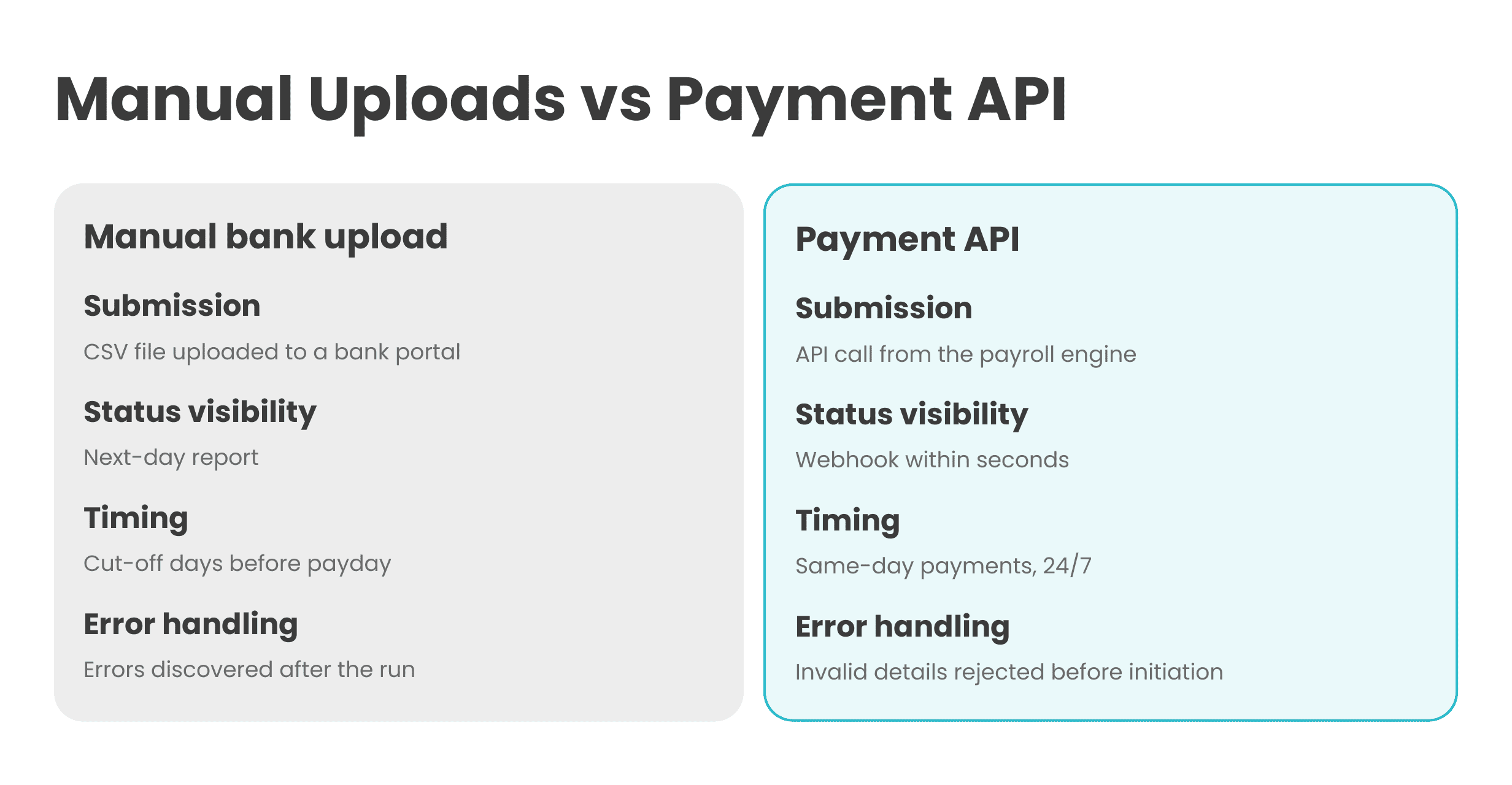
Here is where the two models diverge:
Manual bank upload | Payment API | |
|---|---|---|
Submission | CSV file to bank portal | API call from the payroll engine |
Status visibility | Next-day report | Webhook within seconds |
Timing | Cut-off days before payday | Same-day, 24/7 |
Error handling | Discovered after the run | Invalid details rejected before initiation |
The Real Cost of a Failed Salary Run
A failed salary payment costs far more than the re-run fee. Employees notice missing wages within hours, and support queues fill the same afternoon.
What this means in practice: a staffing agency running weekly pay for 300 temporary workers cannot absorb a bounced file. Workers who miss a Friday payment may not return on Monday, and the agency's client relationships take the damage.
Late wages also create contractual exposure. Employment agreements set pay dates, and repeated misses invite complaints and regulatory attention.
The pattern repeats across the industry: the run itself takes minutes, while cleaning up a failed one consumes days of operations time and a measurable share of monthly support capacity.
What You Need Before Integrating a Payment API
Payroll platforms need three things before the first automated run:
a regulated business account able to hold and send GBP and EUR
API credentials issued for server-to-server access
a tested webhook endpoint for payment status events
Each item sits on a different critical path. Account onboarding involves compliance review and takes the longest, so experienced teams start it first.
Account Setup with an FCA-Regulated EMI
The account is the foundation. A payroll provider API connection only works on top of a business account that supports both GBP and SEPA EUR rails, which is why many platforms choose a multi-currency payroll account with a UK EMI rather than two separate bank relationships.
UK EMIs are authorised by the Financial Conduct Authority under the Electronic Money Regulations. Client money sits in segregated accounts under the Electronic Money Regulations 2011 rather than under FSCS deposit protection, a distinction explained in detail in this guide to safeguarding of client funds in a UK EMI account.
EQWIRE, for example, operates as an FCA-regulated EMI and issues GBP and EUR account access with API credentials from a single onboarding. The compliance review covers corporate documents and ownership structure. Expected payout volumes come up too, so payroll platforms should prepare projected run sizes in advance.
Technical Prerequisites: API Keys, Sandbox, Webhooks
Server-to-server payroll flows use API key authentication. The platform generates a secret key in the account dashboard and passes it as a header on every request, with no per-user OAuth consent screens involved.
In practice, how payroll platforms integrate a UK EMI API to automate GBP Faster Payments and SEPA EUR salary runs depends less on code volume than on testing discipline. A sandbox environment lets engineers simulate full salary runs, including forced failures, before any real money moves.
The webhook endpoint deserves equal attention. Payment status events arrive asynchronously, and the payroll ledger must record each one exactly once, even when the same event is delivered twice.
A short internal runbook helps here. It should name the alert that fires when the webhook stops responding, and state how long the platform waits before escalating to the provider's support desk.
Step-by-Step: Automating a GBP Faster Payments Salary Run
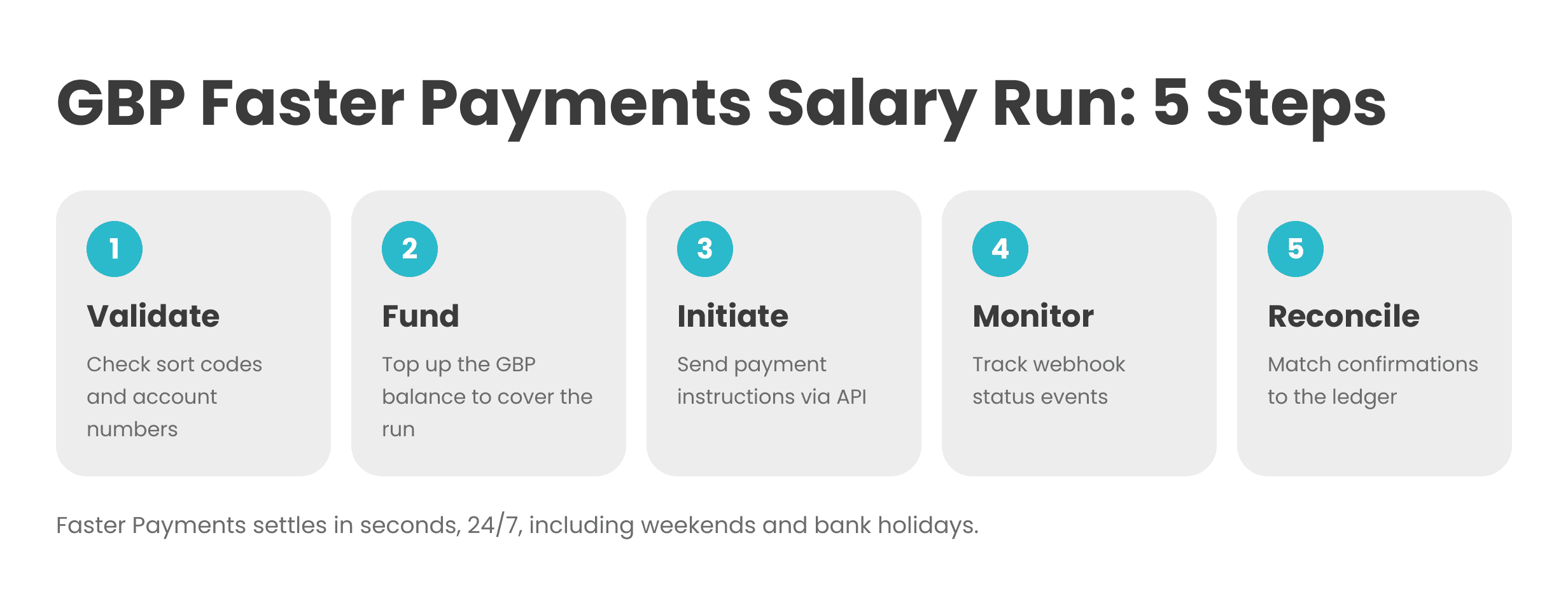
A salary run through a GBP Faster Payments API follows five steps:
Validate each employee's sort code and account number.
Fund the GBP balance to cover the full run.
Initiate one payment instruction per employee, or a single batch.
Monitor webhook events for every payment status.
Reconcile confirmations against the payroll ledger.
Faster Payments is the UK's near-real-time retail rail, running around the clock within the Bank of England's payment and settlement framework. Transfers arrive in seconds on any day of the year.
[aa fast-fact]
Fast Fact: Faster Payments operates 24/7, including weekends and bank holidays, with a scheme limit of £1 million per transaction. Individual providers set their own lower limits.
[/aa]
Step 1–2 — Validate Recipient Details and Fund the Account
Validation happens days before the run executes. The platform checks each sort code against the official sort code directory and runs a modulus check on the account number. Records that fail go back to the employer for correction while there is still time.
Funding follows a simple rule: the available GBP balance must cover the full run value plus a buffer. A staffing agency paying £180,000 every Friday tops up the account on Thursday, then triggers the run once the balance confirms.
Step 3–5 — Initiate, Monitor, Reconcile
The payroll engine sends one payment instruction per employee, each carrying an idempotency key so a retried request never duplicates a salary. Platforms with high volumes group instructions into batch payments and receive per-item statuses back.
Webhooks then do the work a payments clerk used to do. Each payment reports its status as it moves from acceptance to settlement, and failures arrive as distinct events with a reason code. The ledger updates automatically, so teams that automate GBP salary payments via API close payday reconciliation the same evening. The same payment initiation architecture powers multi-currency marketplace payouts, where seller payments follow the identical validate-fund-initiate pattern.
[aa cta]
Automate GBP and EUR salary runs through one API
One EQWIRE account covers Faster Payments and SEPA payouts, with sandbox access and webhook status events for every payment.
[aa btn]Start Integrating[/aa]
[/aa]
Step-by-Step: Running SEPA EUR Salary Payments
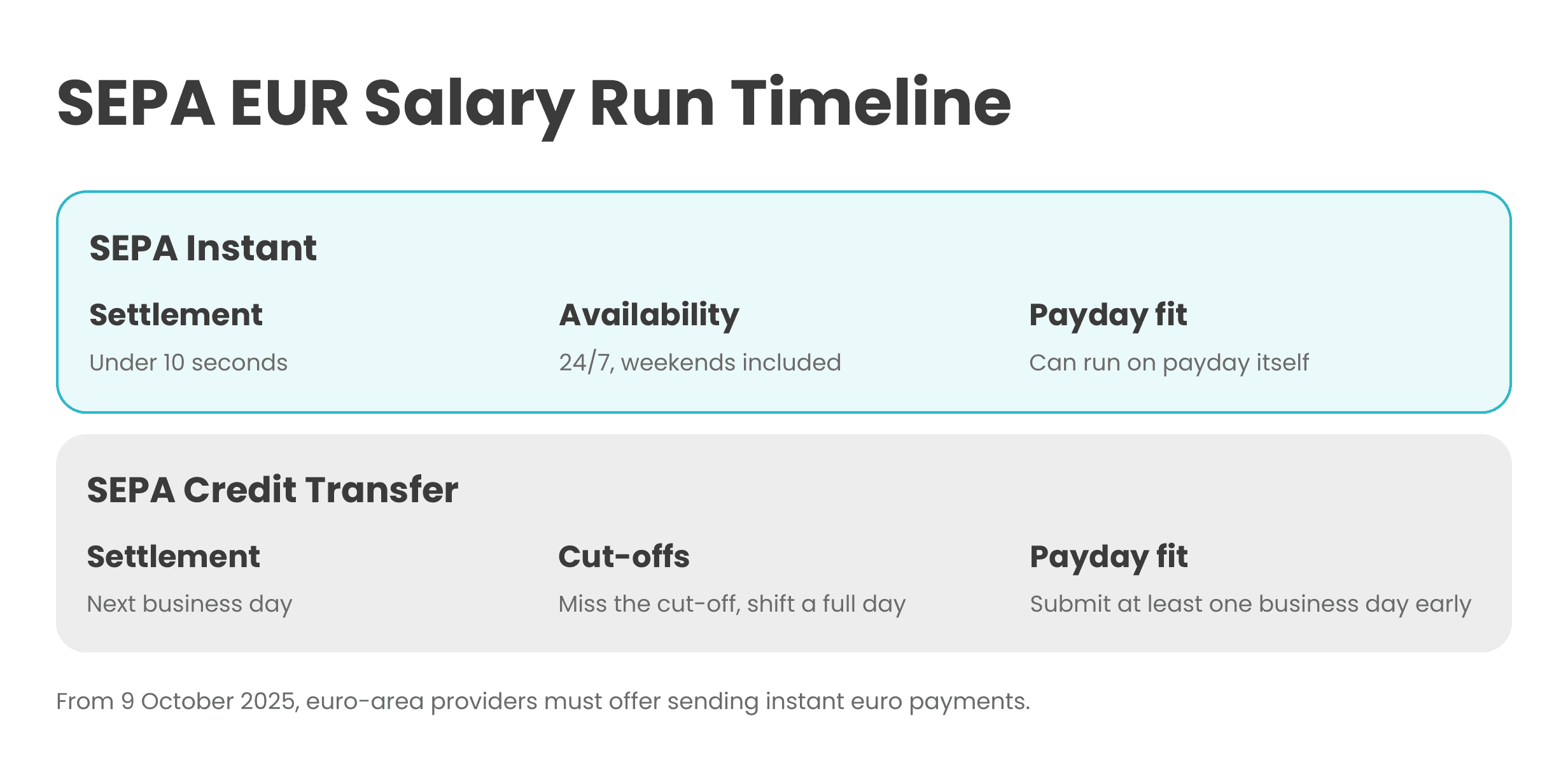
SEPA EUR salary payments run on two rails. SEPA Credit Transfer reaches the employee's bank by the end of the next business day, and SEPA Instant settles in under 10 seconds at any hour, according to the European Central Bank.
Both schemes are managed by the European Payments Council, which publishes the rulebooks that every participating bank and EMI follows. For a payroll platform, the practical difference is scheduling.
SEPA Credit Transfer Timelines and Cut-offs
A standard SCT submitted before the provider's cut-off arrives the next business day. Miss the cut-off, and the payment shifts a full day, which on a Thursday submission means wages land after the weekend.
SEPA EUR salary run automation handles this by scheduling SCT batches at least one business day before payday, or by using instant rails on payday itself. Since 9 October 2025, euro-area providers must offer outbound instant euro payments and verify payee names under the Instant Payments Regulation, and the former €100,000 scheme cap on SEPA Instant no longer applies.
[aa fast-fact]
Fast Fact: From 9 October 2025, EU rules require euro-area payment providers to offer sending instant euro payments and to run Verification of Payee name checks before each transfer.
[/aa]
Handling Multi-Country EUR Payrolls
One EUR IBAN reaches employees in all 36 SEPA countries under identical rules. An HR platform paying staff in Spain, Portugal and Germany runs a single EUR batch from one London-held account, with no per-country bank setup.
The same account structure serves recruitment agencies paying international contractors, where contractor invoices in EUR settle alongside employee salaries. The limitation is scope: SEPA carries euro only, so payrolls in other currencies need separate rails. Marketing agencies distributing client media budgets to publishers and influencers use an identical batch-payment structure — see how agencies manage client budgets and media payouts.
Common Errors in Automated Salary Runs — and How to Prevent Them
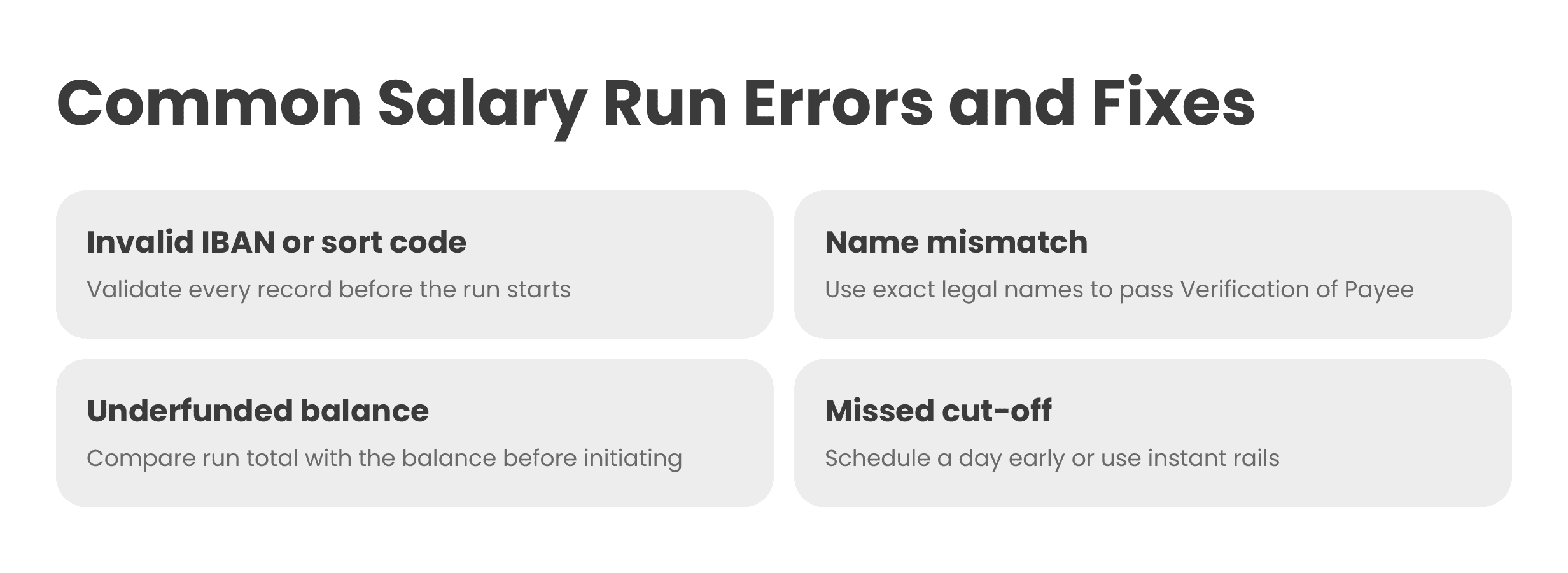
Most failed salary payments trace back to four causes: invalid account details, name mismatches, underfunded balances, and missed cut-offs. All four are preventable before the run starts.
Data Errors: IBANs, Sort Codes, Reference Fields
An IBAN with a failed checksum never reaches the employee, and the rejection may surface hours after submission. Pre-run validation catches this earlier; validating a EUR IBAN before sending a SEPA payment takes seconds and removes the most common EUR failure mode.
Name mismatches now matter more than before. Verification of Payee checks compare the account holder's name with the name on the instruction, and material mismatches trigger warnings or rejections. Payroll data pulled from HR records should match bank records exactly, including legal names rather than nicknames.
Reference fields cause quieter failures. Overlong references and unsupported characters lead some receiving banks to reject or truncate payments, so platforms enforce clean reference formats at input.
Funding and Timing Errors
An underfunded balance stops a run partway through, paying some employees and not others. The fix is procedural: the platform compares the run total against the available balance before initiating the first payment, and blocks the run on a shortfall.
Timing errors concentrate around SCT cut-offs and holiday calendars. TARGET closing days shift EUR settlement, so payday scheduling accounts for both. Failed items should re-enter the queue automatically once the underlying cause clears, driven by webhook failure events rather than manual checks.
Integration Checklist for Payroll Platforms
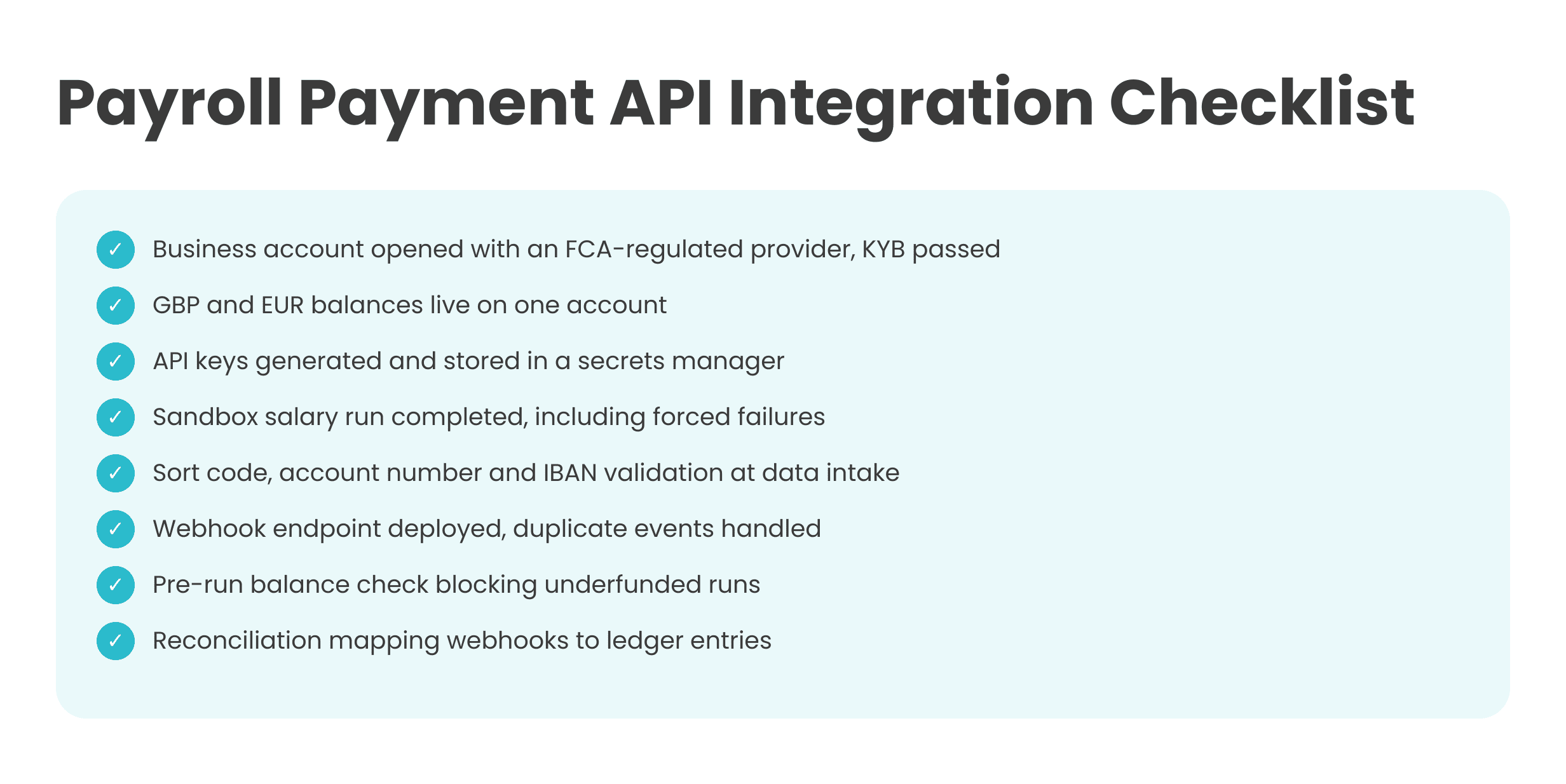
A payout API integration is ready for production when every item below is done:
Business account opened with an FCA-regulated provider and KYB review passed.
GBP and EUR balances live on one account.
API keys generated and stored in a secrets manager, never in code.
Sandbox salary run completed, including forced failure scenarios.
Sort code, account number and IBAN validation wired into payroll data intake.
Webhook endpoint deployed, with duplicate event delivery handled.
Pre-run balance check blocking underfunded runs.
Reconciliation mapping webhook confirmations to payroll ledger entries.
Platforms that clear all eight points move from CSV uploads to same-day automated payouts without a transition period. The checklist also doubles as an audit trail for compliance reviews.
FAQ
How do payroll platforms integrate a UK EMI API to automate GBP Faster Payments and SEPA EUR salary runs?
The integration follows a fixed sequence: open a business account with an FCA-regulated EMI, pass the compliance review, generate API keys, build and test the payment flow in a sandbox, then connect a webhook endpoint for status events. Once live, the payroll engine initiates GBP payments over Faster Payments and EUR payments over SEPA from the same account. Most platforms complete the technical work in days; account onboarding runs in parallel and depends on the compliance review.
How long does payment API integration take for a payroll platform?
Technical integration takes from a few days to a couple of weeks for a typical payroll platform. The API surface is small: authentication, a payment initiation endpoint, a balance check and webhook handling. The longer pole is usually account onboarding, since an FCA-regulated provider reviews company documents and expected volumes before issuing production credentials. Starting KYB and sandbox development at the same time shortens the total timeline.
What details are needed to automate GBP salary payments via API?
Each GBP salary payment needs the employee's sort code, account number, full name, the amount and a payment reference. The sending platform also needs a funded GBP balance and valid API credentials. Providers reject instructions with failed sort code or account number checks before any money moves, so validated banking details at data intake are the main requirement.
Can SEPA EUR salary run automation schedule payments for a specific payday?
Yes. A platform schedules SEPA Credit Transfer batches at least one business day before payday, ahead of the provider's cut-off, so wages land on the correct date. Where the receiving bank supports SEPA Instant, payments settle in under 10 seconds and can run on payday itself, including weekends. Scheduling logic should account for TARGET closing days, which pause standard EUR settlement.
What happens if the account balance doesn't cover the full salary run?
A well-built integration blocks the run before it starts by comparing the run total with the available balance. If a run is initiated regardless, the provider rejects instructions that exceed the balance, and each rejection arrives as a webhook event with a reason code. The platform then tops up the account and re-queues only the failed payments, avoiding duplicates for employees already paid.
Manual bank files made sense when payroll ran on paper timetables. They stop making sense the day a platform's volumes outgrow a CSV upload, and payday becomes a single point of failure. A payment API for payroll providers turns salary runs into software: validated data goes in, and GBP Faster Payments and SEPA EUR salary payments come out with a webhook trail proving every wage arrived. The account layer matters as much as the code, and an FCA-regulated EMI supplies both rails from one integration. EQWIRE provides that combination, with multi-currency accounts and REST API access built for payout automation; platforms ready to test the flow can open an account and start in the sandbox.
Reviewed by
Related Articles

UK Payment Account for a B2B Marketplace with Invoice-Based Supplier Payouts

Sandbox Testing for UK Payment APIs: Faster Payments, SEPA and SWIFT
Payment API for Payroll Providers: Automate GBP Faster Payments and SEPA EUR Runs

REST API for Multi-Currency Payouts: How Marketplaces Can Pay Sellers in GBP, EUR and USD

Power your payments
with EQWIRE
Create your account in minutes and experience smooth, secure global payments.
" height="9.0156px" id="LIcbdboyB" transform="translate(4.987 4.5)" width="9.01562px"/></svg>)