•
•

Articles
Multi-Currency Account for Israel-UK Tech Companies: Hold ILS, USD and GBP
[aa disclaimer]
Legal Disclaimer: This article is for informational purposes only and does not constitute legal, financial, compliance, or tax advice. Banking eligibility, regulatory requirements, and provider policies vary by jurisdiction. Consult qualified professionals before making decisions.
[/aa]
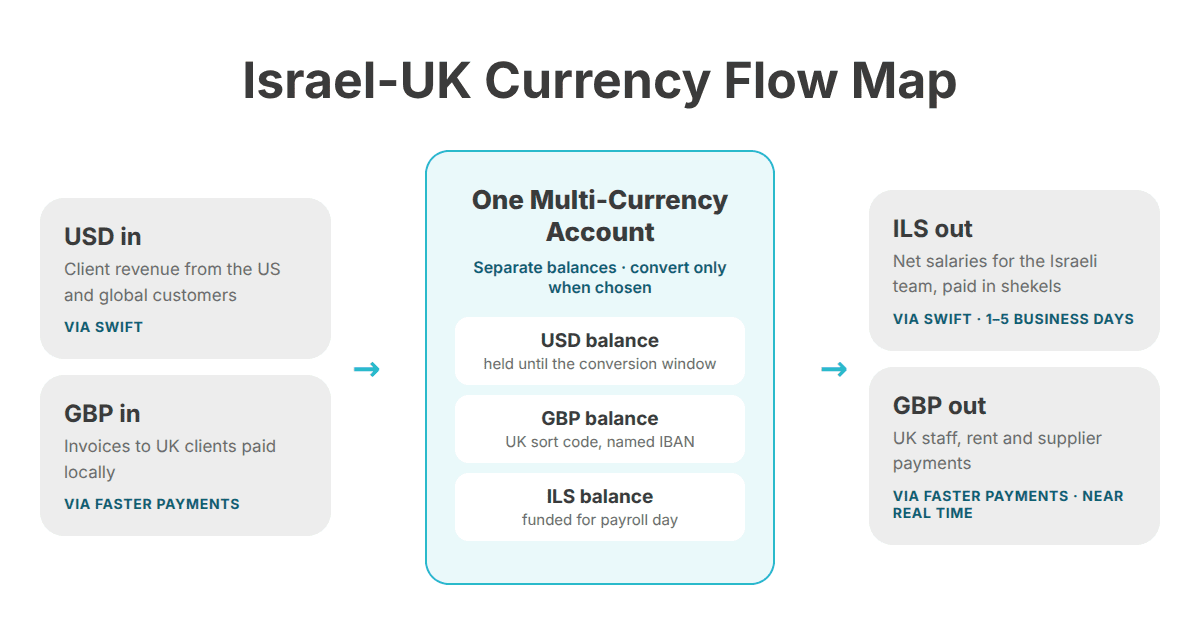
An Israeli software company with a UK entity runs on three currencies at once. Client revenue arrives in USD. Payroll for the Tel Aviv team runs in ILS, while London salaries and office costs settle in GBP. A multi-currency account for an Israel-UK tech company holds ILS, USD and GBP as separate currency balances, so funds convert only when the business decides, at a spread it can see in advance.
When the three currencies sit in three unconnected banks instead, every month-end forces conversions at bank markups that typically reach 2–5% above the mid-market rate. On a company processing $100,000 a month, that difference compounds into tens of thousands of dollars a year.
This guide compares the three structures an Israel-UK business can choose from and examines fees and shekel support in each. It closes with a decision framework built around where the money actually moves.
[aa key-takeaways]
Key Takeaways
Israel-UK tech companies have three options: parallel accounts at an Israeli and a UK bank, a global fintech platform, or a single UK EMI account
Holding ILS, USD and GBP in one account removes the double conversion that occurs when USD revenue passes through GBP before reaching Israeli payroll
A UK EMI provides a named account with a UK sort code for GBP over Faster Payments, plus SWIFT rails for USD and ILS
FCA safeguarding and Israeli bank deposit insurance protect funds through different mechanisms; neither is automatically stronger
The right structure follows the currency flows: where revenue lands, where payroll runs, and where operating costs sit
[aa btn]Book a Call[/aa]
[/aa]
Three Ways an Israel-UK Tech Company Can Hold ILS, USD and GBP
An Israel-UK tech company has three practical ways to hold ILS, USD and GBP: parallel accounts at an Israeli bank and a UK bank, a global fintech platform, or a single multi-currency account with a UK-regulated electronic money institution (EMI). Each model routes the same three flows differently, and the routing determines the cost.
The flows themselves rarely change. USD arrives from customers in the US and elsewhere. ILS leaves monthly for salaries in Israel, and GBP covers UK staff, rent and suppliers.
Option 1: Parallel accounts at an Israeli bank and a UK bank
The traditional setup keeps an account at an Israeli bank such as Leumi or Hapoalim for the parent, and a separate UK bank account for the subsidiary. Each relationship carries its own fees, its own onboarding and its own compliance reviews.
The hidden cost sits in the transfers between the two. Money moving from the UK entity to Israel converts at the sending bank's spread, and incoming USD often converts on arrival whether the company wants it or not. Establishing the UK side also takes time: banks commonly quote 4–12 weeks to open an account for a foreign-owned entity after UK incorporation.
Option 2: Global fintech platforms
Platforms such as Wise, Airwallex and Payoneer entered the shekel corridor after the Bank of Israel opened payment licensing to non-bank providers between 2022 and 2024. They offer fast onboarding and clean interfaces.
The limits appear at the edges. ILS support on many platforms covers receiving or converting but not holding at scale, transaction ceilings apply to business tiers, and support quality varies once flows become complex. For a company running payroll on a fixed date, a delayed conversion is a missed salary run.
Option 3: UK-regulated EMI multi-currency account
An EMI authorised by the Financial Conduct Authority (FCA) can issue a UK account for an Israeli-owned company with a named IBAN and a UK sort code. GBP moves over Faster Payments, while USD and ILS travel over SWIFT from the same interface.
Balances stay in their original currency. The account holds shekels received or purchased until payroll day, keeps dollars until the company chooses a conversion window, and pays GBP invoices locally. One onboarding process covers all three currencies.
Corporate KYC for an Israeli-owned applicant follows a predictable document set. Reviewers expect the certificate of incorporation and a UBO register showing the Israeli shareholders, plus evidence of real activity such as client contracts or invoices. Clean documentation typically moves the review from weeks into days.
Comparison: Fees, Rails, ILS Support and Fund Protection
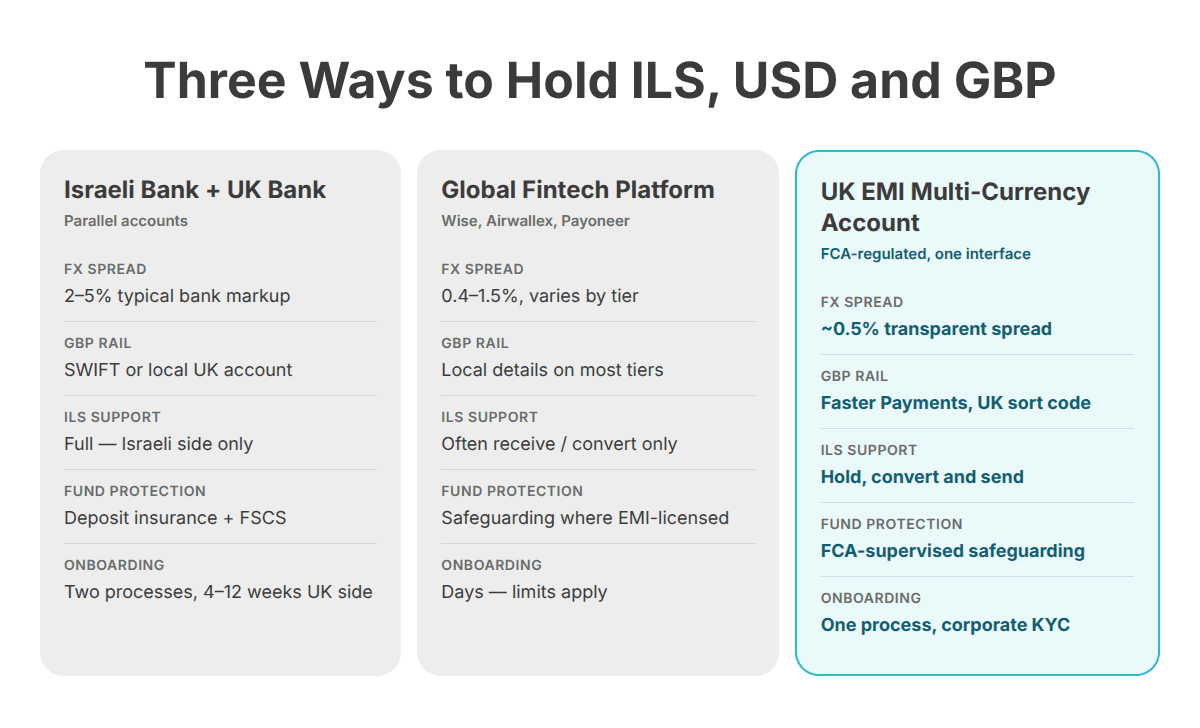
The three models differ most on four dimensions: fees, payment rails, shekel support and how funds are protected. The table summarises the practical differences before each dimension is examined in detail.
Dimension | Israeli bank + UK bank | Global fintech platform | UK EMI multi-currency account |
|---|---|---|---|
FX spread | 2–5% typical bank markup | 0.4–1.5%, varies by tier | ~0.5% transparent spread |
GBP rail | SWIFT or local UK account | Local details on most tiers | Faster Payments, UK sort code |
USD rail | SWIFT via correspondents | SWIFT or local US details | SWIFT |
ILS support | Full (Israeli side only) | Often receive/convert only | Hold, convert and send |
Fund protection | Israeli deposit insurance + FSCS | Safeguarding (where EMI-licensed) | FCA-supervised safeguarding |
Onboarding | Two processes, 4–12 weeks UK side | Days, limits apply | One process, corporate KYC |
Account fees and FX spreads
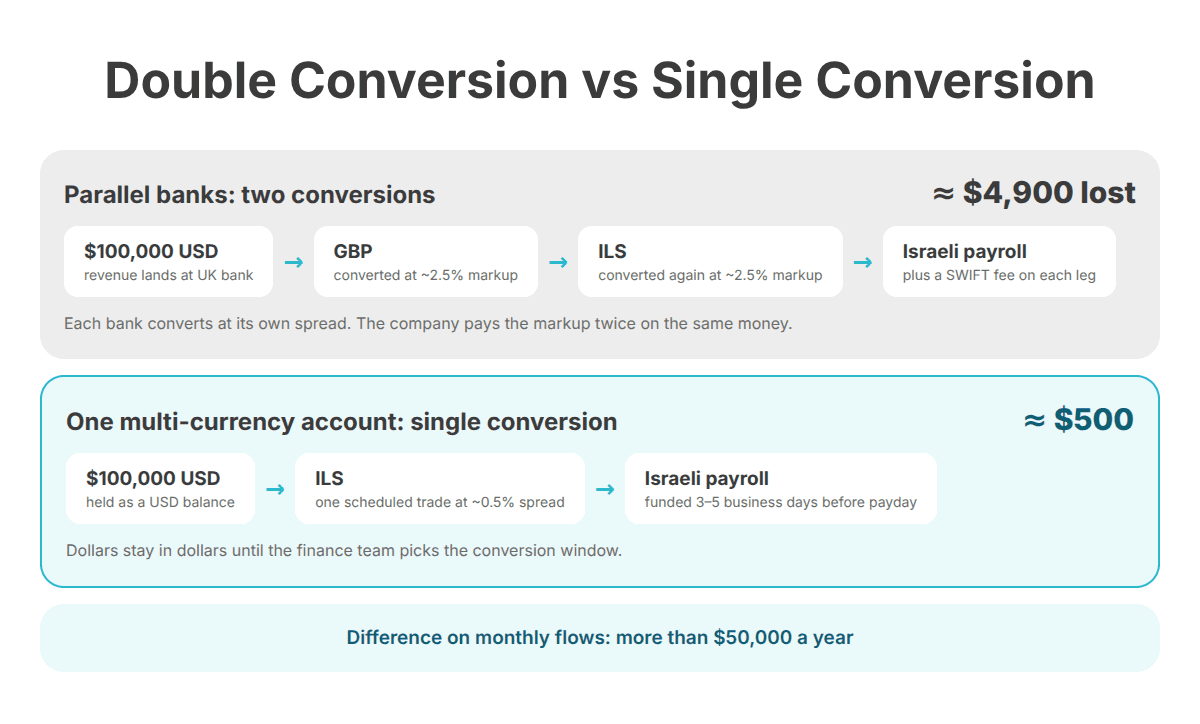
Double FX conversion is where the parallel model loses the most money. USD revenue converts to GBP when it lands at the UK bank, then converts again to ILS when payroll funding leaves for Israel. Two conversions at a 2.5% markup each cost roughly $4,900 on a $100,000 transfer chain.
A single account holding the original dollars converts once, directly into shekels. At a 0.5% spread, the same flow costs about $500. The Bank for International Settlements tracks exactly this friction in its G20 cross-border payments programme, which targets lower cost and higher speed for corporate corridors.
[aa fast-fact]
Fast Fact: Converting $100,000 twice at a 2.5% bank markup costs around $4,900. Converting once at a 0.5% spread costs about $500, a difference of more than $50,000 a year on monthly flows.
[/aa]
Payment rails: Faster Payments, SEPA, SWIFT
GBP payments inside the UK clear over Faster Payments in near real time, 24/7, under systems overseen by the Bank of England. A UK sort code therefore matters for paying British staff and suppliers without wire delays.
USD and ILS move internationally over SWIFT. Transfer times run 1–5 business days depending on the correspondent chain, so payroll funding to Israel needs to leave with that buffer built in. Cut-off times per currency decide whether a payment settles T+0, T+1 or T+2.
SEPA becomes relevant the moment the company signs its first EU client. An account that already offers a euro IBAN extends the same separate-balance logic to EUR without a second provider. Euro credit transfers settle same-day or T+1 inside the SEPA zone, far cheaper than routing euros over SWIFT.
How each model handles the shekel
The shekel is the bottleneck currency in this corridor. Israeli labour law requires net salaries to be paid in ILS, so a company cannot simply wire dollars to employees in Tel Aviv. A shekel business account, or at minimum reliable ILS conversion and delivery, is non-negotiable.
Most UK providers treat ILS as a convert-and-send currency rather than a holding currency. Since the Bank of Israel's licensing reforms, more providers route ILS directly, but an ILS account UK businesses can actually hold funds in remains rare. Providers that list ILS among supported holding currencies remove the forced-conversion step entirely.
What this means in practice: before opening any account, a finance team should confirm three ILS specifics in writing: hold, convert and send.
[aa cta]
One account for ILS, USD and GBP flows
Hold, receive and convert all three currencies from a single FCA-regulated business account with a UK sort code.
[aa btn]Open Business Account[/aa]
[/aa]
Fund protection: safeguarding vs deposit insurance
Banks and EMIs protect money differently. UK banks carry FSCS deposit insurance up to £120,000 per depositor since 1 December 2025, a cap that offers limited comfort on corporate balances. Israeli banks operate under their own deposit protection arrangements supervised by the Bank of Israel.
EMIs do not hold deposits. Under the Electronic Money Regulations 2011, they must safeguard 100% of client funds in segregated accounts at credit institutions, separate from the EMI's own money. The FCA explains how this protection works for customers of payment and e-money firms. A detailed breakdown of the two models is available in this guide to how an FCA-authorised EMI compares with a bank.
The practical takeaway: for balances above insurance caps, segregation covers the full amount, while insured deposits cover a fixed slice. Companies holding large working balances should read the safeguarding terms, not just the headline protection claim.
When a Single Multi-Currency Account Makes Sense
Unlike parallel banking, a structure that holds ILS, USD and GBP in one account converts each flow exactly once, on a date the finance team picks. The gain is largest when revenue currency and payroll currency differ, which describes most Israel-UK tech companies.
Use case: SaaS with USD revenue and Israeli R&D payroll
A SaaS company bills $150,000 monthly from a UK entity while its 20-person R&D team sits in Haifa. With a single account, dollars accumulate as a USD balance, and the team converts the payroll portion to ILS in one scheduled trade to pay Israeli payroll from the UK account on the 25th.
The alternative routes the same money USD → GBP → ILS through two banks. Same payroll, two spreads, plus a SWIFT fee on each leg. The mechanics mirror the setup described in this guide to a multi-currency account in the UK, extended with a shekel balance.
Use case: UK-first go-to-market with Israeli parent
A multi-currency account for an Israeli startup with a UK entity also fits the reverse flow. The UK subsidiary invoices British clients in GBP over Faster Payments, holds USD from American customers, and periodically funds the parent's ILS obligations.
The parent does not need a UK office for the subsidiary's banking to work. A UK entity owned from Israel can obtain a named GBP account for a non-UK company structure with full sort code details, provided corporate KYC documents pass review.
When Parallel Banking Is Still the Better Fit
A multi-currency business account for an Israeli tech company does not replace local banking in every scenario. Honest cases for keeping the traditional structure include:
Credit facilities. Israeli banks extend working-capital lines and venture lending that EMIs cannot offer
Israel Innovation Authority grants. IIA disbursements and some government programmes require an Israeli bank account
ILS-heavy domestic operations. A company invoicing Israeli clients daily in shekels benefits from a local clearing relationship
Cash and cheque handling. Physical instruments still require a branch network
Many companies land on a hybrid: an Israeli bank account for credit and grants, one multi-currency account for everything that crosses the border. Broader routing patterns for that hybrid appear in this guide to cross-border business payments.
Decision Framework: Matching the Account to Your Currency Flows
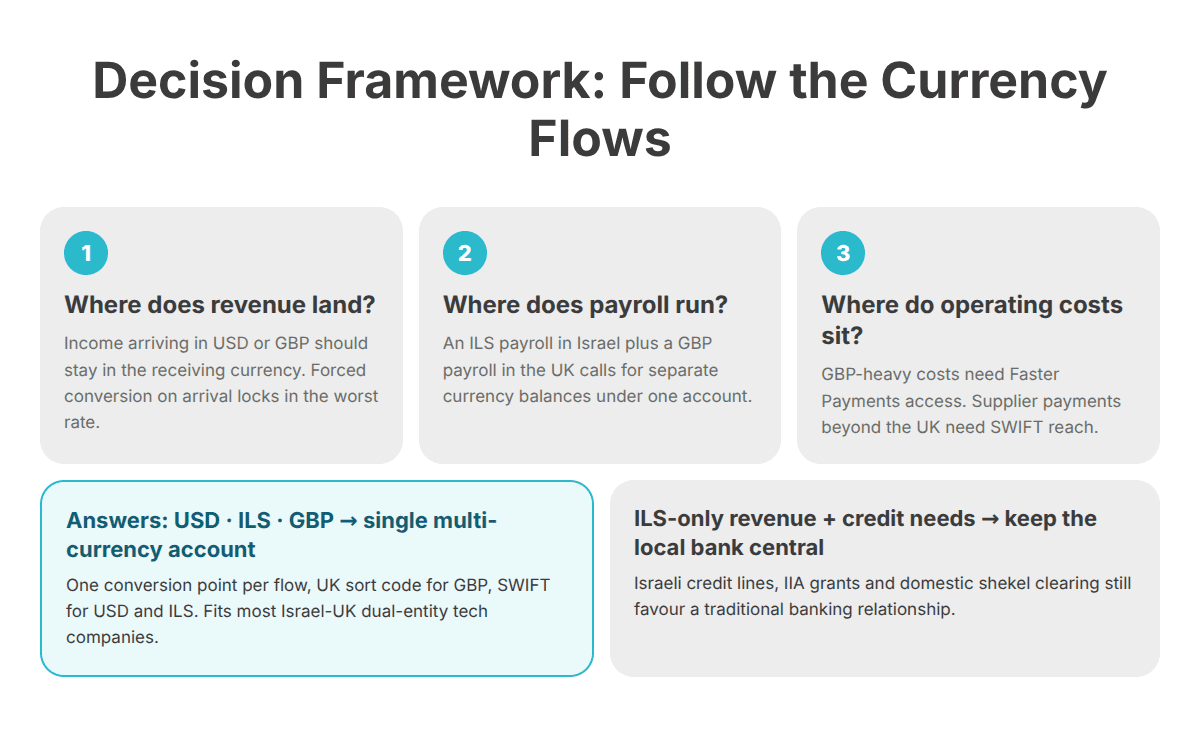
Three questions determine the right structure: where revenue lands, where payroll runs, and where costs sit.
Where does revenue land? If most income arrives in USD or GBP, holding it in the receiving currency preserves optionality. Forced conversion on arrival locks in the worst rate
Where does payroll run? An Israeli payroll in ILS plus a UK payroll in GBP argues for an account that sends both from separate currency balances
Where do operating costs sit? GBP-heavy costs need Faster Payments access; supplier payments beyond the UK need SWIFT reach
A company answering "USD, ILS, GBP" to those three questions in that order fits the single-account model almost exactly. One with ILS-only revenue and Israeli credit needs should keep its local bank at the centre.
For teams comparing providers on corridor coverage, EQWIRE's currency network lists 66 supported currencies, including ILS, with cut-off times and T+0 to T+2 settlement windows per currency.
FAQ
How does an Israel-UK dual-country tech startup hold ILS, USD and GBP in one account?
Through a multi-currency account that maintains separate balances per currency under one set of account credentials. The UK entity receives USD via SWIFT and GBP via Faster Payments, and holds or purchases ILS for Israeli obligations. In practice, how to hold shekels in a UK business account comes down to provider support: the account must list ILS as a holding currency, not only as a conversion target. FCA-authorised EMIs that support ILS let the company keep all three balances until it chooses to convert.
Is a UK EMI account safer than keeping funds in an Israeli bank?
Neither structure is automatically safer; they protect funds differently. An FCA-authorised EMI must safeguard 100% of client funds in segregated accounts under the Electronic Money Regulations 2011, with no upper cap. Bank deposits rely on insurance schemes with limits, such as the UK's £120,000 FSCS cap per depositor in force since December 2025. For corporate balances above insurance caps, segregation-based safeguarding often covers a larger share of the funds, while banks offer credit services EMIs cannot.
Can a company keep its Israeli bank and add a multi-currency account for an Israeli startup with a UK entity?
Yes, and the hybrid model is common. The Israeli bank account stays for credit lines, Israel Innovation Authority grants and domestic ILS clearing. The multi-currency account handles cross-border flows: USD collection, GBP operating payments and scheduled ILS payroll funding. The two structures do not conflict, and most providers have no exclusivity requirements.
Which option has the lowest FX costs between ILS, USD and GBP?
A single multi-currency account with a transparent spread converts each flow once and typically costs the least. At a 0.5% spread, converting $100,000 of revenue into shekels costs about $500. The parallel-bank route converts twice at markups of 2–5% per leg, which can exceed $4,900 on the same flow. Fintech platforms fall between the two, with pricing that varies by tier and monthly volume.
Can a business pay Israeli payroll from a UK account?
Yes, with one legal constraint: net salaries in Israel must be paid in ILS. A UK account that supports ILS conversion and SWIFT delivery can fund an Israeli payroll provider or the parent company's payroll account. Companies typically schedule the USD-to-ILS conversion 3–5 business days before payday to absorb SWIFT transit time through correspondent banks.
Choosing between parallel banks, fintech platforms and a single regulated account is ultimately a routing decision. A multi-currency account for an Israel-UK tech company wins when USD revenue, ILS payroll and GBP costs each need their own balance and a single conversion point; local banking wins when credit and domestic clearing dominate. An ILS, USD and GBP account for an Israel-UK business will not fix a broken flow map, so finance teams should chart their flows first. Those that do choose faster and renegotiate less later. EQWIRE provides FCA-regulated business accounts with named UK sort codes, SWIFT reach and ILS among 66 supported currencies.
[aa cta]
Map your ILS, USD and GBP flows onto one account
Open an EQWIRE business account and hold all three currencies with a single conversion point.
[aa btn]Create Account[/aa]
[/aa]
Reviewed by
Related Articles

UK Multi-Currency Account for a Global Payroll Software Company Paying Service Providers
Multi-Currency Account for Israel-UK Tech Companies: Hold ILS, USD and GBP

Multi-Currency Account for Property Management Companies: Collect Rents in GBP and EUR
ILS to EUR or GBP: Converting Israeli Shekel for International Businesses

Power your payments
with EQWIRE
Create your account in minutes and experience smooth, secure global payments.
" height="9.0156px" id="LIcbdboyB" transform="translate(4.987 4.5)" width="9.01562px"/></svg>)