•
•

Articles
Business Account for Gibraltar Company: GBP and EUR in the UK
[aa disclaimer]
Legal Disclaimer: This article is for informational purposes only and does not constitute legal, financial, compliance, or tax advice. Banking eligibility, regulatory requirements, and provider policies vary by jurisdiction. Consult qualified professionals before making decisions.
[/aa]
A Gibraltar-registered company trading with British customers and European suppliers occupies an unusual position in the payment map. Gibraltar left the European Union with the United Kingdom, so its firms hold no EU passporting rights. It also sits outside the United Kingdom, so a Gibraltar entity has no automatic claim on British domestic payment rails. Finance teams searching for a Gibraltar company business account GBP EUR UK setup are working around both constraints at once, usually without knowing that the two gaps have separate causes and separate fixes. This article maps where a Gibraltar company actually stands on each rail, explains what the Gibraltar pound does and does not buy, corrects the most expensive misconception about UK market access, and sets out the two account identifiers that close both gaps.
[aa key-takeaways]
Key Takeaways
Gibraltar sits inside the geographic scope of SEPA but outside the EEA, so euro receivables are reachable while EU payment-law protections do not follow automatically.
Gibraltar pound notes are legal tender in Gibraltar only and carry a statutory one-to-one sterling peg, which makes a genuine GBP balance a separate operational requirement.
The Gibraltar Authorisation Regime covers Gibraltar-based regulated financial firms, never trading companies, and it is not yet operational; interim UK–Gibraltar passporting runs to 31 December 2026.
Under the Electronic Money Regulations 2011, a UK electronic money institution must be established in the United Kingdom, with no restriction on where its customers are incorporated.
Funds held with a UK EMI are safeguarded under regulation 20, and the Financial Services Compensation Scheme limit of £120,000 does not apply to them.
[aa btn]Book a Call[/aa]
[/aa]
Where a Gibraltar Company Sits on the UK and EU Payment Map
Two separate boundaries run between a Gibraltar company and the accounts it needs, and conflating them produces the wrong procurement decision. Anyone specifying a Gibraltar company business account GBP EUR UK structure has to price both boundaries separately. One boundary is a scheme boundary, governing which payment messages can reach the company. The other is a legal boundary, governing which regulatory protections apply once they arrive. A business account for a Gibraltar company has to be specified against both.
Is Gibraltar in SEPA or the EEA?
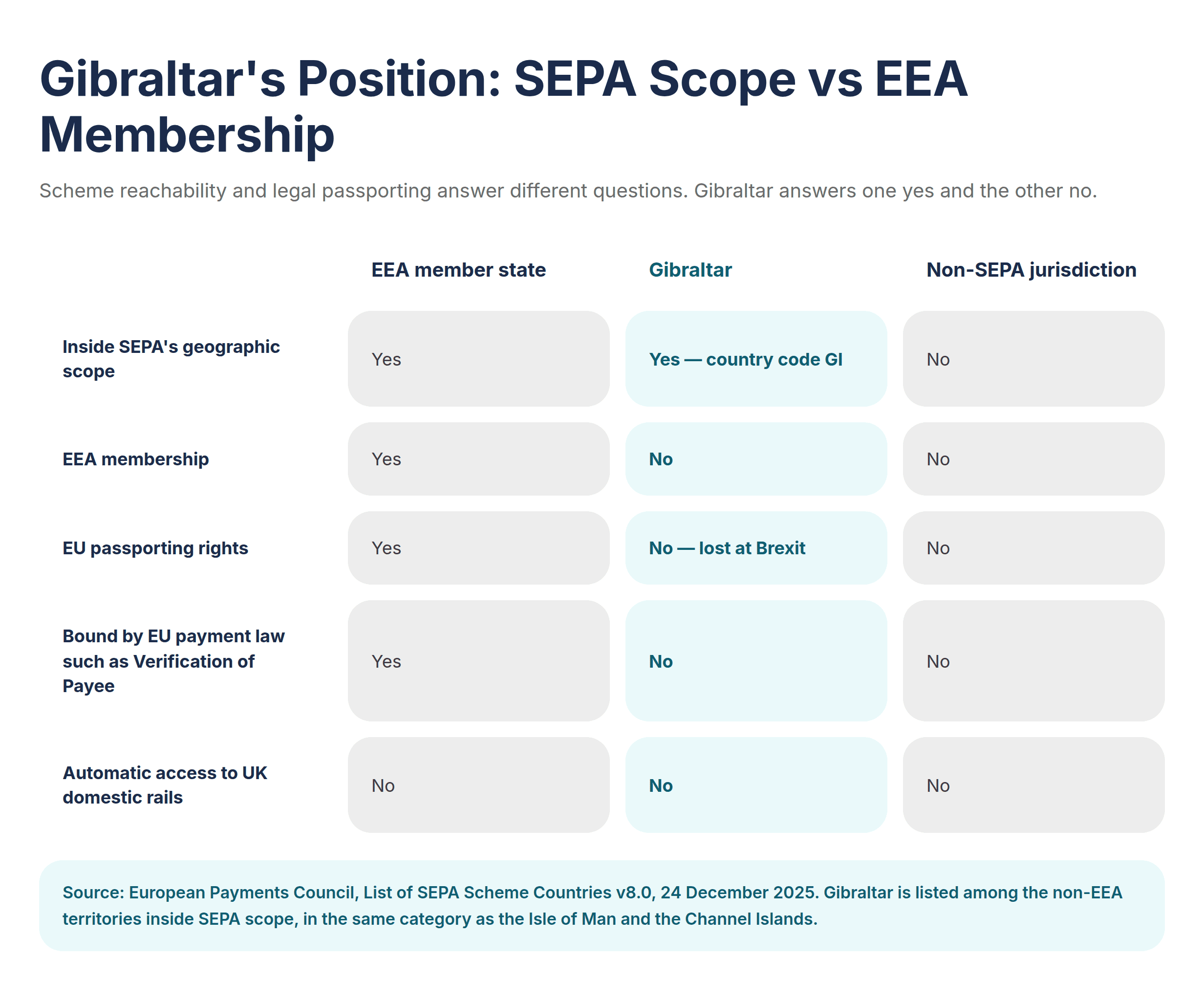
Gibraltar sits inside SEPA's geographic scope but outside the EEA, so a Gibraltar company can receive euro SEPA credit transfers while falling outside EEA passporting rules. The Gibraltar Authorisation Regime (Financial Services Act 2021, Schedule 6) covers only Gibraltar-regulated financial firms, not trading companies; interim UK–Gibraltar passporting runs to 31 December 2026.
The scheme half of that answer comes from the European Payments Council, which publishes the definitive participation list. Its List of SEPA Scheme Countries (version 8.0, 24 December 2025) records Gibraltar under country code GI, with GIP recorded as its currency. Gibraltar appears there among the non-EEA territories in scope, in the same category as the Isle of Man and the Channel Islands.
The legal half runs the other way. The Gibraltar Financial Services Commission confirmed after Brexit that the right to passport across the European Union no longer applies to firms based in Gibraltar. Scheme reachability and legal passporting answer different questions, and Gibraltar answers one of them yes and the other no.
Outside the UK, With No Automatic Sterling Rail Access
A Gibraltar-incorporated company holds no automatic route into British domestic payment systems, so sterling from UK customers typically arrives as an international wire. Correspondent deductions apply, value dates slip by one to three business days, and reconciliation depends on whatever reference survives the message chain.
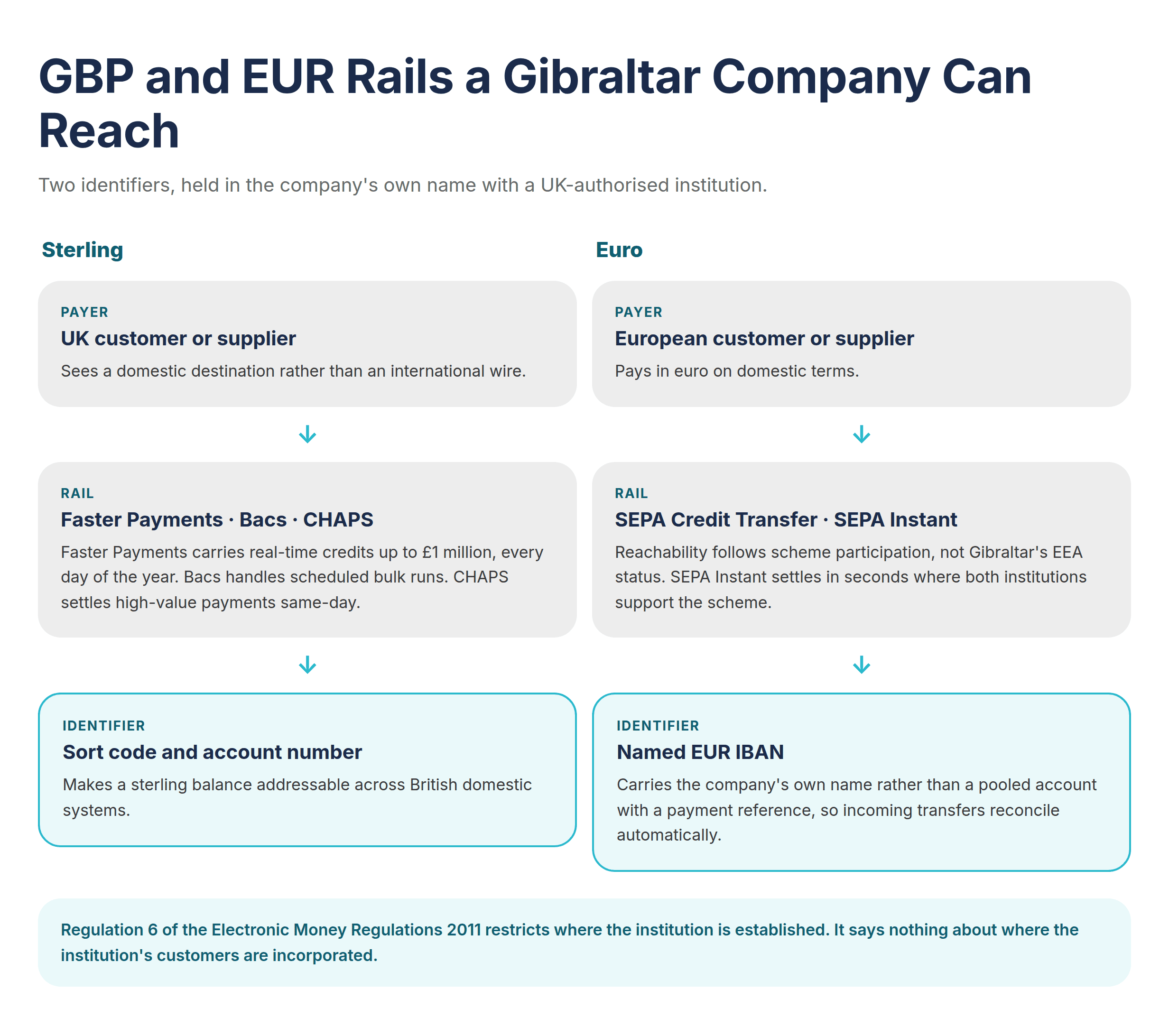
The alternative is a set of UK account identifiers in the company's own name. Pay.UK reports that the Faster Payment System runs day and night, 365 days a year, carrying payments of up to £1 million subject to individual firm limits, and that it processed 5.55 billion transactions worth £4.84 trillion during 2025. Reaching that volume of domestic settlement requires a sort code and account number rather than a correspondent relationship. The mechanics of how non-UK entities reach Faster Payments apply to Gibraltar companies in the same way they apply to any company incorporated outside Britain.
Why a Gibraltar Pound Balance Is Not a GBP Account
The Gibraltar pound tracks sterling exactly and travels almost nowhere. Under the Currency Notes Act 2011, section 5 makes Gibraltar currency notes legal tender in Gibraltar for the payment of any amount, and section 6 sets their exchange with sterling at one pound for one pound sterling. The peg removes currency risk inside the territory. The legal tender limit removes usability outside it.
For a company invoicing British customers, that distinction has a direct operational cost. A GIP balance cannot settle a UK supplier invoice or fund a domestic payroll run. It cannot receive a Faster Payments credit either. Each of those actions needs a sterling balance sitting behind UK account identifiers.
Gibraltar's wider profile reinforces why the question is operational rather than reputational. HM Government of Gibraltar's Income Tax Office records the corporation tax rate at 15%, raised from 12.5% with effect from 1 July 2024. A Gibraltar company GBP account is not a workaround for a zero-tax structure. It is infrastructure for a taxed, supervised entity that happens to trade across two currency zones.
[aa fast-fact]
Fast Fact: Gibraltar currency notes are legal tender in Gibraltar only, yet exchange with sterling at exactly one pound for one pound sterling under sections 5 and 6 of the Currency Notes Act 2011.
[/aa]
What the Gibraltar Authorisation Regime Covers, and What It Does Not
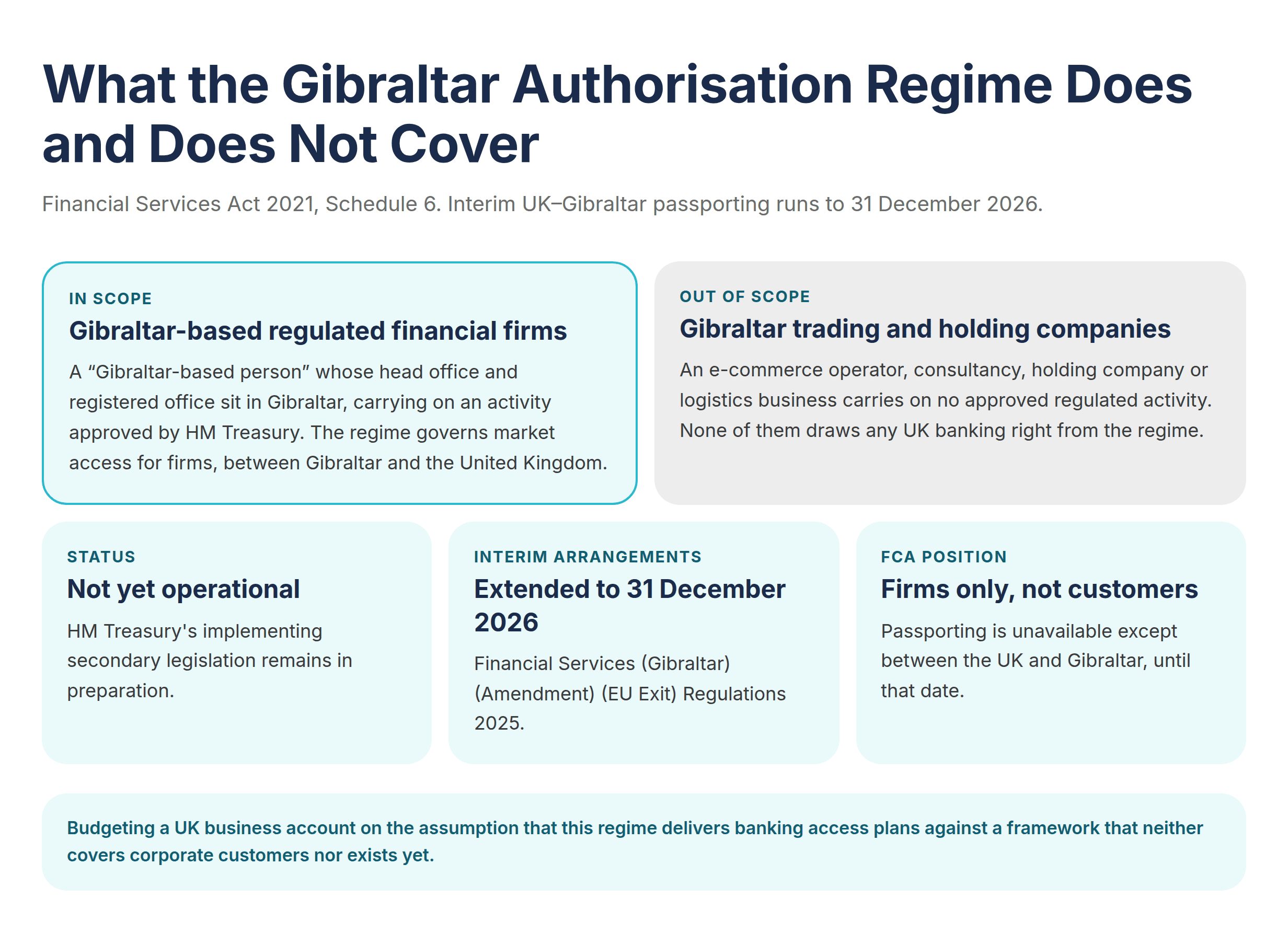
The Gibraltar Authorisation Regime governs which Gibraltar firms may carry on regulated financial business in the United Kingdom. Schedule 6 of the Financial Services Act 2021 inserts a market-access framework into the Financial Services and Markets Act 2000 for a "Gibraltar-based person" whose head office and registered office sit in Gibraltar and who carries on an activity approved by HM Treasury.
Every element of that definition matters. The regime attaches to regulated activity, so a Gibraltar e-commerce operator or consultancy falls outside it entirely. A holding company or a logistics business sits equally outside. Does Gibraltar have EU passporting after Brexit? No, and the Gibraltar Authorisation Regime UK market access framework never claimed to restore it. GAR runs between Gibraltar and Britain, and it covers firms rather than corporate customers.
The regime is also not yet live. HM Treasury's implementing secondary legislation remains in preparation, and Parliament extended the interim arrangements by twelve months through the Financial Services (Gibraltar) (Amendment) (EU Exit) Regulations 2025. The Financial Conduct Authority states the position plainly on its guidance for passporting between the UK and Gibraltar: passporting is no longer available except for firms wishing to passport between the two jurisdictions, and that exception expires on 31 December 2026.
Boards that budget a Gibraltar business bank account on the assumption that GAR delivers British banking access are planning against a regime that neither covers them nor exists yet. Meanwhile the practical constraint sits elsewhere. Gibraltar's domestic banking market is small, and applications from Gibraltar entities also meet the wholesale de-risking that has thinned correspondent relationships worldwide. Neither pressure reflects a current listing problem: the Financial Action Task Force removed Gibraltar from increased monitoring on 23 February 2024, and the European Commission removed Gibraltar from the EU list of high-risk third countries by a delegated act adopted on 10 June 2025 and published in the Official Journal on 16 July 2025. Applicants still face enhanced scrutiny, and the AML expectations for non-UK applicants set out what that scrutiny involves in practice. For the distinction between the two provider types a Gibraltar company can approach, an FCA-authorised EMI compared with a bank covers the structural differences.
[aa cta]
Sterling and Euro Rails Without a Gibraltar Bank Dependency
A UK FCA-authorised account gives a Gibraltar company a sort code for domestic sterling and a EUR IBAN reachable on SEPA, both held in the company's own name.
[aa btn]Create Account[/aa]
[/aa]
What Closing Both Gaps Requires from a UK Account
Specifying a Gibraltar company UK GBP sort code EUR IBAN arrangement comes down to two identifiers and what each one reaches. One identifier carries sterling across British domestic systems. The other carries euro across SEPA. A single multi-currency account for a Gibraltar company can hold both, provided the underlying institution is authorised in the United Kingdom and its permissions extend to both currency sets. That combination is what a Gibraltar company business account GBP EUR UK specification has to deliver.
One provision does most of the work here, and almost nobody cites it. Regulation 6 of the Electronic Money Regulations 2011 requires an applicant electronic money institution to be a body corporate with its head office and registered office in the United Kingdom, or to operate a UK branch, and to carry on part of its business in Britain. The regulation restricts where the institution sits. It says nothing about where the institution's customers are incorporated. That asymmetry is the legal reason a UK account is available to a Gibraltar company at all.
GBP: A Sort Code and Account Number in the Company's Own Name
A sort code identifies the institution holding the account, and the account number identifies the account within it. Together they make a balance addressable across British domestic systems rather than reachable only through a correspondent chain.
What each identifier reaches depends on the rail:
Faster Payments carries real-time credits up to £1 million, running every day of the year
Bacs handles scheduled bulk runs, including supplier files and payroll, on a multi-day cycle
CHAPS settles high-value and time-critical sterling payments same-day
A Gibraltar company GBP account held under UK identifiers can receive customer settlements on the same terms as a British counterparty, because the sending bank sees a domestic destination. The wider set of eligibility questions behind opening a GBP account for a non-UK company covers the assessment criteria providers apply.
EUR: A Named IBAN Reachable on SEPA Credit Transfer
A EUR IBAN for a Gibraltar company works properly only when the IBAN carries the company's own name rather than a pooled account with a payment reference. Named allocation determines whether an incoming SEPA Credit Transfer reconciles automatically and whether the payer's own compliance checks pass. The difference between the two structures, and why it matters at volume, is covered in detail for a named IBAN held in the company's own name.
SEPA Credit Transfer reach means European customers pay in euro on their domestic terms. SEPA Instant settles in seconds where both institutions support the scheme. Neither depends on Gibraltar's own EEA status, because reachability follows scheme participation. Where euro payments fall outside SEPA territory altogether, the choice between SEPA and SWIFT for euro payments drives cost and timing.
Verification of Payee and the Non-EEA SEPA Gap
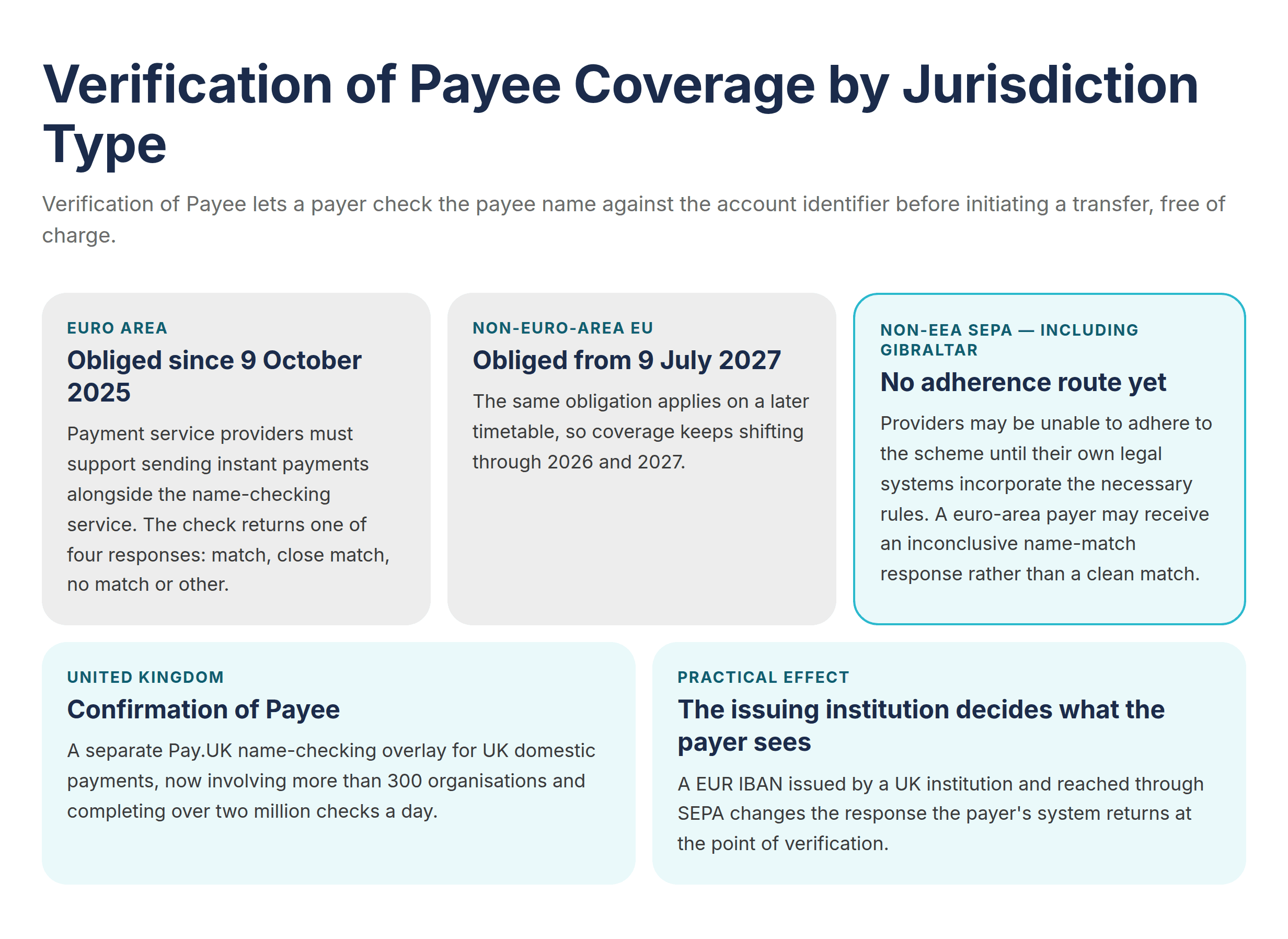
Euro-area payment service providers have been obliged to offer Verification of Payee since 9 October 2025, the date the Instant Payments Regulation required them to support sending instant payments alongside the name-checking service. Verification of Payee lets a payer confirm, free of charge and before initiating a transfer, whether the payee name matches the account identifier. The service returns one of four responses: match, close match, no match or other. The European Central Bank publishes the framework governing how those responses are produced.
That obligation binds providers inside the European Union. Gibraltar's position inside SEPA's scheme scope and outside the EEA sits precisely in the gap: the European Payments Council has noted that providers in non-EEA SEPA countries may be unable to adhere to the Verification of Payee scheme until their own legal systems incorporate the necessary rules.
The operational consequence is narrow and worth stating precisely. A euro-area customer initiating a payment to a Gibraltar-issued IBAN may receive an inconclusive name-match response rather than a clean match, and inconclusive responses generate compliance queries that stall settlement or abandon it altogether. A EUR IBAN issued by a UK institution reached through SEPA changes what the payer's system sees at the point of verification.
Non-euro-area European Union providers have until 9 July 2027 for their own Verification of Payee obligation, so the coverage picture keeps shifting through 2026 and 2027. Britain runs a separate name-checking overlay: Pay.UK's Confirmation of Payee service now involves more than 300 organisations and completes over two million checks a day across UK domestic payments.
Protection works differently from a bank account, and finance teams should price that in. The Financial Services Compensation Scheme states directly that it cannot protect money held with e-money institutions and payment providers, and its deposit limit of £120,000 per person per authorised firm, in force since 1 December 2025, does not extend to them. Instead, regulation 20 of the Electronic Money Regulations 2011 requires safeguarding through segregation or an insurance arrangement, and the mechanics of how client funds are safeguarded determine what a balance is actually backed by.
[aa fast-fact]
Fast Fact: Euro-area payment providers have been required to offer Verification of Payee since 9 October 2025, while providers in non-EEA SEPA countries such as Gibraltar may not yet be able to adhere to the scheme at all.
[/aa]
[aa cta]
One Account for GBP and EUR Business Payments
Hold both currencies without forced conversion, and pay UK and European counterparties on their own domestic rails.
[aa btn]Open Business Account[/aa]
[/aa]
FAQ
How Gibraltar-registered company gets GBP sort code and EUR IBAN via UK FCA EMI
A Gibraltar-registered company obtains both identifiers by opening an account with an electronic money institution authorised by the Financial Conduct Authority in the United Kingdom, because regulation 6 of the Electronic Money Regulations 2011 restricts where the institution is established rather than where its customers are incorporated. The institution issues a sort code and account number that make sterling balances addressable across Faster Payments, Bacs and CHAPS, and a named euro IBAN reachable on SEPA Credit Transfer. Onboarding runs on corporate documentation rather than physical presence. Providers request the certificate of incorporation together with the memorandum and articles, then the register of members and directors, then ultimate beneficial ownership evidence for anyone holding more than 25% and identification for the authorised signatory. They assess the trading model alongside the paperwork, so evidence of named counterparties and expected payment corridors carries weight. Approval is never automatic, and eligibility for a Gibraltar-incorporated entity specifically, as distinct from a Gibraltar-resident applicant, varies between providers and should be confirmed directly before an application begins.
Is a Gibraltar company inside SEPA?
Yes for scheme purposes. The European Payments Council lists Gibraltar within the geographic scope of the SEPA schemes under country code GI, alongside other non-EEA territories including the Isle of Man and the Channel Islands. So can a Gibraltar company receive SEPA credit transfers from EU customers? In principle yes, provided the account it uses is held with a participating institution and the euro IBAN is reachable on the scheme. The qualification matters more than the headline. SEPA participation is a question of scheme reachability, and it carries none of the legal consequences of EEA membership. European Union payment law, including the Verification of Payee obligation under the Instant Payments Regulation, binds providers established in the Union. A Gibraltar company therefore sits inside the payment rails and outside the regulatory perimeter that governs them, which is why the institution issuing the euro IBAN determines how smoothly incoming payments clear.
Does the Gibraltar Authorisation Regime give a Gibraltar company a UK bank account?
No. The Gibraltar Authorisation Regime, established by Schedule 6 of the Financial Services Act 2021, is a market-access framework for a "Gibraltar-based person" carrying on a regulated activity approved by HM Treasury. It determines which Gibraltar financial services firms may operate in the United Kingdom. A Gibraltar trading or holding company carries on no approved regulated activity and falls outside the regime altogether. Two further points are frequently missed. The regime is not yet operational, because HM Treasury's implementing secondary legislation is still in preparation. And the interim arrangements that currently permit UK–Gibraltar passporting were extended by twelve months to 31 December 2026, a date the Financial Conduct Authority confirms in its published guidance. Any procurement assumption that GAR delivers British banking access to a Gibraltar corporate customer rests on a misreading of who the regime binds.
Can a Gibraltar company hold GBP rather than Gibraltar pounds?
Yes, and for cross-border trade it generally needs to. The Currency Notes Act 2011 pegs the Gibraltar pound to sterling at one pound for one pound sterling, so there is no exchange-rate exposure between them. What differs is usability. Section 5 of the same Act makes Gibraltar currency notes legal tender in Gibraltar for the payment of any amount, and that status stops at the territory's boundary. A Gibraltar pound balance cannot settle a British supplier invoice or fund a UK payroll run, and no Faster Payments credit can reach it. Holding genuine sterling behind UK account identifiers solves every one of those, because the balance then sits inside the domestic system that British counterparties already pay into. The peg means the conversion carries no rate risk; the account structure is what determines whether the money can move.
Are funds in a UK EMI account covered by the FSCS?
No. Are funds held with a UK electronic money institution protected by the FSCS in the way a bank deposit is? They are not, and the Financial Services Compensation Scheme says so explicitly: it cannot protect money held with e-money institutions and payment providers, because those firms are authorised for payment services rather than deposit-taking. The FSCS deposit limit of £120,000 per person per authorised firm, in force since 1 December 2025, applies to deposit-taking institutions authorised by the Prudential Regulation Authority. What applies instead is safeguarding. Regulation 20 of the Electronic Money Regulations 2011 requires an institution to protect relevant funds either by segregating them from its own money or by covering them with an insurance policy or comparable guarantee. Segregation keeps customer funds out of reach of the institution's creditors in an insolvency, and it offers no compensation scheme and no guaranteed payout timetable, so funds may remain unavailable while an insolvency process runs.
Gibraltar's payment position is unusual rather than difficult, and specifying an account correctly starts with separating the two boundaries that produce the friction. Scheme reachability puts euro receivables within range through SEPA. The absence of EEA membership and of UK incorporation is what leaves both a sterling gap and a regulatory-protection gap behind them. A business account for a Gibraltar company closes the first by supplying UK account identifiers, and closes the second by making clear what safeguarding does and does not cover. Finance teams comparing options for a Gibraltar company business account GBP EUR UK arrangement should test each provider against one question: does the account issue a sort code and a named EUR IBAN for a Gibraltar-registered entity, in the company's own name? EQWIRE is authorised in the United Kingdom and issues both identifiers to companies incorporated elsewhere, with settlement windows and cut-off times published across its currency network. Applications open at https://client.eqwire.com/sign-up.
Reviewed by

Related Articles


Power your payments
with EQWIRE
Create your account in minutes and experience smooth, secure global payments.
" height="9.0156px" id="LIcbdboyB" transform="translate(4.987 4.5)" width="9.01562px"/></svg>)