
•
•

Articles
UK Payment Account for an Online Lottery Technology Company with Cross-Border Vendors
[aa disclaimer]
Legal Disclaimer: This article is for informational purposes only and does not constitute legal, financial, compliance, or tax advice. Banking eligibility, regulatory requirements, licensing conditions and provider policies vary by jurisdiction. Consult qualified professionals before making decisions.
[/aa]
A €40,000 wire sat frozen for four days over one missing invoice. The sender licensed platform software to lottery operators and owed a Warsaw development contractor for ongoing work.
Nothing about the setup itself was in question: it was already open and working, built specifically for a gaming-sector business paying overseas suppliers. What stalled was the paperwork attached to that one instruction. Reviewers rarely shut an account down; instead, they hold the individual payment until its file is complete. This piece covers the closer look a gaming-sector supplier gets compared with an ordinary B2B vendor, the exact evidence a reviewer checks before releasing funds, and how setup choices and rail selection change the wait.
[aa key-takeaways]
Key Takeaways
A gambling-adjacent SIC code, not the size of the transfer, drives most of the extra scrutiny on these payments
A signed contract and matching invoice go in before the money moves, with delivery proof close behind
Account-opening checks and single-payment justification are separate hurdles, and both apply here
A gambling or lottery licence adds weight to the file but never substitutes for ownership or source-of-funds records
SWIFT settles in one to three working days; SEPA Instant clears in seconds, but only inside the EU/EEA
[aa btn]Book a Call[/aa]
[/aa]
Why Cross-Border Vendor Payments from Lottery Technology Companies Trigger Extra Checks
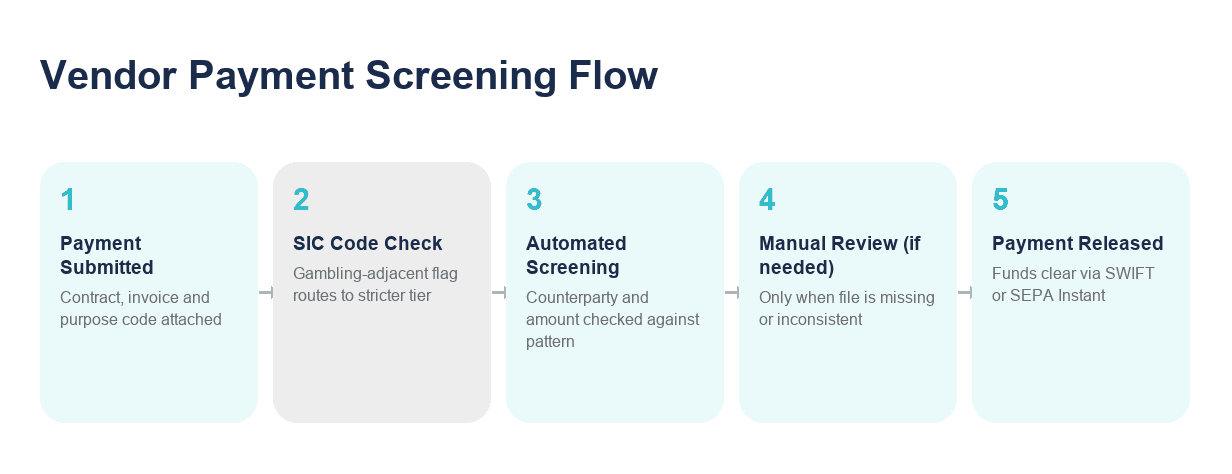
A gambling-adjacent SIC code and client list route a payment into a stricter review tier automatically. The trigger is classification, not the amount on the wire. The Financial Conduct Authority expects payment institutions to weight gambling-related activity higher in their money-laundering risk models, even when the business never touches player funds directly.
That model rarely separates a licensed operator from its own software supplier. A lottery platform vendor bills for development and data services. It holds no player deposits. Reviewers still apply near-identical scrutiny to both files, at least at first contact.
Consider a supplier building draw-management software for three national lottery operators. Its own outgoing payments cover a QA team in Bangalore and a data-feed licence in Stockholm. Neither payment touches a single player's stake, yet a compliance analyst screening the SIC code sees "gambling services" before anything else. The real question that follows is rarely about the transfer itself; it is about which side of the industry the business actually sits on.
Gambling-Adjacent SIC Codes and Their Effect on Payment Screening
A gambling-related SIC code pushes a transfer into extra automated screening and, often, a manual check. That reviewer weighs the counterparty and the stated purpose against the size and pattern already approved for the relationship. A first payment to a brand-new counterparty draws the closest look; a fifth payment on an established schedule draws the least.
[aa-fast-fact]
Fast Fact: the Gambling Commission licenses operators and, in some cases, their technology suppliers directly. A licence number in the file speeds initial risk scoring; it settles nothing about ownership or the money's origin on its own.
[/aa]
The extra check itself is not usually the slow part. A well-documented file clears automated screening in the same pass as any other B2B payment. The manual step only activates when something in the file is missing or inconsistent, which is precisely why the paperwork behind a payment matters more here than in most other sectors.
Technology Supplier Payments vs Operator-Side Payments
A vendor's payments to its own contractors sit one step removed from player funds. Providers that decline gambling operator accounts outright will often still take on the technology supplier once its file shows software licensing instead of deposit-taking. Making that distinction explicit at the account application stage shortens the initial review considerably.
The distinction matters because the two businesses carry genuinely different obligations. An operator holds customer deposits and must safeguard them under specific rules; a technology vendor holds none of that money at any point. Explaining this difference in the application's own wording, instead of leaving a reviewer to work it out from a generic business description, changes which risk category the file lands in from the first pass.
What Documents Support a Vendor Payment Made by a Lottery Technology Supplier
A vendor payment needs three things at minimum:
A signed contract naming both parties and the service scope
An invoice matching the contract's currency and amount
Proof the service was actually delivered
Assembling these three rarely takes more than an hour once a vendor relationship is already documented in a signed statement of work.
Contract, Invoice, and Proof of Service Delivery
Terms should be spelled out clearly enough that a reviewer never has to infer them. Who is being paid and for what are the basics a reviewer looks for first, alongside the agreed schedule. An invoice total that does not match the wire amount is one of the most common reasons a payment stalls; the mismatch alone can add a full extra day. A signed acceptance note or a milestone confirmation from the receiving project manager closes the loop.
A recurring monthly retainer needs less repeat paperwork than a one-off project fee. Once a reviewer has seen the contract and confirmed the pattern of payments against it, later invoices in the same series tend to clear on the strength of that established relationship. A brand-new supplier resets that trust. So does a payment that jumps sharply above the usual amount; either one pulls the file back into closer review.
A UK software consultancy owned by a German parent files near-identical ownership paperwork when it settles its own cross-border invoices, despite operating in an entirely different sector. The overlap says something useful: this is a documentation habit, not a gambling-specific burden.
A finance team that keeps a standing folder per vendor avoids most of the delay entirely. Update it once when the contract is signed, not for every invoice that follows. The folder needs a refresh only when the contract terms change or a new milestone structure replaces the old one; everything else stays reusable payment after payment.
Source of Funds vs Source of Wealth
Source of funds explains where the money behind this specific payment came from, usually operator licence fees or subscription revenue. Source of wealth looks at something wider: how the company or its owners built their financial position over time. A reviewer checking one payment almost always asks only about the former, since broader ownership history tends to surface elsewhere: at account opening, or once risk climbs for reasons unrelated to any single transfer.
Bank statements showing the licence-fee deposits landing before the outbound transfer leaves are usually enough on their own. A short cover note naming which incoming receipt funded which outgoing wire saves a reviewer the extra step of asking, and that single sentence is often the difference between same-day clearance and a query sitting in someone's inbox overnight.
[aa fast-fact]
Fast Fact: a UK EMI's source-of-funds file typically covers bank statements and audited accounts, with records retained for a minimum of five years under UK anti-money-laundering rules.
[/aa]
[aa cta]
Get Vendor Payment Documents Right Before Sending
A prepared compliance file turns a multi-day hold into a same-day release on most cross-border payments.
[aa btn]Talk to EQWIRE[/aa]
[/aa]
UK Payment Account for a Lottery Technology Company with Cross-Border Vendors
Account setup decides how much friction repeats every month, apart from the document question above.
Multi Currency Business Account vs Converting on Every Payment
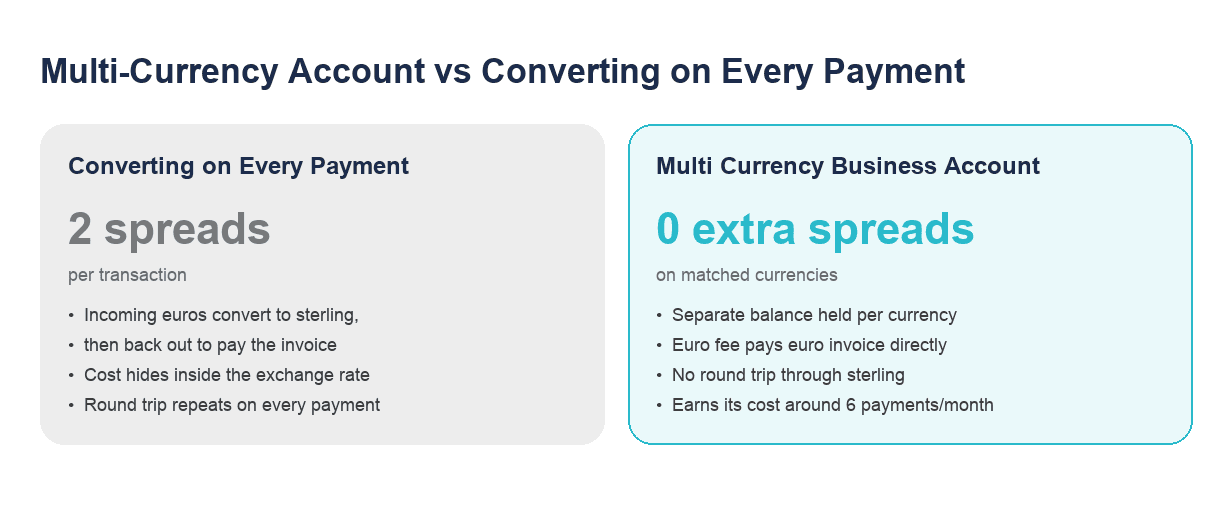
A multi currency business account holds separate balances per currency. A euro licence fee collected from an operator can then pay a euro invoice directly, with no round trip through sterling. Converting on every payment instead means two spreads per transaction. One hits on the way in; the other hits on the way out. An international business account with several currencies removes both spreads for the currencies a vendor actually uses, whether marketed as a business foreign currency account, plainly as a foreign currency account, or grouped further into a single international business bank account once the vendor list spans several countries.
That setup earns its cost once outbound payments in one currency reach roughly six a month. Below that line, the maintenance fee can outweigh what it saves.
A separate, narrower option sits between these two: a virtual IBAN. It gives the business a local-format account number for collecting or settling in a specific market, held under the same provider relationship, without a fresh local entity or tax registration. A lottery software vendor billing a handful of Polish and Indian contractors might add a złoty and a rupee virtual IBAN instead of opening two foreign subsidiaries just to settle invoices locally.
How a Lottery or Gambling Licence Fits into the Account-Opening File
A licence number tells a reviewer where regulatory oversight already sits, which speeds the first pass through risk scoring. What it does not do is fix the ownership structure on file. Providers still ask who holds more than 25% of the business, wherever that person or entity is based, before opening the account regardless of licensing status.
A structure with a holding entity in one jurisdiction and an operating arm in another adds a layer most SaaS applicants never face. Each layer in that chain needs its own ownership evidence under standard know your business checks, right up to the individual who ultimately controls the business. Flattening the explanation into a single ownership diagram, submitted with the application instead of assembled piecemeal under later questioning, is the single most effective way to shorten this part of onboarding.
SWIFT Payments and Compliance Delays
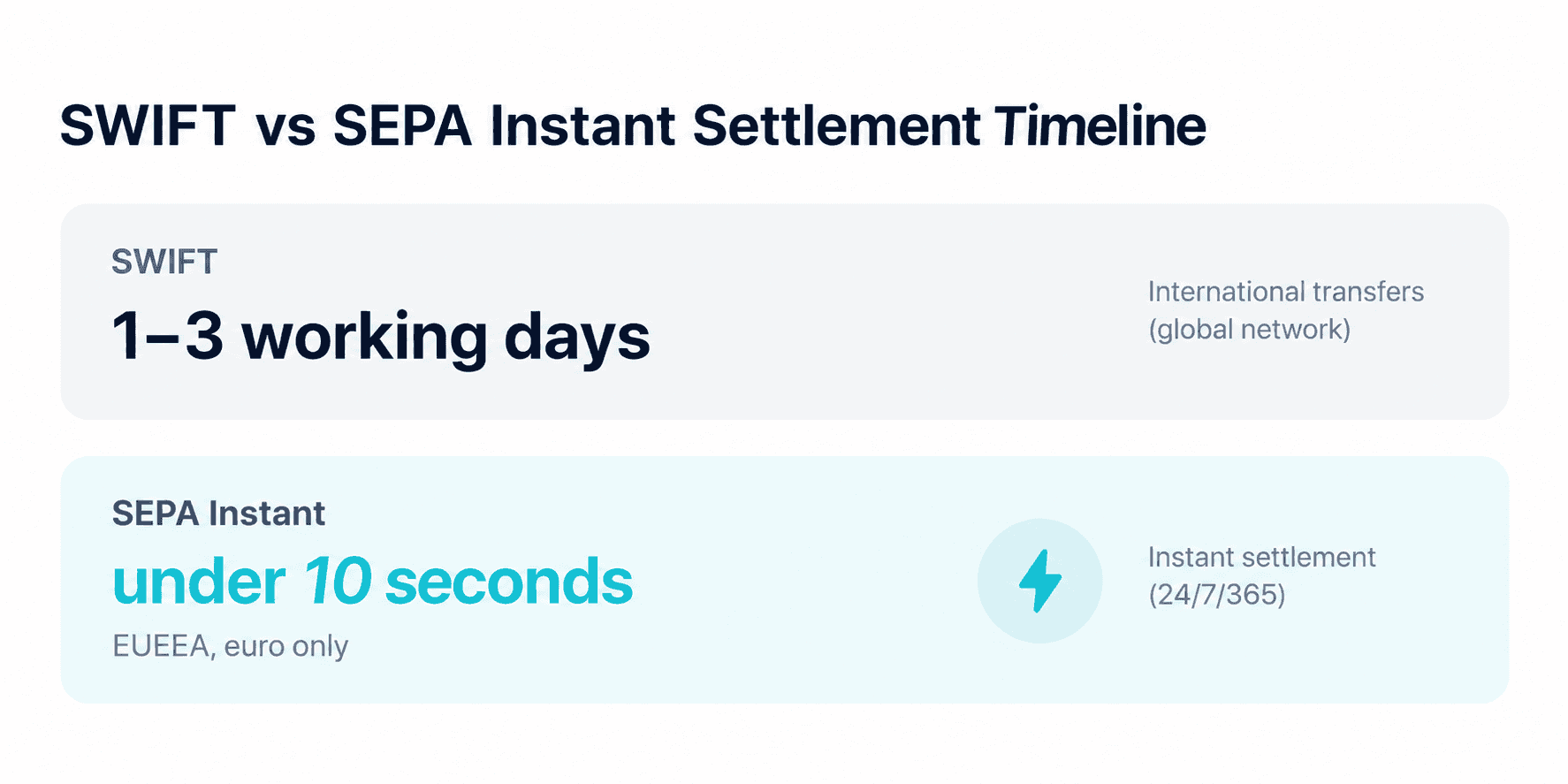
SWIFT settles in one to three working days; SEPA Instant clears in seconds, but only within the EU/EEA and only in euros. International vendor payments outside the SEPA zone still route through SWIFT, and that corridor is where most review-related delay accumulates.
A lottery software vendor settling a Warsaw contractor in euros can use SEPA Instant directly, since Poland sits inside the EU/EEA scheme regardless of the zloty being its domestic currency. Settling a Bangalore QA team in rupees has no equivalent fast rail available; that leg defaults to SWIFT, with the working-day settlement window attached.
What a Bank or EMI Checks Before Releasing a SWIFT Payment
The sending institution matches beneficiary details against the invoice and confirms the stated purpose code before the message leaves the building. It also screens the counterparty against sanctions lists, a step that runs automatically on every SWIFT payment regardless of sector. A mismatched beneficiary name almost always triggers a manual hold, adding a full business day to an otherwise clean transfer. A UK business sending its first SWIFT payment to a brand-new vendor should expect this same closest look, regardless of sector.
Fees compound the delay question, even when a payment clears on schedule. A SWIFT transfer typically picks up a sending charge from the originating institution and a separate correspondent-bank fee somewhere along the chain. A third charge often lands at the destination bank. Three unrelated institutions can each take a cut before the Warsaw contractor sees the full amount; that is why some vendors quietly ask to be paid a few percent above the invoice total to cover the shortfall.
How to Shorten the Review Without Losing Audit Control
Submitting the contract and invoice alongside the payment instruction removes the largest single cause of delay. Waiting for the provider to ask instead adds a full review cycle every time. A finance team that standardises this submission sees measurably fewer holds within a few payment cycles, without loosening a single check a regulator would expect.
Businesses that pay cross border corporate vendors on a fixed monthly schedule build reviewer trust fastest, since a repeated pattern is easier to approve than a one-off. Naming a single point of contact for supplier payments helps too. Answering every provider query through the same person lets a reviewer build familiarity over time, instead of starting cold on each occasion. Passing the job around the finance team resets that familiarity every time it changes hands. One named contact avoids the friction entirely.
Do UK Payment Providers Accept Lottery Technology Companies as Business Customers
Most FCA-authorised electronic money institutions assess a lottery technology vendor against its own activity and permissions. They do not simply apply the licensed operator's risk profile by association. That narrower question, distinct from a provider's blanket appetite for gambling-adjacent files in general, is the one worth putting directly during onboarding, since it changes how the file gets reviewed.
A gambling merchant account handles player deposits and withdrawals on the operator side, which is a different product entirely from a technology vendor's account. That account only receives licence fees and pays suppliers. Specialist igaming payment providers mainly serve those operator-side flows. A software supplier's own billing activity sits closer to standard SaaS invoicing.
Appetite still varies by provider. A high-street bank's SIC-code policy can decline a file that an EMI would approve after review. Sportsbook software providers hit an identical wall when settling their own supplier invoices abroad, one layer removed from the operator risk a bank is actually pricing in.
A workable path for a first-time applicant starts with a direct conversation, not a form. Naming the SIC code upfront and describing the client base as operators, not players, lets a reviewer scope the file correctly before submission. Stating the payment purpose in that same conversation avoids the guesswork an application form built for a generic SaaS business would otherwise invite. That single conversation often decides whether onboarding takes a week or a month.
FAQ
How can an online lottery technology company explain cross border vendor payments?
The explanation should pair the transfer with its underlying contract and a matching invoice, then add evidence the work was actually delivered. The explanation should name the payment purpose plainly, such as software development or data feed licensing, and confirm the funds came from the company's own operator licence fees or subscription revenue. Providers accept a paired submission far more readily than a bare payment instruction with no supporting file.
What documents support vendor payments made by a lottery technology supplier?
The core set is a signed contract, an invoice matching the contract's currency and amount, and proof the service was delivered, such as a milestone sign-off. A source-of-funds statement showing the payment came from licence fee income strengthens the file further. For larger or recurring payments, some providers also request the vendor's own incorporation details and beneficial-owner information, though providers usually collect that once, not for every payment.
Do UK payment providers accept lottery technology companies as business customers?
Yes, provided the company can produce ownership records, a description of its services, and evidence of where its revenue originates. Turnaround for a straightforward file typically runs five to twenty working days with a specialist EMI, longer with a high-street bank that needs a credit committee sign-off. The licence itself rarely decides the outcome; the completeness of the file does. A company that gathers these documents before its first application, instead of after an initial decline, often halves that timeline on the second attempt.
Why do cross border vendor payments trigger extra checks for gaming technology firms?
Extra checks happen because providers classify gambling-adjacent activity as higher money-laundering risk under FCA guidance, regardless of whether the sender touches player funds. The screening treats the SIC code and client relationships as the primary signal. It then verifies the individual payment against a contract and invoice, backed by source-of-funds evidence. A lottery technology company payments UK file built around this evidence from day one clears review faster than one assembled after a query arrives.
[aa cta]
Open a UK Payment Account Built for Cross-Border Vendors
Multi-currency balances and direct SWIFT and SEPA Instant access. One compliance file covers every payment.
[aa btn]Book a Call[/aa]
[/aa]
A workable setup for an online lottery software business paying overseas suppliers treats both layers as routine: the account sets the baseline cost of paying abroad, and the file behind each transfer sets how fast that specific payment clears. Handled this way, supplier relationships stay on schedule, and finance teams stop repeating the same explanation every month.
Reviewed by

Related Articles

GBP Payment Account for UK Exporter Receiving EUR Customer Payments

UK Business Account for a Corporate Gaming Software Provider Receiving Licence Fees
How to Document Expected Transaction Volumes for a UK Multi-Currency Account

UK Payment Account for a Company with Several Licensed Activities and One UK Entity

Power your payments
with EQWIRE
Create your account in minutes and experience smooth, secure global payments.
" height="9.0156px" id="LIcbdboyB" transform="translate(4.987 4.5)" width="9.01562px"/></svg>)