
•
•

Articles
UK Account for a Licensed Sportsbook Technology Vendor Paying Global Suppliers
[aa disclaimer]
Legal Disclaimer: This article is for informational purposes only and does not constitute legal, financial, compliance, or tax advice. Banking eligibility, regulatory requirements, licensing conditions and provider policies vary by jurisdiction. Consult qualified professionals before making decisions.
[/aa]
A licensed sportsbook platform bills operator clients in euros, buys its odds feed in dollars, pays a Warsaw studio in zloty and settles a Bangalore QA team in rupees. On one sterling account, each of those four outgoing runs crosses the spread twice.
A multi currency business account fixes the arithmetic. It holds sterling, euro, dollar and zloty funds on separate balances, so euros collected on the 3rd can clear a dollar invoice on the 5th without a round trip through GBP. For a sportsbook software provider the harder problem sits earlier: finding anyone willing to open the thing.
This article compares the four configurations open to a UK-registered technology vendor serving gambling operators. It covers what each one costs, which rail carries which currency, what the know your business file has to contain, and when a second provider starts to earn its keep.
[aa key-takeaways]
Key Takeaways
Four configurations cover almost every vendor case: one UK bank account, a single provider holding several currencies, local accounts per supplier country, or a bank alongside an electronic money institution.
High-street banks decline gambling-adjacent B2B files far more often than FCA-authorised payment firms do.
Local accounts remove the spread and add a filing obligation in each country.
Held balances overtake per-payment conversion at roughly six outbound runs a month.
Faster Payments clears sterling in seconds. SEPA Instant carries euros in nine seconds with no scheme cap. SWIFT takes one to three working days.
A remote gambling software licence helps the file. It does not replace ownership evidence or proof of where operator revenue came from.
[aa btn]Book a Call[/aa]
[/aa]
Four Account Setups a Sportsbook Technology Vendor Can Choose From
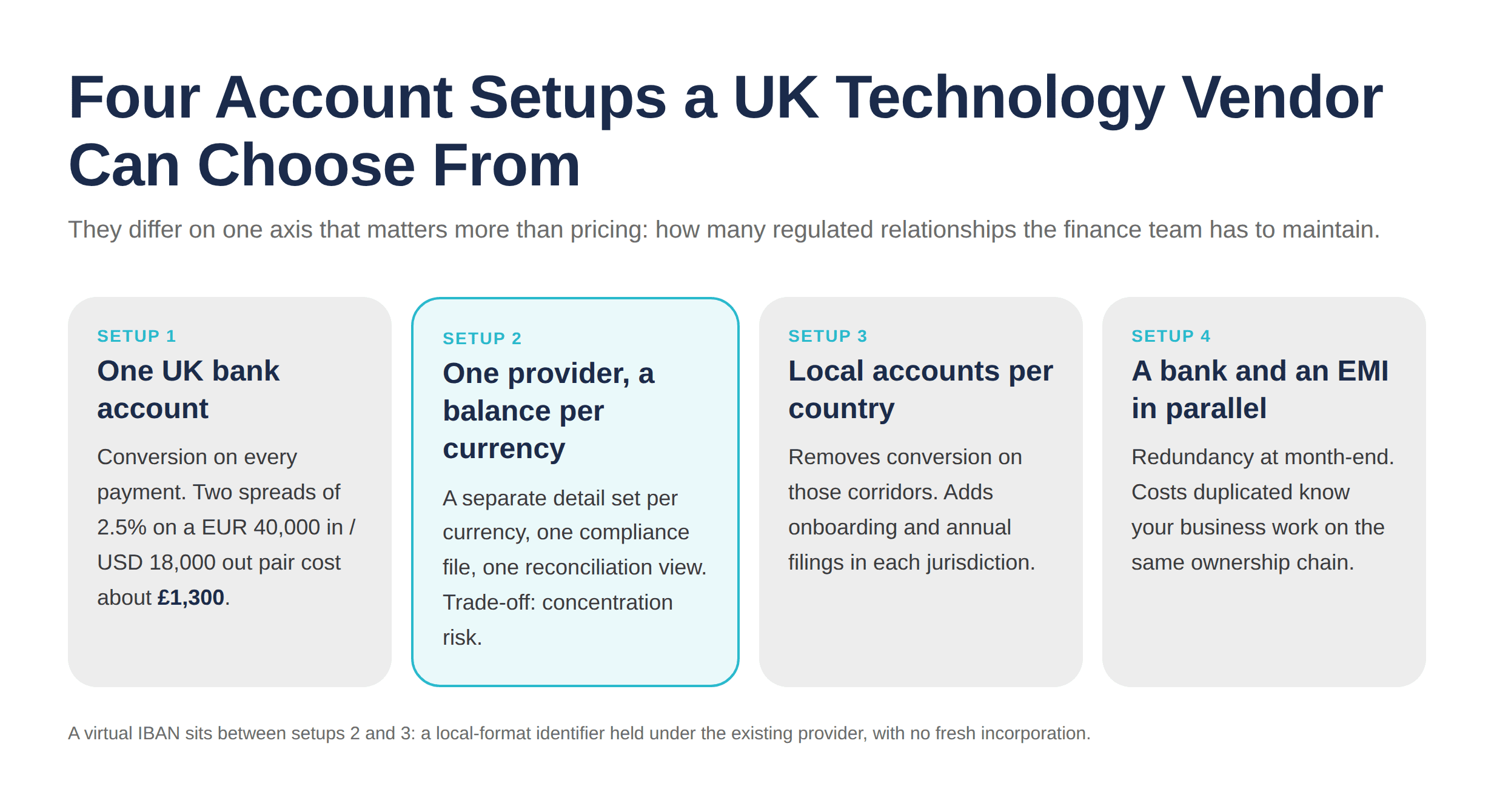
A UK vendor paying suppliers abroad has four workable configurations. They differ on one axis that matters more than pricing: how many regulated relationships the finance team has to maintain. An international business account under one roof keeps that number at one. Local entities push it to four or five.
One UK Bank Account With Conversion on Every Payment
The default arrangement costs the most and nobody notices. Take a vendor receiving EUR 40,000 in licence fees and sending USD 18,000 to a data feed the same week. Incoming euros convert to sterling at the bank's retail rate, then outgoing dollars convert back out of sterling. Two spreads of 2.5% on that pair cost about £1,300, and the invoice value never moved.
Small firms wear this for years because the charge never appears as a line item. It hides inside the rate.
A Multi Currency Business Account Under One Provider
One provider, several balances, one compliance file. A multi currency account issues a separate detail set per currency, so operator settlements land in the denomination they were billed in and wait there until a matching invoice falls due. Reconciliation gets easier too, because the euro ledger only ever contains euro movements.
The trade-off is concentration. If that single relationship goes under review, every outbound run pauses at once.
Local Accounts in Each Supplier's Country
Opening a złoty account in Poland and a rupee account in India removes conversion on those two corridors entirely. Each new entity then brings its own onboarding and its own annual filings. A virtual IBAN sits between the two extremes: the firm gets a local-format identifier for collections or payouts in a given market, held under the existing provider, without a fresh incorporation or a new tax registration.
Most vendors reach for a virtual IBAN long before they incorporate abroad.
A Bank and an EMI in Parallel
Keeping the high-street relationship for payroll and HMRC while routing trade payments through an authorised firm buys redundancy. Month-end never depends on one login. The cost is duplicated know your business work, because both institutions run their own checks on the same ownership chain.
UK Banks Versus EMIs for a Licensed Vendor
Most UK high-street banks offer multi-currency accounts, and so do FCA-authorised electronic money institutions such as EQWIRE and Airwallex. A bank holds client funds as deposits with FSCS cover to £85,000. Authorised e-money firms safeguard client balances in segregated accounts instead. For a licensed vendor, appetite for the file usually decides the outcome before either feature does.
UK high-street bank | FCA-authorised EMI | |
|---|---|---|
Appetite for gambling-adjacent B2B | Low; SIC code and client list often trigger decline | Higher; assessed against the vendor's own permissions |
Fund protection | FSCS deposit cover to £85,000 | Safeguarding in segregated client accounts, no FSCS |
Currencies held | Typically 2 to 5 on a business account | 40 to 66 depending on the firm |
Rails reachable directly | Faster Payments, CHAPS, BACS, SWIFT | Faster Payments, CHAPS, SEPA, SEPA Instant, SWIFT |
Typical onboarding | 4 to 12 weeks with a relationship manager | 5 to 20 working days, document-led |
Re-verification trigger | Annual review | Licence renewal or a shareholding change above the threshold |
Unlike a gambling merchant account, which sits on the operator's deposit-taking side and handles player funds, a technology supplier's account only handles inbound licence fees and outbound trade payments. Specialist igaming payment providers occupy the ground in between, carrying permissions for operator-side flows the high street avoids. Compliance teams that grasp the distinction price the file differently. Ones that skip it read the SIC code and stop there.
Checking a firm on the FCA register before applying takes two minutes and rules out the worst surprises.
[aa cta]
An account assessed on the licence, not the SIC code
EQWIRE weighs a vendor against its own regulatory permissions and issues separate sterling, euro, dollar and 63 further balances.
[aa btn]Open a Business Account[/aa]
[/aa]
What a Multi Currency Business Account Costs Against Conversion on Every Payment
Return to the EUR 40,000 in, USD 18,000 out week.
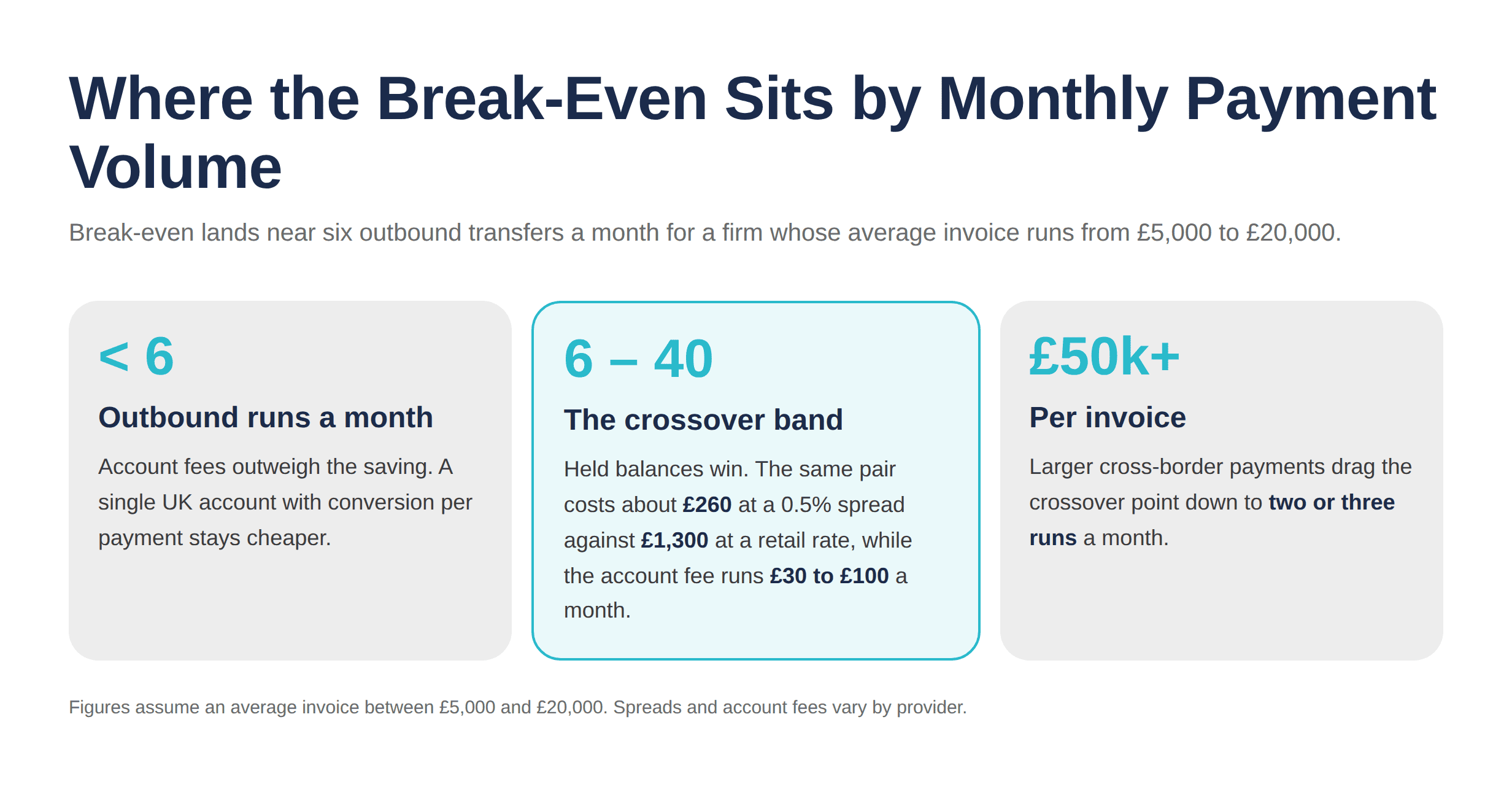
Two conversions at 0.5% cost roughly £260 on that pair, against about £1,300 at a retail high-street rate. Six outbound runs a month put the arithmetic beyond argument, and the monthly account fee of £30 to £100 disappears into the saving. One run a quarter does not.
Where the Break-Even Sits by Monthly Payment Volume
Break-even lands near six outbound transfers a month for a firm whose average invoice runs from £5,000 to £20,000. Below that, fees outweigh the saving. Above it, every extra transfer widens the gap, and cross border b2b payments of £50,000 and up drag the crossover point down to two or three a month.
How to Pay International Suppliers: The Three Rails Compared
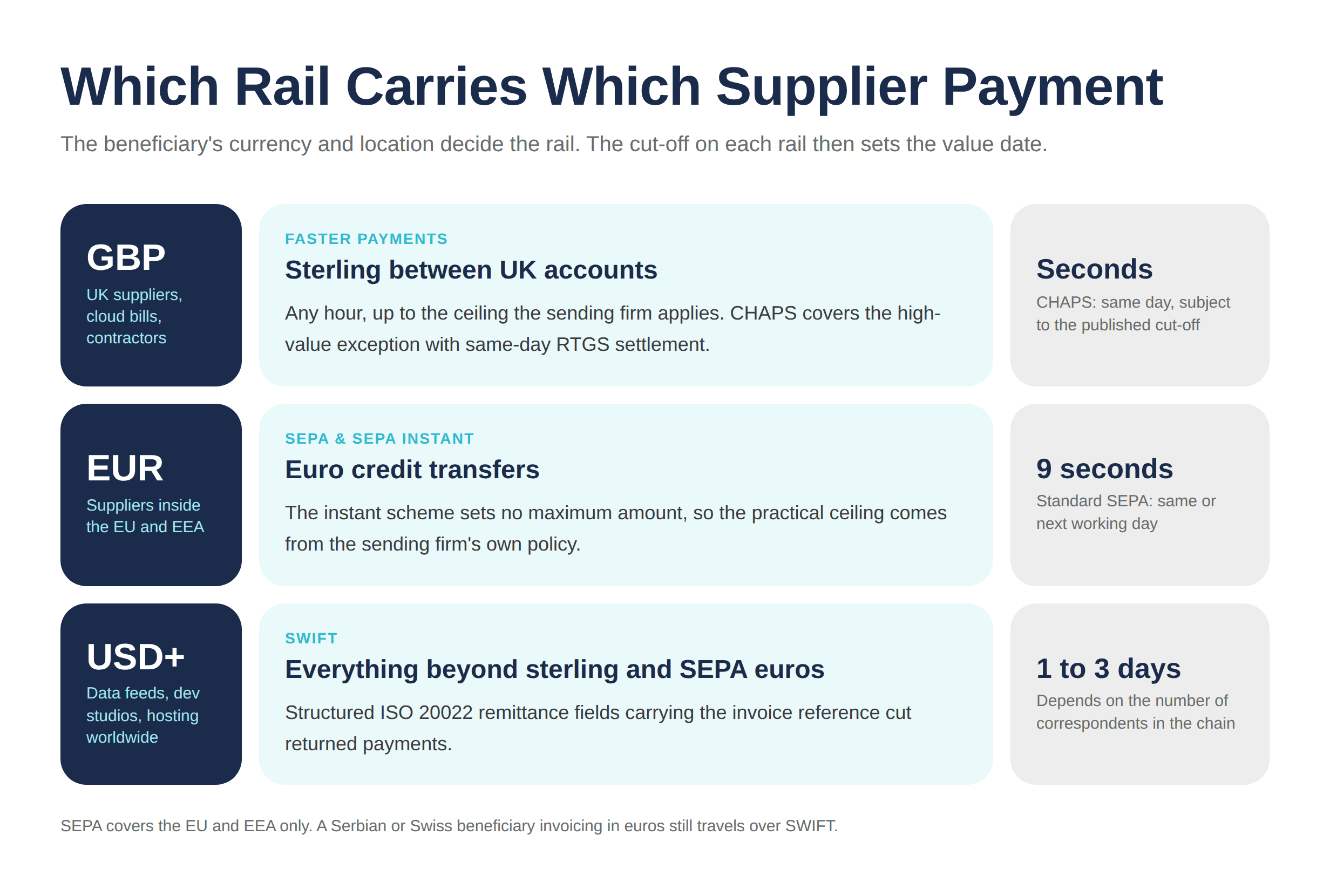
Three rails carry almost all international payments a UK technology firm makes. Which one carries a given invoice depends on the beneficiary's currency and location. The cut-off on each rail then sets the value date.
Faster Payments and CHAPS for GBP Suppliers
Faster Payments moves sterling between UK accounts in seconds, at any hour, up to whatever ceiling the sending firm applies. Cloud bills, UK contractors, agency retainers and domestic hosting all go this way. CHAPS handles the high-value exception: same-day settlement across the Bank of England's real-time gross settlement system, useful for a £400,000 licence prepayment where the beneficiary's bank wants certainty. Miss the CHAPS cut-off in the RTGS daily timetable and the funds land tomorrow.
SEPA and SEPA Instant for EUR Suppliers
SEPA payments reach euro suppliers inside the EU and EEA. A standard transfer arrives the same or next working day. SEPA Instant Credit Transfer settles in nine seconds, tightened from ten by the 2025 rulebook that took effect on 5 October 2025 under the Instant Payments Regulation. The detail most articles still get wrong: the scheme sets no maximum amount at all, so the practical ceiling on a large euro invoice comes from the sending firm's own policy.
SEPA covers the EU and EEA only. A Serbian or Swiss beneficiary invoicing in euros falls outside it.
SWIFT for USD and Everything Else
A SWIFT payment typically arrives in one to three working days, depending on how many correspondents sit in the chain. Dollar odds feeds, Indian development houses, Singaporean hosting contracts and Australian data partners all land here. International supplier payments fail most often on beneficiary data, so populating structured ISO 20022 remittance fields with the invoice reference cuts returns and shortens the chase.
The KYB Evidence That Decides the Outcome
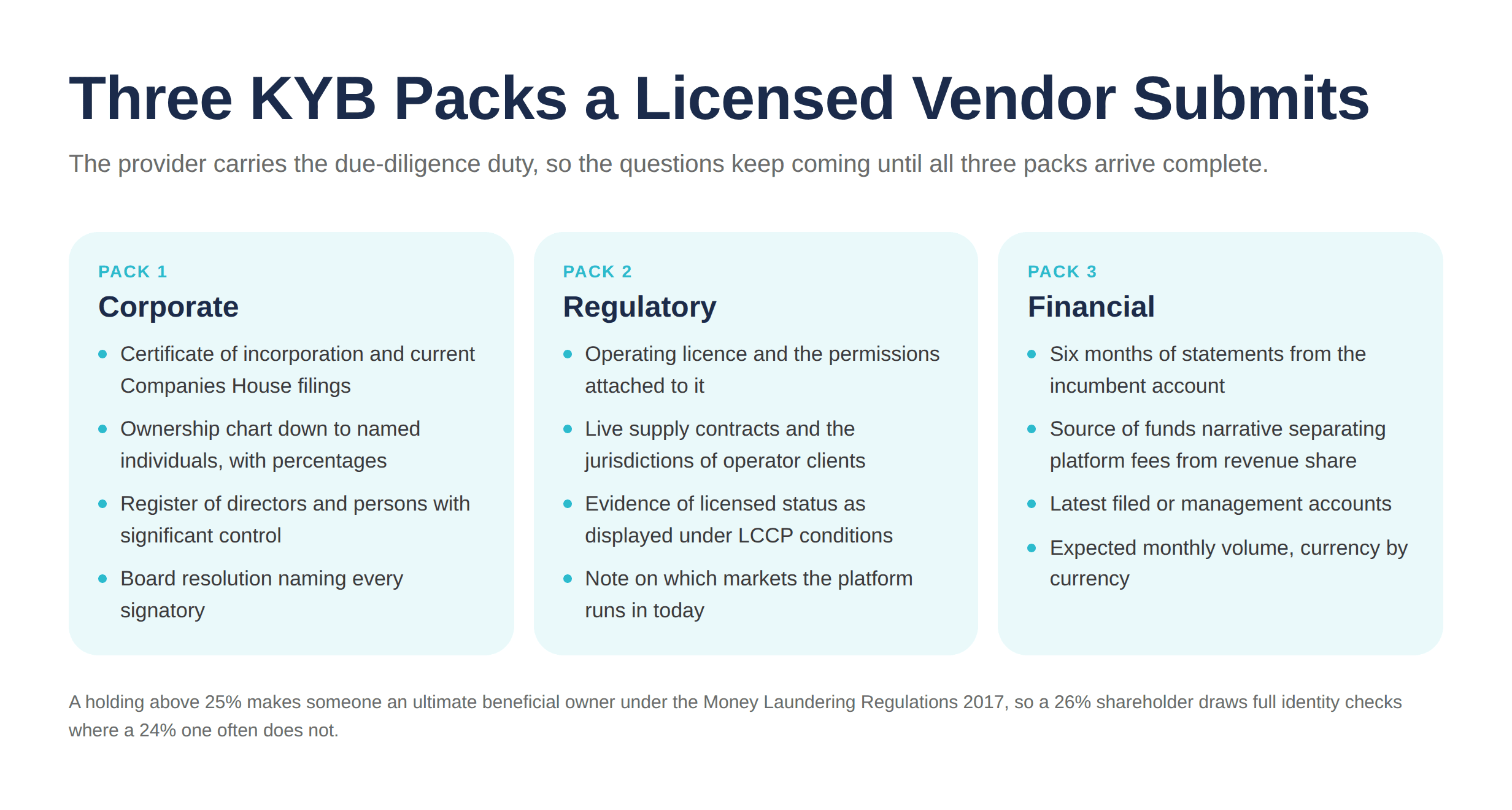
Know your business (KYB) checks on a licensed vendor cover three packs of evidence. The provider carries the due-diligence duty under the Money Laundering Regulations 2017, so the questions keep coming until all three arrive complete. Assembling them before applying cuts weeks off the wait.
Corporate Pack
Certificate of incorporation and current Companies House filings.
An ownership chart running down to named individuals, with the percentage each one holds.
Register of directors and persons with significant control.
A board resolution authorising the account and naming every signatory on it.
Regulatory Pack
The operating licence, its permissions, live supply contracts and the jurisdictions of the operator clients served.
Evidence of licensed status, as displayed under LCCP conditions.
A short note on which markets the platform runs in today.
Financial Pack
Six months of statements from the incumbent account.
A source of funds narrative that separates platform fees from revenue share.
Latest filed accounts, or management accounts if the year end has not passed.
Expected monthly inbound and outbound volume, currency by currency.
[aa fast-fact]
Fast Fact: A holding above 25% makes someone an ultimate beneficial owner (UBO) under those rules, which is why a 24% shareholder often passes unexamined while a 26% one draws full identity checks.
[/aa]
A Gambling Commission remote gambling software licence costs £9,138 to apply for at the smallest turnover band and £5,809 a year to hold, rising to £23,435 and £76,289 at the largest.
[aa fast-fact]
Fast Fact: Yield-based tiers replace the revenue bands from 1 October 2026, moving application charges into a £7,212 to £99,446 range.
[/aa]
Published figures like these work in the vendor's favour during review, because a compliance analyst can verify the spend against the public licence record in one sitting.
When One Provider Is Not Enough
A second relationship earns its place in two situations. The first is currency reach: an operator client settling in Brazilian real or Mexican peso needs a counterparty that holds those balances, and the incumbent may not. The second is operational risk, where a single review or outage stalls the whole month-end run.
Vendors who pay global software and service suppliers across more than eight corridors tend to split the work deliberately. Operator collections stay with the firm holding the widest currency network, while igaming payment solutions built for the payout side handle the outbound schedule. Splitting also keeps igaming payments traffic legible to each institution, since neither sees a mixed flow it cannot explain.
Two files, two annual reviews, one fewer single point of failure.
Decision Checklist by Supplier Mix and Payment Volume
Supplier mix, more than turnover, points to the right configuration. One provider holding a balance per currency suits most vendors in the middle of this table, and the edges belong elsewhere.
Supplier mix | Monthly outbound runs | Recommended setup |
|---|---|---|
All invoices in GBP | Any | Single UK account; the extra machinery earns nothing |
GBP and EUR | Under 6 | One UK account, conversion per payment |
GBP, EUR, USD and one more | 6 to 40 | One provider holding a balance per currency |
Three or more currencies plus a restricted corridor | Over 40 | Primary provider plus a second for reach |
Heavy concentration in one foreign market | Any | Local account or virtual IBAN for that corridor only |
The remaining question is which institution will look past the SIC code to the licence behind it. A multi currency business account earns its fee once each international transfer leaves from the balance matching the invoice. EQWIRE's network reaches 66 currencies with settlement windows from T+0 to T+2, so a finance lead can build the supplier payments schedule around confirmed value dates instead of estimates.
[aa cta]
Pay each supplier from the balance it invoiced against
One FCA-authorised provider, a distinct ledger per billing currency, and cut-off times listed corridor by corridor.
[aa btn]Create an Account[/aa]
[/aa]
FAQ
What KYB information should a licensed sportsbook technology vendor provide?
Three packs: corporate, regulatory and financial. The corporate pack covers incorporation documents, Companies House filings, the register of directors and an ownership chart naming every holder above 25%. The regulatory pack covers the operating licence, its permissions, live supply contracts and the jurisdictions of the operator clients served. The financial pack covers six months of statements, filed accounts, expected volumes and a source of funds narrative that separates platform fees from revenue share.
How do sportsbook technology vendors pay software suppliers in several currencies?
By holding a balance in each billing currency and paying from the matching one. Sterling invoices go over Faster Payments. Euro invoices inside the EU and EEA go over SEPA, and everything else over SWIFT. Sportsbook technology vendor payments uk workflows usually group invoices by rail instead of by due date, because a batch built that way clears in one cut-off window.
Does a gambling licence help a technology vendor pass UK account onboarding?
It helps, without settling the matter. A Gambling Commission software licence hands the analyst a verifiable public record, a known fee band, a renewal date and a published set of permissions, which shortens the regulatory half of any review. Ownership evidence and source of funds still have to stand on their own.
When do payment providers ask a sportsbook vendor for updated licence evidence?
At licence renewal, at any change in permissions, at any move into a new jurisdiction, and whenever a shareholding crosses the 25% threshold. Many providers also run a scheduled review every 12 to 24 months. A refusal to supply refreshed documents can freeze outbound activity, so most finance teams calendar the renewal date alongside the filing deadline.
Which UK banks offer multi-currency accounts?
HSBC, Barclays, Lloyds, NatWest and Starling all offer foreign currency account options or multi-currency business accounts, typically holding two to five currencies each. Authorised electronic money institutions hold between 40 and 66 in most cases. For cross border b2b payments in a regulated sector, the deciding factor tends to be which institution accepts the profile, since a provider that declines at onboarding never gets as far as its currency list.
Reviewed by

Related Articles

GBP Payment Account for UK Exporter Receiving EUR Customer Payments

Monthly Close Checklist for UK Companies with Multiple Currency Accounts

UK Business Account for a Corporate Travel Management Company Settling Hotel Suppliers
How to Document Expected Transaction Volumes for a UK Multi-Currency Account

Power your payments
with EQWIRE
Create your account in minutes and experience smooth, secure global payments.
" height="9.0156px" id="LIcbdboyB" transform="translate(4.987 4.5)" width="9.01562px"/></svg>)