
•
•

Articles
UK Business Payment Account for a Software Consultancy Owned by a German Parent
[aa disclaimer] Legal Disclaimer: This article is for informational purposes only and does not constitute legal, financial, compliance, or tax advice. Banking eligibility, regulatory requirements, and provider policies vary by jurisdiction. Consult qualified professionals before making decisions. [/aa]
A UK software consultancy owned by a German GmbH usually meets the problem in the same order. The company is registered at Companies House, the first British client invoice goes out in three weeks, and four contractors in Berlin and Hamburg expect euros at month end. The parent already has banking in Germany, so the instinct is to route everything through it. That works until a UK client's payment form rejects a German IBAN, or the accountant asks why sterling revenue sits in another company's books.
Paying international contractors and receiving UK client income are two different jobs, and a UK-incorporated subsidiary can do both from one account in its own name. German ownership changes the evidence an onboarding team asks for. It does not change whether the company qualifies. What follows is the working sequence: the monthly euro run, the application, and the points where things stall.
[aa key-takeaways]
Key Takeaways
A UK subsidiary is a separate legal person and needs payment rails in its own name, whoever owns it
SEPA Credit Transfer credits euros to German contractors by the next business day, without a correspondent chain
Six documents cover most applications from a German-owned UK entity; the ownership chain is what slows them
Knowing how to pay international contractors is partly a compliance question: worker status and VAT sit alongside the mechanics
Funds at an FCA-authorised electronic money institution are safeguarded under the Electronic Money Regulations 2011, not FSCS-covered
[aa btn]Book a Call[/aa] [/aa]
Paying international contractors in EUR: the monthly run for a UK consultancy
A UK company pays a German contractor in euros over SEPA Credit Transfer (SCT), a euro payment scheme run by the <a href="https://www.europeanpaymentscouncil.eu/what-we-do/sepa-instant-credit-transfer" target="_blank" rel="nofollow">European Payments Council</a> whose payments are credited to the beneficiary by the next business day when submitted before the daily cut-off. Many settle the same day. The alternative, a SWIFT wire, typically takes one to five business days and passes through correspondent banks that may deduct their own charges along the way.
The monthly run itself is short once the details are right:
Collect each contractor's IBAN and BIC, and the exact account holder name
Agree the invoice currency and payment terms in the contract
Choose the rail: SEPA for euro payments inside the scheme area
Submit the payments as a batch before the provider's cut-off
Reconcile each payment against its invoice using the reference
Businesses running this monthly find the cost driver is rarely the transfer fee. It is the conversion. A consultancy holding only sterling absorbs the margin four times a month, while holding a euro balance removes the conversion from the run entirely.
Collecting IBAN and BIC details correctly
Most returned euro payments fail on two fields: a mistyped IBAN, or an account holder name that does not match the contractor's bank records. SCT and SEPA Instant identify accounts by IBAN and BIC, with instructions carried in ISO 20022 messages, so there is no free-text tolerance. A returned payment costs twice, because the outbound fee is spent and the corrected payment carries its own.
SEPA batch runs versus one-off transfers
A batch run submits every contractor payment in one instruction, which keeps the cut-off consistent and produces a single reconciliation set. One-off transfers suit an unexpected invoice. Where speed matters, SEPA Instant makes funds available in under ten seconds, any day of the year. The Instant Payments Regulation obliged euro-area credit institutions to send instant transfers from October 2025, with electronic money institutions phased in later.
Payment references that keep contractor invoices reconciled
A reference should carry the invoice number and nothing decorative. Where the payment covers an intercompany charge to the parent, not a contractor fee, the payer on the instruction must still be the UK entity. That detail keeps the two companies' records separable at year end, and it is the most common thing this structure gets wrong. Rail choice affects both cost and settlement day, and the SWIFT and SEPA comparison sets out when each one applies.
Why the German parent's account cannot do this job
The UK subsidiary is a separate legal person. Money paid to it and out of it should therefore move through an account in its own name. <a href="https://www.gov.uk/government/organisations/companies-house" target="_blank" rel="nofollow">Companies House</a> records the entity, and its register of people with significant control names the German GmbH as the controlling party. Onboarding teams read both.
Route it through the parent and three things break:
UK client payment forms and direct debit mandates often reject a foreign IBAN
Sterling revenue lands in the parent's books, making the subsidiary's accounts harder to prepare
HMRC filings and supplier records name a payer that does not match the contracting entity
Whether the UK entity needs its own IBAN
Yes in practice. The pressure comes from commerce, not statute. Clients need details they can pay into without an international transfer, which means a UK sort code and account number, plus a euro IBAN once the company holds euros. Some providers issue the euro leg as a virtual IBAN in the entity's name.
The parent's registry extract and the ownership chain
Expect a request for a current extract from the German commercial register, the Handelsregister. It names the GmbH and its directors. A certified English translation may or may not be required, depending on the provider. Identification for the beneficial owners behind the parent is requested in almost every case. For the same sequence in a different jurisdiction, see the Gibraltar company precedent.
Document checklist and expected timeline
Six documents cover most applications from a German-owned UK subsidiary, and each is checked for something specific:
Companies House certificate of incorporation: confirms the entity exists and when
Parent registry extract: establishes the ownership chain above the UK company
Identification for ultimate beneficial owners: verifies the people behind the parent
Proof of the UK business address: confirms an operating presence, not just a registered office
Business plan or activity description: establishes what the company actually does
Expected transaction profile: sets the volumes, currencies and counterparty countries the account is opened for
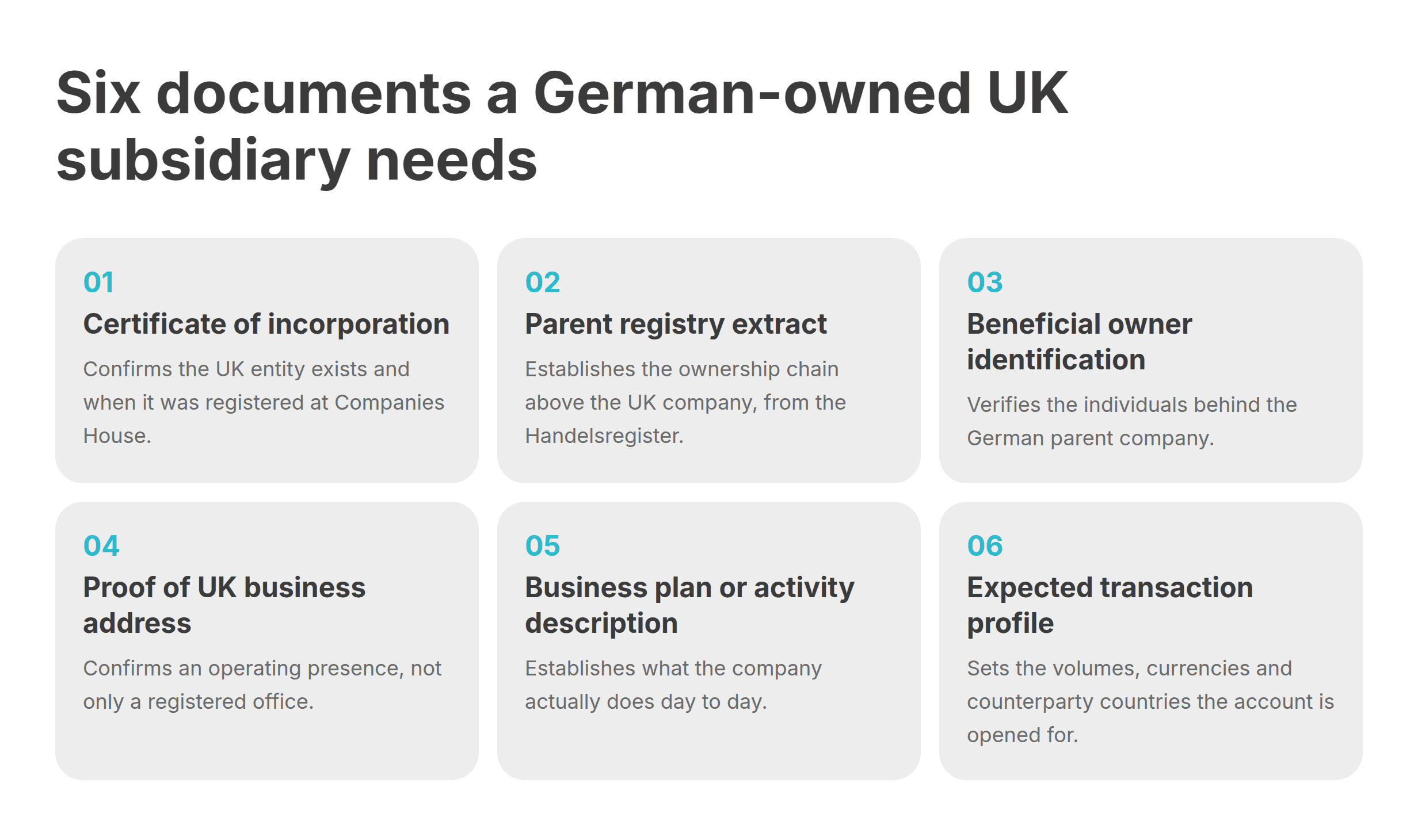
The sixth trips up most applicants. Spelling out sterling in from British clients and euros out to Berlin matches the application to reality from day one.
Realistic timelines: high-street bank versus an authorised provider
A high-street bank application from a foreign-owned entity commonly runs several weeks, longer where the ownership chain needs manual review. An international business account UK companies open with an FCA-authorised electronic money institution is typically faster, because onboarding is built around digital submission. EQWIRE operates on that model. The trade-off is worth stating plainly: client funds at an electronic money institution are safeguarded under the Electronic Money Regulations 2011, not protected by the FSCS. Any authorisation can be checked on the FCA Financial Services Register.
[aa cta]
Onboarding built for overseas-owned entities
EQWIRE handles the ownership-chain evidence online and issues local sterling details alongside a euro IBAN.
[aa btn]Create Account[/aa] [/aa]
Multi-currency business account UK: opening one for the subsidiary, step by step
To open the account, the UK entity submits its own registration details, then the ownership chain above it, then the signatories who will operate it. How a multi currency business account uk works as a product category is covered in the multi-currency account guide. The sequence below is specific to a foreign-owned subsidiary.
Steps 1 to 3: entity details, ownership chain, signatories
Submit the company number and the UK business address
Supply the parent's registry extract and beneficial ownership identification
Name the signatories and their authority limits, including any non-UK-resident director
Steps 4 to 6: currency balances, expected volumes, going live
Open the sterling and euro balances the business will actually use
Confirm expected monthly volumes and the countries money will move to
Receive the UK account details and the euro IBAN, then test with a small payment
[Visuals - Paying International Contractors - Six-Step Account Opening Flow - Six-step process flow for opening a multi-currency business account for a UK entity]
A multi currency account for business purposes keeps each currency in its own balance. A euro receipt therefore stays in euros until the company chooses to convert it. Providers that let a firm open multi-currency business account online complete all six steps without a branch visit.
Putting the GBP details on client invoices
Once live, the sterling account details go on every UK client invoice. Payments then arrive over Faster Payments the same day. Strip the parent's details out of the invoice templates while doing it.
Contractor status and tax: what a UK entity must check before paying
Before the first payment, a UK entity should confirm each contractor's employment status, because getting it wrong costs more than any payment fee. Unlike an employee on UK payroll, a contractor invoices for services and handles their own tax at home, and the distinction rests on how the relationship operates day to day, not on the contract's label.
Worker classification
Misclassification is the costly error here. A contractor who works set hours, under direction, exclusively for one client may be treated as an employee regardless of the paperwork. A consultancy with four long-standing German contractors should review this, not assume it.
Where IR35 and the off-payroll working rules can reach
IR35 and the off-payroll working rules can apply to a contractor based outside the UK. Where the UK client is a medium or large private-sector business, responsibility for determining status generally sits with the client. Whether that applies depends on the size of the UK entity and the facts of the engagement.
VAT reverse charge
Services bought by a UK VAT-registered business from a supplier outside the UK are often accounted for under the reverse charge, meaning the buyer reports the VAT and the invoice arrives without it. Treatment shifts with where that supplier sits and how each side is registered. Status assessment and VAT are tax and legal questions, not payment ones. A qualified accountant or employment lawyer should confirm both before the first run.
International business account UK: what to compare before choosing
Five criteria separate the options. Onboarding fit for an overseas-owned entity. Which currencies sit as real balances. Which rails are reachable. How conversion gets priced. What protection covers the money.
Criterion | High-street bank | Authorised electronic money institution |
|---|---|---|
Foreign-owned entity onboarding | Manual review, several weeks | Built for it, typically faster |
Currency balances | Often sterling plus one or two | Multiple balances held separately |
Euro rails | SEPA access varies by product | SEPA Credit Transfer and Instant |
Protection | FSCS deposit protection | Safeguarding under the 2011 Regulations |
Lending and merchant services | Available | Not available |
A business bank account multi currency product from a high-street bank wins where lending or merchant acquiring matters more than speed. Neither sits on this consultancy's list. For a uk business payment account for software consultancy with german parent ownership and no borrowing need, the comparison lands the other way. Pricing is the easiest thing to compare and the least useful. When ranking what the best multi currency business account uk options offer, weigh rail access above the headline number.
Choosing between a euro business account and one multi-currency account
Where euro traffic is occasional and sterling does the daily work, one extra balance is enough. Monthly euro movement flips that, because two separate accounts mean two statement sets and a transfer before every run.
Occasional euro invoices. A euro business currency account or a standalone euro business account alongside sterling covers it
Monthly euro contractor runs. A multi currency account for business use avoids the internal transfer and keeps one reconciliation set

What the best euro business account uk offers share is a real euro IBAN. A euro-labelled balance that converts the moment money arrives fixes nothing here.
Seven errors that delay or reject an application
Naming the parent as the payer on UK client invoices. The most common reconciliation error, and it quietly undermines the subsidiary's records all year
Submitting the ownership chain incompletely. Missing identification behind the GmbH stalls more applications than anything else
Understating the expected transaction profile. Open the account for low volumes and the first real run gets queried
Using a registered office as the only UK address. Providers want evidence of a real operating presence
Collecting contractor IBANs by email without verification. One wrong character costs two fees
Treating a multi currency business bank account uk application as a formality. It is a full onboarding, parent documents included
Leaving worker status unreviewed. Years of payments on an unexamined arrangement build exposure quietly
Where the contractor base grows beyond a handful, an employer of record or global payroll provider may fit better than an account plus manual runs. The answer depends on headcount and how much compliance work the finance function wants to own. Cross-currency payroll covers the same problem at larger scale.
Bringing it together
For a UK software consultancy owned by a German parent, paying international contractors cleanly rests on three decisions. Give the UK entity its own account details. Hold euros so no conversion happens on the monthly run. Settle the contractor status question before the first payment, not in year four. Onboarding evidence is heavier here than for a standalone British company, though eligibility is identical. An international business account UK companies open remotely covers the operational half. A qualified adviser covers the rest.
[aa cta]
Sterling in, euros out, one balance sheet
Keep both currencies where they land and settle over SEPA without touching an exchange desk first.
[aa btn]Create Account[/aa] [/aa]
FAQ
Can a UK subsidiary of a German company open a UK business account
Yes. A company registered at Companies House is its own legal person, whoever the shareholder happens to be. What German ownership changes is the paperwork, not the answer. Providers will want a current extract from the German commercial register naming the parent, plus identification for the individuals who ultimately own it. Refusals are rare. Delays are common, and the usual culprit is a gap in that ownership chain. Reviews at high-street banks tend to run several weeks. An FCA-authorised electronic money institution moves faster because everything runs on uploaded files, with one trade-off: money held there is safeguarded under the Electronic Money Regulations 2011 and sits outside FSCS cover.
How does a UK software consultancy pay German contractors in EUR
Through SEPA Credit Transfer, drawn from a euro balance the UK company already holds. Gather each recipient's IBAN and BIC, push everything through as one batch ahead of the daily cut-off, and the money lands by the next working day. Plenty clear same-day, and SEPA Instant delivers inside ten seconds where a provider offers it. Knowing how to pay international contractors well is largely about dodging the exchange desk: pay out of sterling and every transfer gets converted, while holding euros means that only happens on request. A SWIFT wire is the other route: one to five working days, and it can land light once correspondent banks take their cut.
Does a UK company with a foreign parent need its own UK IBAN
In practice, yes. The pressure is commercial. British clients pay into a sort code and account number, and plenty of UK payment and direct debit forms simply reject a foreign IBAN, so a subsidiary leaning on its parent's German details will see payments fail. Euros need a euro IBAN registered to the UK company too, which some providers supply as a virtual IBAN UK firms run beside their sterling details. There is a bookkeeping cost as well: sterling income arriving in the parent's name muddies the subsidiary's own accounts and its HMRC filings.
Can one account hold GBP and EUR for a UK subsidiary
It can. The two currencies sit in separate balances, so sterling from a British client and euros earmarked for contractors sit side by side untouched. What that buys is timing: the company picks the moment to exchange instead of watching every euro receipt land as sterling. A euro business currency account kept apart reaches a similar place, at the price of a second statement set and a transfer between the two. Check that the euro side arrives with a genuine euro IBAN attached.
Reviewed by

Related Articles

UK Multi-Currency Account for a UK Procurement Group with Separate Entity Billing

UK Payment Account for a Delaware Company with UK SaaS Revenue

UK Multi-Currency Account for a Global Payroll Software Company Paying Service Providers

UK Payment Account for an Online Lottery Technology Company with Cross-Border Vendors

Power your payments
with EQWIRE
Create your account in minutes and experience smooth, secure global payments.
" height="9.0156px" id="LIcbdboyB" transform="translate(4.987 4.5)" width="9.01562px"/></svg>)