•
•

Importing from China: How to Hold CNY and Pay Chinese Suppliers Directly
[aa disclaimer]
Legal Disclaimer: This article is for informational purposes only and does not constitute legal, financial, compliance, or tax advice. Banking eligibility, regulatory requirements, and provider policies vary by jurisdiction. Consult qualified professionals before making decisions.
[/aa]
Most UK businesses importing from China settle supplier invoices in US dollars. The habit carries two separate costs. The supplier pads the dollar price to cover exchange risk, and the importer pays conversion fees on every transfer. For companies importing from China, a CNY account for supplier payments removes both charges at once: the business holds Chinese yuan with a regulated UK provider and pays mainland suppliers directly in their own currency. This guide explains why CNY-denominated invoices tend to be cheaper and what the difference between CNY and CNH means in practice. It also shows how an FCA-regulated account lets an importer hold a yuan balance between orders instead of converting on every invoice.
[aa key-takeaways]
Key Takeaways
Chinese suppliers commonly price USD invoices 2–5% higher than CNY invoices, because a dollar contract leaves the exchange risk on their side.
CNY is the onshore renminbi used inside mainland China; CNH is the same currency traded offshore. UK importers send offshore renminbi that settles onshore through CIPS and designated clearing banks.
A CNY account for a UK company held with an FCA-authorised EMI keeps funds safeguarded under the Electronic Money Regulations 2011 and lets the importer time conversions instead of accepting each day's rate.
Chinese banks match incoming payments against official records. A misspelt beneficiary name or a personal account instead of a business account can freeze a payment for a week or longer.
Setting up CNY supplier payments takes one KYB onboarding, verified supplier details, and a CNY-denominated invoice.
[aa btn]Book a Call[/aa]
[/aa]
Why Pay Chinese Suppliers in CNY Instead of USD
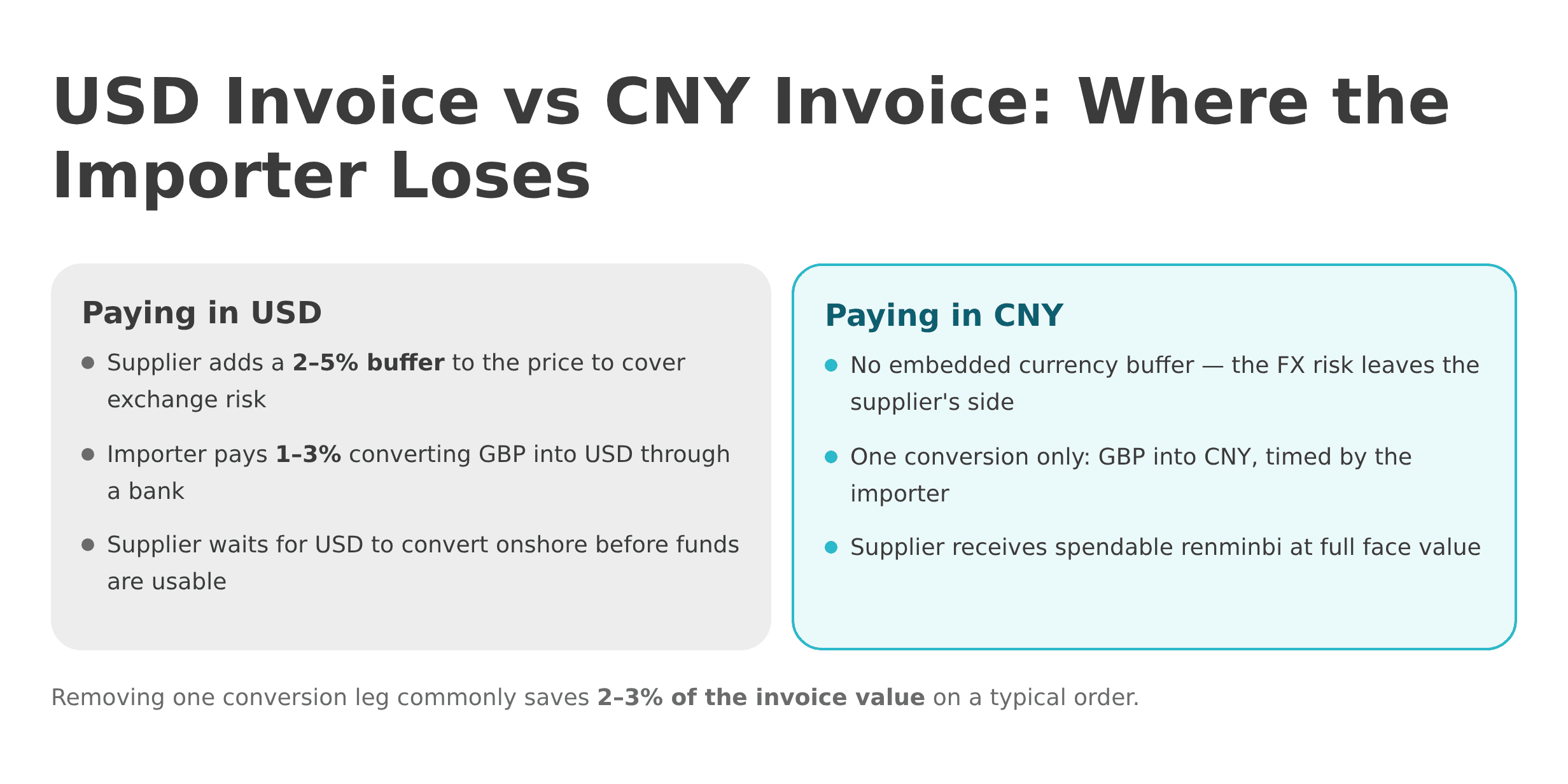
Chinese suppliers typically price USD invoices 2–5% higher than equivalent CNY-denominated invoices. The premium exists because a dollar contract forces the supplier to carry exchange risk between signing and settlement, then pay their own bank to convert dollars into renminbi. Businesses that pay Chinese suppliers in CNY take that risk off the supplier's books, and pricing usually follows.
The renminbi is no niche settlement currency. It ranked second only to the US dollar in global trade finance, at roughly 7.6% of the market (SWIFT RMB Tracker, 2025), and sits among the top six most active payment currencies worldwide (SWIFT RMB Tracker, 2026).
For an importer, the choice of invoice currency decides three things:
Who carries the FX risk: the supplier under USD terms, the importer under CNY terms
How many conversions happen: two under USD (GBP to USD, then USD to RMB), one under CNY
How fast the supplier confirms receipt: RMB arrives spendable; dollars wait for onshore conversion
Invoice currency also interacts with payment terms. Chinese manufacturers commonly work on a 30/70 structure: a 30% deposit before production starts and the 70% balance before shipment. Under USD terms, the importer faces two separate conversions weeks apart, each at an unknown future rate. A funded yuan balance fixes the cost of both instalments on the day the currency is bought.
The hidden FX margin suppliers build into USD invoices
Consider a £100,000 stock order from a Guangdong manufacturer. Quoted in dollars, the invoice usually includes a 2–5% buffer against currency swings before production ends. The importer then loses another 1–3% converting sterling into dollars through a bank. Removing one conversion leg by paying in renminbi commonly saves 2–3% of the invoice value, depending on the supplier's banking arrangements.
[aa fast-fact]
Fast Fact: RMB payments grew 102% in value year-on-year in December 2025, against 4.4% growth across all currencies (SWIFT RMB Tracker).
[/aa]
Negotiating CNY-denominated contracts
The starting point is a dual quote: the same order priced in USD and in CNY. The gap between the two shows exactly what the supplier charges for carrying currency risk.
Suppliers often welcome the switch. Receiving renminbi spares them conversion paperwork with SAFE (State Administration of Foreign Exchange) and removes the wait for dollar settlement. A CNY-denominated invoice also simplifies the importer's audit trail, since the contract price and the paid amount match to the fen.
CNY vs CNH: What UK Importers Actually Send
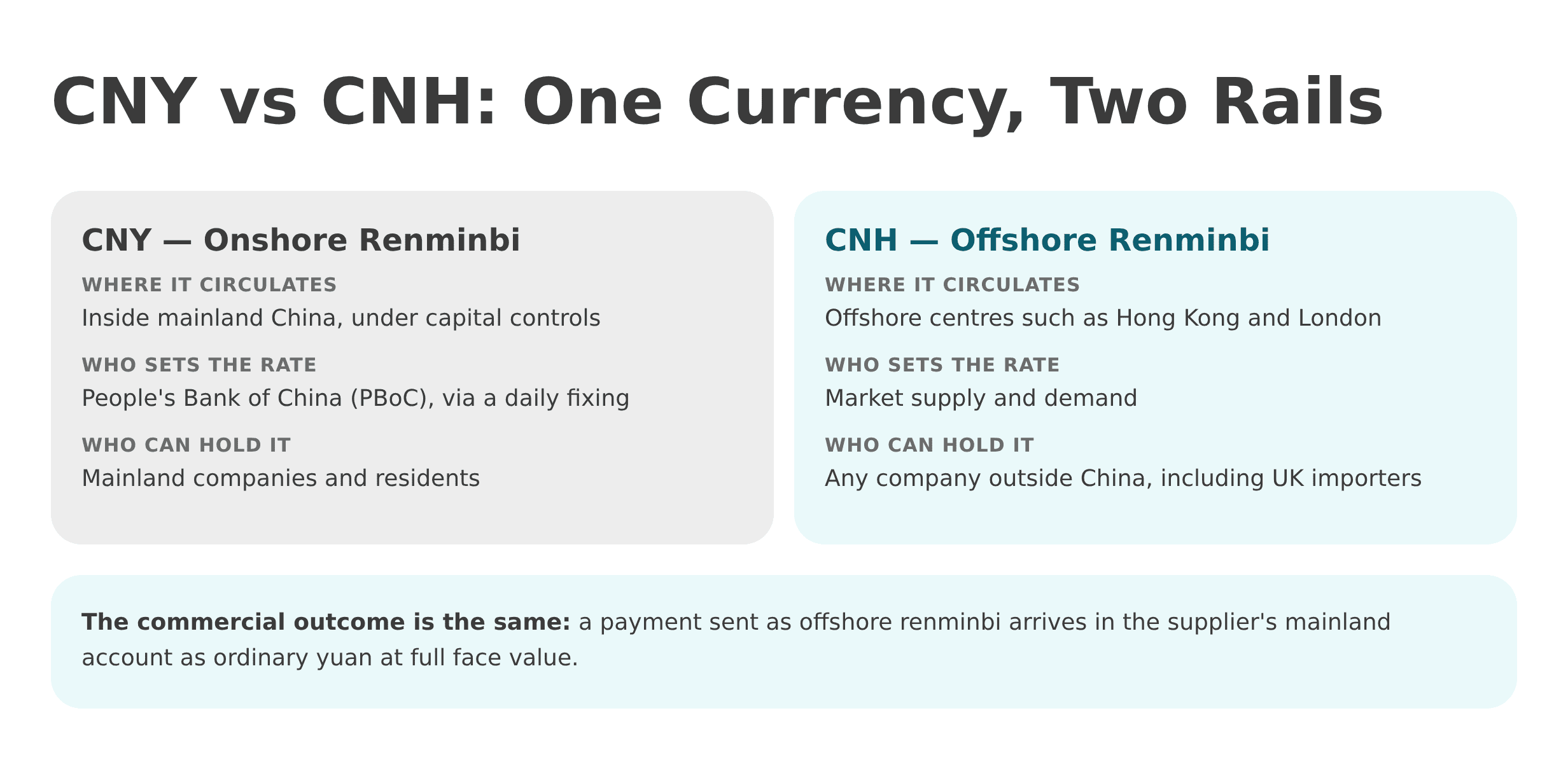
CNY is the onshore renminbi that circulates inside mainland China under capital controls; CNH is the same currency held and traded offshore, in centres such as Hong Kong and London. The People's Bank of China (PBoC) manages the onshore rate through a daily fixing, while the offshore rate moves with market supply and demand.
Unlike CNY, companies outside China can buy and hold CNH freely. When a UK importer funds a yuan balance, the balance is offshore renminbi. The distinction rarely changes the commercial outcome: the supplier still receives renminbi into a mainland account at full face value.
The two rates track each other closely, though they can drift apart by a fraction of a percent in volatile weeks. Importers converting large sums may want to compare the offered rate against the mid-market rate on the day.
In practice, the distinction surfaces at only one moment: when the importer buys yuan. A quote for CNH may differ slightly from the onshore fixing published by the central bank. Once the payment is on its way to the supplier, the label stops mattering, because the beneficiary receives ordinary renminbi.
Onshore vs offshore renminbi
The difference between CNY and CNH comes down to regulatory geography. Both are renminbi and both carry the yuan as their unit. CNY exists inside mainland China's controlled system; CNH exists outside it, created in 2010 when Beijing allowed renminbi deposits in Hong Kong. Research from the Bank for International Settlements on the renminbi's internationalisation traces how this offshore pool became the main route for foreign firms settling trade in yuan.
How settlement reaches a mainland supplier account
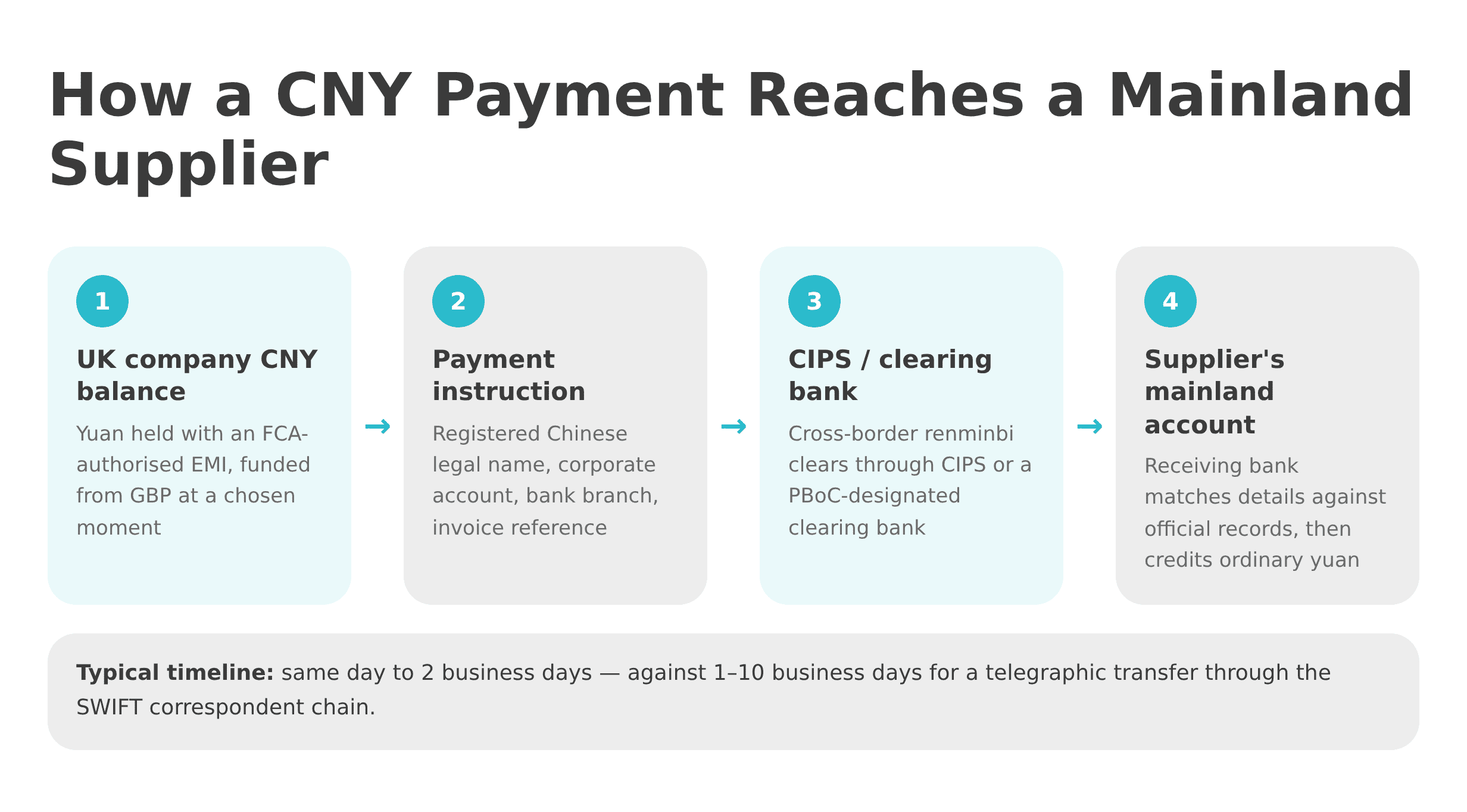
Cross-border renminbi payments clear through CIPS (Cross-Border Interbank Payment System) or through PBoC-designated clearing banks. A payment sent from a UK-held yuan balance typically reaches the supplier's mainland account the same day or within one to two business days.
The traditional alternative, a telegraphic transfer (T/T) through the SWIFT correspondent chain, can take anywhere from one to ten business days depending on the intermediaries involved. Each intermediary may also deduct its own fee in transit.
How a CNY Account Works for a UK Company
A CNY account for a UK company provides renminbi account details through a regulated provider, letting the business hold and send yuan without opening a Chinese bank account. Providers such as EQWIRE, an FCA-authorised electronic money institution, offer CNY as one balance inside a multi-currency account alongside GBP, EUR, and USD.
The regulatory basis matters. E-money institutions operate under the Payment Services and Electronic Money Regulations, and the Electronic Money Regulations 2011 require them to safeguard client funds in segregated accounts at credit institutions. The protection model differs from a bank's FSCS cover, and the comparison between FCA-authorised EMIs and banks is worth understanding before choosing where a CNY balance sits.
For a business importing from China, a CNY account for supplier payments turns currency management into a treasury decision rather than a per-invoice cost.
Consider a UK e-commerce retailer restocking from two mainland factories every quarter. Under the old setup, four invoices a year each triggered a fresh GBP-to-USD conversion at that day's rate, with no visibility of the total annual FX cost until year end. With a yuan balance, the finance manager buys CNY twice a year when the rate looks strong, and every subsequent invoice settles at a cost fixed months in advance.
Holding a CNY balance without conversion
Importers who hold a CNY balance for supplier payments buy yuan whenever the rate looks favourable, independent of any invoice due date. A quarter's worth of orders can be funded in one conversion, then paid out invoice by invoice with no further FX cost.
The approach carries its own exposure. A yuan balance loses sterling value if the rate moves against it, so the strategy suits businesses with predictable, recurring CNY obligations rather than one-off purchases. Finance teams handling wider flows can apply the same logic across currencies, as covered in EQWIRE's guide to cross-border business payments.
Paying suppliers directly from the balance
Payments leave the yuan balance with the supplier's business name and full bank coordinates attached. Importers paying several factories on a schedule can group transfers into weekly supplier batch payments instead of keying each one manually.
Each payment needs a clear reference to the underlying invoice. Chinese receiving banks check incoming trade payments against documentation, and a clean reference shortens that review.
[aa cta]
Hold CNY and pay suppliers from one account
EQWIRE multi-currency accounts let UK importers hold CNY alongside GBP, EUR and USD, and pay mainland suppliers directly from the balance.
[aa btn]Create Account[/aa]
[/aa]
Chinese-Side Requirements and Compliance
Chinese banks reject or freeze incoming payments when beneficiary details do not match official records. Mainland institutions verify the receiving company's registered legal name and account details against government registration data before releasing funds. A single transposed character can hold a payment for seven business days or more.
The rules exist because China regulates money entering the country as tightly as money leaving it. SAFE oversees cross-border flows, and receiving banks answer to it for every trade payment they credit.
In practice, a UK importer's pre-payment routine looks like this:
Confirm the supplier's registered Chinese legal name, not the English trading name on the sales brochure
Verify the account is a corporate account held in the company's name
Match the payment reference to the invoice and contract the supplier filed on their side
Why payments get rejected or frozen
Name mismatches cause most failures. The registered name in Chinese bank records must match the payment instruction exactly, and English transliterations often differ from the official registration. Payments to personal accounts fail for a different reason: trade settlement into an individual's account breaches mainland rules and is a common marker of invoice fraud. The UK government's overseas business risk guidance for China recommends verifying counterparties through official registries before money moves.
A frozen payment costs more than the delay itself. Production slots slip while funds sit in review, and a supplier waiting on a deposit will not order raw materials. One round of detail verification before the first transfer prevents most of these situations outright.
Documentation Chinese banks expect
The supplier's bank may ask for the commercial invoice and the sales contract before crediting a large payment. Customs documentation sometimes joins the request list. Importers keep settlement smooth by sending the invoice number in the payment reference and holding copies of the contract ready. Suppliers receiving regular renminbi payments from the same buyer clear these checks faster over time.
None of this paperwork sits on the UK side of the transfer. The importer's role is simply to make the payment traceable: a reference that matches the invoice and a beneficiary name that matches the registration. Payments that tick both boxes rarely attract questions.
Step-by-Step: Setting Up CNY Supplier Payments
The process of how to pay Chinese suppliers in CNY from the UK comes down to six steps:
Complete KYB onboarding with a regulated provider, submitting company registration and director identification.
Get CNY account details as part of a multi-currency account setup.
Verify supplier details: registered Chinese legal name, corporate account number, bank and branch.
Agree a CNY-denominated invoice with the supplier, ideally after comparing dual USD and CNY quotes.
Fund the yuan balance, converting from GBP at a chosen moment rather than on the invoice due date.
Send the payment with the invoice number in the reference, and reconcile once the supplier confirms receipt.
Importers new to the China trade should also have customs basics in place. The UK government's import guidance covers EORI registration and declaration requirements that sit alongside the payment process.
An importer running quarterly orders can complete steps one to three once, then repeat only the funding and payment steps each cycle.
FAQ
Can a UK importer hold a CNY balance and pay suppliers directly without conversion?
Yes. For a UK importer from China, hold CNY balance and pay suppliers directly without conversion is exactly what a multi-currency account with CNY support provides. The importer converts GBP into yuan once, at a time of their choosing, and the balance then covers any number of supplier invoices with no further exchange step. Funds held with an FCA-authorised e-money institution are safeguarded in segregated accounts under the Electronic Money Regulations 2011. The main caveat is exchange exposure: a held yuan balance changes sterling value as the rate moves, so the approach fits businesses with recurring CNY obligations.
How to pay Chinese suppliers in CNY from the UK?
A UK business pays Chinese suppliers in CNY by opening a multi-currency account with renminbi support, funding the yuan balance, and sending payments to the supplier's corporate account in mainland China. The payment travels as offshore renminbi and settles through CIPS or a designated clearing bank, typically arriving the same day or within two business days. The supplier must provide their registered Chinese legal name and business account details, since mainland banks verify both before crediting funds.
Do Chinese suppliers accept payments in CNH?
Yes. CNH and CNY are the same renminbi, and a supplier's mainland account receives the payment as ordinary yuan at full face value. The CNH label only describes where the currency was held before transfer: offshore, outside mainland China's capital controls. Suppliers see a renminbi credit and do not deal with the onshore-offshore distinction at all.
How long does a CNY payment to a Chinese supplier take?
A renminbi payment sent from a UK-held balance typically reaches the supplier's account the same day or within one to two business days. A traditional telegraphic transfer routed through the SWIFT correspondent chain can take one to ten business days, with possible intermediary deductions along the way. Large first-time payments may face an extra compliance review by the receiving bank, which adds time until the supplier has a payment history with the sender.
What documents does a Chinese supplier need to receive CNY?
The supplier's bank may request the commercial invoice, and sometimes the sales contract or customs paperwork, before crediting an incoming trade payment. The receiving account must be a corporate account registered in the supplier's official Chinese legal name. Payments referencing a clear invoice number clear compliance checks faster, and repeat payments between the same parties face progressively less scrutiny.
Paying suppliers in their own currency is one of the few importing costs a finance team can remove without renegotiating a single commercial term. Importing from China with a CNY account for supplier payments cuts the embedded dollar buffer, halves the conversion count, and gives the business control over when exchange happens. As renminbi settlement keeps growing across global trade, suppliers will increasingly expect the option. UK companies that hold CNY and pay Chinese suppliers directly put themselves ahead of that curve, and opening a multi-currency account with EQWIRE is a practical first step.
Reviewed by
Related Articles



Power your payments
with EQWIRE
Create your account in minutes and experience smooth, secure global payments.
" height="9.0156px" id="LIcbdboyB" transform="translate(4.987 4.5)" width="9.01562px"/></svg>)