
•
•

Articles
Sandbox Testing for UK Payment APIs: Faster Payments, SEPA and SWIFT
[aa disclaimer]
Legal Disclaimer: This article is for informational purposes only and does not constitute legal, financial, compliance, or tax advice. Banking eligibility, regulatory requirements, and provider policies vary by jurisdiction. Consult qualified professionals before making decisions.
[/aa]
UK fintechs and payment service providers increasingly route transactions across three separate rails: Faster Payments for domestic GBP transfers, SEPA for euro payments, and SWIFT for wider international settlement. Each rail publishes its own payment API and its own sandbox, and the three sandboxes do not behave the same way. A team that assumes uniform sandbox behaviour across rails often discovers the gaps only after go-live, when a Faster Payments test scenario that passed cleanly does not translate to SEPA's scheme rules or SWIFT's correspondent-chain delays. This article compares how sandbox testing works for Faster Payments, SEPA and SWIFT, what each environment actually simulates, and where the differences create risk for teams moving toward production. It closes with a practical checklist for choosing which rail combination to build first.
[aa key-takeaways]
Key Takeaways
Faster Payments, SEPA and SWIFT each maintain a separate sandbox, and none fully replicates production settlement behaviour.
SEPA Instant sandbox testing caps transactions at €100,000 and simulates settlement within roughly ten seconds.
SWIFT sandbox environments cannot reproduce every correspondent-banking delay that shows up once a payment reaches production.
Open banking APIs sit alongside these three rails rather than replacing them, and their sandbox behaviour follows separate PSD2-driven rules.
A rail-by-rail go-live checklist reduces the risk of discovering scheme-specific quirks after an integration is already live.
[aa btn]Book a Call[/aa]
[/aa]
What Is a Sandbox Environment for a Payment API?
A sandbox environment is a self-contained test version of a payment API that simulates real transactions without moving actual funds. It mirrors the production API's endpoints, authentication flow and response formats, so integration code written against the sandbox can move to production with minimal changes.
For payment rails specifically, the sandbox substitutes test data for live bank connections. Faster Payments, SEPA and SWIFT each run this simulation differently, because each rail's underlying infrastructure differs in ownership, settlement mechanics and message format. A sandbox environment that works well for one rail does not guarantee equivalent coverage for another.
In practice, an e-commerce business preparing to accept both GBP and EUR payouts might test a Faster Payments scenario successfully within a week, then find the SEPA sandbox requires different test IBAN formats before the same logic passes. That difference reflects how the schemes are actually governed, not a flaw in either sandbox.
Sandbox access usually comes bundled with a provider's developer account, separate from the production credentials issued once onboarding and compliance checks are complete. Engineering teams should treat sandbox credentials and production credentials as entirely separate environments, since mixing test and live API keys is a common source of accidental live transactions during integration work. Most providers also rotate sandbox test data periodically, so a test IBAN or account number that worked six months ago may no longer be valid.
Faster Payments, SEPA and SWIFT: Three Rails, Three Test Environments
Faster Payments, SEPA and SWIFT each run their own sandbox, and none of the three behaves identically. Faster Payments is a UK-only real-time rail overseen under Bank of England supervision; its sandbox typically returns an instant success or failure response, mirroring the live network's near-instant settlement. SEPA covers euro payments across the EU and EEA under European Payments Council scheme rules; its sandbox enforces the same scheme-level validation that production enforces. SWIFT connects correspondent banks worldwide for settlement outside the EU/UK domestic rails; its sandbox simulates message acceptance but cannot fully reproduce the correspondent-chain routing delays that appear once a payment leaves the sending bank.
Testing each rail's sandbox in isolation, one at a time, catches most integration bugs early. Testing them as a single combined checklist, matched against each rail's actual production behaviour, catches the remainder.
A UK business accepting domestic invoice payments through a Faster Payments business account faces a narrower testing scope than one also sending SWIFT payments to suppliers abroad. Scoping the sandbox checklist to the rails a business actually needs, rather than testing every rail a provider offers, keeps the pre-launch testing phase focused and shortens the path to go-live.
How Faster Payments Sandbox Testing Works
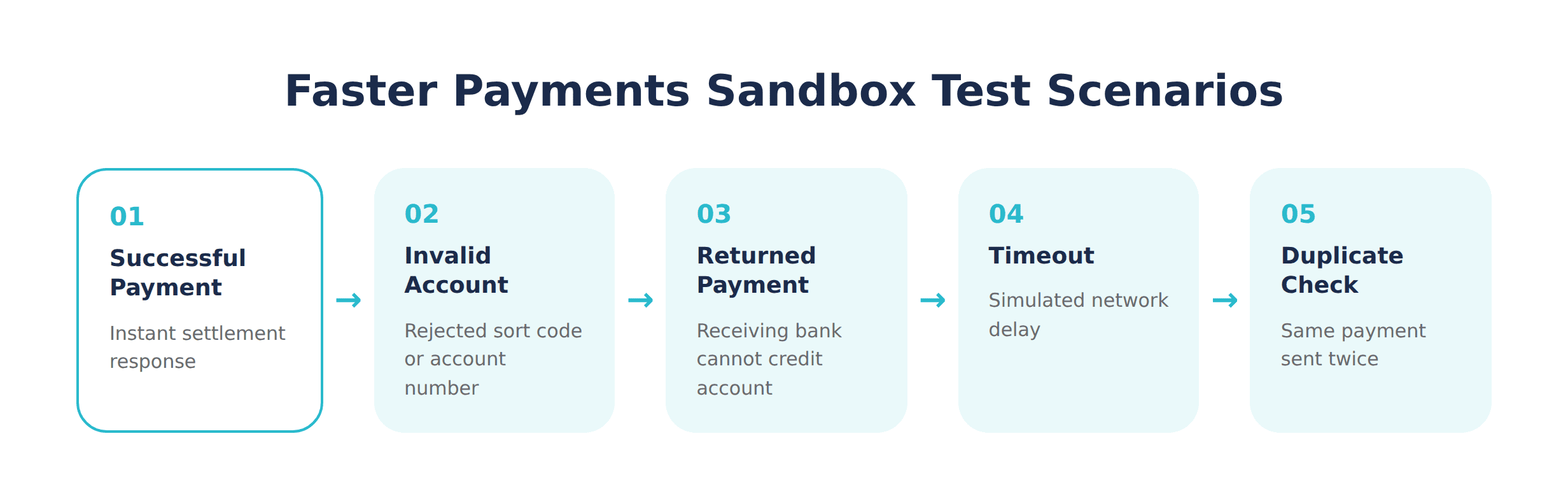
Faster Payments API sandbox testing simulates the UK's real-time domestic rail without moving GBP between real accounts. A complete test suite should cover five scenarios:
A successful instant payment
A rejected payment due to invalid sort code or account number
A returned payment where the receiving bank cannot credit the account
A timeout simulating network delay
A duplicate-payment check
[aa fast-fact]
Fast Fact: Faster Payments is built for near-instant settlement in production, and the Bank of England continues to modernise the scheme's retail payments infrastructure as transaction volumes grow.
[/aa]
Engineering teams testing Faster Payments integrations should confirm their code handles all five outcomes correctly, not only the successful path. EQWIRE's REST API for Faster Payments and SEPA documents each scenario in its own sandbox, giving integrating businesses a concrete reference for what a Faster Payments test suite should cover before go-live.
How SEPA Sandbox Testing Works
SEPA sandbox testing covers two related but distinct schemes governed by the European Payments Council (EPC): SEPA Credit Transfer (SCT), which settles same-day or within one business day, and SEPA Instant (SCT Inst), which settles in roughly ten seconds and caps individual transactions at €100,000. A SEPA sandbox validates IBAN structure, creditor identifiers and scheme-specific fields before accepting a test payment, matching the same validation production enforces.
Test data for SEPA differs from Faster Payments test data because IBAN format is mandatory rather than a UK sort code and account number pair. Businesses building against SEPA should confirm their sandbox test IBANs use the correct country-code prefix and check-digit format for each EU/EEA country they intend to support. A malformed test IBAN fails validation before the transaction logic is ever exercised.
One limitation worth flagging: SEPA sandbox testing confirms scheme-level acceptance, but it does not replicate every intermediary bank's individual processing time once a live SEPA Instant payment enters the TARGET Instant Payment Settlement (TIPS) infrastructure.
How SWIFT Sandbox Testing Works
SWIFT sandbox testing differs from production mainly in what it cannot show: correspondent-chain routing. A SWIFT payment message, formatted as MT103 or the newer ISO 20022-based MX standard, travels through one or more correspondent banks before reaching the beneficiary's bank. A sandbox can confirm that a message is correctly formatted and accepted by the first bank in the chain. It cannot simulate how many correspondent banks a live payment will pass through, or how long each one takes to process it.
Faster Payments and SEPA settle under a single scheme owner that controls the process end-to-end. SWIFT payments instead depend on relationships between individual banks. That is why a UK business testing SWIFT payments successfully in sandbox can still see meaningfully different settlement times in production, typically one to five business days, depending on how many correspondent banks the payment crosses.
Cross-border settlement research from the Bank for International Settlements describes correspondent banking as a chain of bilateral relationships rather than a single centrally-controlled network, which is precisely why no SWIFT sandbox, however well built, can model every possible chain a live payment might travel through. Teams should treat sandbox-verified SWIFT integrations as formatting-correct, not settlement-time-guaranteed. Building in a monitoring step for the first live SWIFT payments, rather than assuming sandbox success carries over directly, catches most surprises early.
Where Open Banking APIs Fit Into the Picture
Open banking APIs sit alongside Faster Payments, SEPA and SWIFT, not in place of them. Under the UK's PSD2-derived open banking rules enforced by the FCA, an open banking API initiates a payment that then settles over one of the underlying rails, most commonly Faster Payments for domestic GBP transfers. Open banking API providers publish their own sandboxes, and businesses evaluating providers should check which underlying rail each sandbox actually tests against. An open banking sandbox that only mocks the initiation step gives no visibility into the settlement rail's own quirks.
Side-by-Side: Sandbox Coverage, Limitations and Test Data
Comparing the three rails side by side clarifies where sandbox testing gives a reliable preview of production, and where it does not.
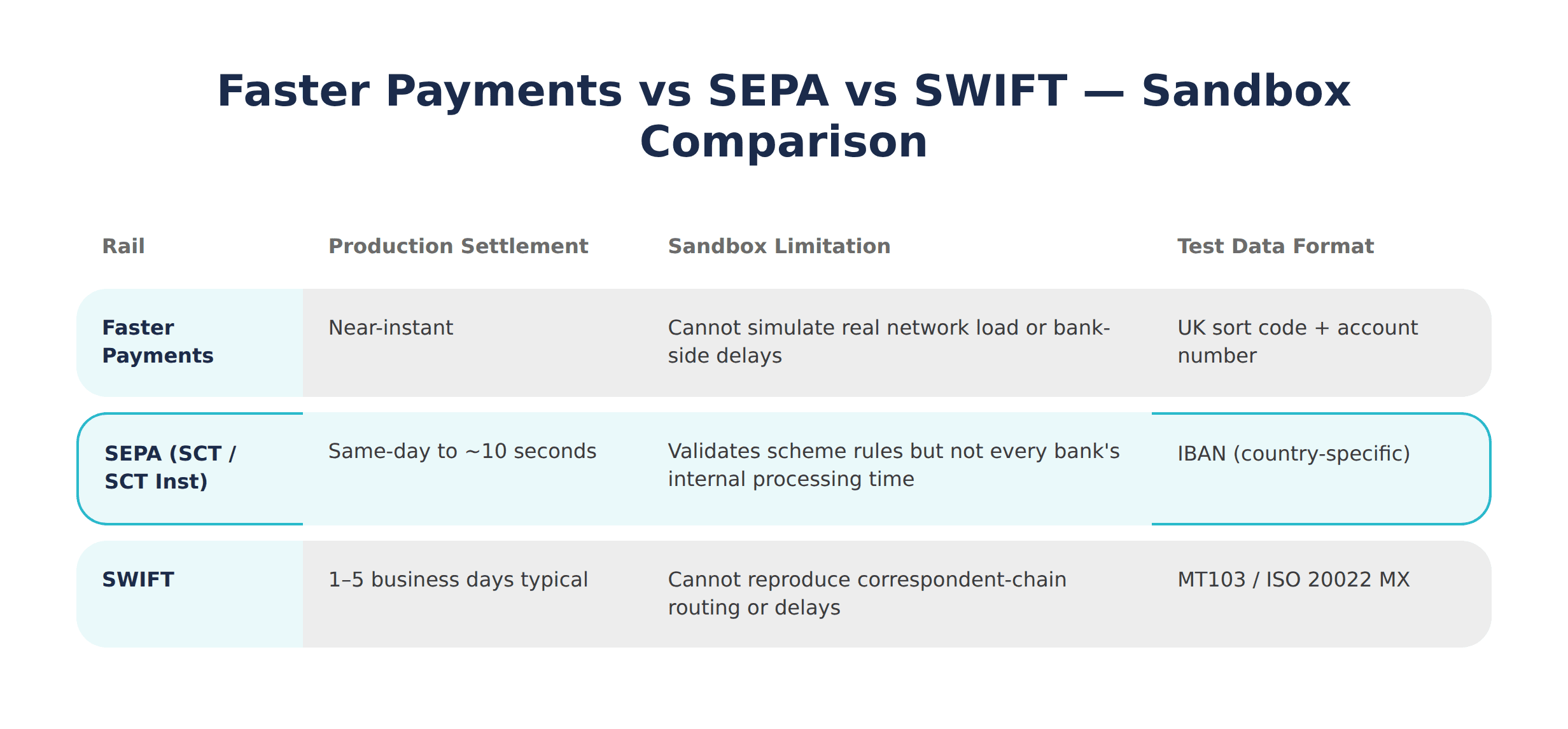
Rail | Production settlement | Sandbox limitation | Test data format |
|---|---|---|---|
Faster Payments | Near-instant | Cannot simulate real network load or bank-side delays | UK sort code + account number |
SEPA (SCT / SCT Inst) | Same-day to ~10 seconds | Validates scheme rules but not every bank's internal processing time | IBAN (country-specific format) |
SWIFT | 1–5 business days typical | Cannot reproduce correspondent-chain routing or delays | MT103 / ISO 20022 MX message |
The pattern holds across all three rails: sandbox testing reliably catches formatting and validation errors. It does not reliably predict real-world settlement timing, because timing depends on factors that only exist in production — network load, correspondent relationships, bank-side processing.
[aa cta]
Comparing Rails Without Building Sandbox Tooling for Each One
Testing three separate sandboxes in parallel takes engineering time most teams would rather spend elsewhere. EQWIRE's multi-currency accounts give businesses Faster Payments, SEPA and SWIFT access through one integration, with sandbox test coverage already mapped against each rail's actual behaviour.
[aa btn]Create Account[/aa]
[/aa]
Choosing the Right Rail Combination Before Building
Most UK businesses accepting or sending international payments need more than one rail. A marketplace paying EU-based sellers needs SEPA. A business paying suppliers outside the EU/UK needs SWIFT. A UK-only SaaS business collecting subscription payments domestically may need only Faster Payments, at least initially.
Reviewing payment API documentation for each rail before writing integration code, rather than after a sandbox test fails, surfaces most of the scheme-specific requirements early: IBAN validation for SEPA, message formatting for SWIFT, sort code and account number pairing for Faster Payments. Teams building a payment API for developers to consume internally should document these differences once, rather than relying on each engineer to rediscover them independently.
An online payment API that only ever touches one rail is simpler to test and maintain, but it also means a business cannot add a second rail later without repeating the sandbox-to-production process from scratch. Businesses that expect to need multiple rails within the next year generally save engineering time by mapping all relevant sandboxes upfront, even if only one rail goes live first.
The UK's National Payments Vision sets out government-level direction for modernising domestic payments infrastructure, which is one reason sandbox environments and scheme rules for rails like Faster Payments continue to change over time. A rail combination that made sense a year ago may need re-testing as scheme rules or infrastructure change, not just when a business's own product requirements shift.
EQWIRE works with UK and EU businesses as a regulated multi-currency account provider, supporting Faster Payments, SEPA and SWIFT through virtual IBANs issued for each currency a business needs to hold or move. Marketplaces handling multi-currency payouts to sellers and businesses running supplier payments without a direct SWIFT connection both build on the same underlying rail combination described above.
[aa cta]
Ready to Move From Sandbox to Production
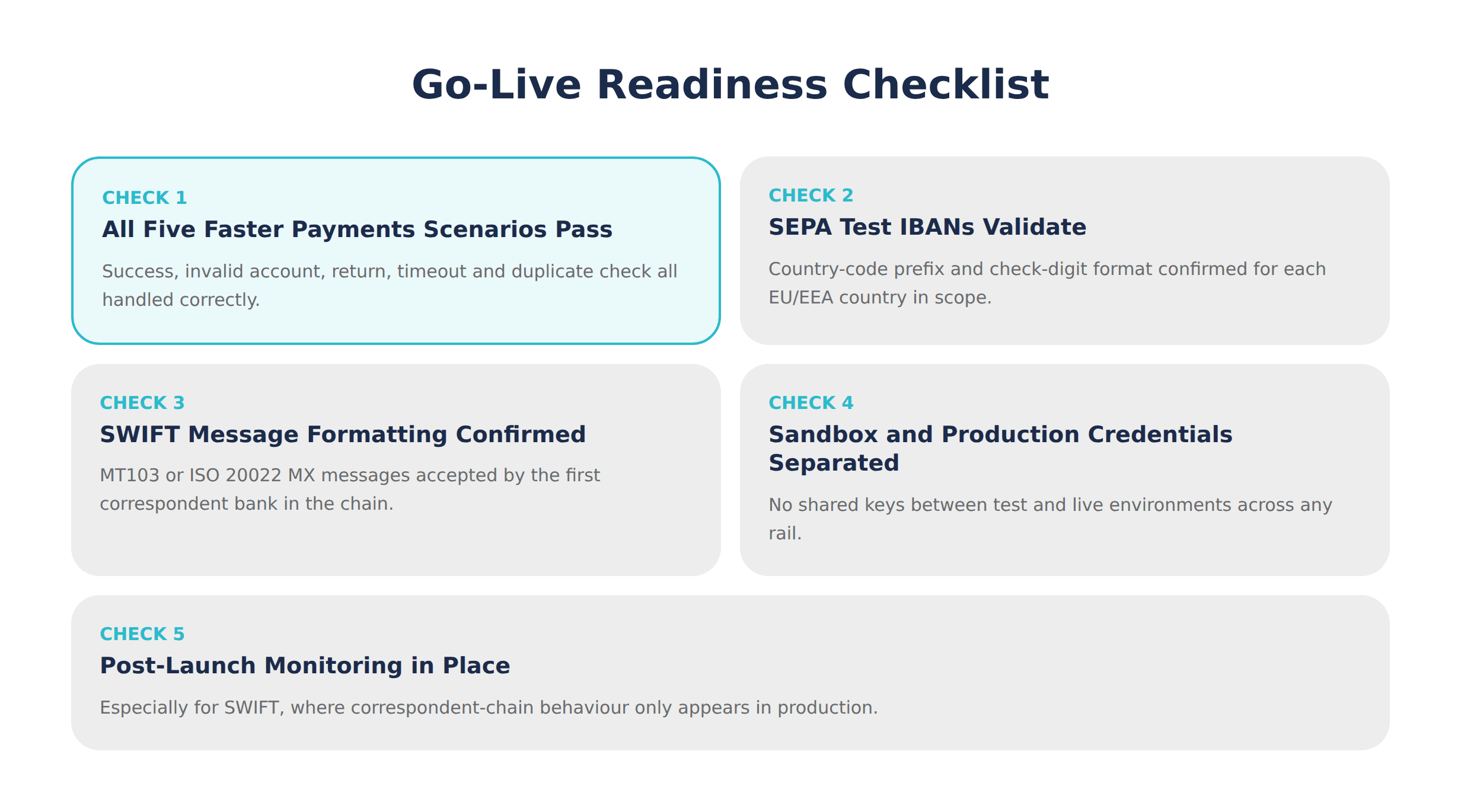
A go-live checklist covering all three rails reduces the risk of a scheme-specific issue surfacing after launch.
[aa btn]Book a Call[/aa]
[/aa]
FAQ
What is a sandbox environment?
A sandbox environment is a test version of a payment API that simulates transactions without moving real money. It mirrors the production API's structure closely enough that code tested there can move to production with minimal changes, though timing and network behaviour are not guaranteed to match exactly.
How developers use sandbox environments to test Faster Payments, SEPA and SWIFT integrations before go-live
Developers typically build a separate test suite for each rail, because Faster Payments, SEPA and SWIFT sandboxes validate different things. A Faster Payments sandbox test confirms instant success and failure handling. A SEPA sandbox test confirms IBAN and scheme-rule validation. A SWIFT sandbox test confirms message formatting acceptance. Running all three test suites against realistic failure scenarios, not just the successful path, is standard practice before any UK payment API integration goes live.
What is the difference between SEPA and SWIFT sandbox testing?
SEPA sandbox testing validates scheme-specific rules, including IBAN format, creditor identifiers, and the €100,000 SEPA Instant transaction cap, because SEPA settlement is governed end-to-end by the European Payments Council. SWIFT sandbox testing can only confirm that a message is correctly formatted and accepted by the first bank in a correspondent chain. It cannot simulate the routing or delays that occur once the payment leaves that bank.
How long does it take to move from sandbox to production for a UK payment API?
Timelines vary by provider and rail, but most integrations move from sandbox to production within two to six weeks once all test scenarios pass, including any provider-side compliance review. SWIFT integrations typically take longer than Faster Payments or SEPA, because correspondent banking relationships add a verification step that domestic and regional schemes do not require. A team that runs a combined test of a UK payment API sandbox covering Faster Payments and SEPA before adding SWIFT usually moves faster overall, since two of the three rails are already validated by the time SWIFT testing starts.
Is Faster Payments available in sandbox for testing?
Yes. UK payment providers that support Faster Payments generally offer a sandbox that simulates instant settlement, rejections, returns and timeouts. The sandbox cannot fully reproduce production network conditions, so businesses should still monitor early production transactions closely even after sandbox testing passes.
Faster Payments, SEPA and SWIFT each demand their own sandbox testing approach, because each rail is governed differently and settles differently in production. Faster Payments sandbox testing centres on instant success and failure handling. SEPA sandbox testing centres on scheme-rule validation. SWIFT sandbox testing centres on message formatting, with correspondent-chain behaviour visible only once a payment reaches production. Businesses building or expanding UK and cross-border payment capability get more reliable results by testing all three rails against a shared go-live checklist rather than treating each integration as a one-off project. EQWIRE supports Faster Payments, SEPA and SWIFT through a single multi-currency account, giving businesses one integration point instead of three separate sandbox-to-production paths — create an account to see how it fits an existing payment stack.
Reviewed by

Related Articles

UK Multi-Currency Account for a Corporate Invoicing Provider with PSP Settlements

UK Payment Account for a B2B Marketplace with Invoice-Based Supplier Payouts
Sandbox Testing for UK Payment APIs: Faster Payments, SEPA and SWIFT
Cross-Currency Payroll: Paying International Teams in Local Currencies from One Account

Power your payments
with EQWIRE
Create your account in minutes and experience smooth, secure global payments.
" height="9.0156px" id="LIcbdboyB" transform="translate(4.987 4.5)" width="9.01562px"/></svg>)