•
•

UK Multi-Currency Account for a Global Payroll Software Company Paying Service Providers
[aa disclaimer]
Legal Disclaimer: This article is for informational purposes only and does not constitute legal, financial, compliance, or tax advice. Banking eligibility and regulatory requirements vary by jurisdiction. Consult qualified professionals before making decisions.
[/aa]
A payroll platform invoicing 400 British clients in sterling will still send 80 outbound transfers every month to people it does not employ: contract developers, implementation partners, local counsel, compliance advisers. Those 80 transfers leave a pound balance. Most of them land as euros or dollars, and a 2% margin on £84,000 of monthly outflow quietly removes £20,160 from the year.
A uk multi currency account takes the conversion out of payment time. One legal entity holds three balances: GBP, EUR and USD. Each balance is topped up once a cycle, then every invoice gets settled from whichever pot matches the figure written on it.
Below: the four routes a British software vendor genuinely has, one payout run costed through all of them, and the volumes at which each choice stops earning its keep.
[aa key-takeaways]
Key Takeaways
Four routes carry money to suppliers abroad: a high street business account, one bank per destination market, an employer of record, one multi-currency account uk.
Opening in-country wins on domestic rails. It also multiplies onboarding, KYC files, mandates and month-end reconciliation across every market.
An employer of record uk arrangement resolves employment status and bills a slice of each transfer, which fits staff better than vendors.
Timing beats rate shopping: one conversion per cycle against 35 separate ones changes the annual figure by five digits at an identical spread.
Around 20 cross-border transfers a month is where switching starts to pay. Converted volume and fixed per-transfer cost decide it.
[aa btn]Book a Call[/aa]
[/aa]
Four ways a payroll software company can pay service providers
A British payroll software company has four workable routes for settling invoices from abroad: a sterling business account converting at payment, an account opened locally in each destination market, an employer of record standing in as the contracting party, or one UK account carrying several currency balances. The query how do businesses pay international contractors lands on one of those four almost every time.
Three measurable axes separate them. Conversion cost, settlement window, administrative surface. Paying international contractors at any volume turns all three into cash, and a vendor already running cross-currency payroll for a distributed team meets identical mechanics with employment status layered on top.
A UK high street business account
One sterling account converts at the instant of payment, on whatever rate the bank posts that morning. High street business FX typically sits 1.5% to 2.5% above the mid market rate, buried inside the quote instead of itemised anywhere. A bolt-on foreign currency account uk facility parks a second balance, yet outbound instructions still travel correspondent chains. Some banks label the same product an international business account.
Cost and speed across borders sit well short of the G20 targets for enhancing cross-border payments. The Financial Stability Board's October 2025 progress report records no closure of that gap. The BIS Committee on Payments and Market Infrastructures maps the cause: chains of intermediaries, each taking time and a cut.
Cheapest on paper. Dearest per invoice settled.
Local accounts in each recipient country
An account inside the destination market unlocks that country's domestic rails. They run quickly and cost almost nothing once the thing is live. A Warsaw developer gets funded within hours for pennies.
Then the paperwork arrives. Every account wants its own application, verification file, signatory mandate, month-end statement. Six markets multiply all of that sixfold, and finance teams running this model usually report reconciliation as what eventually collapses.
The IBAN (International Bank Account Number) pinpoints the destination account. The BIC (Bank Identifier Code) names the institution holding it. Euro instructions inside the SEPA area need only the first.
An employer of record or contractor platform
An employer of record uk provider becomes the legal counterparty in the worker's country, applies local withholding, forwards the net sum. Pricing lands as a percentage per transfer or a flat charge per head.
Employees were the design brief. A vendor buying server capacity or retaining a Dublin law firm on a commercial contract gains nothing from an employment wrapper and funds one regardless. Where the outbound list skews toward suppliers, the route fits badly.
A UK multi currency account
A UK multi currency account keeps GBP, EUR, USD in separate pots under a single legal entity, each pot carrying its own virtual IBAN. Funding happens when the holder chooses. Conversion happens once. Payouts depart from the matching pot, and the recipient's bank statement shows their invoice currency arriving with nothing deducted for exchange.
That structure is what sits behind a uk multi-currency account for global payroll software company paying service providers: one onboarding, one reconciliation, three pots. EQWIRE runs it as an FCA-authorised e-money institution, safeguarding client money instead of insuring deposits, and either status is checkable on the FCA Financial Services Register. A SaaS business collecting subscription revenue in several currencies already holds these pots on the inbound side.

Cost comparison across one monthly payout run
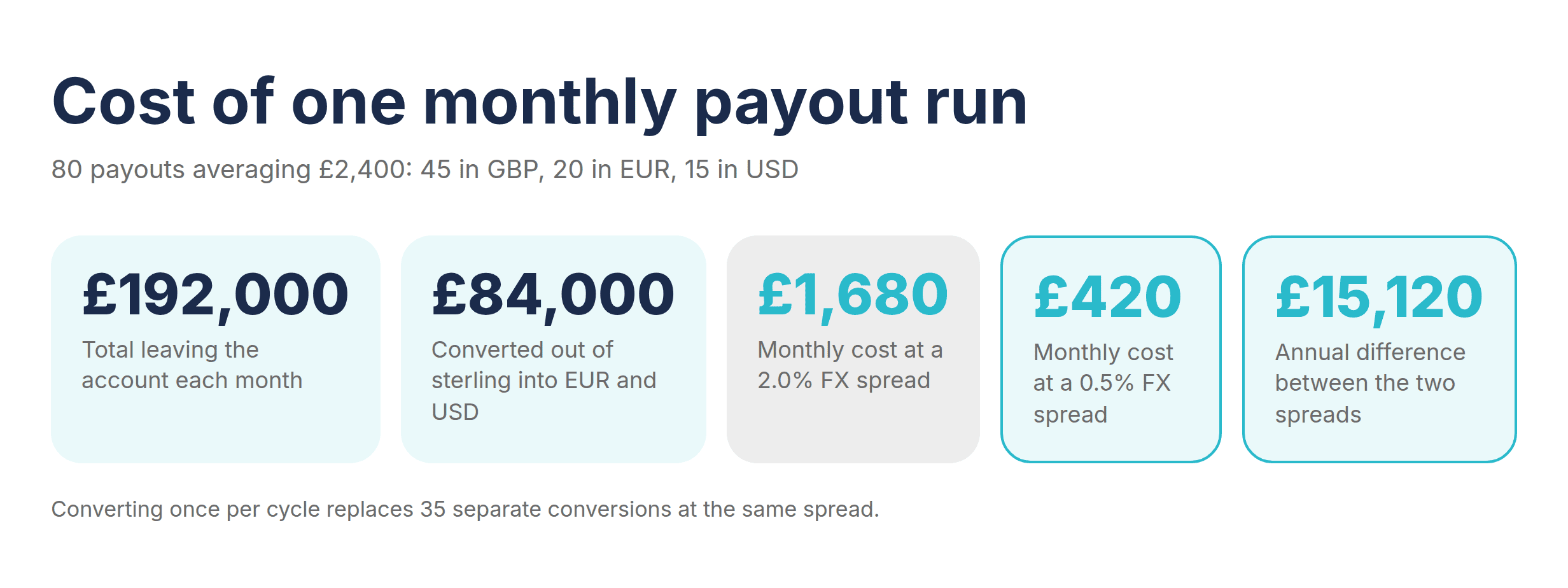
Eighty payouts averaging £2,400 move £192,000 monthly, of which £84,000 exits sterling. The margin charged on that £84,000 dominates every other line in the cycle. No provider comparison publishes it.
The split: 45 in pounds, 20 in euros, 15 in dollars.
FX spread on 80 payments in three currencies
An FX spread is the distance between the mid market rate and the number printed on the statement. Two per cent on £84,000 costs £1,680 monthly. Half a per cent costs £420. Over twelve months the difference reaches £15,120.
A second loss hides underneath. Converting per transfer produces 35 discrete conversions, each struck at that morning's rate plus margin, with no chance to pre-fund when a rate moves helpfully. One conversion per cycle leaves a single monthly decision.
Route | FX spread | Fixed cost per payout | Onboarding | Fit for B2B vendors |
|---|---|---|---|---|
UK high street account | 1.5–2.5% | £15–£30 on SWIFT | One application | Workable, expensive |
Local accounts per country | Local rates | Low domestically | One per market | Good, high admin |
Employer of record | Provider rate | % of payout | Per worker | Poor |
Multi-currency account | 0.5% | £0–£5 on local rails | One application | Good |
Fixed transfer fees and intermediary deductions
Flat fees look trivial beside the margin until a correspondent chain intervenes. Two or three intermediary banks may touch a SWIFT instruction, and any of them can take its charge out of the principal instead of billing the sender.
What follows is commercial. An adviser who billed €3,000 sees €2,962 credited and raises a query. Someone in finance then burns twenty minutes accounting for a €38 haircut applied by an institution neither side picked. A euro sepa transfer settled inside the scheme suffers no such trimming, which makes routing the variable worth optimising. For recipients sitting in the SEPA area, a weekly batch that avoids SWIFT entirely deletes the issue.
[aa cta]
Pay each service provider in the currency of their invoice
Hold GBP, EUR, USD under one UK entity, convert once per payout cycle at a 0.5% spread, and send on local rails wherever they reach the recipient.
[aa btn]Open a Business Account[/aa]
[/aa]
Speed and predictability per rail
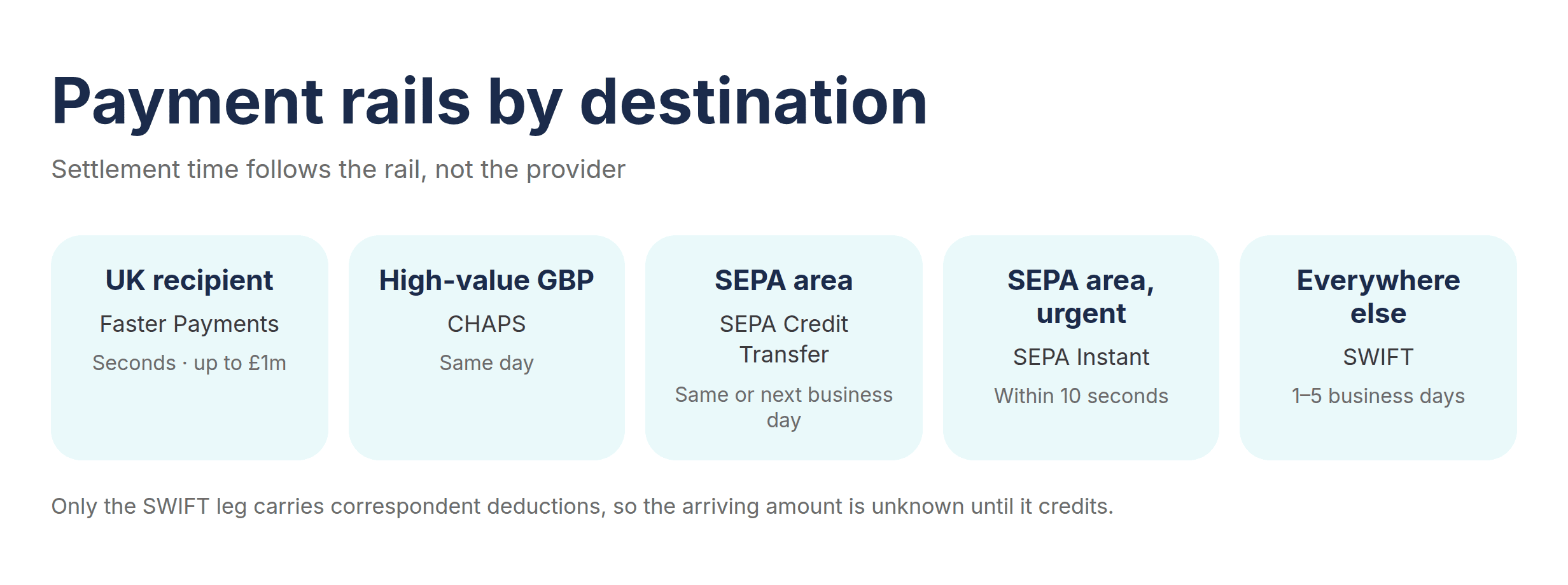
Rails govern timing, providers do not. Money bound for London and money bound for São Paulo ride different infrastructure, and the distance between them gets counted in working days.
Faster Payments, SEPA and SWIFT side by side
Sterling to a British recipient rides the Faster Payments Service, which now clears individual payments of up to £1 million. No plausible contractor invoice tests that ceiling. Bigger sterling sums route through CHAPS, same day, at a heftier unit price.
Euros offer a choice. Standard SEPA Credit Transfer completes same day or next working day. SEPA Instant finishes inside ten seconds at any hour, and the scheme-level ceiling disappeared with the rulebook effective 5 October 2025 under EU Regulation 2024/886. Settlement itself happens on the Eurosystem's TIPS platform.
Whatever falls outside both schemes travels SWIFT: one to five working days, arriving sum unknown until credited. ISO 20022 messaging carries structured remittance data, so a credit that does arrive can be tied back to an invoice number without a spreadsheet.
Rail | Currency | Settlement | Amount predictable |
|---|---|---|---|
Faster Payments | GBP | Seconds, up to £1m | Yes |
CHAPS | GBP | Same day | Yes |
SEPA Credit Transfer | EUR | Same or next business day | Yes |
SEPA Instant | EUR | Within 10 seconds | Yes |
SWIFT | Most others | 1–5 business days | No |
When a delayed payout costs more than the fee
Five lost days on a £30 charge is not really about the charge. An unpaid contractor deprioritises the coming sprint, and a fortnight's slip on a client-facing release bills the vendor far beyond anything the wire cost.
[aa fast-fact]
Fast Fact: The Eurosystem's TIPS platform clears euro credits every day of the year, 25 December included. Payout runs no longer need scheduling around public holidays.
[/aa]
How to pay international contractors from one account
Four steps, repeated every cycle, cover how to pay international contractors without opening anything abroad:
Gather destination details: sort code and account number for Britain, IBAN across the SEPA area, IBAN plus BIC beyond it.
Top up each currency pot once, at the front of the cycle.
Upload one batch file listing all recipients instead of keying 80 instructions.
Let the platform pick the cheapest rail reaching each destination.
Batch payments are what let step three survive growth. A CSV holding 80 rows takes no longer to prepare at 200 rows, while 80 manual instructions cost eighty times one. Knowing how to pay overseas contractors at scale reduces to getting a file layout right once.
Payroll software supplier payments uk carry one further discipline. Populate the reference field from the accounting system, never by hand, or month-end matching becomes detective work.
What a multi currency account for business does not solve
A multi currency account for business moves money. Who the recipient legally is, what tax falls due where, whether a given currency is even reachable: none of that is its job. Two ceilings deserve stating before anyone applies.
Contractor status, IR35 and local employment rules
Three currency pots say nothing about who the recipient legally is. The UK's off-payroll regime, laid out in HMRC's guidance on IR35, governs when someone supplied through an intermediary must be taxed as an employee. A hirer with no British footprint moves that test elsewhere. HMRC's Employment Status Manual at ESM10006 describes the mechanics.
Employment law in the worker's own jurisdiction may separately reclassify a long-running engagement. The contract wording rarely helps. Outcomes turn on facts particular to each relationship, and this article is not tax or legal advice. Have a qualified adviser in the relevant country confirm the position before building a payout schedule around it.
Currencies outside the account's network
Where a currency sits outside the network, the instruction reverts to SWIFT with a conversion, and correspondent trimming comes back with it. EQWIRE reaches 66 currencies, covering most corridors a British software vendor needs. Not all of them.
Firms that pay service providers in gbp eur and usd almost exclusively can treat coverage as academic. Anyone funding recipients in thinly traded currencies should test the corridor first.
When to open a multi currency business account uk and when to skip it
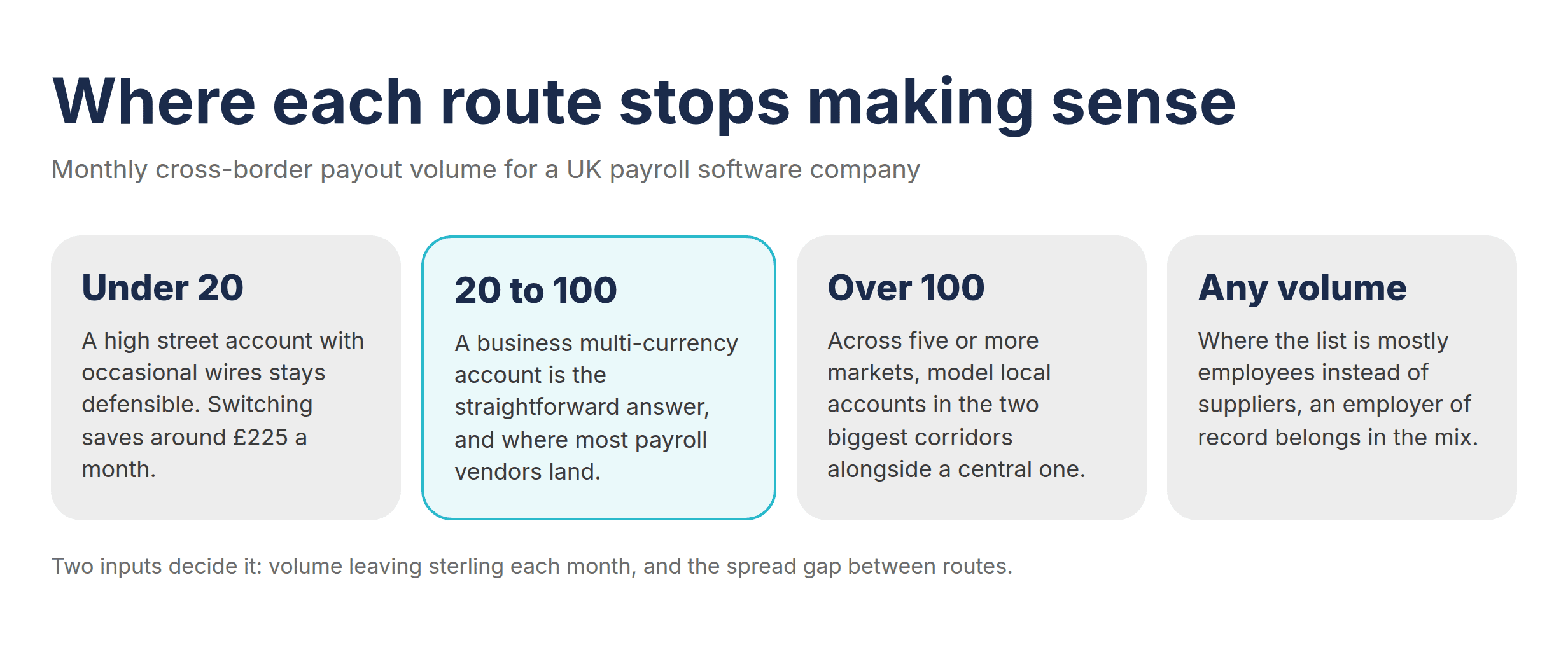
Under roughly 20 cross-border payouts monthly, the arithmetic stays thin. Ten transfers averaging £2,000 save about £225 a month on a 1.5-point margin difference. Past 20 the case firms up fast. Past 50 it stops being arguable.
Two inputs drive the whole calculation: monthly volume leaving sterling, and the margin gap between the incumbent route and the alternative. Account maintenance fees are almost always the smallest term.
Volume thresholds where each option stops making sense
Under 20 cross-border payouts a month: a high street account with occasional wires remains defensible.
20 to 100 payouts a month: a business multi currency account is the obvious answer. Most payroll vendors open a multi currency account uk somewhere inside this band.
Over 100 payouts a month across five or more markets: model local accounts in the two biggest corridors alongside a central one.
Mostly employees instead of suppliers: an employer of record belongs in the picture at any volume.
One figure settles it for a British vendor with recipients scattered across the SEPA area, Britain, the United States: how much sterling departs each month. Five digits is the tipping point. Past it, the switch repays itself inside a quarter, and the mechanics of holding three balances under one entity get covered separately. Vendors building payout automation into their own product can start from the EQWIRE IT and SaaS page.
[aa cta]
Run the next payout cycle from one account
Fund three pots once a cycle. Settle every invoice from the one that matches it.
[aa btn]Create Account[/aa]
[/aa]
FAQ
What is a multi currency account?
A multi currency account is one account holding balances in several currencies at once, each with its own banking details, under a single legal entity. Funds arriving in euros remain euros until the holder decides otherwise. A standard business account behaves differently: any foreign amount converts automatically the moment it moves. For a firm both invoicing and settling in one currency, two conversions disappear per round trip.
How does a multi currency account work?
Every currency occupies its own balance with dedicated IBAN or local details, so a payer sends euros to a euro IBAN and the money lands as euros. Exchange happens only on the holder's instruction, at a published margin over the mid market rate. Outgoing instructions leave the matching balance on whichever rail serves the destination: Faster Payments for domestic sterling, SEPA or SEPA Instant for euros inside the SEPA area, SWIFT further afield.
How fast can I open a multi-currency account?
For a British company with tidy paperwork, e-money institution onboarding usually finishes within three to ten working days, against four to eight weeks at a high street bank. Documentation drives that timeline. Software company applications most often stall on ownership: a parent entity or investor above the 25% threshold requires separate verification. Gathering the incorporation certificate, tax reference, address evidence and a shareholder chart beforehand removes most of the wait.
Does IR35 apply to overseas contractors?
British off-payroll working rules can reach an overseas contractor where the engaging client has a UK connection, and HMRC's Employment Status Manual sets out how that connection gets tested. Where that engager sits wholly outside the UK with no local presence, the determination generally passes back to the worker's own intermediary. Facts decide each case. Treat the above as background instead of tax advice and have an adviser confirm the position. Anyone asking who needs a multi-currency account is raising a separate matter: an account governs money movement, never anyone's tax position.
How do I open a multi currency account for a UK software company?
A British firm applying to open multi currency account facilities generally supplies the incorporation certificate, company UTR, registered office evidence, identity documents for directors and beneficial owners above 25%, plus a written description of expected flows. Providers serving payroll and HR software vendors usually ask about destination countries and monthly outbound volume too. Verifying the provider's authorisation on the FCA Financial Services Register makes a sensible opening move.
Reviewed by
Related Articles


Power your payments
with EQWIRE
Create your account in minutes and experience smooth, secure global payments.
" height="9.0156px" id="LIcbdboyB" transform="translate(4.987 4.5)" width="9.01562px"/></svg>)