
•
•

Articles
UK Payment Account for a B2B Marketplace with Invoice-Based Supplier Payouts
[aa disclaimer]
Legal Disclaimer: This article is for informational purposes only and does not constitute legal, financial, compliance, or tax advice. Banking eligibility, regulatory requirements, and provider policies vary by jurisdiction. Consult qualified professionals before making decisions.
[/aa]
A marketplace closing its books with 140 supplier payouts outstanding meets a familiar problem. Buyers paid 140 invoices into one account, and the finance team must now match every outgoing transfer to the right invoice by hand. Marketplace payouts break down at exactly that point. The money exists, but nothing links it to a supplier, an invoice or a due date.
A UK payment account for a B2B marketplace closes the gap by splitting funds across separate accounts and attaching a reference to every payment. Invoice-led B2B marketplace payments rarely reconcile themselves, so structure decides the outcome. The sections below cover setup, safeguarding rules, virtual IBANs, bulk files, daily matching and cross-border transfers.
[aa key-takeaways]
Key Takeaways
Supplier payouts work best when the invoice number travels with the money from the buyer's transfer to the final payout.
A collection account and a separate payout account give each balance one clear owner.
A virtual IBAN per supplier or invoice lets incoming transfers match themselves.
Bulk files save hours only with a fixed layout and a second approver.
Daily reconciliation catches returns and short payments before month-end.
[aa btn]Book a Call[/aa]
[/aa]
Set up a UK payment account for a B2B marketplace: step by step
A business account that receives buyer money and sends supplier payouts is the core of the setup. A bank or an electronic money institution (EMI), regulated under the Electronic Money Regulations 2011, issues it. Card checkouts settle in seconds, whereas B2B buyers pay by bank transfer against an invoice, and a single invoice can reach tens of thousands of pounds.
The order of work matters. The marketplace documents its funds flow first. It then opens the account and adds sub-accounts with references. Skipping the first step causes most of the later delays.
Documents and onboarding for an EMI account
An EMI application asks for company records and a clear description of the money flows. Providers typically request the certificate of incorporation, proof of registered address, details of directors and beneficial owners, and a business plan with expected monthly volumes. Marketplaces add one more item: a written description of who owns the funds at each stage.
That last item sets the onboarding path. A platform that only issues invoices for one party may qualify for a standard business account. A platform that collects buyer money and pays suppliers weeks later must explain the holding period.
The FCA's guidance on the commercial agent exclusion explains why. A business is likely acting for both payer and payee when payments reach an account it controls before moving on to the payee. Operators in that position typically take legal advice on whether they need their own authorisation or can rely on a regulated provider's accounts.
Choosing currencies and rails
Currency choice follows supplier locations. UK suppliers need GBP accounts with Faster Payments access. EU suppliers add EUR and SEPA. Suppliers elsewhere need SWIFT.
Faster Payments runs around the clock, whereas CHAPS settles only on working days. Each rail also has its own ceiling, so a later section compares them side by side.

Structure accounts to separate marketplace funds from supplier payouts
Marketplaces keep collected funds and supplier payouts in separate accounts so that every balance has one owner. The split matters most in the days after a buyer settles an invoice, because that window decides whose cash sits where.
Collection account and payout account
A worked example shows the flow. A buyer pays £48,000 against invoice INV-2041. The platform keeps a 7.5% fee, which is £3,600, and owes the vendor £44,400 on day 30. For those 30 days, £44,400 is a liability that must stay away from the cash covering salaries and rent.
Three accounts handle this cleanly:
Account | Holds | Tracked by |
|---|---|---|
Collection | Buyer payments awaiting release | Invoice number |
Payout | Approved supplier amounts | Supplier |
Operating | Marketplace fees | Marketplace |
What this means in practice: a fee withdrawal can never spend a supplier's money, because the operating balance contains none of it.

Safeguarding checks before the first payout
Safeguarding ring-fences client cash at an EMI or payment institution. The FCA safeguarding rules define relevant funds as customer money held in connection with payment transactions and e-money issuance. Protection starts once the firm is entitled to those funds, often at the moment they reach an account in the firm's name.
[aa fast-fact]
Fast Fact: The FCA's safeguarding page, updated on 7 May 2026, requires daily reconciliations under CASS 15. EMIs file the monthly REP027 return within 15 business days of month-end.
[/aa]
Those duties fall on the provider, and an EMI such as EQWIRE describes how it protects client money in public documents. Even so, a marketplace gains from asking four questions before the first release of funds:
How does the provider record balances held under each virtual IBAN?
Where does it safeguard customer funds, and by which method?
Can statements show balances per supplier and per invoice?
What happens to pending payouts if the provider fails?
The last question points to the resolution pack, a document that lets a failed firm return client money quickly. A provider that answers all four in writing has usually thought the structure through.
Assign virtual IBANs to suppliers and invoices
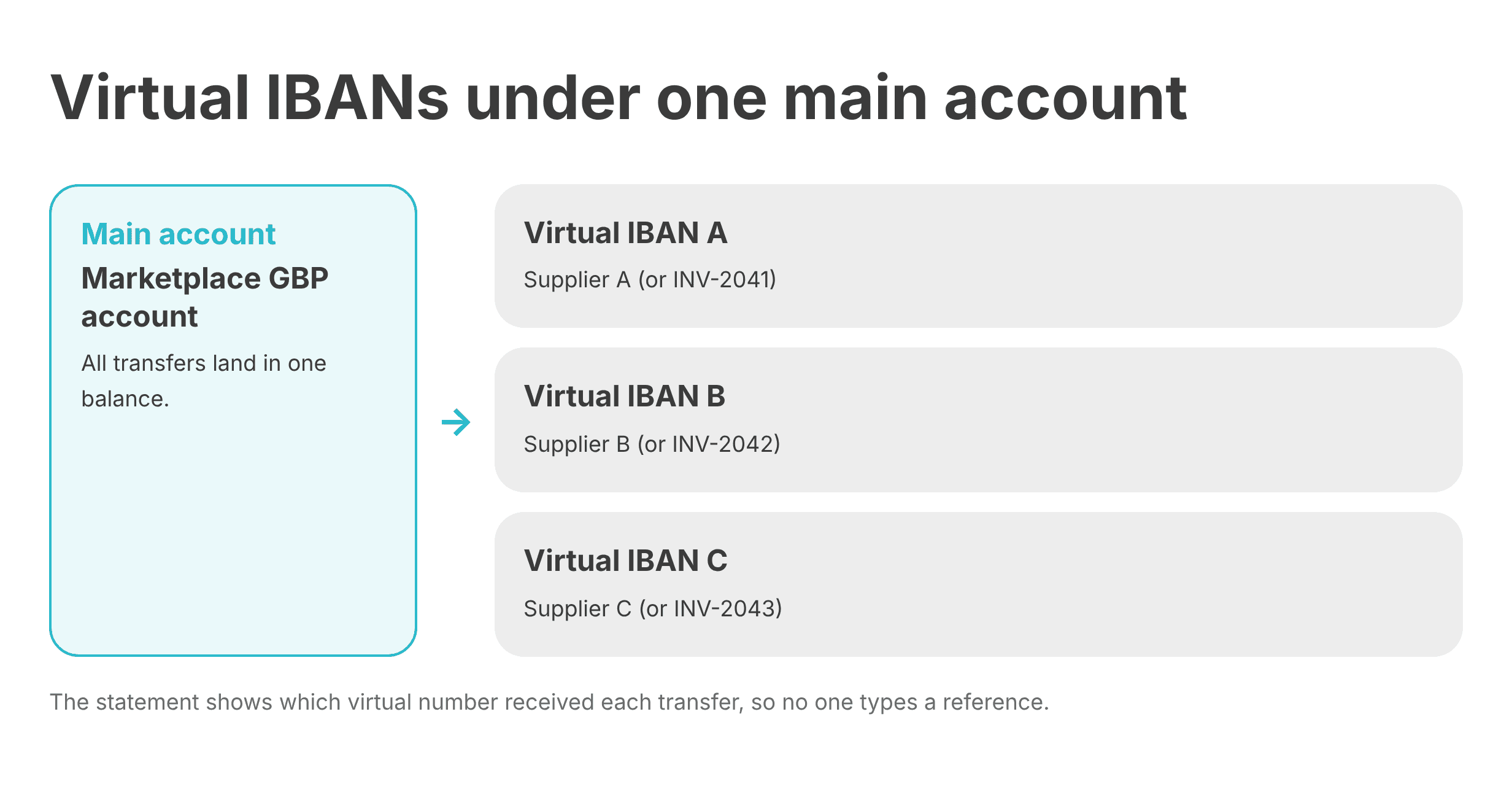
A virtual IBAN is an extra IBAN issued under a main account. Money sent to it lands in the main balance. The statement then shows which virtual number received the transfer and at what time, so for a marketplace that detail alone names the supplier or invoice, and nobody has to type a reference.
One virtual IBAN per supplier or per invoice
Two models exist, and each carries a cost.
Per supplier: one stable IBAN per vendor, so buyers reuse the same details. Several bills can arrive together, so matching still relies on an invoice number or an amount.
Per invoice: one IBAN for each bill, which gives an exact match every time. A platform with 4,000 invoices a month issues 4,000 numbers and therefore needs API support from the provider.
A marketplace with 300 suppliers and moderate volumes often starts per supplier. It then moves its largest accounts to per-invoice numbers. The choice follows effort: the more bills share one reference, the more manual checks remain.
Business IBAN accounts: when a dedicated account is enough
Business IBAN accounts suit marketplaces with a handful of suppliers. A named IBAN account in the company's own name appears on statements and invoices, which helps buyers recognise the payee. It does not label individual bills, so staff still match transfers by reference text.
Once suppliers number in the dozens, reference text becomes the weak link. Buyers drop invoice numbers, mistype them or settle several bills in one transfer. A dedicated number per bill takes that weak link away.
[aa cta]
Give every supplier invoice its own payment reference
EQWIRE business accounts support virtual IBANs, so each incoming buyer transfer lands against the right bill automatically.
[aa btn]Open a Business Account[/aa]
[/aa]
Run bulk supplier payments in the UK
Bulk payments send many payouts from one file. A file with 140 rows replaces 140 manual transfers and carries the same reference field on every line. The saving is real only when the file layout and the approval step hold up.
Payment file format and approval flow
A reliable file holds six columns: payee name, account number with sort code (or IBAN), amount, currency, reference and execution date. The invoice number goes in that last-but-one slot. Without it, reconciliation starts from zero.
Approval needs two people. One prepares the file and a second reviews totals before release. That second look catches what a single preparer misses: a duplicated row, a payout in the wrong currency or a supplier whose bank details changed last week.
A short checklist before each release:
Compare the file total with the sum of approved invoices.
Check that no invoice number appears twice in the batch.
Confirm bank details against the supplier record.
Release the file only after the second approver signs off.
Timing: Faster Payments, BACS, CHAPS
UK rails differ in speed and ceiling, and the right pick depends on payout size and urgency.
Rail | Typical timing | Best for |
|---|---|---|
Faster Payments | Seconds to minutes, 24/7 | Routine payouts up to the provider's limit |
BACS | Three working days | Scheduled batches where speed is secondary |
CHAPS | Same day, working days | High-value payouts |
The scheme limit for Faster Payments is £1 million per payment according to the Bank of England. Providers may set lower limits on individual accounts, so a marketplace planning a £250,000 payout confirms its own ceiling first. Cut-off times also differ, which is why Faster Payments on UK business accounts deserve a check before each release. CHAPS settles through the Bank of England's real-time gross settlement system.
Reconcile supplier payouts every day
Supplier payout reconciliation for a marketplace pairs each outgoing payment with one invoice through a shared reference. Done daily, it takes a few minutes per batch. Left to month-end, it turns 140 payments into a two-day search.
The process has five steps:
Put the invoice number in the reference field of every payment.
Issue a virtual IBAN for each supplier or invoice so that incoming transfers identify themselves.
Export the account statement every morning.
Match statement lines by reference first and by amount second, then flag whatever remains.
Clear each flagged line before the working day closes.
Reference fields that make matching work
Matching fails when the data is thin. Four fields do most of the work.
Field | What it holds | Check |
|---|---|---|
Invoice number | Unique ID such as INV-2041 | No duplicates in the batch |
Supplier ID | Internal code for the payee | Matches the supplier record |
Amount | Exact payout in the invoice currency | Equals invoice less fee |
Execution date | Date the bank releases the payment | Falls on a working day |
For INV-2041, the books expect one debit of exactly £44,400 with that reference on that date. Any deviation becomes an exception.
Exceptions: returns, short payments, duplicates
Exceptions are normal. They become costly only when they sit unresolved.
A short payment arrives when a payer transfers £47,200 on a £48,000 bill. The marketplace holds the payout until the £800 gap clears, or releases a proportional amount if the contract allows it. A return occurs when a vendor's bank rejects a payout: the money goes back to the payout account and waits for corrected details before resending. A duplicate appears when two files include the same invoice, which the pre-release checklist exists to stop.
Rule of thumb: an exception older than one working day needs a named owner.

Pay suppliers abroad
Overseas suppliers receive a SWIFT payment or, for euro payouts inside the single euro payments area, a SEPA credit transfer. Cross-border payouts add two variables that domestic ones lack: the correspondent bank chain and the currency conversion.
SWIFT vs SEPA for cross-border payouts
SWIFT reaches almost any country, but a transfer passes through correspondent banks and typically takes one to five business days. Each bank in the chain may deduct a fee. The recipient can end up with less than the invoice amount unless the sender covers all charges.
SEPA covers euro credit transfers across participating countries. It settles the same day or the next business day, and the fee structure is simpler.
Feature | SWIFT | SEPA credit transfer |
|---|---|---|
Coverage | Worldwide | SEPA countries only |
Currency | Many | Euro |
Typical timing | 1 to 5 business days | Same day or next business day |
Fee structure | Sender, intermediary and receiving bank fees | Usually one fee |
For a marketplace with 40 vendors in Germany and the Netherlands, SEPA is the default. One seller in Singapore needs SWIFT.
FX timing and fees
Paying in the recipient's currency spares the recipient a conversion. The marketplace carries that conversion instead, and the spread sets the cost. On a £44,400 payout, a 2% spread costs £888, while a 0.5% spread costs £222. Over 140 payouts of similar size, the gap exceeds £90,000.
Timing adds a second risk. Rates move between invoice date and payout date, so operators either lock rates on the invoice date or hold balances in the payout currency. Euros received from EU buyers can fund EU payouts directly, which avoids two conversions. The same logic applies to platform payouts that arrive without a second FX conversion, and a GBP account for a non-UK company serves sellers who invoice in sterling.
Common mistakes in marketplace payouts
Five errors cause most reconciliation and compliance problems. Each has a direct fix.
Missing invoice numbers in references. Buyers pay the bill but omit the number. A virtual IBAN per invoice removes the dependency.
One balance for fees and vendor money. A single pot hides what the platform owes. Keep the collection and payout accounts apart from operating cash.
No second approver on bulk files. One duplicated row can send £44,400 twice. Require a second review.
Monthly reconciliation. Errors compound over 30 days. Match every working day.
Skipping the funds-flow review. A platform holding buyer money may fall outside the commercial agent exclusion. Take legal advice before launch.
[aa cta]
Pay vendors in GBP, EUR and other currencies from one account
Send one bulk file to recipients in several currencies, with conversion handled inside the same account.
[aa btn]Get Started[/aa]
[/aa]
FAQ
How can a UK B2B marketplace reconcile invoice-based supplier payouts?
A UK B2B marketplace reconciles invoice-based supplier payouts by carrying the invoice number through every payment and matching statement lines to it each working day. The reference field gets the identifier from the bill, and every payee or bill receives its own virtual IBAN. The morning routine starts with a statement export, continues with matching by reference and then by amount, and ends with clearing every unmatched line. Returns and short payments go on an exceptions list with a named owner.
What account structure separates marketplace funds from supplier payouts?
A three-account structure keeps marketplace funds apart from supplier payouts. Buyer money lands in a collection account and moves to a payout account once the invoice is approved. It leaves for the vendor on the due date. A separate operating account receives only the marketplace's own fee, so day-to-day spending never touches money owed to vendors.
Can a marketplace use virtual IBANs to track supplier invoices?
Yes, a marketplace can use virtual IBANs to track supplier invoices. Each virtual number works as a label: any transfer that arrives under it identifies its payee before staff open the statement. One number per bill gives an exact match without typed reference text. A single number per payee keeps details stable, though bills for that payee then still need an identifier to tell them apart.
Does a B2B marketplace need safeguarding for supplier payout balances?
Safeguarding applies to the regulated firm that holds the money, and the answer depends on the marketplace's model. An EMI or payment institution must safeguard relevant funds under the Payment Services Regulations 2017 and FCA rules, including CASS 15. A platform that holds buyer money in its own account before paying out may itself fall inside payment services regulation. The outcome turns on whom the platform acts for under its contracts, so operators confirm their position with a legal adviser or the FCA.
How can I pay suppliers abroad?
Payment abroad goes through SWIFT or, for euros inside SEPA countries, through a SEPA credit transfer. SWIFT reaches most destinations and typically needs one to five business days, whereas SEPA lands the same day or the next business day. Teams that want to pay international suppliers in volume send a bulk file with the invoice number as the reference on every line. FX spread then becomes the main cost: 2% on £44,400 is £888.
Marketplace payouts stay manageable when the groundwork comes first. Ring-fenced balances protect what vendors are owed, virtual IBANs label every arrival, and bulk files carry the volume. A provider that answers the safeguarding questions in writing settles the compliance side. Platforms that also take PSP settlements can see how EQWIRE's e-commerce accounts combine those settlements with supplier payments and FX. A pilot on one invoice cycle shows what the structure needs before it scales.
Reviewed by

Related Articles

GBP Payment Account for UK Exporter Receiving EUR Customer Payments

Monthly Close Checklist for UK Companies with Multiple Currency Accounts

UK Business Account for a Corporate Travel Management Company Settling Hotel Suppliers

UK Business Account for a Corporate Gaming Software Provider Receiving Licence Fees

Power your payments
with EQWIRE
Create your account in minutes and experience smooth, secure global payments.
" height="9.0156px" id="LIcbdboyB" transform="translate(4.987 4.5)" width="9.01562px"/></svg>)