•
•

Articles
Citizenship by Investment Jurisdictions: Financial Accounts for Antigua, St Kitts and Dominica Companies
[aa disclaimer]
Legal Disclaimer: This article is for informational purposes only and does not constitute legal, financial, compliance, or tax advice. Banking eligibility, regulatory requirements, and provider policies vary by jurisdiction. Consult qualified professionals before making decisions.
[/aa]
Five Eastern Caribbean states operate citizenship by investment programmes, and all five sit inside the same currency union. Investors comparing them tend to compare price. Dominica's Economic Diversification Fund opens at USD 200,000 for a single applicant, while St Kitts and Nevis sets its Sustainable Island State Contribution at USD 250,000.
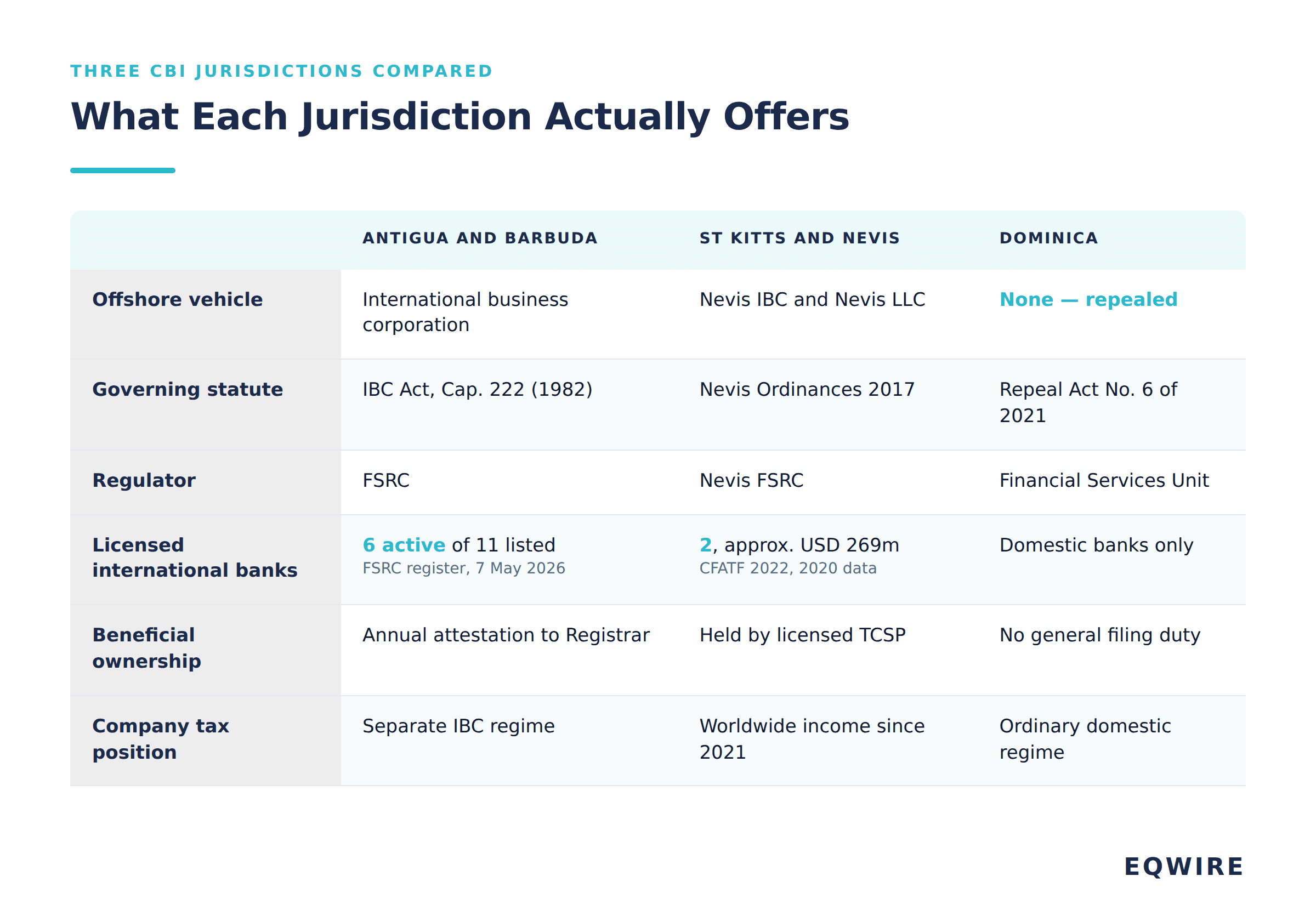
Price comparison hides the part that determines whether the resulting company can trade. Anyone researching a citizenship by investment Caribbean company bank account XCD option is really asking three separate questions, one per jurisdiction. Each of the three most commonly chosen states offers a different corporate vehicle, retains a different amount of local banking capacity, and applies a different tax rule to resident companies. One of them no longer has an international business company regime at all.
[aa key-takeaways]
Key Takeaways
Dominica's international business company regime was repealed. The sector was dissolved on 1 January 2022, so a Dominica IBC can no longer be registered, despite what many formation agency pages still advertise.
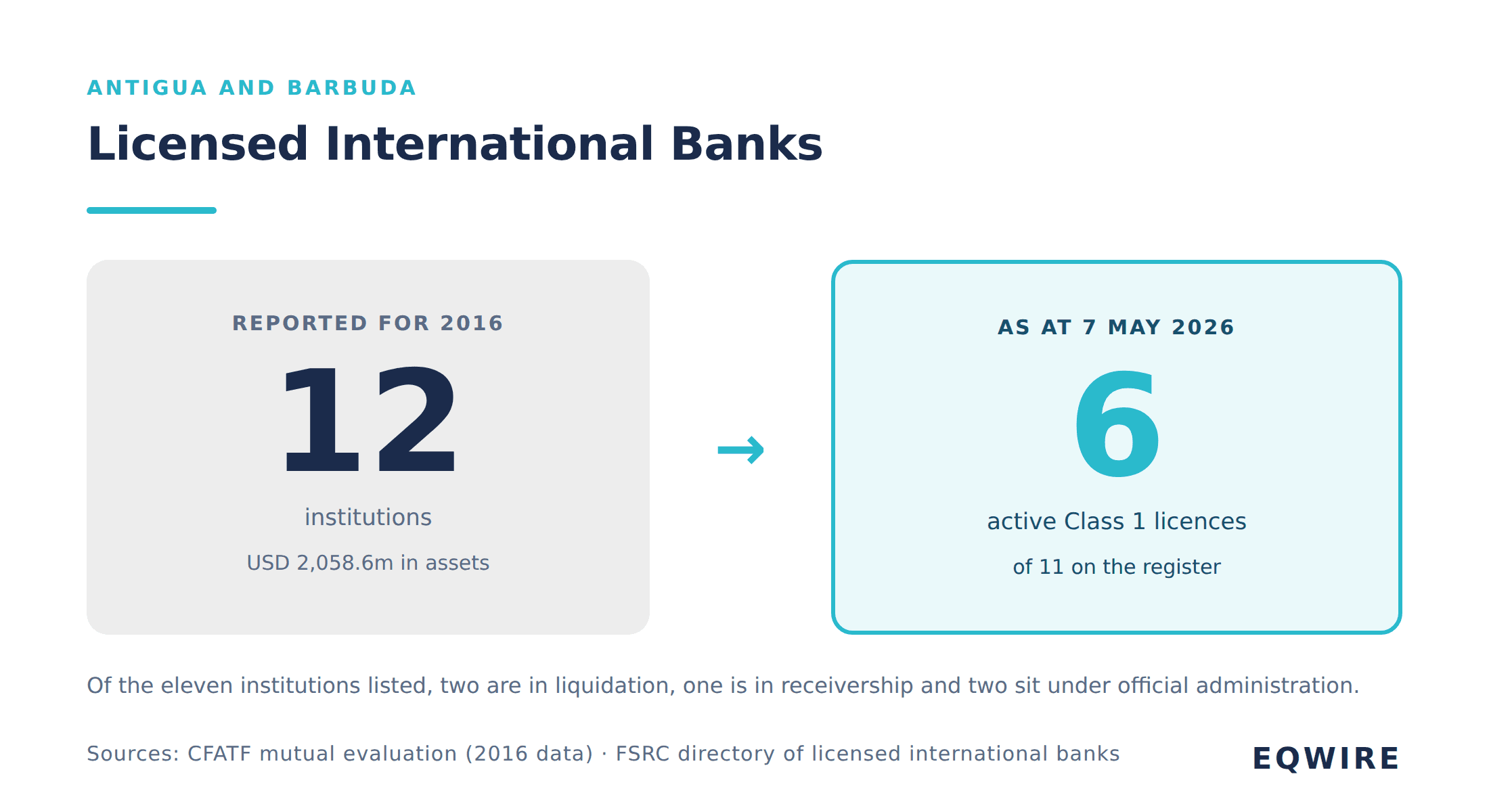
Antigua and Barbuda keeps its IBC regime, but local banking capacity has halved. The Financial Services Regulatory Commission listed six active Class 1 licences as at 7 May 2026, against twelve licensed international banks reported in 2016.
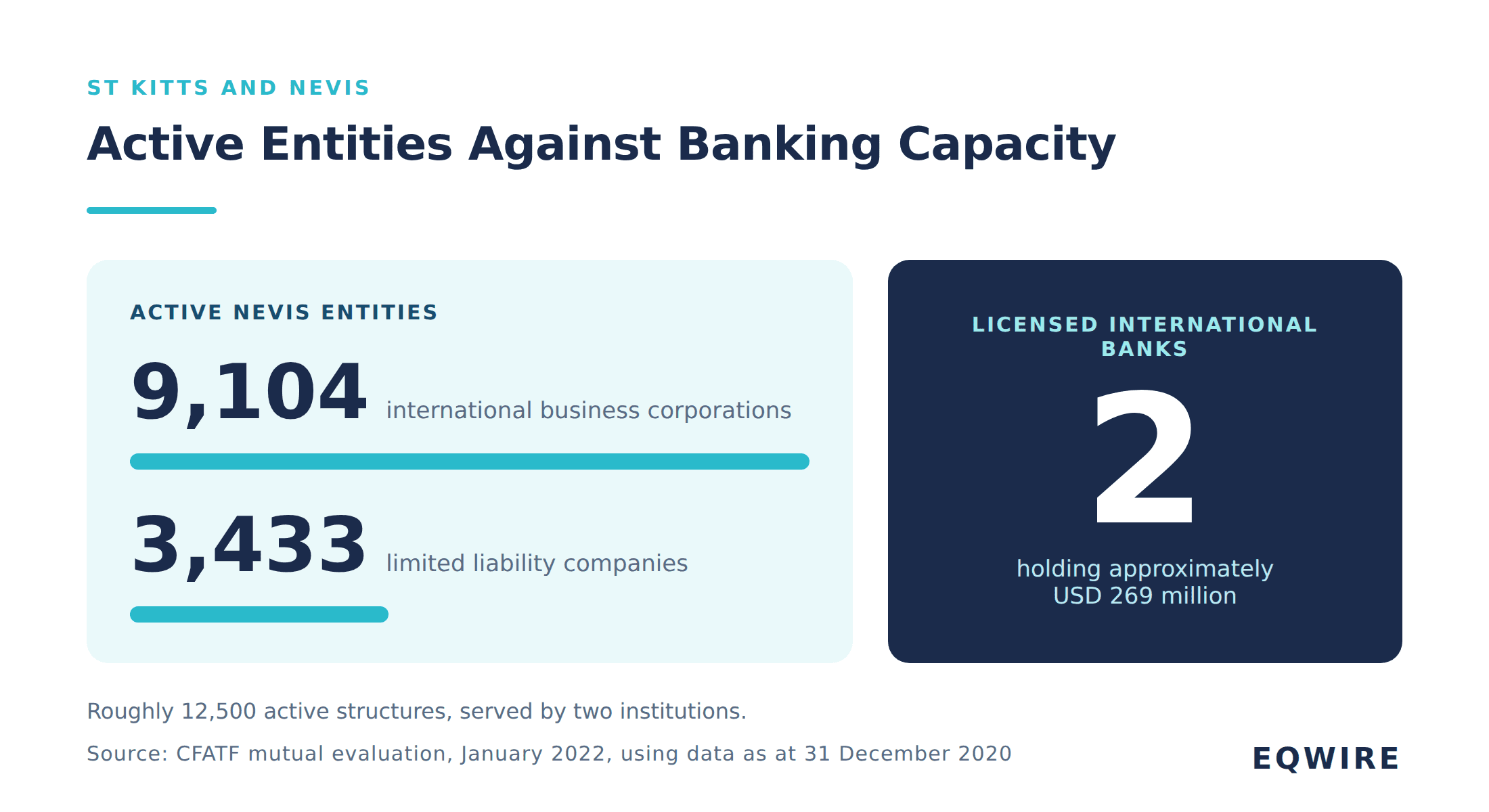
St Kitts and Nevis has the strongest corporate statutes of the three and the least local banking to match. Two licensed international banks served roughly 12,500 active Nevis entities at the last published count.
The East Caribbean dollar functions as a domestic currency. XCD has been pegged at 2.70 to the US dollar since 7 July 1976 and does not appear among Swift's twenty largest payment currencies.
None of the three appears on the UK or EU high-risk third country lists in 2026, so enhanced due diligence on these companies reflects individual firm policy rather than an automatic statutory trigger.
[aa btn]Book a Call[/aa]
[/aa]
Why a Caribbean CBI Company Is Three Different Situations
The Eastern Caribbean Currency Union covers eight territories that share one currency and one central bank. Five of those eight run investment migration programmes: Antigua and Barbuda, Dominica, Grenada, St Kitts and Nevis, and Saint Lucia. Company law, however, remains national.
That split matters for payments. Every company registered in the union faces the same currency arrangement and the same regional correspondent banking conditions. What changes across borders is the corporate form available and the tax treatment applied once the company starts earning.
Programme governance has been converging. The five states set a common minimum investment of USD 200,000 from 1 July 2024, and signed the agreement establishing the Eastern Caribbean Citizenship by Investment Regulatory Authority on 23 September 2025. The Eastern Caribbean Central Bank confirmed at the fourth US–Caribbean roundtable in December 2025 that all five had enacted it, with the authority operational during 2026.
Corporate and banking rules have not converged at all. An Antigua St Kitts Dominica company multi-currency account decision therefore starts with the question of what entity exists in each place, and that answer has changed materially since 2021. Companies weighing local versus offshore arrangements will find the underlying options mapped out in more detail in this comparison of multi-currency accounts for Caribbean businesses.
Antigua and Barbuda: An IBC Regime With a Shrinking Local Banking Sector
Antigua and Barbuda still offers the international business corporation, and the statute behind it has been in force since 1982. Local banking capacity for those companies has contracted sharply over the past decade. Both facts shape what a citizenship by investment Caribbean company bank account XCD arrangement can realistically look like here.
The International Business Corporations Act and the FSRC
International business corporations in Antigua and Barbuda are governed by the International Business Corporations Act, Cap. 222, enacted in 1982. The Financial Services Regulatory Commission supervises them under the Financial Services Regulatory Commission Act No. 5 of 2013, which also covers international trusts and the offshore banking licences discussed below.
Domestic companies sit elsewhere, under the Companies Act as amended in 2024 and administered by the corporate registry rather than the FSRC. An Antigua IBC therefore answers to a different regulator than an ordinary local company, which affects the documents an account application requires.
What Happened to the Licensed International Banks
The FSRC's directory of licensed international banks, published as at 7 May 2026, lists eleven institutions of which only six hold active Class 1 licences. Two are in liquidation, one sits in receivership, and two are under official administration. The Caribbean Financial Action Task Force reported twelve international banks holding USD 2,058.6 million in assets when it assessed the jurisdiction against 2016 data.
Among the institutions now under administration is Global Bank of Commerce Limited, placed there in November 2025 under section 104 of the International Banking Act 2016. The International Monetary Fund noted the same event in its May 2026 Article IV report on Antigua and Barbuda.
[aa fast-fact]
Fast Fact: Antigua and Barbuda's licensed international banking sector went from twelve institutions reported for 2016 to six active Class 1 licences on the FSRC register as at 7 May 2026.
[/aa]
The Annual Beneficial Ownership Attestation
Beneficial ownership disclosure in Antigua and Barbuda runs through an annual filing rather than a public register. The Companies (Amendment) Act 2022 introduced sections 194A and 356B, and the 2024 amendment carried the obligation forward.
Companies file a beneficial ownership attestation with the Registrar within thirty days of each incorporation anniversary. The filing captures any person holding five per cent or more of total voting rights, the ultimate beneficial owner behind any nominee holder, and every director and officer. Changes require notification within fourteen days, and persistent non-filing exposes the company to being struck off.
St Kitts and Nevis: Strong Corporate Law, Almost No Local Banks
St Kitts and Nevis presents the widest gap of the three between corporate law quality and local banking availability. Nevis operates its own registry and its own ordinances, separate from the federal side, and those ordinances are among the more developed in the region.
Nevis Business Corporations and Limited Liability Companies
The Nevis Financial Services Regulatory Commission administers two principal vehicles. International business corporations fall under the Nevis Business Corporation Ordinance 2017, requiring one shareholder and one director as a minimum, with bearer shares prohibited. Limited liability companies fall under the Nevis Limited Liability Company Ordinance 2017, which recognises single-member LLCs and sets no ceiling on membership.
Both forms carry standing obligations. Every entity needs a licensed trust and corporate service provider plus a registered office on Nevis, and must retain corporate records for at least five years. Multiform foundations exist separately under Cap. 7.08.
Two International Banks for Thousands of Active Entities
The scale mismatch here is the operative fact. CFATF's 2022 mutual evaluation recorded 52,266 registered Nevis international business corporations, of which 9,104 were active, plus 20,425 registered LLCs, of which 3,433 were active, using data as at 31 December 2020. The same report counted two licensed international banks in the federation, holding roughly USD 269 million between them.
Supervision has lagged. The IMF observed in its 2025 currency union assessment that designating the ECCB as AML/CFT supervisor for banks remained outstanding in St Kitts and Nevis.
[aa fast-fact]
Fast Fact: Roughly 12,500 active Nevis companies and LLCs were served by two licensed international banks at the last published count, per CFATF's 2022 mutual evaluation using 31 December 2020 data.
[/aa]
The 2021 Move to Worldwide Taxation
Resident companies in St Kitts and Nevis are taxed on worldwide income. The Income Tax (Amendment) Act No. 12 of 2021, assented on 26 March 2021, inserted section 3A to charge a resident company on "all of its assessable income wherever arising". Non-resident companies became chargeable on income attributable to a permanent establishment.
No standalone economic substance statute accompanied that change. The federation took the tax route rather than the substance-test route used in Bermuda or the British Virgin Islands, which means the compliance question for a Nevis LLC centres on residence and permanent establishment rather than on local activity thresholds.
Dominica: The IBC Regime No Longer Exists
Dominica remains an active citizenship by investment jurisdiction while no longer offering the corporate vehicle most commonly associated with it. That combination catches investors who research the programme and the company structure at different times.
What the 2021 Repeal Actually Did
No, Dominica does not still have an IBC regime. The sector was dissolved on 1 January 2022 following the International Business Companies (Repeal) Act 2021, Act No. 6 of 2021. CFATF recorded that 3,581 international business companies had already been struck off by the Registrar for non-compliance before the repeal took effect.
The repealed statute was the International Business Companies Act No. 10 of 1996, amended eight times through 2015. Dominica's Financial Services Unit still regulates the remaining specialist regimes, among them international exempt trusts and virtual asset businesses. Formation pages advertising a Dominica IBC are describing a regime that ended more than four years ago.
What a Dominica-Linked Business Uses Instead
A domestic company incorporated through the Companies and Intellectual Property Office is what remains available. Beneficial ownership visibility is weaker here than in Antigua: CFATF found that Dominica imposes no general requirement for all types of legal persons to file adequate and current beneficial ownership information with the registry, and rated the jurisdiction partially compliant on the relevant recommendation.
The programme itself continues. Dominica's Citizenship by Investment Unit sets the Economic Diversification Fund at USD 200,000 for a single applicant. The IMF put CBI receipts at 30.9 per cent of GDP for 2025 and observed that these flows had exceeded tax revenue in each of the preceding five fiscal years. A passport remains obtainable; the offshore company that used to accompany it does not.
[aa cta]
Hold GBP, EUR and USD From One Business Account
Companies incorporated in the Eastern Caribbean can hold hard currency balances and receive payments through UK rails without a local bank relationship.
[aa btn]Create Account[/aa]
[/aa]
What All Three Share: XCD, Correspondent Banking and Reporting
Three constraints apply identically across all three jurisdictions, whichever corporate vehicle a business ends up using: currency reach, correspondent banking access, and automatic tax reporting. Together they explain why a citizenship by investment Caribbean company bank account XCD arrangement rarely stops at one local institution.
XCD Is a Domestic Currency, Not a Settlement Currency
The East Caribbean dollar has been fixed at XCD 2.70 to USD 1.00 since 7 July 1976, administered by the Eastern Caribbean Central Bank and legal tender across eight territories. The ECCB issues currency only to commercial banks and approved international financial institutions.
Regional clearing reflects that domestic scope. The Eastern Caribbean Automated Clearing House settles in EC dollars and US dollars across four daily sessions, with cut-offs between 08:15 and 14:30 local time. Beyond the union, XCD carries little weight. Swift's June 2026 currency tracker ranks twenty currencies by share of payment value, from the US dollar at 59.10 per cent down to the South African rand at 0.27 per cent, and XCD appears nowhere on it. Practical mechanics for moving the currency in and out of the region are covered separately in this guide to sending and receiving XCD from the UK.
Domestic modernisation continues along a new path. The ECCB Monetary Council suspended development of DCash 2.0 at its 112th meeting on 13 February 2026, redirecting effort to a Fast Payment System and the CARICOM Payments and Settlement System pilot.
Correspondent Banking Withdrawal Across the Region
Correspondent banking relationships worldwide fell by around a quarter between 2011 and 2020, with a further 4 per cent decline during 2020 alone, according to data published by the Bank for International Settlements. Active corridors dropped from about 10,800 to 9,800 over a comparable period, and the BIS Quarterly Review recorded Latin America as the region losing the most.
Eastern Caribbean institutions felt it directly. ECCB Governor Timothy N. J. Antoine told an audience in July 2024 that correspondent banks had withdrawn services, claiming that money laundering and terrorist financing risks outweighed returns. The Financial Conduct Authority reached a structural explanation in its 2023 research note on de-risking: Caribbean nations generate comparatively low transaction volumes, which makes economies of scale harder for a correspondent to reach.
Current figures are unavailable rather than reassuring. The committee behind the annual quantitative review stopped after the 2022 data, so no official regional count exists for 2023 onwards.
FATCA and CRS Apply Wherever the Account Sits
All three jurisdictions operate Model 1 intergovernmental agreements with the United States. US Treasury records show St Kitts and Nevis in force from 28 April 2016, Antigua and Barbuda from 7 June 2017, and Dominica from 12 August 2019, all treated as effective from 30 June 2014.
Under a Model 1 agreement, the financial institution reports to its local tax authority, which forwards the data. Reportable items include:
Account holder name and address
Tax identification number
Account number
Balance or value
Gross payments received
All three jurisdictions participate in the Common Reporting Standard as well. Relocating an account elsewhere changes which authority receives the file rather than whether reporting happens.
Choosing the Account Route in 2026
Three routes remain open to a company incorporated in a CBI jurisdiction, and each carries a distinct trade-off between local standing and payment reach.
Local ECCU and Licensed International Banks
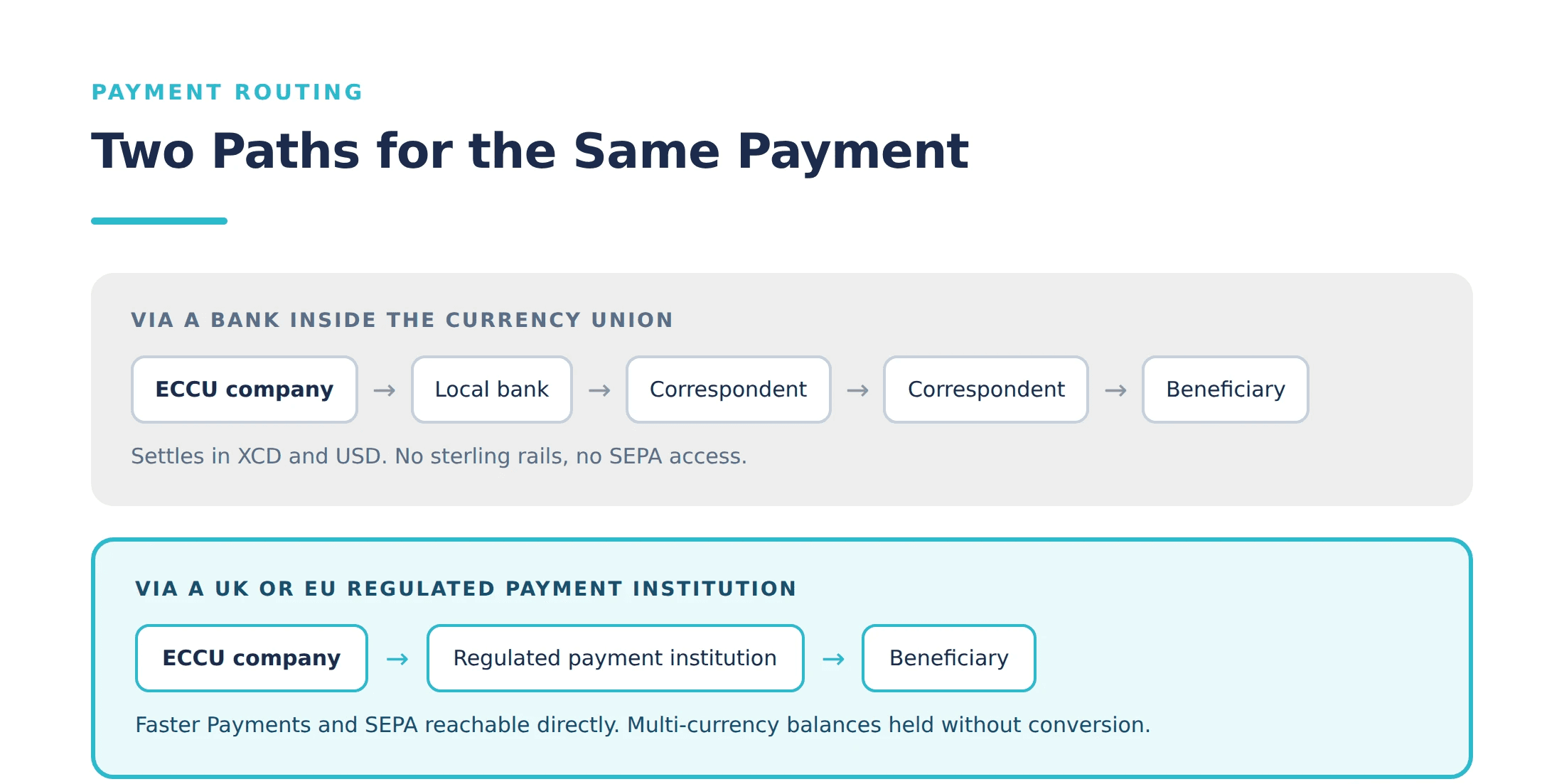
A bank inside the currency union keeps the company in regional clearing, with settlement available in EC dollars and US dollars. That local standing matches what a registry or corporate service provider expects to see.
The limits are structural. Correspondent chains from the region run longer than from a major financial centre, and neither sterling rails nor SEPA access forms part of the offering. Capacity is the harder constraint, with six active offshore licences in Antigua and two in the federation leaving few institutions to approach.
UK and EU Regulated Payment Institutions
Regulatory positioning here is better than most commentary suggests. As at 2026, none of Antigua and Barbuda, St Kitts and Nevis, or Dominica appears on any of the following:
The HM Treasury money laundering advisory notice listing FATF call-for-action and increased-monitoring countries, current as at 19 June 2026.
The annex to the EU list of high-risk third countries for anti-money laundering purposes.
Either annex of the EU list of non-cooperative jurisdictions for tax purposes, from which Antigua and Barbuda was removed on 17 February 2026.
The UK rule itself changed in mid-2026. HMRC's supervision handbook records that from 30 June 2026 regulation 33(3) of the Money Laundering Regulations 2017 no longer refers to high-risk third countries, and mandatory enhanced due diligence now attaches only to FATF call-for-action countries. European guidance points the same way. The EBA's guidelines on access to financial services require institutions to avoid blanket refusal of entire customer categories and to document why mitigating measures were rejected before declining a relationship. In its earlier risk factors review, the authority declined to make investment citizenship a standalone risk factor, treating it within customer and geographic risk instead.
Scrutiny still applies, and applications still fail. What the position above establishes is that additional checks come from firm-level risk appetite rather than an automatic legal classification. Document expectations and the review sequence are set out in this walkthrough of opening an XCD account for a Caribbean offshore company, with the evidentiary side covered in these notes on AML compliance for offshore companies and documenting source of funds.
Jurisdiction of incorporation still governs whether a provider will consider the company at all, and criteria differ between institutions. EQWIRE publishes its eligibility and acceptance criteria, which lets applicants check that threshold question before assembling a file.
[aa cta]
One Account for All International Business Payments
Hold multi-currency balances and send GBP and EUR payments from one FCA-authorised account.
[aa btn]Open Business Account[/aa]
[/aa]
FAQ
Can a bank account for a company in a CBI jurisdiction be opened outside the Caribbean?
Yes. Incorporation in Antigua and Barbuda, St Kitts and Nevis, or Dominica does not bar a company from holding an account with a regulated institution elsewhere, and none of the three sits on a UK or EU high-risk list in 2026. Approval still depends on the provider's own acceptance criteria. What a company incorporated in Antigua needs to receive GBP and EUR payments is current constitutional documentation supported by verified beneficial ownership evidence and a documented account of trading activity.
Does Dominica still have an IBC regime?
No. The International Business Companies (Repeal) Act 2021 removed the regime, and the sector was dissolved on 1 January 2022. CFATF recorded 3,581 companies struck off by the Registrar before the repeal took effect. Dominica's citizenship by investment programme continues to operate, so the passport route and the offshore company route have separated.
Can a Caribbean company hold XCD outside the region?
Holding East Caribbean dollars outside the currency union is possible through providers that support the currency, though options are limited. The ECCB issues XCD only to commercial banks and approved international financial institutions, and the currency does not appear among Swift's twenty largest payment currencies by value. Most companies registered in these jurisdictions settle cross-border trade in US dollars, euro, or sterling instead.
Are Antigua, St Kitts and Nevis or Dominica on a high-risk third country list in 2026?
None of the three appears on the FATF grey or black lists, the HM Treasury advisory notice current as at 19 June 2026, or the EU anti-money laundering high-risk annex. All three are also absent from both annexes of the EU list of non-cooperative tax jurisdictions, with Antigua and Barbuda removed from Annex II on 17 February 2026.
What account options exist for a company registered in one of these jurisdictions?
Three routes are realistic. A bank inside the currency union keeps the company in regional clearing, an offshore bank in a third jurisdiction adds distance, and a regulated payment institution in the UK or EU adds reach. Multi-currency account options for companies incorporated in XCD-zone CBI jurisdictions most often mean that last route, since it supplies sterling and euro rails regional clearing does not carry. Firms handling euro receivables should also review the requirements for opening a SEPA account for a Caribbean company.
Jurisdiction choice for an investment migration applicant now carries corporate consequences that did not exist five years ago. Dominica has closed its offshore company regime, Antigua and Barbuda has lost half its licensed international banks, and St Kitts and Nevis maintains strong statutes with minimal local banking to support them. Regional currency arrangements and correspondent banking conditions apply across all of them. For most operating businesses, an Antigua St Kitts Dominica company multi-currency account held with a regulated institution outside the region provides the payment reach that a citizenship by investment Caribbean company bank account XCD held locally cannot. Companies weighing that decision can review the criteria and open a business account with EQWIRE.
Reviewed by

Related Articles

UK Business Payment Account for a Software Consultancy Owned by a German Parent
Citizenship by Investment Jurisdictions: Financial Accounts for Antigua, St Kitts and Dominica Companies

SWIFT vs SEPA: When to Use Each for EUR Payments from a UK Account

Multi-Currency Account for Caribbean Businesses: Hold XCD, USD and GBP Together

Power your payments
with EQWIRE
Create your account in minutes and experience smooth, secure global payments.
" height="9.0156px" id="LIcbdboyB" transform="translate(4.987 4.5)" width="9.01562px"/></svg>)