•
•

Multi-Currency Account for Property Management Companies: Collect Rents in GBP and EUR
[aa disclaimer]
Legal Disclaimer: This article is for informational purposes only and does not constitute legal, financial, compliance, or tax advice. Banking eligibility, regulatory requirements, and provider policies vary by jurisdiction. Consult qualified professionals before making decisions.
[/aa]
A property management company with flats in London and Berlin, plus a serviced block in Dubai, invoices rent in three currencies every month. When every payment lands in a single GBP account, the bank converts EUR and AED receipts at its own rate. Between 2% and 4% of rental income can disappear before any landlord sees a statement.
A multi-currency account for property management removes that leak. The company collects rent in GBP and EUR on local payment details and holds each currency in its own balance. Conversion happens only when the finance team decides the rate works.
This guide compares the three account models available to international property businesses, from FX cost to compliance obligations, and shows when each setup pays off.
[aa key-takeaways]
Key Takeaways
Property management companies choose between three models: local bank accounts in each country, a single-currency account with forced FX, or one multi-currency account with separate balances.
A multi-currency account keeps GBP rent in GBP and EUR rent in EUR, so conversion applies only when the company decides the timing.
GBP rent arrives through Faster Payments and EUR rent through SEPA; AED payments reach the same account via SWIFT in 1–5 business days.
A property management company can hold GBP and EUR rent in a UK EMI account, with funds safeguarded in segregated accounts under the Electronic Money Regulations 2011.
Letting and management agents holding client money in England must join a government-approved Client Money Protection scheme or face fines of up to £30,000.
[aa btn]Book a Call[/aa]
[/aa]
Three Ways Property Management Companies Handle Multi-Currency Rent
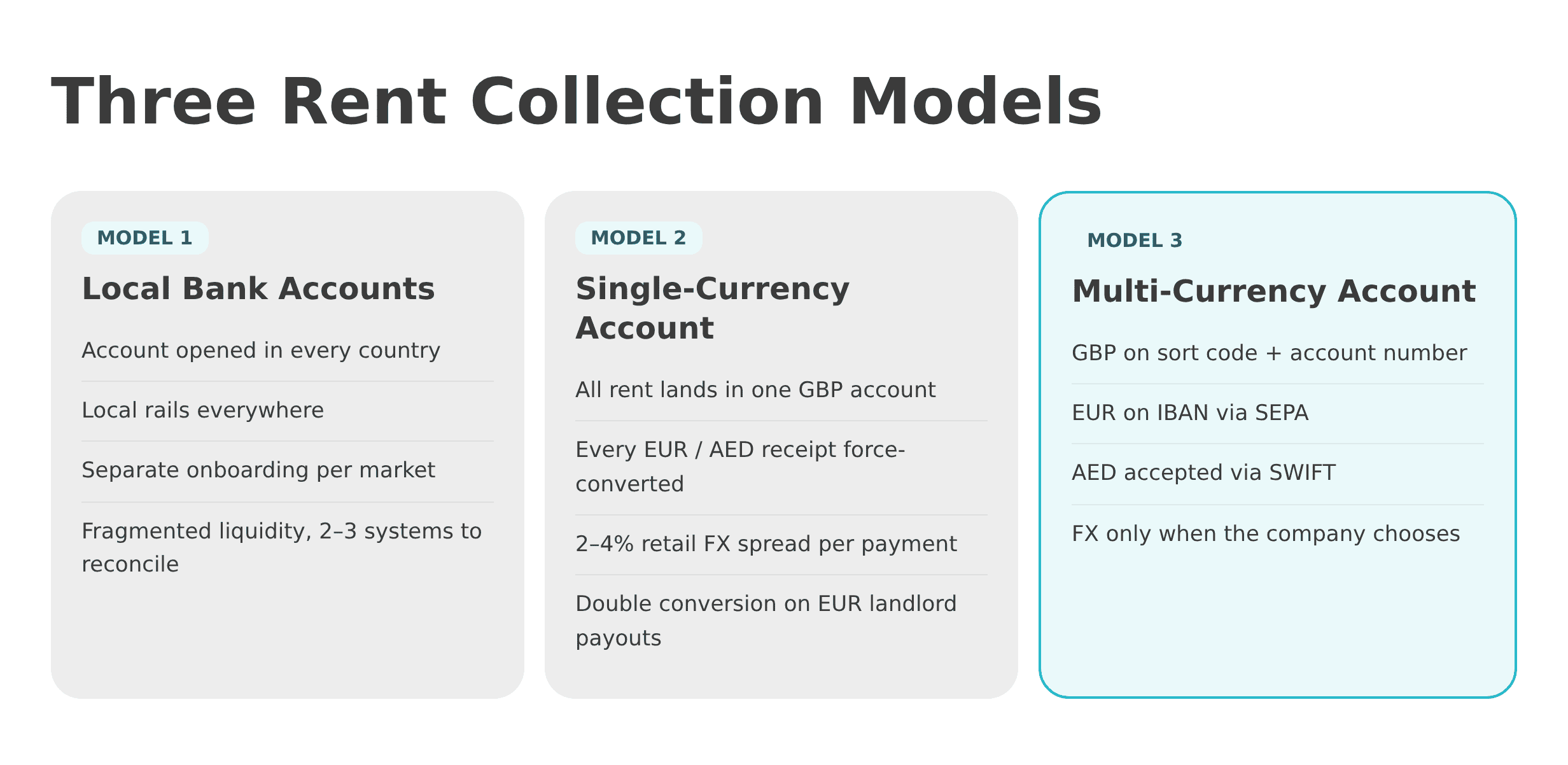
Property management companies with international portfolios handle rent in one of three ways: local bank accounts in every operating country, a single-currency account that converts every incoming payment, or one multi-currency account with separate GBP and EUR balances. Only the third model collects each currency on its local rail and skips forced conversion.
The right choice depends on where the properties sit and where the owners want their money. Here is how each model behaves in practice.
Model 1: Local Bank Accounts in Every Country
A company opens a domestic account in each market: a UK current account for GBP rent and a German or Irish account for EUR. Tenants pay on familiar local details, and transfers clear fast.
The costs sit elsewhere. Each account demands separate onboarding and a separate compliance file. Liquidity fragments across institutions, and the finance team reconciles statements from two or three systems every month.
In practice, a mid-sized agency running 40 units across the UK and Portugal spends weeks opening the second account and then maintains two banking relationships indefinitely. For a portfolio concentrated in one country this overhead makes sense. For a cross-border operation, it rarely does.
Model 2: A Single-Currency Bank Account With Forced FX
Unlike a multi-currency setup, a single-currency account converts every incoming foreign payment automatically. A €1,500 rent payment sent to a GBP-only account arrives as pounds, exchanged at the bank's retail rate.
Retail spreads on business accounts commonly run between 2% and 4% above the interbank rate. On that single payment, €30 to €60 vanishes.
The damage doubles when the landlord lives in the eurozone. The agent collects EUR and the bank converts it to GBP on arrival. Paying the owner then converts the same money back to EUR, so two spreads apply to funds that never needed to leave the euro.
What this means in practice: a €40,000 monthly eurozone rent roll can lose €800 to €1,600 every month to conversions the company never requested.
Model 3: One Multi-Currency Account With GBP and EUR Balances
A multi-currency account holds several currency balances under one set of credentials, each with local receiving details. GBP arrives on a UK sort code and account number. EUR arrives on an IBAN that accepts SEPA transfers. AED and other non-core currencies come in through SWIFT.
This is how an international property management company collects rents in GBP and EUR without forced FX: each tenant pays a domestic-style transfer in their own currency, and the money stays in that currency until the company converts it deliberately.
Landlord payouts work the same way in reverse. An owner in Lisbon receives EUR from the EUR balance with no conversion at all. The company can hold GBP and EUR rent for weeks and pick its moment on the rate.
Cost Comparison: What Each Model Does to Rental Income
FX margin separates the three models more sharply than any feature list. The table below shows where the money goes on a typical cross-border rent roll.
Factor | Local accounts | Single-currency account | Multi-currency account |
|---|---|---|---|
FX cost on EUR rent | None (stays local) | 2–4% on every receipt | 0% until chosen conversion |
Setup time | Weeks to months per country | Days | Days |
Account fees | Per account, per country | One fee structure | One fee structure |
Reconciliation | 2–3 banking systems | One statement, one currency | One platform, per-currency balances |
EUR payout to landlord | Local and cheap | Double conversion | From EUR balance, no FX |
FX Margins, Wire Fees and Hidden Charges Side by Side
The visible fee is rarely the expensive part. A SWIFT wire shows a £15–30 charge on the statement, while the FX spread hides inside the exchange rate. The Bank for International Settlements runs a G20 programme targeting exactly this problem: cross-border payments remain slower and costlier than domestic ones.
For a property manager, the arithmetic is short. £600,000 of EUR-denominated rent per year at a 3% forced spread costs £18,000. The same flow held in a EUR balance costs nothing at receipt, and a later conversion near the interbank rate cuts the annual bill by more than half.
Here is where the money leaks unnoticed: the spread never appears as a fee line, so most agencies discover the cost only when an owner questions why euro rents keep shrinking on the way to their account.
[aa fast-fact]
Fast Fact: Retail FX spreads of 2–4% on a €40,000 monthly rent roll cost €9,600 to €19,200 per year. A multi-currency balance defers that cost until the company chooses to convert.
[/aa]
Operational Overhead: Reconciliation Across Accounts
Money is one cost; hours are the other. Fragmented accounts force the ops team to match rent receipts across two or three portals, then explain rate differences to owners whose statements never quite align.
A single platform with per-currency balances produces one export. Each receipt keeps its original amount and currency, so owner reporting matches what the tenant actually paid.
The practical gain shows up at month-end. Agencies that stop converting on receipt close their books faster because conversion noise disappears from the ledger, and every EUR entry reconciles against a EUR invoice.
Bank vs UK EMI for a Property Management Multi-Currency Account
The practical difference between a high-street bank and a UK Electronic Money Institution comes down to onboarding speed and the protection model. Opening a multi-currency account for property management at a bank can take months of compliance review; an EMI focused on international business commonly completes onboarding in days.
Onboarding, Safeguarding and FCA Regulation
A UK EMI operates under authorisation from the Financial Conduct Authority and must safeguard customer funds under the Electronic Money Regulations 2011. Safeguarded money sits in segregated accounts, separate from the EMI's own funds.
The FSCS does not cover e-money. Protection comes from segregation instead, and the detail matters, so the safeguarding rules for UK EMI accounts deserve a careful read before any client money moves.
Property agents carry a second obligation. Letting and management agents holding client money in England must belong to a government-approved Client Money Protection scheme, and non-membership carries fines of up to £30,000. An EMI account does not replace CMP membership; firms should confirm their exact setup with a qualified adviser.
How EMIs stack up against mainstream fintech options is a separate question, covered in this comparison of EMI accounts and fintech alternatives.
Payment Rails: SEPA, Faster Payments and SWIFT for AED
Each currency rides its own rail. GBP rent moves over Faster Payments, part of the UK's payment and settlement infrastructure overseen by the Bank of England, and lands in near real time around the clock.
EUR rent travels through SEPA, which treats euro credit transfers between member countries like domestic payments. The UK kept SEPA membership after Brexit as a third country, so a UK EMI can issue EUR IBANs that eurozone tenants pay at domestic cost. Where both sides support SEPA Instant, the transfer settles in under 10 seconds.
AED has no local rail in the UK. Payments from Dubai arrive via SWIFT in one to five business days, and correspondent fees along the chain vary by route. For steady AED volumes the timing stays predictable enough to schedule owner payouts around it.

[aa cta]
Collect GBP and EUR Rent on One Account
EQWIRE's multi-currency accounts give property businesses local GBP and EUR payment details plus SWIFT reach for AED. Conversion happens only when the finance team picks the moment.
[aa btn]Open a Business Account[/aa]
[/aa]
Use Cases: Which Setup Fits Which Property Business
UK Letting Agent With EU-Based Landlords
A London agency manages 60 flats, and 14 of the owners live in the eurozone. Tenants keep paying GBP by Faster Payments. The agency opens a EUR balance and pays those 14 owners by SEPA transfer after one planned conversion at a known margin.
The result: each owner receives euros directly instead of a GBP wire their bank re-converts on arrival. The same logic behind FX-neutral settlement for multi-currency inflows applies to rent: money changes currency once, at a rate someone actually chose.
International Operator With GBP, EUR and AED Rent Flows
A Dubai-headquartered operator managing property in Manchester and Lisbon collects rent across three currencies. GBP and EUR arrive on local details and stay put. AED from Gulf tenants comes in by SWIFT and can sit in balance until repatriation makes sense; the mechanics of converting AED to GBP without hidden markups decide how much of the Gulf income survives the trip.
Owner reporting stays clean because every receipt keeps its original currency. When the operator needs to collect rent in GBP and EUR for UK and EU owners, payouts leave the matching balance the same day the rent clears.
How to Choose: Decision Checklist
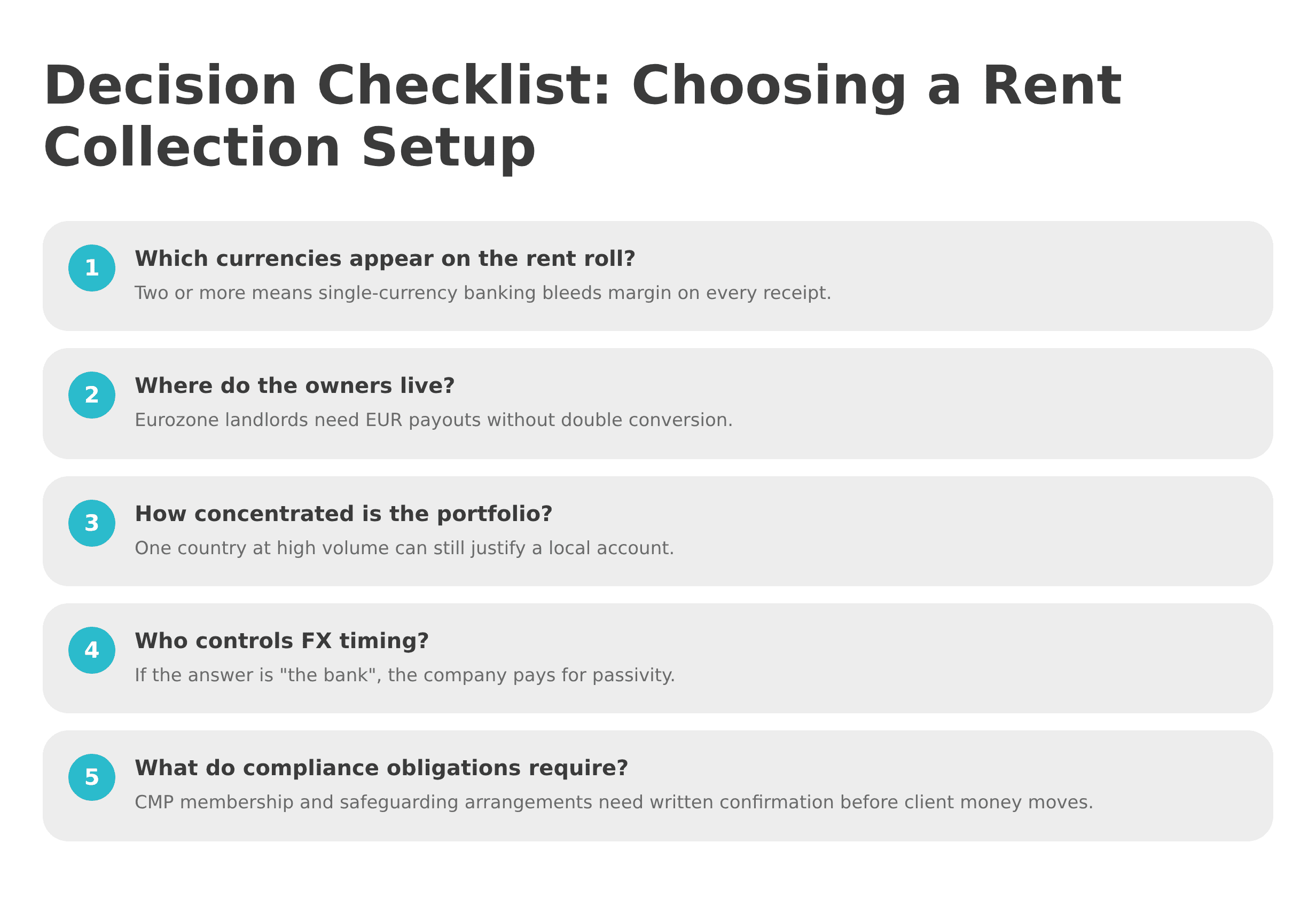
Five questions settle the choice for most property businesses:
Which currencies appear on the rent roll? Two or more means single-currency banking bleeds margin on every receipt.
Where do the owners live? Eurozone landlords need EUR payouts without double conversion.
How concentrated is the portfolio? One country at high volume can still justify a local account.
Who controls FX timing? If the answer is "the bank", the company pays for passivity.
What do compliance obligations require? CMP membership and safeguarding arrangements need written confirmation before client money moves.
A portfolio spread across the UK and the EU, with any Gulf exposure on top, points at one multi-currency account. The company can hold GBP and EUR rent as long as it wants and keep AED whole until rates justify converting. Every owner gets paid in the currency they expect.
FAQ
How does an international property management company collect rents in GBP and EUR without forced FX?
By using an account that issues local payment details for each currency. UK tenants pay GBP to a sort code and account number over Faster Payments; eurozone tenants pay EUR to an IBAN by SEPA transfer. Each amount credits a balance in its original currency, so no conversion happens at receipt. The company converts later, if at all, at a rate and moment it selects.
Can a property management company hold GBP and EUR rent in a UK EMI account?
Yes. A UK EMI authorised by the FCA can hold business funds in multiple currencies, safeguarded in segregated accounts under the Electronic Money Regulations 2011. The FSCS does not cover e-money; safeguarding is the protection model instead. Agents holding client money in England also need membership of a government-approved Client Money Protection scheme, which applies regardless of where the account sits.
Is a multi-currency account cheaper than local bank accounts in each country?
For portfolios spread across two or more countries, usually yes. Local accounts avoid FX but multiply fixed costs, since every extra bank means another onboarding and another statement to reconcile. A single multi-currency account carries one fee structure and one platform. The exception is a high-volume portfolio concentrated in one country, where a domestic account can still win on total cost.
Do tenants pay extra fees when paying rent to a multi-currency account?
No. Tenants make ordinary domestic transfers: Faster Payments for GBP and SEPA for EUR, both at standard domestic cost. That is the point of using local details to collect rent in GBP and EUR, since nothing changes on the tenant's side. Only AED payers send an international SWIFT transfer, where the sending bank's own fees apply.
Can a multi-currency account receive AED rent payments?
Yes, through SWIFT. AED payments from the UAE arrive in one to five business days depending on the correspondent chain, and incoming wire fees vary by provider. The received dirhams can stay as an AED balance or convert to GBP or EUR when the company chooses. For monthly rent cycles the timing is predictable enough to plan owner payouts around.
Forced conversion is a silent line item on every international rent statement. The three models compared here move that cost around; only one removes it. For most cross-border portfolios, a multi-currency account for property management keeps each rent in its original currency and pays owners without a second spread. Safeguarding and client money obligations still apply and deserve professional confirmation. EQWIRE, a UK EMI regulated by the FCA, provides multi-currency accounts with local GBP and EUR details plus SWIFT connectivity for currencies like AED. Property businesses ready to test the model can open an account and run the next rent cycle on rails that keep every currency whole.
Reviewed by
Related Articles

UK Multi-Currency Account for a Global Payroll Software Company Paying Service Providers

Multi-Currency Account for Israel-UK Tech Companies: Hold ILS, USD and GBP

Cross-Currency Payroll: Paying International Teams in Local Currencies from One Account
Multi-Currency Account for Property Management Companies: Collect Rents in GBP and EUR

Power your payments
with EQWIRE
Create your account in minutes and experience smooth, secure global payments.
" height="9.0156px" id="LIcbdboyB" transform="translate(4.987 4.5)" width="9.01562px"/></svg>)