•
•

Multi-Currency Account for Hong Kong Trade: Hold HKD, USD and CNY Together
[aa disclaimer]
Legal Disclaimer: This article is for informational purposes only and does not constitute legal, financial, compliance, or tax advice. Banking eligibility, regulatory requirements, and provider policies vary by jurisdiction. Consult qualified professionals before making decisions.
[/aa]
A Hong Kong trading company runs on three currencies at once. Buyers in the US and Europe pay in USD, mainland suppliers invoice in renminbi, and rent, payroll and local costs settle in HKD. When each currency sits with a different institution, every payment cycle forces a conversion, and every conversion takes a spread. A multi-currency account for Hong Kong trade removes that friction: HKD, USD and CNY sit as separate balances in one place, and the business converts only when it chooses. The harder question is where to hold that account. Traditional Hong Kong banks, local fintech platforms and UK-regulated providers each answer it differently. This guide compares all three routes and shows how to hold HKD, USD and CNY together without paying for conversions nobody ordered.
[aa key-takeaways]
Key Takeaways
Three realistic structures let a Hong Kong business hold HKD, USD and CNY together: traditional HK banks, HK fintech platforms and UK FCA-regulated EMIs.
Traditional banks add trade finance and HKD 800,000 deposit protection, but onboarding takes weeks and rejection rates for young trading companies are high.
HK fintech platforms onboard remotely in days, though fund protection depends on licence type rather than deposit insurance.
A UK FCA-authorised EMI provides named IBANs, safeguarded client funds and reach beyond the HKD–USD–CNY trio, with fully remote onboarding.
The right choice depends on buyer geography, supplier mix and expansion plans, and many trading companies run two structures in parallel.
[aa btn]Open a multi-currency account[/aa]
[/aa]
Why Hong Kong Trading Companies Need HKD, USD and CNY in One Place
USD remains the default invoicing currency of global trade, carrying roughly half of all payments sent over SWIFT. The renminbi ranks sixth at close to 3% (SWIFT RMB Tracker, 2026), yet for a company sourcing in Shenzhen or Guangzhou it is the currency that pays the factory. HKD covers everything the business does at home. One company, three settlement currencies, and none of them optional.
Splitting them across institutions creates a structural cost. Each provider holds one piece of the flow, each transfer between them crosses an FX desk, and finance teams reconcile three statements to see one cash position.
The renminbi adds its own nuance. Onshore CNY circulates inside mainland China under capital controls and settles through China's domestic system. Offshore renminbi, traded as CNH, clears outside the mainland at a freely floating rate, with Hong Kong as its largest hub. A company paying mainland suppliers from outside China transacts in CNH, and the funds typically route through CIPS (the Cross-border Interbank Payment System), which counted 1,791 participating institutions as of Q1 2026 and settled the equivalent of around $24.5 trillion in 2025.
Why this matters: suppliers quoting in USD usually pad the price to cover their own conversion risk. Paying in renminbi removes that padding, which regularly beats the USD quote even before the spread is counted.
The Three-Currency Reality of HK Trade Flows
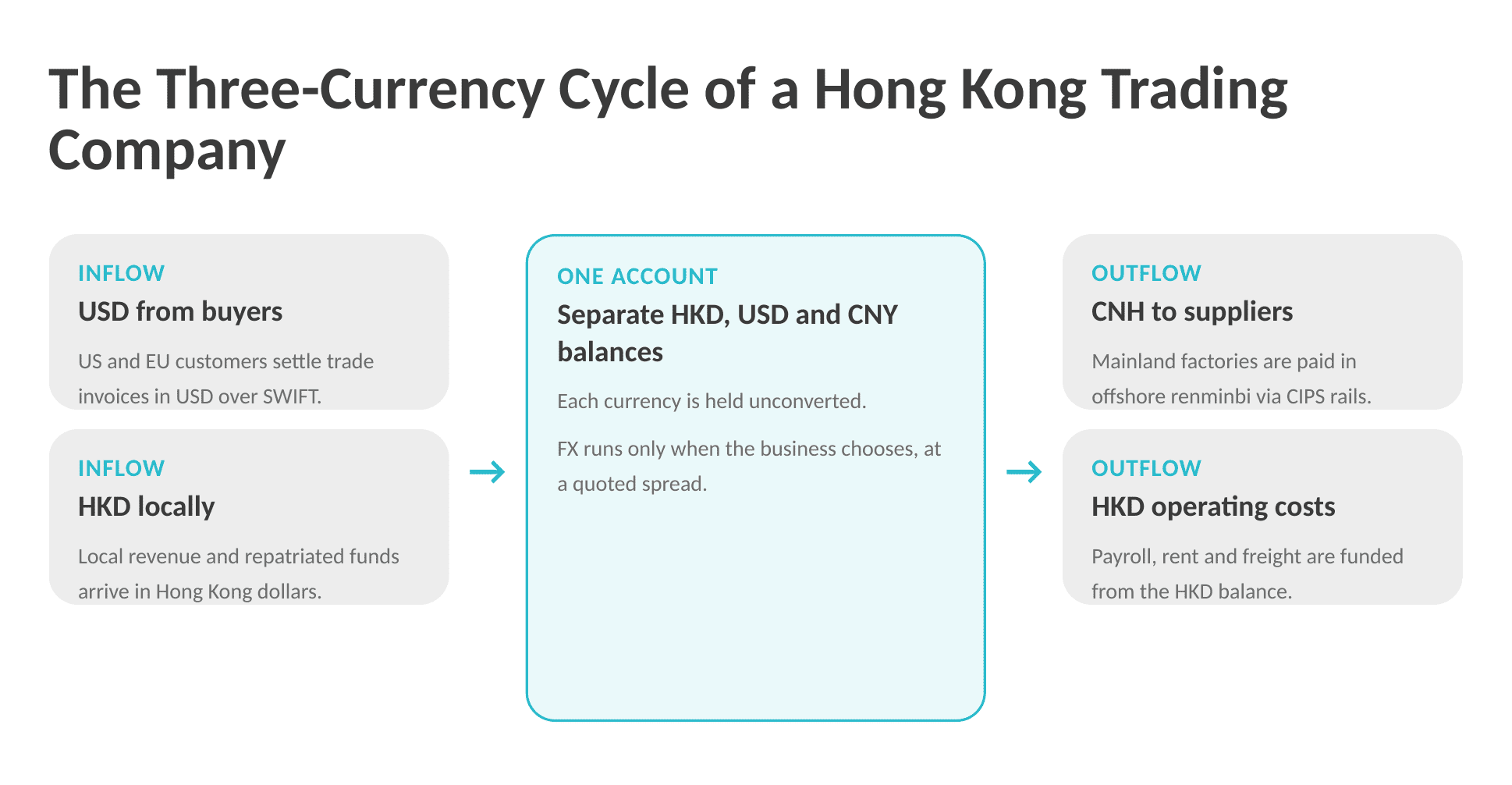
A typical monthly cycle looks like this. A US buyer settles a $500,000 invoice. The trading company owes ¥2.8 million to two mainland factories and needs HKD for payroll and freight.
Inflows: USD from overseas buyers, occasionally EUR or GBP.
Payables: CNH to mainland suppliers, USD to regional partners.
Operating costs: HKD for staff, rent and logistics.
With separate single-currency accounts, the USD receipt converts to HKD on arrival, then part of it converts again to renminbi for the supplier run. Two spreads on the same money. At a 0.5–1.5% margin per conversion, a company cycling $6 million a year can hand over $60,000–180,000 in FX costs that a single account structure would avoid.
[aa fast-fact]
Fast Fact: Hong Kong's total merchandise trade exceeded HK$9 trillion in 2025 (HK Census and Statistics Department), and most of it is invoiced in a currency other than the one local costs are paid in.
[/aa]
Option 1 — Traditional Hong Kong Banks
Traditional Hong Kong banks such as HSBC and Bank of China (Hong Kong) offer integrated multi-currency accounts covering ten to twelve currencies, including HKD, USD and CNY, under one account number. For an established trading company they remain the strongest option for credit: trade finance, letters of credit and FX forwards live here.
Deposits also carry statutory protection. The Hong Kong Deposit Protection Scheme, supervised by the Hong Kong Monetary Authority (HKMA), covers up to HKD 800,000 per depositor per bank after the limit rose from HKD 500,000 in October 2024.
The trade-offs sit at the front door. Corporate onboarding regularly takes four to eight weeks, usually requires an in-person meeting, and expects minimum balances or relationship fees. Young trading companies with mainland ownership face the hardest path: industry analyses put rejection rates for that segment as high as 60%, a consequence of tightened AML expectations rather than any single bank's policy.
In practice: a two-year-old trading company with a Shenzhen parent and no HK office space is exactly the profile that gets declined, regardless of genuine turnover.
Option 2 — Hong Kong Fintech Platforms
Hong Kong fintech platforms offer multi-currency business accounts with remote onboarding measured in days. Providers in this group hold Money Service Operator or Stored Value Facility licences, support the HKD–USD–CNY trio alongside other majors, and price FX at tighter margins than branch banking.
For a young company that a bank has declined, these platforms are often the first workable account. They also integrate cleanly with e-commerce and payment tooling.
The limits appear on closer reading:
Protection model. These are not banks, so the HKD 800,000 Deposit Protection Scheme does not apply. Client money arrangements vary by licence and provider.
Currency mechanics. Some currencies are receive-only or convert automatically on arrival, so the "hold" part of holding three currencies needs checking per provider.
No credit. Trade finance, overdrafts and FX forwards stay out of scope.
None of this makes the platforms unsafe. It makes them different, and the difference is worth understanding before large balances accumulate.
In practice: a trading company that keeps a working float of HKD 300,000 on a fintech platform and moves the rest out weekly gets the speed benefit with limited exposure. A company that lets HKD 5 million sit on a stored-value licence has taken a protection decision, whether or not anyone framed it that way.
Option 3 — A UK-Regulated EMI Account
An FCA-authorised electronic money institution (EMI) gives a Hong Kong trading company a third structure: named IBANs and separate HKD, USD and CNY balances held under UK safeguarding rules, opened remotely without any UK presence. This is the route most comparison guides skip, because it sits outside Hong Kong entirely while serving the same trade flows.
A multi-currency account for a Hong Kong trading company at a UK EMI receives USD from buyers over SWIFT, holds it unconverted, sends CNH to mainland suppliers and keeps an HKD balance for repatriation or local costs. The same account typically covers GBP and EUR, which matters once European buyers enter the picture. The structural differences between an FCA-authorised EMI and a bank are narrower than most founders expect, but they are real and they cut both ways.
FCA Safeguarding vs Deposit Insurance
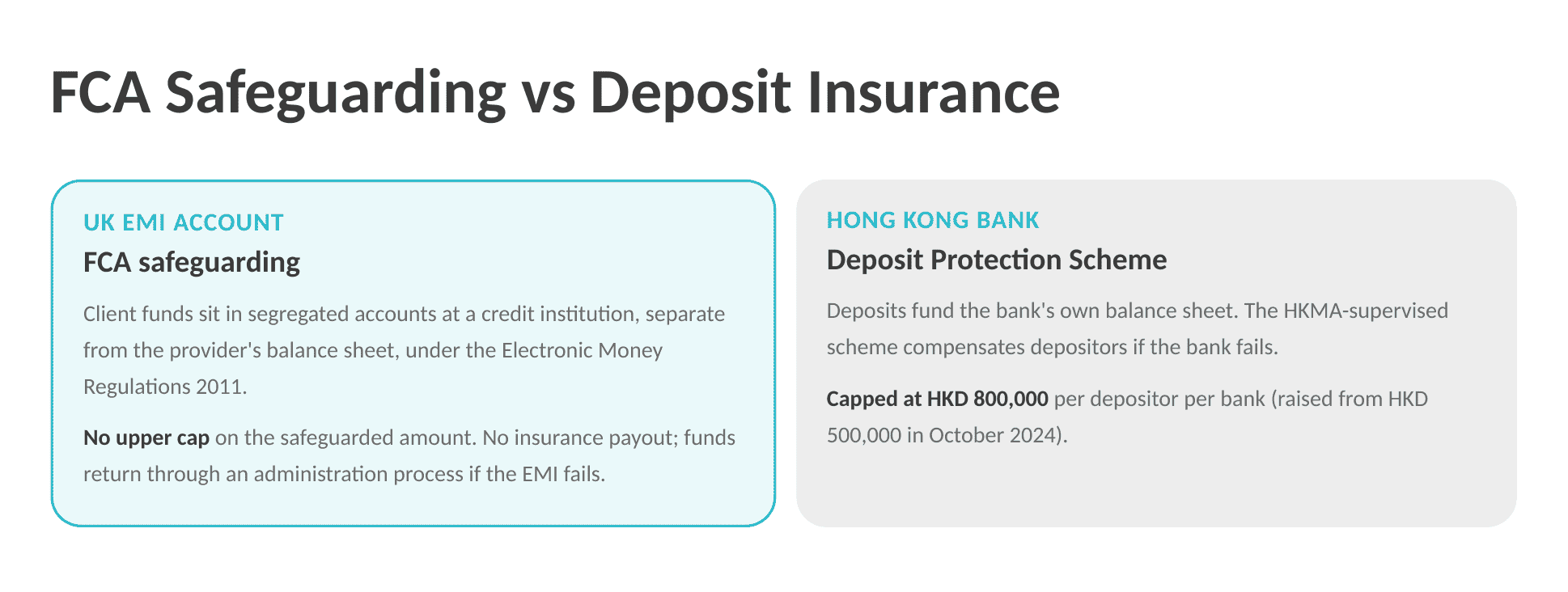
Safeguarding and deposit insurance protect money through different mechanisms. Under the UK Electronic Money Regulations 2011, an EMI must hold client funds in segregated safeguarding accounts at a credit institution, separate from its own money. If the EMI fails, the safeguarded pool exists specifically to be returned to clients.
Deposit insurance works the other way round. A bank uses deposits on its own balance sheet, and a statutory scheme (HKD 800,000 under the HK DPS, £85,000 under the UK's FSCS) compensates depositors if the bank fails.
Neither model is strictly stronger. Safeguarding has no upper cap and keeps funds out of the institution's balance sheet, but it carries no insurance payout and return of funds follows an administration process. The FCA's safeguarding requirements set out how EMIs must segregate and reconcile these funds. For a trading company holding seven-figure balances, an uncapped segregation model is often the more relevant protection; for smaller balances, an insured cap may feel safer.
How a Trading Company Holds HKD, USD and CNY in One Regulated UK Account
A trading company holds HKD, USD and CNY in one regulated UK account by opening a multi-currency EMI account with named IBANs, activating a balance per currency, and routing each flow to its matching balance so conversion happens only by choice. That is the complete answer; the setup runs as follows.
Pass KYB remotely. The HK entity submits incorporation documents, ownership structure and trade evidence. The application requires no UK company or office.
Activate currency balances. HKD, USD and CNY wallets open under one account, each with its own receiving details.
Receive without conversion. USD invoices settle into the USD balance over SWIFT; HKD can arrive the same way, the structure UK-facing exporters use to receive HKD without forced conversion.
Pay suppliers in renminbi. CNH payments go out to mainland beneficiaries, the same rails used by businesses that receive CNY from mainland counterparties.
Convert deliberately. FX runs at a quoted spread when the business decides, at around 0.5% with EQWIRE, rather than automatically on every receipt.
Businesses using this structure typically keep working capital in the currency it will be spent in and convert only the surplus.
Settlement timing follows the rails. SWIFT receipts land in one to three business days depending on the correspondent chain, and outbound CNH runs are best scheduled around cut-off times rather than fired ad hoc. Finance teams that batch supplier payments weekly report the cleanest reconciliation, since each run produces one statement line per currency instead of a scatter of conversions.
The de-risking angle deserves a mention. When a Hong Kong bank exits a client relationship or declines an application, the company still needs somewhere to receive next month's invoices. A UK EMI account works as a functioning primary account or as a standing backup, and the KYB file assembled for one application largely reuses for the other.
[aa cta]
One account for HKD, USD and CNY
Open separate currency balances, receive buyer payments unconverted and pay mainland suppliers in renminbi from the same place.
[aa btn]Open Business Account[/aa]
[/aa]
Decision Framework: Which Setup Fits Which Business
The right structure depends on three variables: buyer geography, supplier mix and expansion plans. The comparison below covers the five axes that decide most cases.
Axis | HK traditional bank | HK fintech platform | UK-regulated EMI |
|---|---|---|---|
Onboarding | 4–8 weeks, in-person | Days, remote | Days, remote |
Fund protection | DPS up to HKD 800,000 | Varies by licence | FCA safeguarding, uncapped segregation |
HKD / USD / CNY | Full support | Support varies per currency | Separate balances, hold and send |
FX cost | Branch-rate spreads | Tight margins | Quoted spread, ~0.5% |
Trade finance | Yes | No | No |
Mapped to real profiles:
Mainland-heavy supplier base. CNH payment capability decides the choice. A multi-currency account for an import-export business must hold and send renminbi, and receive-only support is a disqualifier.
US and EU buyer base. USD and EUR receiving details matter most. Named IBANs at a UK EMI keep collections clean, and the same setup already covers a multi-currency account for GBP, EUR and USD when European revenue grows.
Credit-dependent trade. Companies financing shipments through letters of credit stay anchored to a bank, whatever else they add.
Many trading companies land on a two-account answer: a bank for credit and an EMI or fintech account as the payment workhorse. One account for three currencies handles the flows; the bank handles the borrowing.
Cost modelling makes the choice concrete. Take a company converting $3 million a year. At a 1.2% blended branch-rate spread the FX bill is $36,000. At a quoted 0.5% spread it is $15,000, and the portion paid to suppliers in held CNH never converts at all. Against numbers like these, monthly account fees stop being the deciding variable.

Conclusion
Holding HKD, USD and CNY together is an account structure decision, and the structure determines the FX bill. A multi-currency account for Hong Kong trade turns three institutions and two forced conversions per cycle into one account and one deliberate conversion. Traditional banks still win on credit, fintech platforms win on speed, and a UK FCA-regulated EMI adds uncapped safeguarding with named IBANs and remote onboarding for HK entities. EQWIRE's business account for Hong Kong trade covers 66 currencies with T+0 to T+2 settlement through the EQWIRE currency network, and a company can open a multi-currency account at client.eqwire.com/sign-up with a fully remote application.
FAQ
How can a trading company hold HKD, USD and CNY in one regulated UK account?
A trading company can hold HKD, USD and CNY in one regulated UK account by opening a multi-currency account with an FCA-authorised electronic money institution. Each currency sits in its own balance with dedicated receiving details, so USD sales, CNH supplier payments and HKD operating funds stay separate until the business converts deliberately. The provider holds client funds in segregated safeguarding accounts under the Electronic Money Regulations 2011, and onboarding for a Hong Kong entity runs remotely on standard KYB documents.
Is CNY held offshore (CNH) different from onshore CNY?
Yes. Onshore CNY circulates inside mainland China under capital controls, while CNH is renminbi traded outside the mainland at a freely floating rate, with Hong Kong as the largest offshore hub. Both are the same currency in the supplier's hands, but cross-border businesses transact in CNH and the two rates can diverge slightly. Any account outside mainland China that holds renminbi holds CNH, and payments to mainland beneficiaries typically clear through CIPS.
Is a UK EMI account safe for a Hong Kong company?
A UK EMI account relies on FCA safeguarding rather than deposit insurance. The provider must keep client funds in segregated accounts at a credit institution, separate from its own balance sheet, under the Electronic Money Regulations 2011. There is no cap on the safeguarded amount, though there is also no insurance payout equivalent to the HKD 800,000 Hong Kong Deposit Protection Scheme or the UK's £85,000 FSCS limit. For companies holding balances above insured caps, uncapped segregation is often the more relevant protection model.
Can one multi-currency account cover both mainland suppliers and Western buyers?
Yes, provided the account can both hold and send all three currencies. The account needs USD receiving details for buyer invoices, outbound CNH capability for mainland supplier payments, and an HKD balance for local flows. A multi-currency account for an import-export business that only receives, or that auto-converts renminbi on arrival, covers half the cycle. Checking send-and-hold support per currency is the single most useful question to ask a provider before onboarding.
Does a Hong Kong company need a UK presence to open a UK multi-currency account?
No. UK EMIs onboard overseas entities remotely, and a Hong Kong company applies with its certificate of incorporation, ownership and director details, and evidence of trading activity. There is no requirement for a UK office, UK director or UK shareholder. Approval timelines depend on the clarity of the ownership chain, and companies with straightforward structures typically complete verification within days.
Reviewed by
Related Articles

UK Business Account for an Industrial Exporter Managing Deposits, Refunds and Final Invoices

Personal MUR Account for Expats in Mauritius: Hold Rupees Without a Local Account

Importing from China: How to Hold CNY and Pay Chinese Suppliers Directly
Multi-Currency Account for Hong Kong Trade: Hold HKD, USD and CNY Together

Power your payments
with EQWIRE
Create your account in minutes and experience smooth, secure global payments.
" height="9.0156px" id="LIcbdboyB" transform="translate(4.987 4.5)" width="9.01562px"/></svg>)