•
•

Articles
SWIFT Code Lookup: Find BIC Code for International USD and CNY Payments
[aa disclaimer]
Legal Disclaimer: This article is for informational purposes only and does not constitute legal, financial, compliance, or tax advice. Banking eligibility, regulatory requirements, and provider policies vary by jurisdiction. Consult qualified professionals before making decisions.
[/aa]
A finance team schedules a USD payment to a supplier in Shanghai. Five days later the money comes back, minus a repair fee. The reason: the BIC pointed to the bank's head office instead of the branch named on the invoice.
A SWIFT code lookup is the process of finding and verifying the Bank Identifier Code (BIC) that routes an international USD or CNY payment to the correct bank. The code is defined by the ISO 9362 standard, and SWIFT maintains the official register. Getting it right before pressing send is the cheapest fraud-and-error control available to any finance team.
This guide explains how the code is built, where to find it, why it behaves differently in USD and CNY transfers, and what a wrong code actually costs.
[aa key-takeaways]
Key Takeaways
A SWIFT code and a BIC are the same identifier, defined by ISO 9362: 8 or 11 characters covering bank, country, location and, optionally, branch.
An 8-character code routes payments to a bank's head office; an 11-character code targets a specific branch, and "XXX" explicitly means head office.
USD transfers move through correspondent bank chains that clear via CHIPS and Fedwire, so the BIC determines the route, fees and timing.
CNY payments to mainland China clear through CIPS, and RMB priority payments have required a SWIFT BIC since 6 December 2020.
A wrong BIC typically triggers rejection, repair fees on both sides and a 3–5 business day delay before funds return.
[aa btn]Book a Call[/aa]
[/aa]
What a SWIFT/BIC Code Is and How the Standard Works
A SWIFT code is an 8- or 11-character identifier that tells the global banking network which institution should receive a payment message. The same identifier is formally called a Business Identifier Code (BIC) under ISO 9362, so the two names describe one code.
SWIFT, the Society for Worldwide Interbank Financial Telecommunication, acts as the registration authority for the standard. It assigns new codes and publishes updates. When banks merge or close, it retires the affected identifiers.
Every BIC code used for international payments appears somewhere in the payment message itself. Banks read it to decide where the instruction travels next. Account numbers identify the destination account; the BIC identifies the institution holding it.
The Anatomy of an 8- and 11-Character BIC
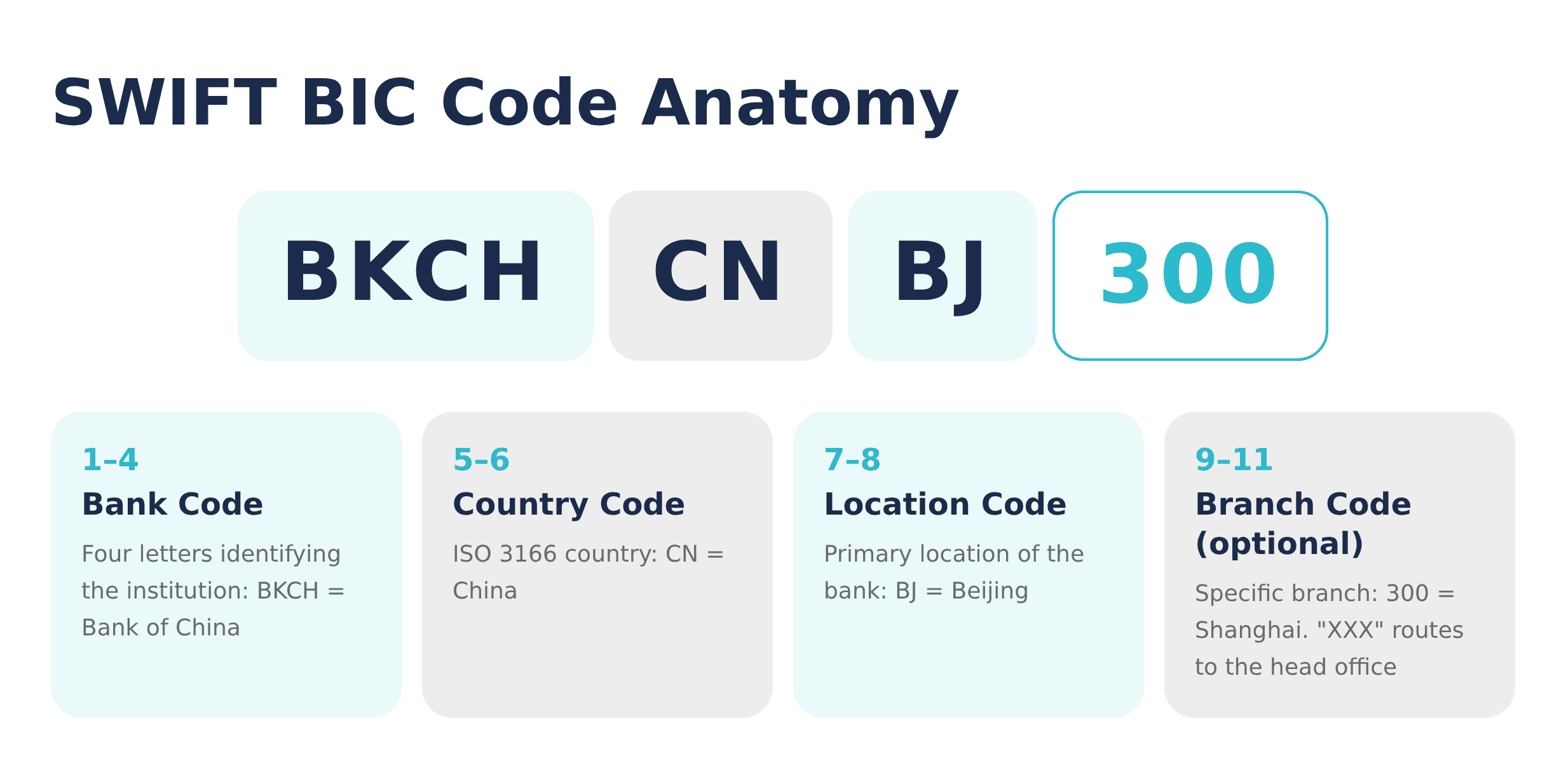
The format follows a fixed pattern. Take BKCHCNBJ300, a code for Bank of China's Shanghai operations:
BKCH: bank code, four letters identifying Bank of China
CN: country code (China) under ISO 3166
BJ: location code, pointing to Beijing as the primary location
300: optional branch code, here designating Shanghai
Strip the last three characters and BKCHCNBJ remains: the 8-character head-office form. When a payment system demands 11 characters, "XXX" fills the branch slot and explicitly routes to the head office.
Here is the detail many finance teams miss. An 8-character bank identifier code plus XXX is not always equivalent to the correct branch code. Some banks centralise incoming international payments at the head office and forward them internally. Others require the exact branch identifier, and a head-office code adds days of internal routing or triggers a return.
SWIFT Code vs BIC vs IBAN vs Routing Number
Unlike an IBAN, which identifies an individual account, a BIC identifies the institution that holds it. The two work together in most cross-border transfers.
Identifier | What it identifies | Where it applies |
|---|---|---|
SWIFT code / BIC | The bank (and optionally branch) | Nearly all international wire transfer details |
IBAN | A specific account at that bank | Europe, UAE, and 80+ other jurisdictions |
Routing number (ABA) | A US bank for domestic rails | US domestic transfers only |
CNAPS code | A Chinese bank branch domestically | Payments inside mainland China |
The US never adopted IBAN, so a USD payment to an American bank pairs the BIC with an account number and, for domestic legs, an ABA routing number. A payment to the UAE needs both a BIC and an IBAN. Hong Kong pairs the BIC with a bank and branch code.
How to Do a SWIFT Code Lookup Before Sending a Payment
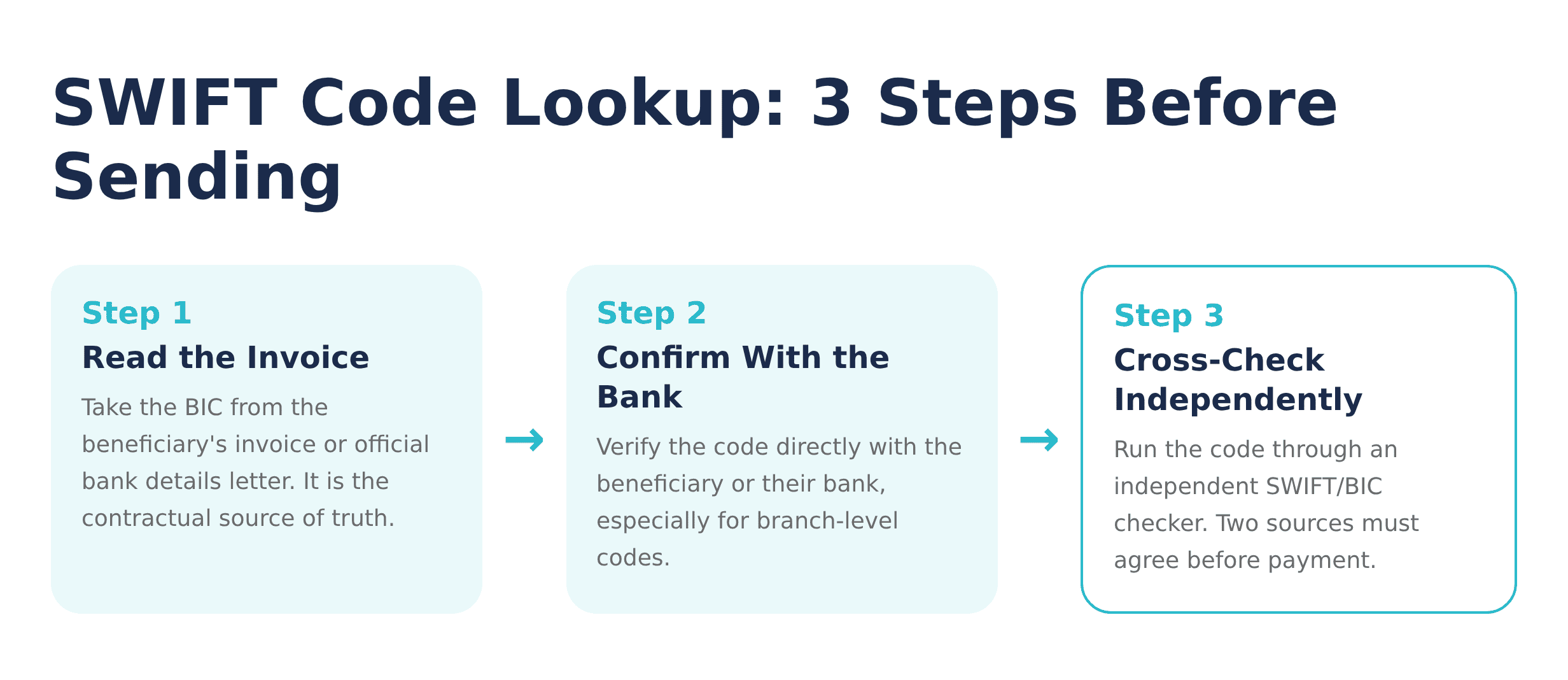
Businesses can find and confirm a SWIFT BIC code in three steps:
Read the code from the beneficiary's invoice or official bank details letter.
Confirm it directly with the beneficiary or their bank.
Cross-check it in an independent SWIFT/BIC code checker before payment entry.
The order matters. The beneficiary's own documents carry the highest authority, because only the receiving company knows which branch its account sits at. Independent directories serve as a second opinion, never as the primary source.
Official and Bank-Provided Sources
Reliable places to find a bank identifier code, ranked by authority:
The beneficiary's invoice or bank details letter: the contractual source of truth
The beneficiary's bank statement header: codes printed by the bank itself
The receiving bank's official website: usually listed under international transfer details
The sending platform's built-in directory: many payment providers validate codes at entry
Independent online checkers: useful for format validation and second-source confirmation
A SWIFT/BIC code lookup tool for businesses sending USD, CNY, AED or HKD international payments works only as a starting point. Directories update on different schedules, and a code that changed after a bank merger can sit in a public database for months. Teams that need to find a SWIFT BIC code for a USD or CNY payment on a deadline should treat any single unverified source as provisional.
Verifying the Code With the Beneficiary
Bank identifier code verification comes down to one discipline: two independent sources must agree before the payment leaves.
In practice, an accounts-payable clerk matches the code on the invoice against the code the supplier's bank publishes. If the two differ by even one character, the payment waits until the supplier confirms in writing. That pause costs an email. Skipping it can cost a returned payment and a missed shipment date.
How BIC Routing Works for USD Payments
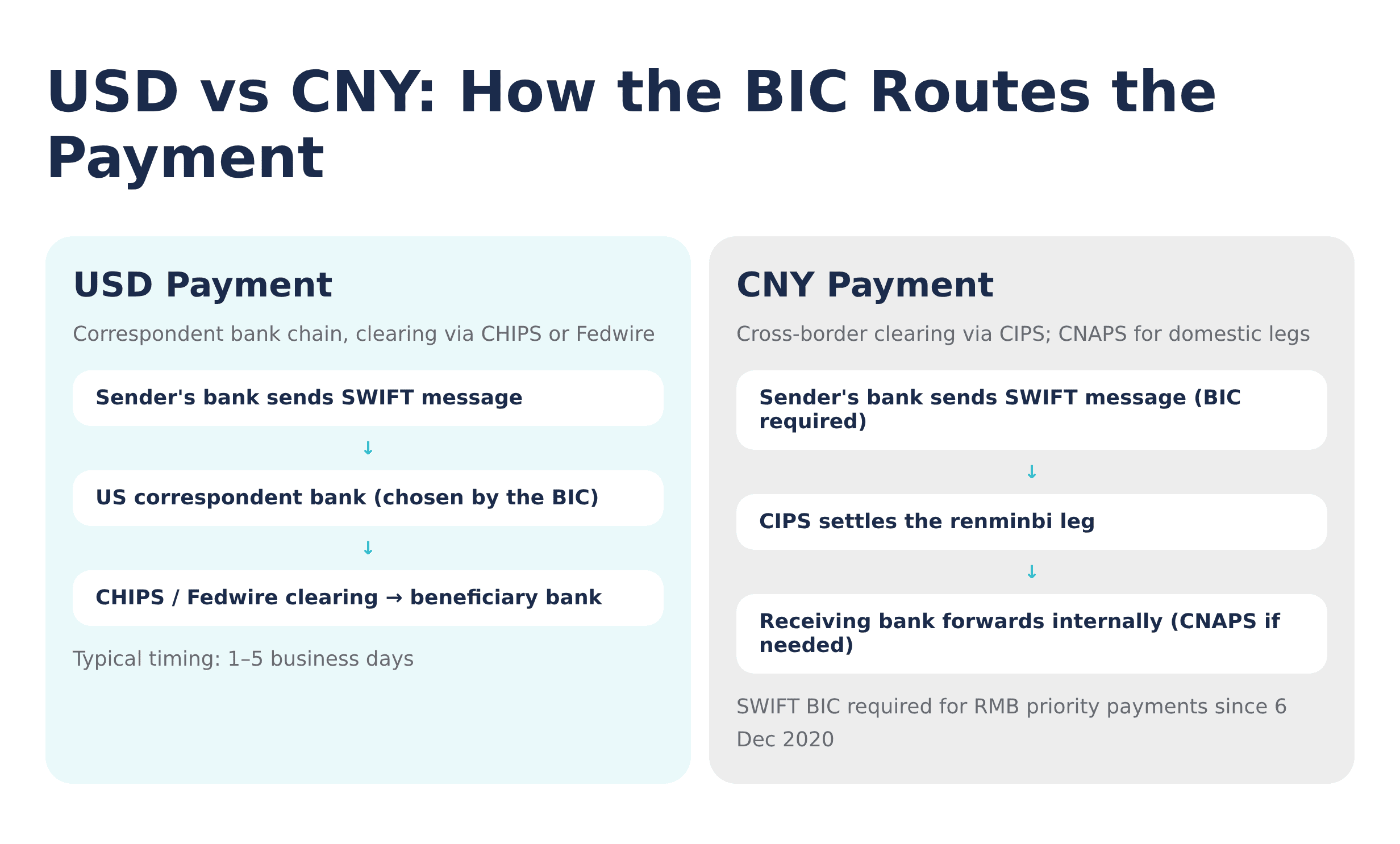
For USD payments, the SWIFT code determines which correspondent bank chain the transfer follows on its way to the beneficiary. A dollar payment from London to Chicago rarely moves in one hop. It passes through at least one US correspondent that holds accounts for both sides.
The economics follow the route. Each correspondent in the chain may deduct a handling fee, which is why an invoice for $10,000 sometimes settles at $9,955. Timing follows the same logic: SWIFT transfers typically take 1–5 business days, depending on how many institutions sit between sender and receiver and when each one's cut-off falls.
Cut-off times deserve more attention than they get. A USD instruction submitted at 16:30 London time has usually missed the same-day window at the US correspondent, so settlement slips a full day before the first intermediary even reads the message. Finance teams that batch supplier payments in the morning routinely gain a day of settlement speed without changing anything else.
Message formats are shifting underneath this process as well. The industry completed its move from legacy SWIFT MT messages to ISO 20022 (SWIFT MX) for cross-border payments in November 2025, and the new format carries richer structured data about the parties. Cleaner beneficiary data reduces manual repair at intermediary banks, yet it makes a valid, current BIC more important: structured messages fail validation faster when the identifier is stale.
Correspondent Banks, CHIPS and Fedwire
Two systems clear nearly all USD interbank value. CHIPS, operated by The Clearing House, nets large-value payments between major banks and settles around $1.8 trillion per day. Fedwire, run by the Federal Reserve, settles payment-by-payment in real time.
The BIC entered at payment creation decides which correspondent receives the SWIFT message, and that correspondent's memberships decide whether the dollar leg clears over CHIPS or Fedwire. A finance team never touches these systems directly, yet the code it types picks the path.
Correspondent relationships are also thinning. The Bank for International Settlements has documented a sustained decline in active correspondent banking channels, which concentrates USD routing through fewer intermediaries and raises the cost of every inaccurate bank identifier.
[aa fast-fact]
Fast Fact: CHIPS, the largest private-sector USD clearing system, settles around $1.8 trillion in payments every day, according to The Clearing House.
[/aa]
How BIC Routing Works for CNY Payments
CNY payments to mainland China route through CIPS, the Cross-border Interbank Payment System, which connects foreign banks to China's domestic clearing infrastructure. The SWIFT message still carries the instruction; CIPS handles the renminbi settlement leg.
Since 6 December 2020, RMB priority payments to mainland China have required a SWIFT BIC as the routing identifier. Before that date, many banks asked for a CNAPS code instead, the 12-digit identifier used inside China's domestic system.
In practice, an importer paying a Shenzhen supplier today provides the supplier bank's BIC and the account details. The supplier's bank may still ask for its own CNAPS code on domestic legs, which is why invoices from Chinese suppliers often list both. Businesses sending CNY from a business account outside China avoid most of this friction when the provider validates the identifiers at entry.
CIPS, CNAPS and When Both Codes Are Needed
CNAPS serves domestic clearing; CIPS serves cross-border clearing. A payment originating outside China needs the SWIFT BIC to reach the right institution. The CNAPS code becomes relevant when the receiving bank forwards funds internally to a specific branch.
The safest approach for a foreign payer: always collect the BIC, and record the CNAPS code whenever the supplier provides one. A supplier relationship survives a one-day payment delay. It survives far fewer disputes about where $40,000 went.
Neighbouring corridors carry their own quirks. AED payments to the UAE pair the BIC with a mandatory IBAN, while companies settling invoices in Hong Kong dollars pair it with a local bank and branch code. The identifier logic stays constant across all four currencies; the companion detail changes.
What Happens When the SWIFT Code Is Wrong
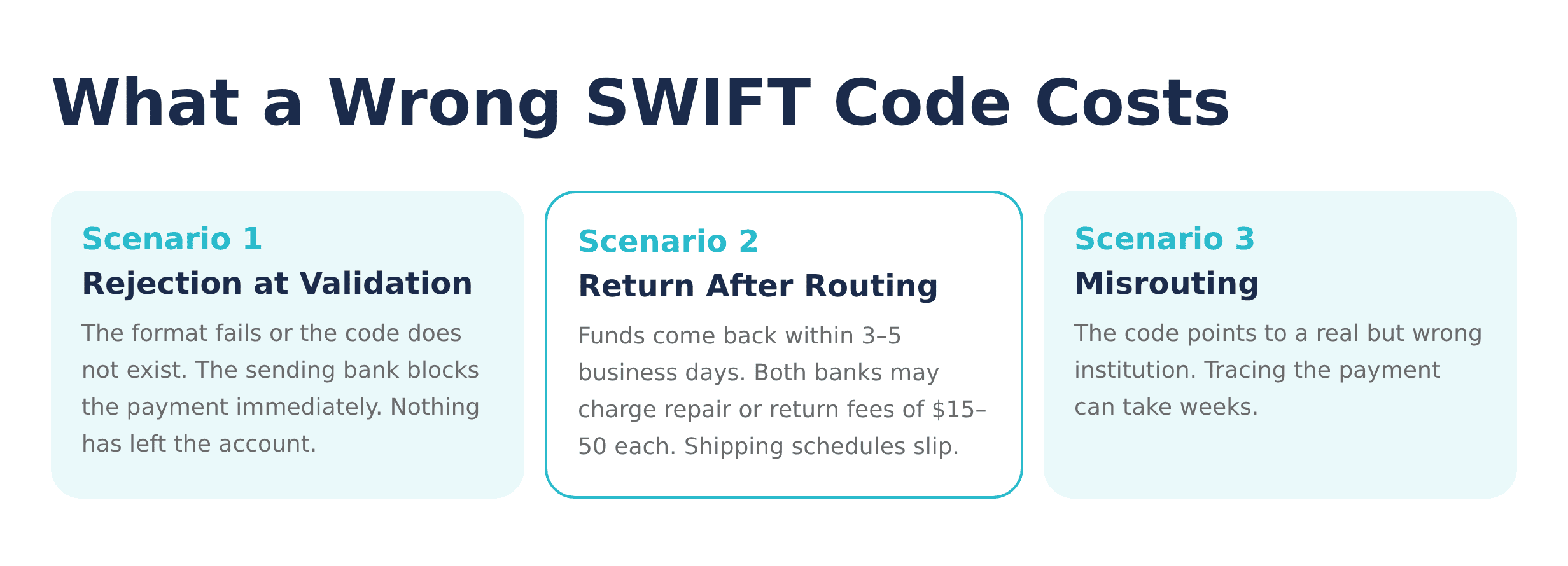
An incorrect SWIFT code typically causes the payment to be rejected and returned, with repair fees deducted before the funds reappear. Three scenarios cover almost every case:
Rejection at validation. The format fails or the code does not exist, and the sending bank blocks the payment immediately. Cheapest outcome: nothing has left.
Return after routing. The code exists but does not match the beneficiary details. The receiving bank returns the funds within 3–5 business days, and both banks may charge repair or return fees of $15–50 each.
Misrouting. The code points to a real, wrong institution. Funds arrive somewhere with no matching account, and tracing the payment can take weeks.
For an importer, the second scenario hurts the most. A returned supplier payment restarts the settlement clock, and production or shipping schedules slip with it. What this means in practice: two minutes to verify SWIFT code details before payment costs less than any of the three outcomes above.
The pattern repeats across corridors, which is why guides on structuring cross-border payment operations treat beneficiary-detail verification as a standing control rather than a one-off check.
[aa cta]
Send USD and CNY Payments With Verified Bank Details
EQWIRE business accounts support 66 currencies, with payment details validated at entry so mistyped codes are caught before the transfer leaves.
[aa btn]Open Business Account[/aa]
[/aa]
FAQ
Is a SWIFT code the same as a BIC code?
Yes. A SWIFT code and a BIC (Business Identifier Code) are two names for the same identifier, standardised under ISO 9362. SWIFT acts as the official registration authority, which is why its name attached to the code in everyday use. The identifier runs 8 or 11 characters: four for the bank, two for the country, two for the location and an optional three for the branch. Banks and payment providers treat the two terms as fully interchangeable.
How do businesses find the SWIFT BIC code for a USD or CNY payment?
The most reliable way to find a SWIFT BIC code is to take it from the beneficiary's invoice or official bank details letter, then confirm it with the beneficiary's bank. An independent directory or checker serves as the second source. For USD payments, the code pairs with the account number and, on domestic legs, an ABA routing number. For CNY payments to mainland China, the BIC is the required routing identifier, and the supplier may additionally provide a CNAPS code for domestic forwarding. When two independent sources disagree, the payment should wait until the beneficiary confirms in writing.
Do CNY payments to China need a CNAPS code as well as a SWIFT code?
Cross-border CNY payments require a SWIFT BIC, and RMB priority payments have required one since 6 December 2020. The CNAPS code, a 12-digit identifier used in China's domestic clearing system, is not the routing identifier for payments originating abroad. Receiving banks sometimes still request it to forward funds internally to a specific branch, so suppliers often list both codes on invoices. Collecting both and entering the BIC as the primary identifier covers every common case.
What happens if an 8-character SWIFT code is used instead of 11?
An 8-character code routes the payment to the bank's head office rather than a specific branch. For many banks this works, because international payments centralise at the head office and forward internally. For banks that require branch-level routing, the payment can stall in internal queues or return to the sender with fees deducted. When a platform demands 11 characters, adding "XXX" preserves head-office routing. The safer habit is to use the exact code the beneficiary provides, at the length they provide it.
Which SWIFT/BIC code lookup tool should businesses use for USD, CNY, AED or HKD international payments?
No single tool is sufficient on its own. A SWIFT/BIC code lookup tool for businesses sending USD, CNY, AED or HKD international payments should be treated as a format check and second source, because public directories can lag behind bank mergers and code retirements. The strongest verification stack combines the beneficiary's own bank documents with confirmation from the receiving bank, backed by a payment platform that validates codes at entry. For AED payments the BIC pairs with a mandatory IBAN, and for HKD payments with a bank and branch code, so the lookup habit extends beyond the BIC itself.
Accurate bank identifiers decide whether an international payment settles on schedule or spends a week in return queues. The mechanics are learnable: a single standard with a fixed structure, plus a two-source verification habit, covers the vast majority of USD and CNY transfers. Businesses that run a SWIFT code lookup as a standing step in payment preparation, rather than an afterthought, rarely see repair fees at all. Importers paying suppliers in USD and CNY can go further by consolidating currencies in one account. The EQWIRE currency network covers 66 currencies with published cut-off times and T+0 to T+2 settlement, and account holders can start at https://client.eqwire.com/sign-up.
Reviewed by

Related Articles

Named IBAN for UK B2B Invoice Collections: Practical Operating Guide

UK Business Account for an Industrial Exporter Managing Deposits, Refunds and Final Invoices

Importing from China: How to Hold CNY and Pay Chinese Suppliers Directly

Multi-Currency Account for Hong Kong Trade: Hold HKD, USD and CNY Together

Power your payments
with EQWIRE
Create your account in minutes and experience smooth, secure global payments.
" height="9.0156px" id="LIcbdboyB" transform="translate(4.987 4.5)" width="9.01562px"/></svg>)