•
•

Articles
Personal MUR Account for Expats in Mauritius: Hold Rupees Without a Local Account
[aa disclaimer]
Legal Disclaimer: This article is for informational purposes only and does not constitute legal, financial, compliance, or tax advice. Banking eligibility, regulatory requirements, and provider policies vary by jurisdiction. Consult qualified professionals before making decisions.
[/aa]
Three expats arrive in Mauritius in the same month. One holds an Occupation Permit and a signed lease. One works remotely for a London employer on a Premium Visa. One has retired on a foreign pension. All three are quoted rent in Mauritian rupees, all three receive income in pounds or euros, and all three are asked by a local bank for a utility bill they cannot obtain until they already have an account.
A personal MUR account through a UK EMI resolves that circular requirement for an expat in Mauritius. An electronic money institution authorised by the Financial Conduct Authority can receive and hold rupees alongside GBP, EUR and USD in a single account, then send them onward, without a Mauritius address proof and without a minimum deposit.
This article compares the three routes on cost and on which permit status each one fits.
[aa key-takeaways]
Key Takeaways
Three routes exist for holding rupees as a foreigner: a local resident account, a local non-resident account, and a personal rupee account with a UK electronic money institution.
Local resident accounts cost the least to run but stay locked behind a residence permit, a Mauritius address proof and a bank reference letter that takes two to three weeks to obtain.
Local non-resident accounts typically require a minimum balance from USD 100,000 and take one to six weeks depending on whether an applicant visits in person or uses a management company.
A UK EMI opens in three to five business days with no minimum deposit. Rupee payments settle on a T+1 value date with a 09:00 UK cut-off.
Cash, ATM withdrawals and instant domestic transfers over MauCAS still require a local bank, which makes a hybrid setup the practical answer for most residents.
[aa btn]Book a Call[/aa]
[/aa]
Three Ways to Hold Rupees as an Expat in Mauritius
A Mauritian rupee account for foreigners comes in three forms, and each carries a different eligibility gate. Two sit inside the domestic banking system supervised by the Bank of Mauritius. The third sits outside it, under UK electronic money regulation. The gate matters more than the pricing, because two of the three routes stay closed during an expat's first weeks in the country.
Route 1: A Local Resident Account
A local resident account requires proof that the applicant already lives in Mauritius. Banks ask for a valid Occupation Permit, Residence Permit or Retirement Permit, and accept an Economic Development Board approval letter where the permit is still pending.
They also ask for a Mauritius address proof. That means a Central Electricity Board or Central Water Authority bill dated within the last three months, or a signed lease accompanied by a copy of the landlord's identity document.
Most banks add an employment contract or an employer salary letter, six months of home-country statements, and a reference letter from an existing bank. That last document is the slow one, and applicants report two to three weeks to obtain it.
Minimum balances stay low once the file is complete. MCB requires no minimum from residents, and most other banks sit between Rs 1,000 and Rs 5,000. Processing runs one to five business days, and the Bank of Mauritius guideline points to completion within a week.
Route 2: A Local Non-Resident Account
A local non-resident account removes the permit requirement and replaces it with capital. Banks request a certified passport copy, a home-country address proof issued within three months, a curriculum vitae, source-of-funds documentation, and a mandatory bank reference letter.
Approval usually depends on either a physical visit to Mauritius or an introduction from a management company registered with the Financial Services Commission.
The minimum balance is the real barrier. Standard applicants face USD 100,000. Higher-risk profiles face USD 1,000,000. Timelines stretch to one to three weeks for in-person applications and two to six weeks through a management company.
AfrAsia serves this segment most actively and offers the widest currency range. Absa suits applicants with Southern African banking history.
Route 3: A Personal MUR Account with a UK EMI
A personal account with an FCA-authorised electronic money institution requires identity documents and evidence of income, and nothing tied to a Mauritius address. Onboarding runs three to five business days, with compliance review taking two to three of those days. No minimum deposit applies.
Rupees sit in the same account as pounds, euros and dollars. Conversion happens on demand inside that account rather than through a second institution.
The trade-off appears later in this comparison. This route reaches Mauritius over SWIFT, which excludes cash handling and instant domestic settlement.
Side-by-Side: Requirements, Timelines and Minimums
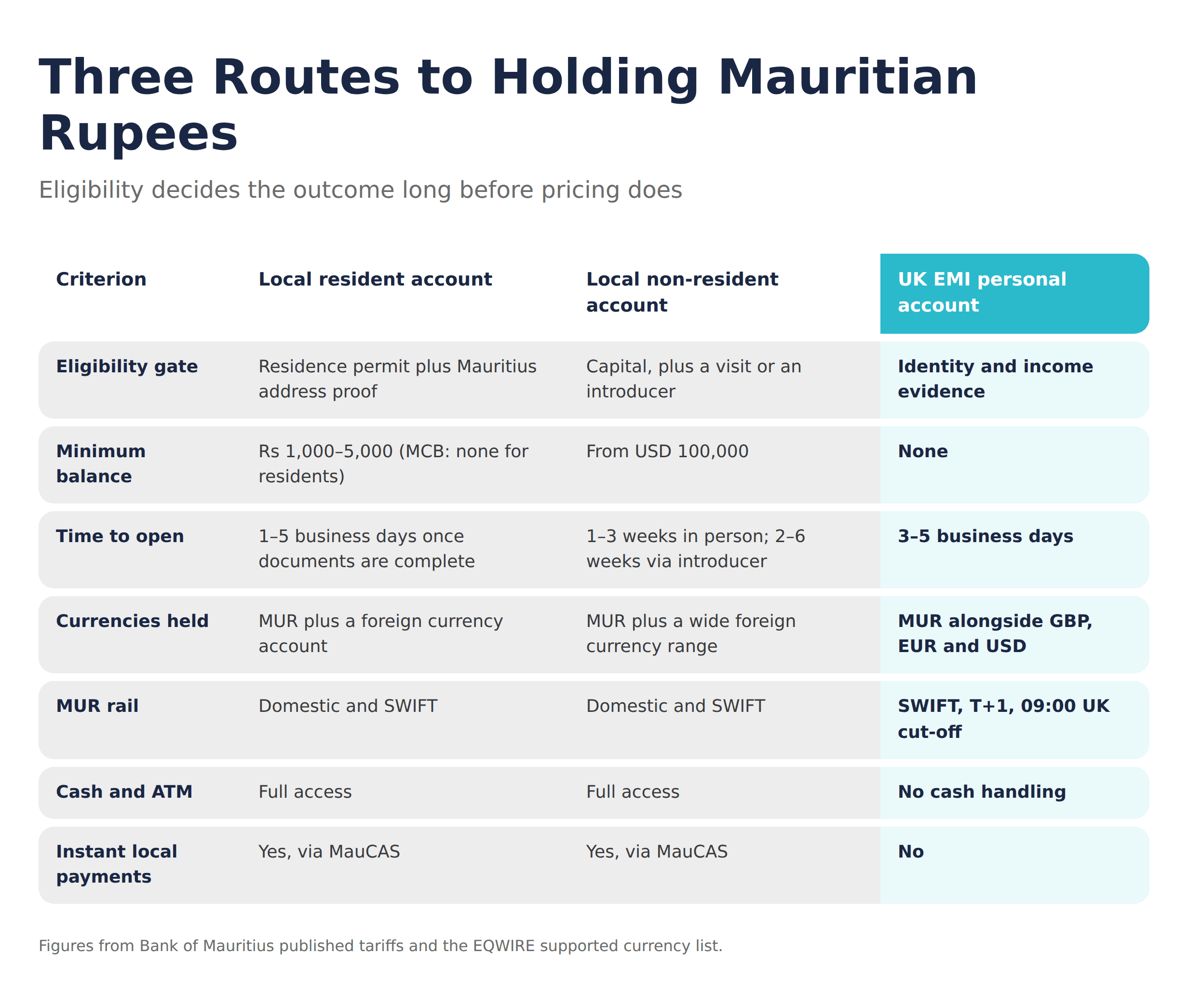
Unlike a local resident account, which stays gated behind a Mauritius address proof, a personal MUR account through a UK EMI opens on the strength of identity and income evidence alone. That single difference explains why an expat in Mauritius can hold rupees within a week of landing while a domestic application is still waiting on a reference letter.
The table below compares the three routes on the criteria that decide the outcome. Anyone opening a bank account in Mauritius as a foreigner should read the eligibility row first, because it determines which columns remain available at all.
Criterion | Local resident account | Local non-resident account | UK EMI personal account |
|---|---|---|---|
Eligibility gate | Residence permit + Mauritius address | Capital + physical visit or introducer | Identity and income evidence |
Documents required | Permit, utility bill or lease, salary letter, bank reference | Certified passport, CV, source of funds, bank reference | Identity, proof of income, source of funds |
Minimum balance | Rs 1,000–5,000 (MCB: none) | From USD 100,000 | None |
Time to open | 1–5 business days after documents complete | 1–3 weeks in person; 2–6 weeks via introducer | 3–5 business days |
Currencies held | MUR plus a foreign currency account | MUR plus wide foreign currency range | MUR alongside GBP, EUR, USD and others |
MUR inbound rail | Domestic and SWIFT | Domestic and SWIFT | SWIFT |
MUR outbound rail | Domestic, MauCAS, SWIFT | Domestic, MauCAS, SWIFT | SWIFT |
Cut-off and value date | Bank-specific | Bank-specific | 09:00 UK, T+1 value date |
Instant domestic payments | Yes, via MauCAS | Yes, via MauCAS | No |
Cash and ATM | Full access | Full access | No cash handling |
Funds protection | Deposit, FSCS not applicable | Deposit, FSCS not applicable | Safeguarded e-money, conditional FSCS look-through |
Rupee timings come from the supported currency list, which places MUR on a T+1 value date behind a 09:00 UK cut-off. That cut-off is the earliest of the 66 currencies listed. A rupee payment instructed at 09:30 London time takes the following value date, which matters when rent falls due on the first of the month.
[aa fast-fact]
Fast Fact: Standard non-resident applicants at Mauritius banks face a minimum balance of USD 100,000, rising to USD 1,000,000 for higher-risk profiles. A UK electronic money institution requires no minimum deposit.
[/aa]
Where a UK EMI Wins — and Where a Local Bank Still Does
The honest answer runs in both directions. A UK electronic money institution removes the documentation blocker and the minimum balance. It does not replace a domestic bank for physical cash or for instant local settlement. Residents who understand that boundary avoid the most common disappointment.
Cash, ATM Access and Domestic Instant Payments
MauCAS is the Bank of Mauritius national payment switch, and it carries instant domestic rupee transfers between local accounts. A UK EMI reaches Mauritius over SWIFT rather than over MauCAS, so instant transfers to a landlord or a garage remain outside its scope.
Cash sits in the same category. Mauritius still runs heavily on notes for small merchants and many everyday services, which is why long-term residents describe layering two providers rather than relying on one.
What this means in practice: an expat paying a car lease and drawing cash weekly needs a domestic account eventually. One receiving a London salary and paying rent by transfer does not need it on day one.
Multi-Currency Holding and the Real Cost of Conversion
Holding MUR and GBP in one account removes the second institution from the chain. Income arrives in its original currency, sits there, and converts when the holder chooses rather than on every receipt.
The legal position deserves precision, because e-money differs from a deposit. An electronic money institution is not a bank. Client funds sit safeguarded in segregated accounts at a credit institution under the Electronic Money Regulations 2011 rather than held as deposits.
Under the Prudential Regulation Authority's depositor protection rules, the Financial Services Compensation Scheme can look through to the end customers of an FCA-authorised EMI where the bank holding those safeguarded funds fails, up to the FSCS deposit limit. That limit rose to £120,000 on 1 December 2025. The protection does not extend to the failure of the EMI itself, nor to funds safeguarded through the investment, insurance or guarantee methods.
The fuller treatment sits in how an FCA-authorised EMI differs from a bank.
[aa cta]
Hold rupees and salary currency in one account
A personal multi-currency account opens in three to five business days, with no Mauritius address proof and no minimum deposit.
[aa btn]Create Account[/aa]
[/aa]
Choosing by Situation
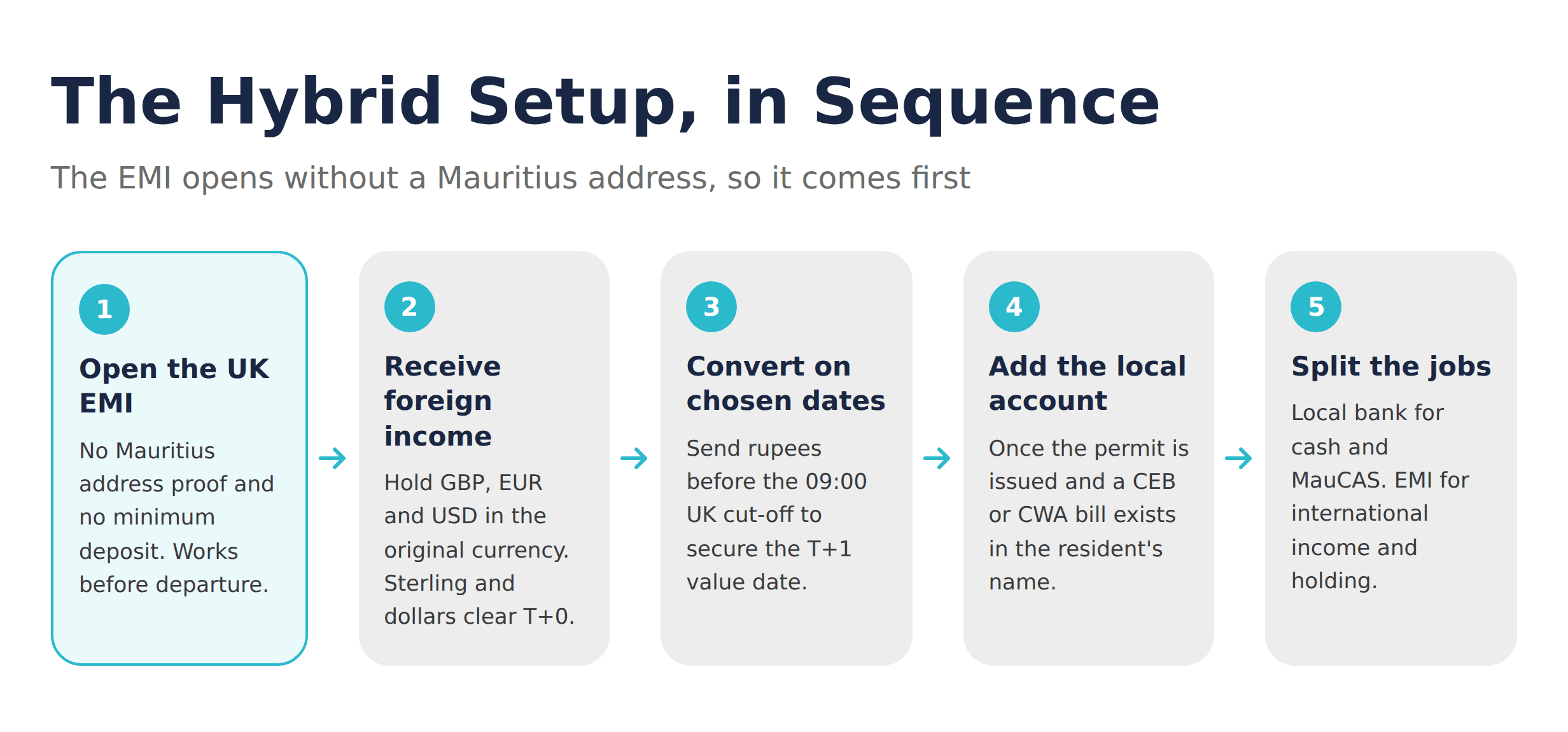
Permit status changes the recommendation. Four profiles cover most arrivals, and each one points to a different starting account.
Remote Worker Paid in GBP or EUR on a Premium Visa
A remote worker on a Premium Visa should start with a UK EMI, because the Premium Visa carries no local employment and therefore no local salary or employer letter. Expats living in Mauritius: how to hold MUR alongside GBP or EUR in one account is the question this profile asks first, and the answer sits in a multi-currency structure rather than a domestic application.
A personal rupee account for expats on a Premium Visa also sidesteps the address-proof loop entirely during the first months, when no utility bill exists in the holder's name.
Occupation Permit Holder on a Local Mauritius Salary
An Occupation Permit holder earning locally should treat a domestic resident account as the primary, because a local salary and daily card spending both settle in rupees through domestic rails.
The EMI becomes the secondary account, useful for foreign income and for school fees billed in sterling or euros.
Retiree on a Retired Non-Citizen Permit Drawing a Foreign Pension
A retiree should prioritise conversion control, because the pension arrives monthly in one currency and the cost of living falls entirely in another. Twelve conversions a year at a domestic bank spread compounds quickly against a fixed income.
Holding the pension in its original currency and converting on chosen dates gives a retiree the ability to hold MUR without a Mauritius bank account during the permit application period.
Non-Resident Property Buyer Settling in MUR
A property buyer should open the EMI first, because purchases settle in rupees while the buyer holds no permit and cannot meet the USD 100,000 non-resident minimum. One large inbound conversion replaces a recurring one, so pricing on that single transaction outweighs monthly fees.
The Cost of Getting It Wrong: Conversion Spreads and Double Fees
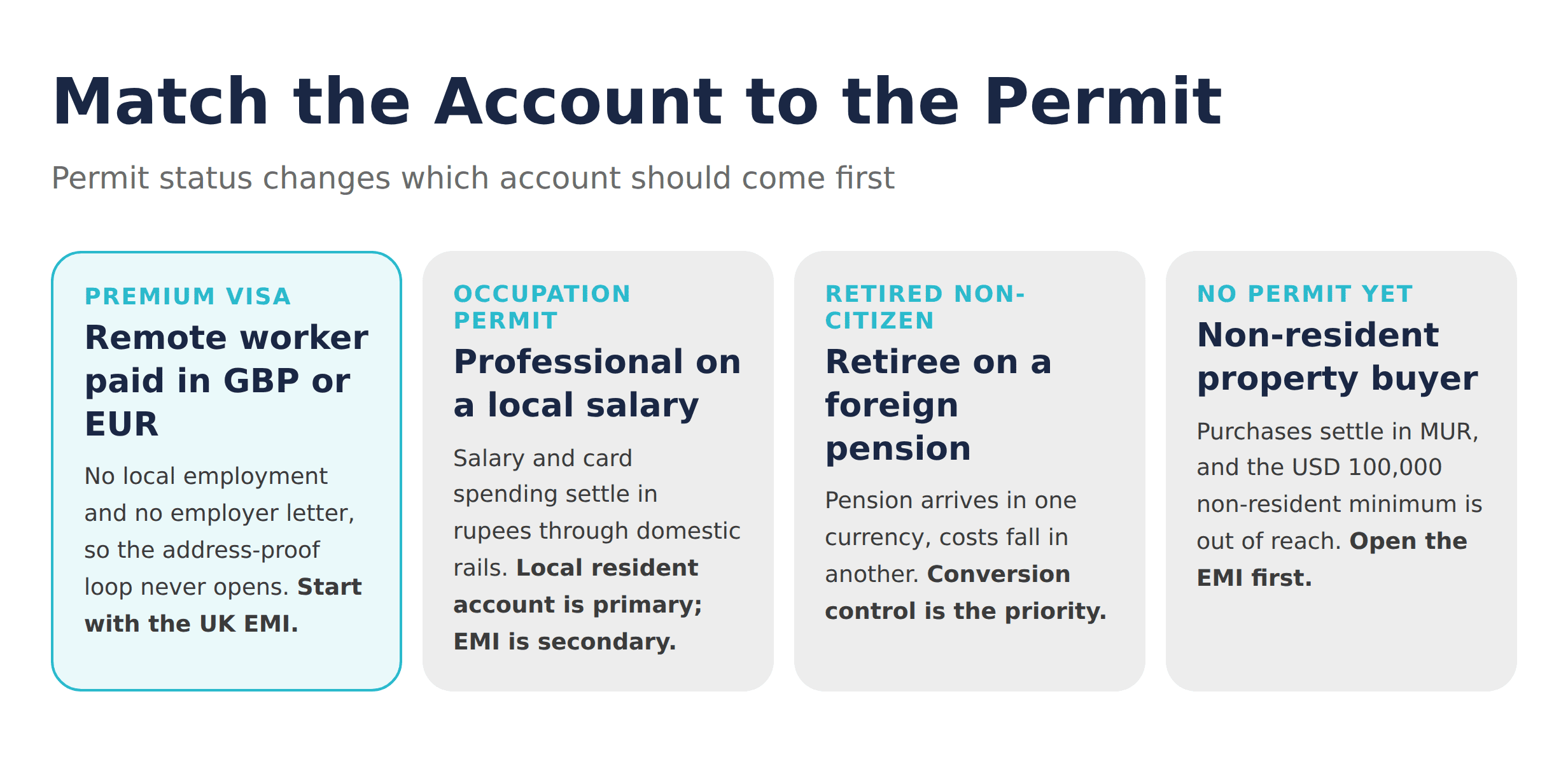
Foreign currency conversion at Mauritius banks carries a spread of roughly 1.5% to 3% against the interbank rate, and that spread applies every time money crosses currencies. Per-transfer charges sit on top. Published bank tariffs show outbound SWIFT charges of Rs 350 to Rs 1,200, correspondent bank deductions of USD 15 to USD 35, and inbound SWIFT charges of Rs 100 to Rs 300.
Consider an illustrative case. A resident earning GBP 4,000 monthly moves that salary to Mauritius by SWIFT and converts it on arrival. Each month the chain applies one inbound charge plus one conversion spread, with correspondent deductions in the middle. Repeated twelve times, the spread alone on GBP 48,000 sits between GBP 720 and GBP 1,440 before a single fixed fee counts.
Where the money actually goes: the visible transfer fee is the smaller number. The spread is larger, and it hides inside the exchange rate rather than appearing on a statement.
A second trap catches holders of local foreign currency accounts. Those accounts handle transfers only, and cash deposits face a cap at the Rs 500,000 equivalent, so they solve the holding problem without solving access. Employers running the same arithmetic across a distributed team handle cross-currency payroll from a single account for the same reason.
Running Both: A Practical Hybrid Setup
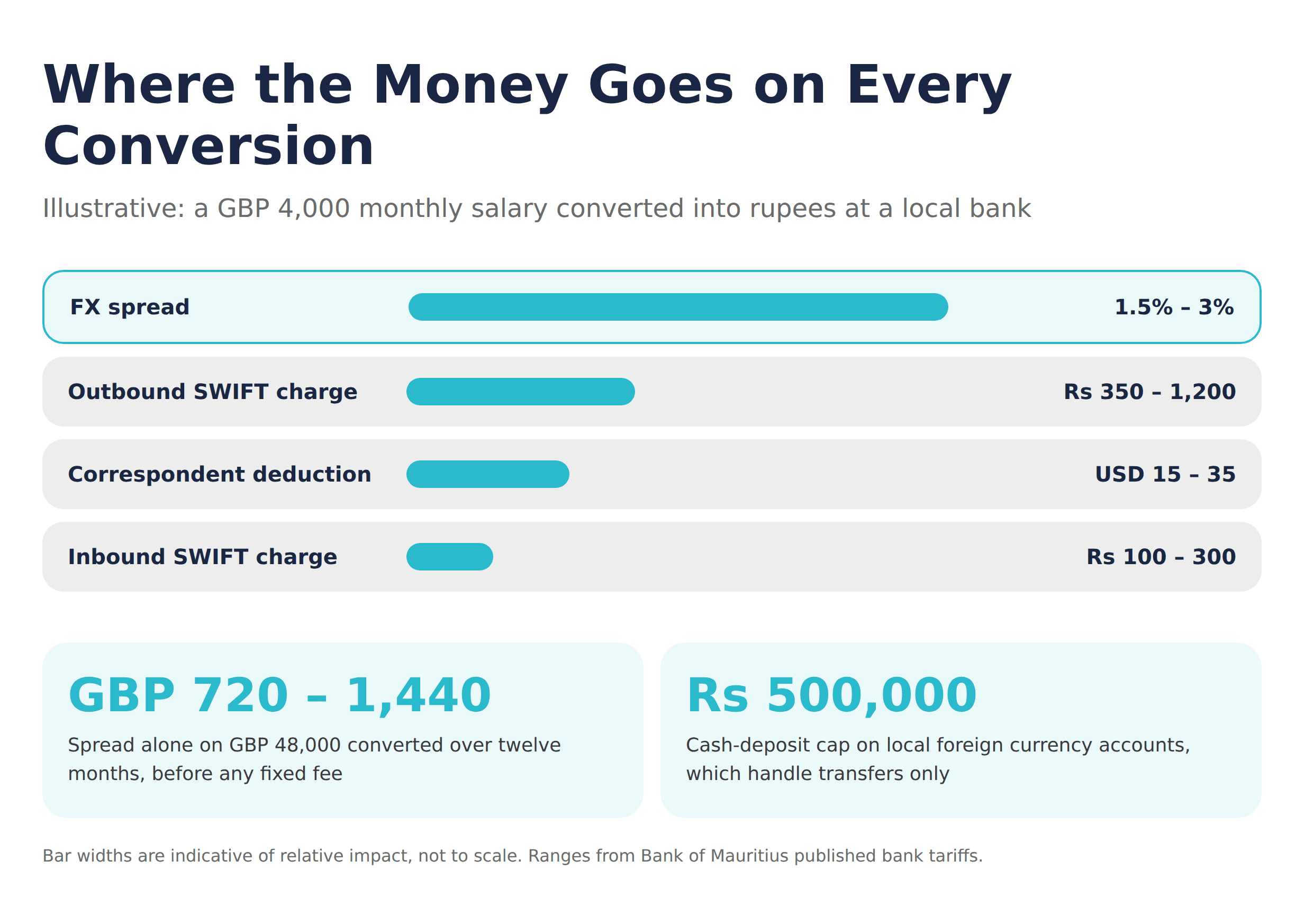
Most long-term residents end up with two accounts. The sequence matters more than the choice, because one route opens immediately and the other does not.
Open the UK EMI first. It requires no Mauritius address proof, so it works from the moment a resident lands or even before departure.
Route foreign income into that account and hold it in its original currency. GBP and USD carry a T+0 value date, so salary clears the same day.
Convert to rupees on chosen dates rather than automatically, and send rupees outward before the 09:00 UK cut-off to secure the T+1 value date.
Apply for the domestic resident account once the permit is issued and a Central Water Authority or Central Electricity Board bill exists in the resident's name.
Use the local account for cash withdrawals and MauCAS transfers. Keep the EMI for international income and multi-currency holding.
The same structure that lets a user hold GBP, EUR and USD in one place extends to rupee balances, which makes the two-account setup workable rather than duplicative. Buyers managing rental income across jurisdictions face a comparable currency-matching problem in property management.
What to Check Before You Commit
Seven checks separate a provider that fits from one that creates work later, each verifiable before applying.
Regulatory status. Confirm the firm reference number on the FCA Financial Services Register. EQWIRE UK Limited is authorised as an electronic money institution under firm reference number 901100.
Funds protection. Establish which safeguarding method the provider uses, because the FSCS look-through applies to segregated bank accounts and not to the investment, insurance or guarantee methods.
Rails that actually reach MUR. Ask whether rupee payments run over SWIFT or over domestic infrastructure, and get the cut-off time in writing.
Conversion pricing. Request the spread applied to MUR pairs, not the headline rate. The indicative rates published by the Bank of Mauritius give a domestic benchmark to compare against.
Documentation the provider will request. Permit status and source-of-funds evidence vary by provider risk appetite.
Individual eligibility. Many providers serve companies only. Confirm that personal accounts are available before starting.
Tax record-keeping. Mauritius tax residency rules depend on days present and income source. Keep statements exportable, and consult a qualified adviser on residency and reporting.
Requirements differ for a company, where a MUR account for an offshore entity follows a separate document path. The Economic Development Board remains the authority on permit criteria.
[aa cta]
One account for rupees, pounds and euros
FCA-authorised, no minimum deposit, live in three to five business days.
[aa btn]Get started[/aa]
[/aa]
Running a business rather than holding funds personally? See our guide to converting MUR for business use.
FAQ
How can an expat hold MUR without a Mauritius bank account?
An expat can hold rupees through a personal account with an electronic money institution authorised by the Financial Conduct Authority in the United Kingdom. Learning how to hold MUR without a Mauritius bank account comes down to eligibility: the EMI route asks for identity documents plus evidence of income and source of funds, and requires no Mauritius address proof or residence permit. Onboarding takes three to five business days with no minimum deposit. Rupees arrive and leave over SWIFT on a T+1 value date, and sit in the same account as pounds, euros and dollars for conversion on demand.
Can someone on a Premium Visa open a personal rupee account before getting a Mauritius address?
Yes. A personal rupee account for expats on a Premium Visa does not depend on a Mauritius address, because an FCA-authorised electronic money institution verifies identity and income rather than local residency. Premium Visa holders work for a foreign employer and hold no local salary or employer letter, which is exactly what a domestic bank asks for. Holders can therefore open the account before arrival, well ahead of any Central Electricity Board bill appearing in their name.
Is a UK EMI account for Mauritius residents legal, and is the money protected?
A UK EMI account for Mauritius residents is legal, and protection works differently from a bank deposit. An electronic money institution operates under the Electronic Money Regulations 2011 and safeguards client funds in segregated accounts at a credit institution rather than holding them as deposits. Under the Prudential Regulation Authority's depositor protection rules, the Financial Services Compensation Scheme can look through to end customers where the bank holding safeguarded funds fails, up to the FSCS deposit limit of £120,000 since 1 December 2025. That cover does not apply if the EMI itself fails, nor to funds safeguarded through investment, insurance or guarantee methods. Regulatory status is verifiable on the FCA Financial Services Register.
How long does MUR take to arrive in a UK EMI account, and which rail is used?
Mauritian rupee payments settle on a T+1 value date and travel over SWIFT rather than through domestic Mauritius infrastructure. The cut-off is 09:00 UK time, the earliest of the 66 currencies on the supported list, so instructions given after that hour take the next value date. Practical consequence: a rupee payment needed on the first of the month should be instructed at least two business days ahead. Sterling and dollar receipts carry a T+0 value date, so foreign salary clears faster than the onward rupee leg.
Does a personal MUR account replace a local bank account entirely?
No. A UK electronic money institution covers international income and multi-currency holding, with rupee transfers over SWIFT. It does not handle physical cash or instant domestic transfers over MauCAS, the Bank of Mauritius national payment switch. Anyone opening a bank account in Mauritius as a foreigner should treat the two as complementary rather than competing. The workable sequence starts with the EMI, which needs no local address, and adds a domestic resident account once the permit and a utility bill exist.
Rupee exposure is a currency-matching problem before it is a banking problem. Income in sterling or euros against costs in rupees produces a conversion event every month, and the route chosen determines whether that event costs a documented spread or an opaque one. A local resident account stays the cheapest home for cash and MauCAS payments, and a non-resident account suits capital above USD 100,000. For everyone in between, a personal MUR account through a UK EMI as an expat in Mauritius opens without a local address, holds rupees beside the currency of income, and settles on a published T+1 value date. EQWIRE's multi-currency accounts support MUR alongside GBP, EUR and USD under FCA authorisation, and an application takes a few minutes to start.
Reviewed by
Related Articles


Power your payments
with EQWIRE
Create your account in minutes and experience smooth, secure global payments.
" height="9.0156px" id="LIcbdboyB" transform="translate(4.987 4.5)" width="9.01562px"/></svg>)