
•
•

Articles
Multi-Currency Account for Dubai Businesses: Hold AED, GBP and EUR Together
[aa disclaimer]
Legal Disclaimer: This article is for informational purposes only and does not constitute legal, financial, compliance, or tax advice. Banking eligibility, regulatory requirements, and provider policies vary by jurisdiction. Consult qualified professionals before making decisions.
[/aa]
A Dubai trading company often bills UK clients in pounds while paying European suppliers in euros. Local salaries and rent still leave in dirhams. Running those flows through a single-currency bank account means every incoming payment converts at the bank's rate, and 2–3% of each transfer disappears into the FX spread. The cost of cross-border payments remains high enough that the G20 runs a dedicated programme to bring it down.
A multi-currency account for Dubai businesses holding AED, GBP and EUR removes that forced conversion. Each currency sits as a separate balance under one account, and funds convert only when the finance team chooses. This guide starts with the documents a UAE-incorporated company needs and ends with the errors that stall approvals. Along the way, it sets realistic timelines and explains how a UK-regulated electronic money institution (EMI) can provide all three balances remotely, with no UK office required.
[aa key-takeaways]
Key Takeaways
A Dubai company can open one account holding AED, GBP and EUR remotely; no UK entity or office is needed.
The standard document pack: valid trade licence, incorporation documents, proof of registered address, and passports for all UBOs.
UK EMI onboarding usually takes 5–15 business days; traditional banks often need several weeks.
GBP balances come with a UK sort code and Faster Payments access, while EUR balances receive a SEPA IBAN.
Most stalled applications trace back to incomplete UBO data, mismatched activity declarations, or missing source-of-funds evidence.
[aa btn]Book a Call[/aa]
[/aa]
What a Dubai Business Needs Before Applying
Before applying for a multi-currency business account, a UAE company needs its corporate paperwork in order. Providers assess non-resident applications on documentation quality first. A complete file moves through compliance review in days; an incomplete one sits in a queue while analysts request clarifications.
The requirements below apply whether the company holds a mainland trade licence issued by the Dubai Department of Economy and Tourism or a free zone licence from DMCC, IFZA, JAFZA or another authority. Free zone incorporation does not block access to a UK-regulated provider. What matters is that the licence is current and the declared activity matches the payment flows the company plans to run.
Why the scrutiny? A UK provider onboarding a UAE company cannot rely on a domestic registry check the way it would for a British applicant. It reconstructs the picture from the documents supplied. Every gap in that file becomes a question, and every question becomes a delay. Finance teams that treat the document pack as the application itself, rather than an attachment to it, get approved faster.
In practice, preparation looks like this: an ops manager at a Dubai electronics importer collects the licence and incorporation set in one afternoon. A bilingual licence extract comes from the free zone authority, and the two shareholders send passport scans with signed UBO forms. The whole pack is ready in under a week.
Document checklist for UAE-incorporated companies
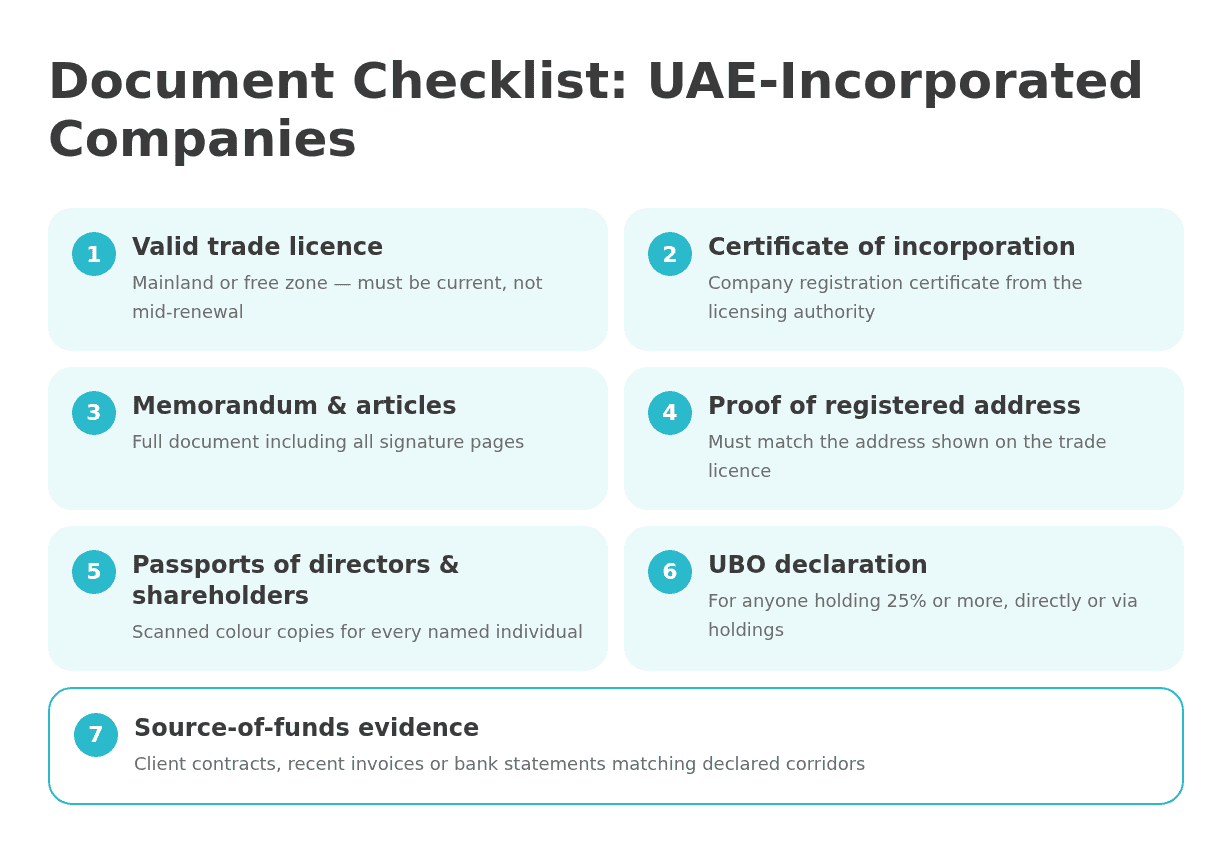
A Dubai business opening a multi-currency business account in the UAE or abroad should prepare:
Valid trade licence (mainland or free zone)
Certificate of incorporation
Memorandum and articles of association
Proof of registered business address
Passports of all directors and shareholders
UBO declaration for anyone holding 25% or more
Source-of-funds evidence, such as client contracts or recent bank statements
Scanned colour copies are standard. Some providers request certified translations when documents are issued only in Arabic, so bilingual licence extracts save time.
UBO and source-of-funds requirements
An ultimate beneficial owner (UBO) is any individual who owns or controls 25% or more of the company, directly or through holding structures. UK EMIs verify the full ownership chain under the Money Laundering Regulations, so nominee arrangements and multi-layer holdings extend review time.
Source-of-funds evidence answers one question: where does the money entering the account come from? Signed client contracts work best. Recent invoices and audited statements also qualify. The evidence should match the corridors declared in the application; a company declaring EUR supplier payments should show EU-related trade documents.
Setting Up a Multi-Currency Account: AED, GBP and EUR Step by Step
Opening the account takes four stages, from application through to activation. Each stage has a defined output, and delays concentrate almost entirely in the compliance review.
Application. The company submits its legal and licence details along with expected monthly volumes and the currencies it needs.
Document verification. The provider checks the corporate file against registry data and flags gaps.
Compliance review. Analysts verify the UBO chain, then weigh the source-of-funds evidence against declared activity and corridors.
Activation. The account opens, and each currency balance receives its own details.
Application and KYC stages
Businesses can open a multi-currency account from Dubai without visiting the provider. Onboarding runs online: directors upload documents through a portal, and identity checks use video verification or certified copies. FCA-authorised EMIs operate under the Payment Services Regulations 2017 and the Electronic Money Regulations 2011, which permit fully remote onboarding when identity verification standards are met.
The application form deserves the same attention as the documents. Declared activity, expected volumes and counterparty countries feed directly into the compliance model that scores the file.
Activating currency balances and receiving details
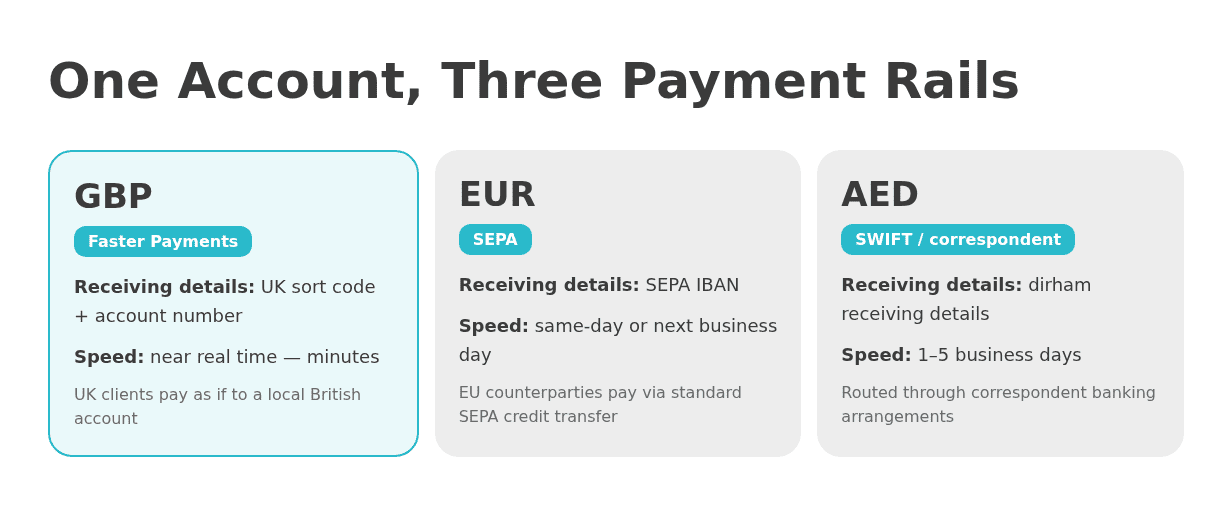
Each currency in the account uses its own settlement rail. The GBP balance receives a UK sort code and account number, so UK clients pay through Faster Payments and funds arrive within minutes. The EUR balance receives a SEPA IBAN; credit transfers under the European Payments Council scheme settle same-day or next business day.
AED settles differently. Dirham payments route through correspondent arrangements via SWIFT, which adds one to five business days depending on the chain. Here is the detail most comparison content misses: a UAE bank sends GBP and EUR through the same SWIFT correspondent process, while a UK EMI gives the company local receiving details in both currencies. Local rails cut both the fee per payment and the settlement wait.
Operational Timeline: From Application to First Payment
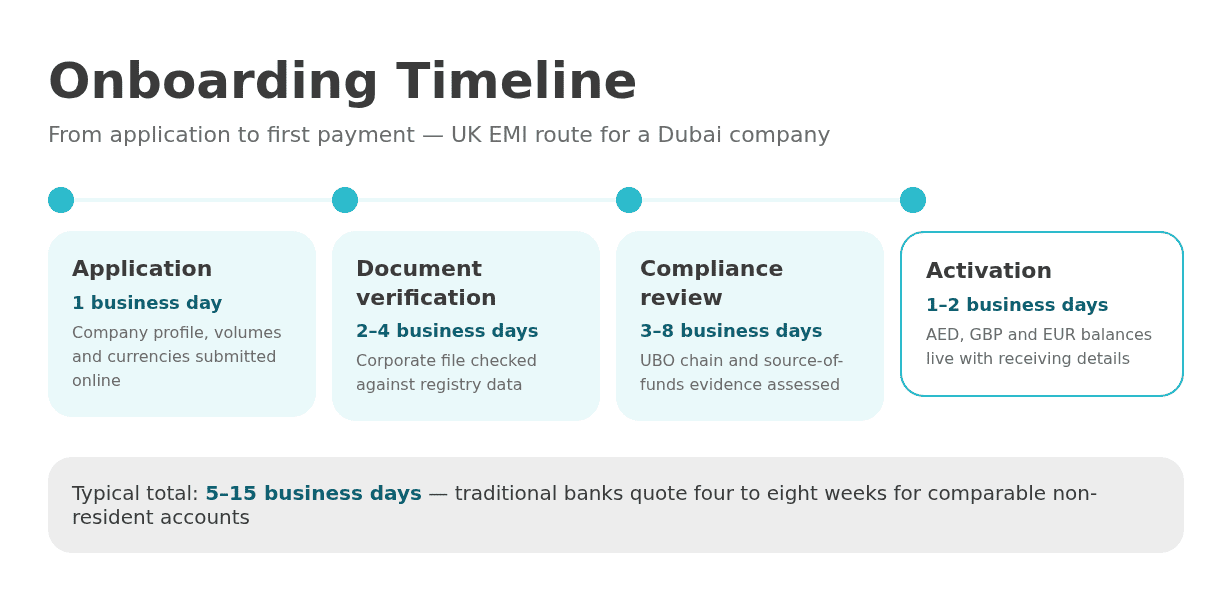
UK EMI onboarding for a UAE-incorporated company usually takes 5–15 business days. Traditional banks quote four to eight weeks for comparable non-resident corporate accounts, and UAE banks often require in-person signatures plus minimum balances starting at AED 50,000.
Stage | Typical duration |
|---|---|
Application submission | 1 business day |
Document verification | 2–4 business days |
Compliance review | 3–8 business days |
Activation and receiving details | 1–2 business days |
The range depends on file quality. A company with two individual shareholders and a clean trade history sits at the fast end. Holding structures with offshore parents add review rounds.
The contrast with local onboarding is sharp. UAE banks build their corporate account process around branch visits and wet signatures, and relationship managers often ask for a business plan on top of the standard file. For a UK regulated account for a UAE company, the entire exchange happens through a portal. Documents upload once, queries arrive by email, and no director boards a plane.
There is useful work to do while the review runs. Finance teams can map which counterparties will pay into which balance and update invoice templates with placeholder fields for the new details. The bookkeeper also needs a brief on how multi-currency ledgers will reconcile against the existing AED accounts.
In practice, the first payment usually lands within a day of activation. A services firm billing a London client can issue a GBP invoice with its new sort code the same week the account opens.
[aa fast-fact]
Fast Fact: SEPA credit transfers settle same-day or next business day under the European Payments Council scheme rules, and UK Faster Payments clear in near real time.
[/aa]
[aa cta]
One Account for AED, GBP and EUR, Opened from Dubai
Receive, hold and convert three currencies under a single UK-regulated relationship, with local GBP and EUR receiving details from day one.
[aa btn]Open Business Account[/aa]
[/aa]
Common Onboarding Errors and How to Avoid Them
The most common reason applications stall is inconsistency between the trade licence and the application data. Compliance teams compare every field, and each mismatch generates a manual query that adds days to the review.
For a Dubai company planning to hold AED, GBP and EUR in one account, the errors below account for most delays.
Documentation mismatches
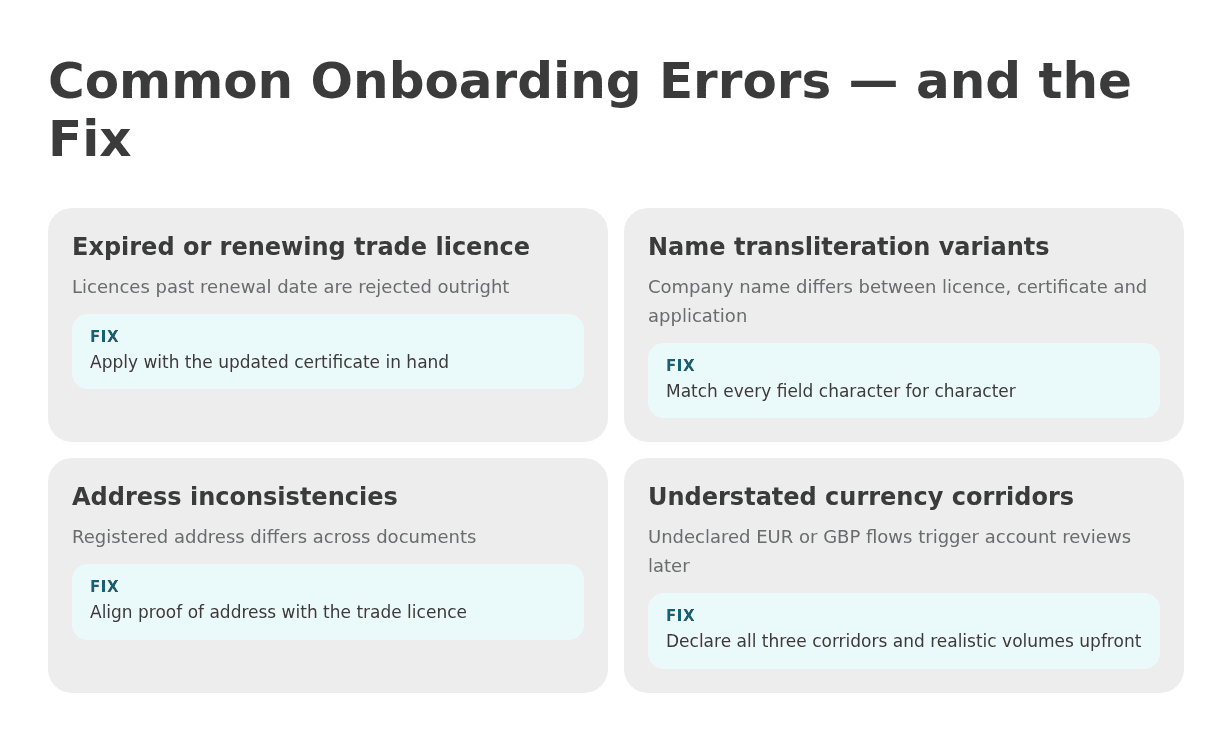
Expired or renewing trade licence. Providers reject licences past their renewal date; applying mid-renewal requires the updated certificate.
Name transliteration variants. The company name on the licence, the incorporation certificate and the application must match character for character.
Address inconsistencies. A registered address that differs between the licence and the proof-of-address document triggers verification queries.
Missing pages. Memorandum extracts without signature pages count as incomplete files.
A pre-submission check against the checklist above removes most of these issues before compliance sees the file.
Activity and jurisdiction declarations
Understating currency corridors is the second major error. A company that declares only UK activity and then receives regular EUR payments from Germany will face a review of its account, and providers may restrict transactions until the file is updated.
The fix is straightforward: declare all three corridors upfront and name the main counterparty countries. Monthly volume estimates should be realistic. Overstating volumes carries no penalty; understating them does. Compliance models read growth against the declared baseline, so a conservative estimate that the business quickly exceeds looks riskier than an honest projection.
Running the Account Day-to-Day: Receiving, Holding, Converting
Unlike an account that converts every incoming payment automatically, a multi-currency structure holds each currency until the business chooses to convert. That single design difference changes the daily economics of an AED GBP EUR account for a Dubai business.
Receiving works on local terms. UK clients pay a sort code through Faster Payments. EU counterparties pay a SEPA IBAN. Dubai customers settle in dirhams. No payer needs to send an international wire, so fewer payments arrive short after correspondent deductions.
E-commerce sellers gain a second benefit. Payment service providers such as Stripe and Adyen can settle directly into the matching currency balance, so a store selling to UK buyers keeps its GBP payouts in pounds instead of watching them convert on arrival.
Holding creates natural hedging. A trading company that receives EUR from European buyers and pays EUR to European suppliers can match those flows inside the balance, converting only the surplus. Consider the arithmetic: on AED 500,000 of monthly EUR-bound payments, a 2.5% bank spread costs AED 12,500 every month. A held EUR balance with a 0.5% conversion spread on the net amount cuts that figure by more than 80%.
Converting on schedule beats converting on arrival. A finance manager who reviews balances weekly can pick the conversion moment, batch several supplier payments into one FX transaction and keep the spread on the net figure rather than the gross. Payment batching works the same way: a single upload settles a whole payroll or supplier run from the relevant balance.
One tradeoff deserves honest treatment. Funds held with a UK EMI are safeguarded under FCA rules, meaning client money sits segregated at credit institutions, but they are not covered by the UK Financial Services Compensation Scheme or by UAE deposit protection. Businesses with heavy domestic AED activity often keep a UAE bank account alongside the multi-currency structure for local operations.
How a Dubai-based SME can hold AED, GBP and EUR in one UK regulated account ultimately comes down to matching provider coverage with the company's real corridors. The EQWIRE currency network spans 66 currencies with settlement from T+0 to T+2 depending on destination, which lets a finance team check corridor fit before applying.
For a deeper look at holding AED specifically, see our guide to AED business accounts via a UK EMI.
FAQ
How can a Dubai-based SME hold AED, GBP and EUR in one UK regulated account?
A Dubai-based SME can open an account with an FCA-authorised electronic money institution that supports all three currencies as separate balances. The company applies remotely with its trade licence, incorporation documents and UBO details. Once approved, the account provides a UK sort code for GBP, a SEPA IBAN for EUR and dirham receiving details for AED. Funds stay in the currency received until the business converts them, and safeguarding rules require the provider to hold client money segregated from its own.
What documents does a Dubai company need to open a multi-currency account from Dubai?
Seven documents cover most applications: a valid trade licence, certificate of incorporation, memorandum and articles of association, proof of registered address, passports of directors and shareholders, a UBO declaration for holders of 25% or more, and source-of-funds evidence such as client contracts. Certified translations may be requested for Arabic-only documents. A file where every name and address matches across documents clears review fastest.
Can a UAE free zone company open a UK regulated account remotely?
Yes. Free zone incorporation, whether DMCC, IFZA, JAFZA or another authority, does not block access to a UK regulated account for a UAE company. FCA-authorised EMIs onboard remotely under the Payment Services Regulations 2017, using video identity verification instead of branch visits. The licence must be current, and the declared business activity must match the intended payment flows.
How long does it take to activate AED, GBP and EUR balances?
Onboarding usually takes 5–15 business days from application to active balances. Document verification takes two to four days, compliance review three to eight, and activation one to two. All three currency balances activate together, with receiving details issued at the same time. Complex ownership structures or incomplete files extend the review stage.
Which payment rails are used for each currency?
GBP payments use UK Faster Payments through a sort code and account number, clearing in near real time. EUR payments use SEPA credit transfers through an IBAN, settling same-day or next business day. AED payments route through correspondent banking via SWIFT, taking one to five business days. Local rails for GBP and EUR mean lower per-payment fees than routing everything internationally.
Dubai businesses working across three currencies no longer need three banking relationships to manage them. A multi-currency account gives a Dubai business AED, GBP and EUR side by side, receives each on its local rail and converts only when the numbers favour it. The practical work sits in preparation: a clean document file and honest corridor declarations take an application from submission to first payment in about two weeks. Providers built for cross-border operators, EQWIRE among them, now offer this structure to UAE-incorporated companies as standard. Finance teams ready to consolidate their currency operations can start with an application at client.eqwire.com/sign-up.
Reviewed by

Related Articles
How to Document Expected Transaction Volumes for a UK Multi-Currency Account

UK Payment Account for a Company with Several Licensed Activities and One UK Entity

UK Payment Account for an Online Lottery Technology Company with Cross-Border Vendors

UK Account for a Licensed Sportsbook Technology Vendor Paying Global Suppliers

Power your payments
with EQWIRE
Create your account in minutes and experience smooth, secure global payments.
" height="9.0156px" id="LIcbdboyB" transform="translate(4.987 4.5)" width="9.01562px"/></svg>)